The French autumn wine fair season opened on 26 August and runs to 25 October. Lidl started on 3 September, Intermarché on the 8th, and E.Leclerc closes the run on the 29th. For a couple of months every year, this is where an enormous share of French people actually buy their wine, in a trolley, next to the washing powder.
And this year, in fair after fair, there is less Bordeaux in it.
What the buyers are actually doing
Monoprix has kept its Bordeaux volumes flat year on year but cut 50 labels out of its permanent range, keeping what sells and dropping what sits. Biocoop, the organic chain, has three Bordeaux in a wine fair of 66 cuvées. Lidl has pulled its price ceiling down from 25 euros a bottle to 20, and its buyer, Valentin Wartelle, describes the strategy without any diplomatic padding: the chain is rationalising in the face of declining consumption, and simplifying the choice.
E.Leclerc has reduced the space it gives classified growths. Its buyer, Olivier Simon, says he is looking for fresh wines under 10 euros. At Carrefour, Jérôme Peter says 70% of the selection has been renewed, largely to avoid ending up in a head-on price war on the same twenty famous labels as everybody else. The one clear dissenting voice is Grand Frais, where François Ménard says Bordeaux is still number one in volume, in revenue and in the size of its selection.
One honest caveat before we go further. Every figure in those two paragraphs is a retail buyer describing their own shelf. There is no panel data here, no interprofession study, no methodology. It is reported speech from people whose job is to explain their buying decisions, and it should be read that way. What makes it worth taking seriously is not statistical rigour, it is that six buyers across six very different formats, from discount to organic to premium, all describe the same movement in the same season.
Why it is happening, and it is not really about the wine
The thing being cut is not “Bordeaux”. It is a very specific object: the anonymous château on a gold-embossed label at somewhere between 5 and 9 euros, of which there were hundreds, all more or less identical, and none of which anybody had any reason to choose over any other.
That object existed because Bordeaux planted for a market that no longer exists. When France drank twice as much wine and China was buying everything with a French name on it, an ocean of undifferentiated generic Bordeaux made commercial sense. It does not now. A supermarket buyer with falling volumes and finite metres of shelf will cut the twelve labels nobody asks for before touching anything else, and generic Bordeaux was carrying twelve labels nobody asked for in almost every store in France.
The famous names have the opposite problem. Nobody buys a classified growth in a hypermarket aisle, so the space it occupies mostly buys prestige rather than sales, and prestige is the first thing to go when the category is shrinking.
Squeezed from both ends, what is left is the interesting middle. Which, as it happens, is where the good Bordeaux has been hiding for about a decade.
The number that says this is nearly over
Here is the part that almost nobody puts next to the shelf-space story, and it is the reason we are not writing a funeral.
Bordeaux is being physically resized. Between 2023 and 2025, roughly 18,000 hectares of vines were pulled out in the region, about 15% of the vineyard. The claimed area for 2025 came in under 90,000 hectares, down 18% in three years. Gironde accounts for 28% of the nearly 28,000 hectares put forward nationally for removal in 2026, at 4,000 euros a hectare, and if that goes through, Bordeaux ends the year at something like 75,000 hectares. That is around 40,000 hectares gone from the peak.
An overproduction crisis ends when the overproduction ends. That is the entire mechanism, and it is grim and slow and it happens one family at a time, but it is happening, and it is a long way through.
We are not going to pretend the human side of that is tidy. In Gironde, 88% of pulled parcels are no longer farmed at all: 41% left fallow, 37% turned to grassland, only 12% moved into another crop. People lost their livelihoods, and mostly the land did not find a new one. Nobody should sell that as a success story. It is a correction, and corrections hurt the people standing where the correction lands.
“I keep meeting Bordeaux producers who have completely changed what they make. Less oak, picking earlier, lighter extraction, wines you can open on a Tuesday. And more white, more rosé, more crémant, which for Bordeaux used to be almost an admission of defeat. Losing the supermarket shelf is not the disaster it reads like, because the wine that is losing it is not the wine those people are making. My honest conviction is that this is close to over, and that the producers who have done the work are about to be rewarded for it.” - Antoine
That is a conviction, not a forecast, and we would rather label it clearly than dress it up as analysis. But it is not baseless. The surplus is being removed. The generic tier that dragged the name down is being removed with it. What has been quietly improving for ten years is the tier in between, and that tier has never had less competition for attention.
What to actually buy while this plays out
The practical consequence of a region losing its reputation is that its good wine gets cheap. That is happening right now, and it is the single best value in French wine at the moment. A shortlist, all of it findable in a decent French wine fair or a good independent:
Castillon Côtes de Bordeaux. Geologically it is the continuation of the Saint-Émilion plateau, and it is priced like an entirely different place. Roughly 10 to 20 euros for wines that would be double on the other side of the boundary.
Fronsac and Canon-Fronsac. Merlot on limestone slopes, structured, ageworthy, deeply unfashionable. This is the appellation people will be smug about having bought in ten years.
Lussac, Puisseguin and Montagne Saint-Émilion. The satellites. Same grape, same broad idea, a third of the price, and the good producers are very good.
Blaye and Francs Côtes de Bordeaux. The best value in the region at the bottom end, and where a lot of the newer, lighter, less oaked winemaking is actually happening.
Bordeaux blanc and Entre-Deux-Mers. The most underrated dry white in France by a distance. Sauvignon and Sémillon, citrus and wax, brilliant with oysters, usually 7 to 12 euros. If you only take one thing from this article, take this one.
Crémant de Bordeaux. Nobody expects it to be good. It frequently is, at around 10 to 14 euros.
And a rule for the fair itself, which holds every year: ignore the pyramid at the end of the aisle. The wines stacked head-high at the entrance are there because somebody had a lot of them, not because somebody thought you would love them. The interesting bottles are the ones with a small facing, halfway down, in an appellation you would struggle to place on a map. That is not a Bordeaux rule. That is just how supermarkets work.
The thing to keep an eye on
If we are right, the signal will not be Bordeaux winning its shelf space back. It will be the fairs carrying fewer Bordeaux labels at higher average prices, with the removed tier not coming back. Fewer, better, dearer is what recovery looks like from the inside, and it looks almost identical to decline from the outside. That is why this story keeps getting written as a collapse.
Bordeaux is not disappearing from French supermarkets. About four fifths of it already did, over three years, mostly out in the vineyards where nobody photographs it. What is happening on the shelf now is the last, most visible part of an adjustment that is nearly finished.
Sources: Vinabox on the 2026 wine fairs, the 2026 wine fair calendar, Vitisphere on 18,000 hectares pulled, Vitisphere on the 2026 removal campaign, Vitisphere on what happens to pulled land
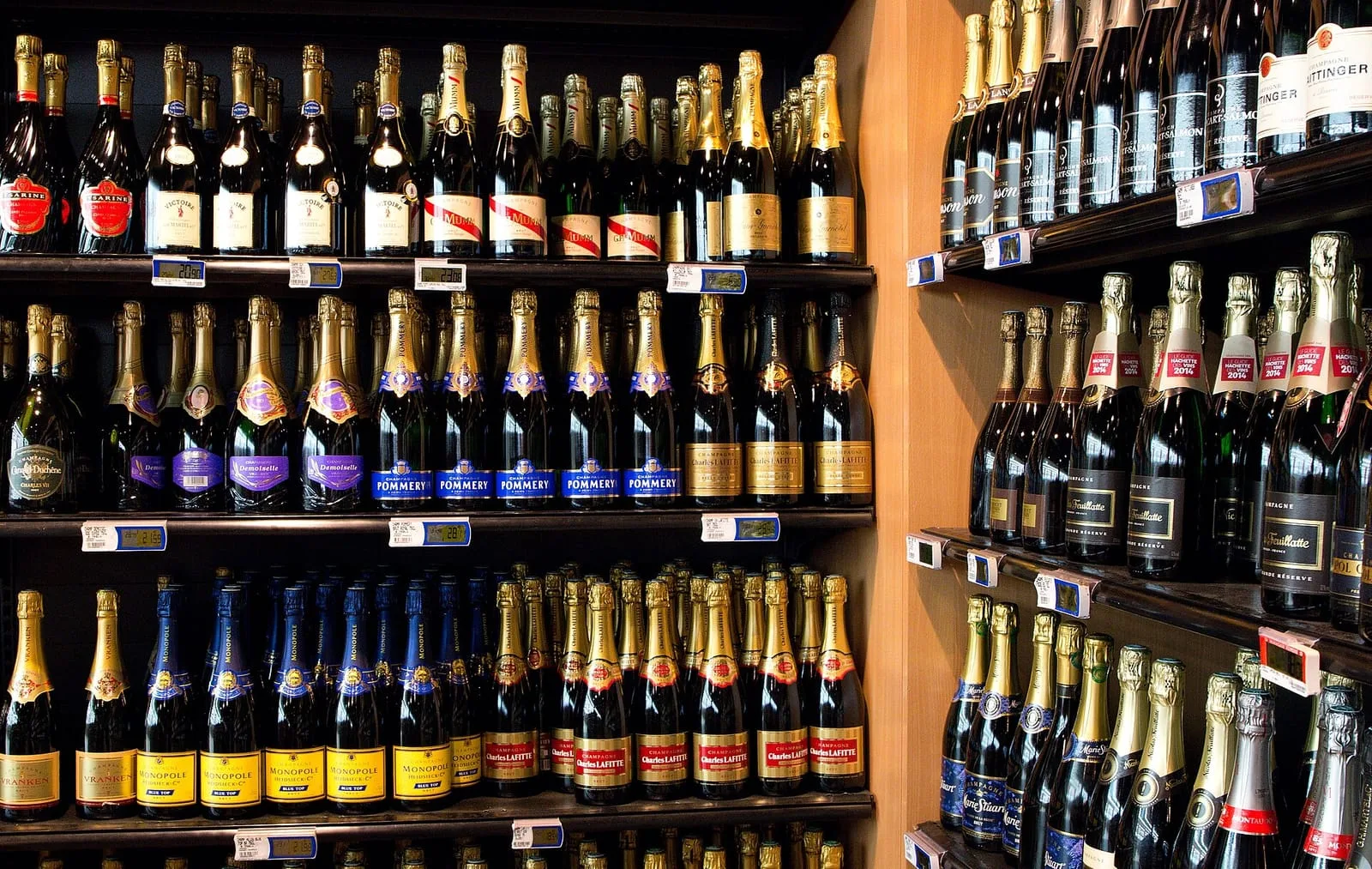
Hero photo: the sparkling wine aisle of a Leclerc hypermarket at Champfleury, Marne, by Perguillaume, CC BY-SA 4.0, via Wikimedia Commons.