On Saturday 22 August, 50% tariffs on Canadian wine, spirits and glass bottles came into force in the United States. Not 10%. Fifty. And note that third item on the list, because it is quietly the most absurd part: the tariff hits the wine and then hits the bottle the wine came in.
Somewhere in Ontario, meanwhile, there is a warehouse. Inside it sits roughly $79 million of American drink that has not been on sale since March 2025. Ontario has now spent about $8 million just keeping it there.
That is where 18 months of drinks trade war has actually landed. Not a victory for anyone. A storage invoice.
How we got to a warehouse
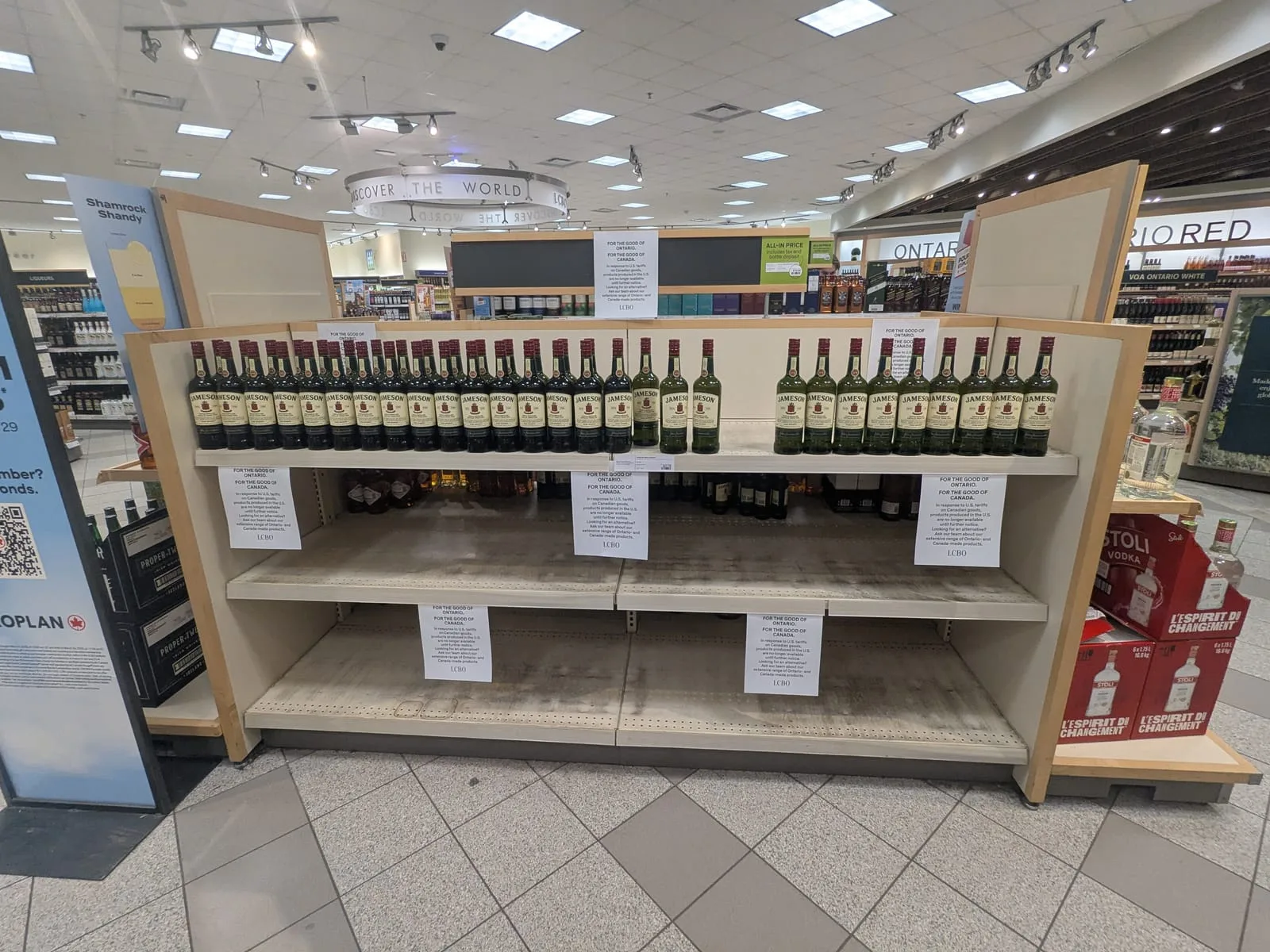
Rewind to 4 March 2025. In response to the first round of US tariffs on Canadian goods, Ontario ordered American alcohol pulled from more than 660 LCBO stores. This was not a symbolic gesture with a press release attached. The LCBO is one of the largest single buyers of alcohol on the planet, and it sells up to $965 million of American product a year across some 3,600 lines. Other provinces followed. The shelves in the photo at the top of this piece were photographed two days after the order, and they look exactly like what they are.
Then everyone waited.
The stock did not go back on sale, and it did not go away either. Sixteen months later, Ontario is still holding it, still paying to hold it, and still, according to the province, reviewing its options. Around 97% of the stranded inventory is somehow still within its normal shelf life, which is a genuine testament to how much of it is bourbon. About $2.6 million of it, roughly 3.3%, has expired. Those are Canadian dollars, and they are real ones.
Quebec had a smaller version of the same problem, with about $27 million in storage and roughly $300,000 of it heading for its expiry date. That stock was mostly the fragile stuff: rosé, boxed wine, ready-to-drink cocktails, a few beers and liqueurs that were never built to sit in a warehouse for a year and a half.
For a while the plan was to pour it away. Then Quebec’s finance minister Eric Girard said no, it will be donated to charitable foundations and given to the province’s hotel and catering schools to train on. Which is, we think, the single best outcome anyone has produced in this entire dispute. Somewhere in Quebec there is a class of trainee sommeliers learning their craft on wine that is in that room purely because two governments fell out.
The number that should frighten the trade
American spirits exports to Canada fell 70% between March and December 2025. That is the figure the US industry keeps citing, and fairly so, because it is brutal.
But it is not the one that should worry them most. This is, from Quebec’s own liquor board in its 2026 annual report: fans of US wines have turned to counterparts from other regions.
Read that again slowly if you sell wine for a living.
The tariff is temporary. Governments change, deals get signed, and eventually the bottles go back on the shelf. The habit is not temporary. When a Montreal shopper who bought Californian Chardonnay every fortnight for a decade finds it gone, they do not stop drinking white wine. They pick up something from the Loire, or Chile, or Sicily, or Niagara. And here is the part the trade does not want to hear: quite often they like it just as much.
That is the actual cost of a drinks trade war, and no ledger anywhere captures it. You can reverse a tariff overnight. You cannot un-discover somebody’s new favourite producer.
Some of the retreat has already started. Alberta and Saskatchewan lifted their bans relatively early. Quebec, Manitoba, Nova Scotia, Prince Edward Island and Newfoundland and Labrador have put at least some American product back. Prime Minister Mark Carney has asked the premiers to restock properly. Ontario is still sitting on its warehouse. And now the US has answered all of that with 50%, so we go around again.
Nobody in this story is a villain, which is what makes it sad
We want to be fair here, because it would be easy and lazy to pick a side.
Canadian provinces did not pull American wine because they dislike American wine. They did it because it was one of the few levers a provincial government actually controls, and because liquor boards are state-owned in a way that makes them an obvious pressure point. That is coherent politics.
The American industry did not ask for any of this. The Distilled Spirits Council’s Chris Swonger has spent a year and a half pointing out that his members are being punished for a fight they did not start, and he is right. The Toasts Not Tariffs coalition has made the same point about the new 50% tariffs, which will land not on Ottawa but on US bars, restaurants and hotels that now pay half as much again for a bottle of Canadian whisky.
Everyone here is behaving rationally, and the collective result is that a lot of perfectly good drink is sitting in the dark in Ontario getting slowly older and less valuable while two governments stare at each other.
“The thing I keep coming back to is that no grape grower anywhere voted for this. Somebody in Kelowna and somebody in Sonoma both spent a year pruning, picking and worrying about frost, and then a decision neither of them was consulted about decided whether their wine could be sold. That is the bit that gets me.” — Antoine
Why this matters if you live nowhere near Canada
Because you are probably already paying for a version of it.
European wine has faced a 15% US tariff since August 2025. On a $30 bottle of French or Italian wine, American drinkers are typically paying $5 to $8 more than they were before, because the tariff goes in at the bottom of a three-tier distribution system and every tier marks up the marked-up price. It is not a 15% problem by the time it reaches the shelf.
The pattern is always the same, whichever countries are involved. Tariffs are announced as pressure on a government. They are paid by an importer, then a distributor, then a restaurant, and then by whoever ordered a glass of wine with dinner and quietly noticed it costs more than last year.
If you want the fuller picture of how this reshapes global trade, we wrote about Chile pivoting to Brazil as US tariffs bit and about the wider decline in global wine trade. The same mechanism, over and over.
What to actually do about it
Nothing dramatic. Three things, though, and they all happen to be good ideas anyway.
Buy closer to home when the maths stops making sense. If a bottle has crossed an ocean and a tariff wall to reach you, you are paying for the journey and the politics as well as the wine. Canadian drinkers rediscovering Niagara and the Okanagan right now are not settling for less. Some of those wines are genuinely excellent and were always underrated at home, which is the usual fate of a local wine industry living next door to a famous one.
Treat a gap on the shelf as an invitation. This is the honest silver lining. Forced substitution is how most people discover anything. If your usual Napa Cabernet is missing, that is the week you find out what Chilean Cabernet from Maipo does, or an Argentinian one, or a Bordeaux from an unfashionable satellite appellation at half the price of a famous neighbour.
Do not confuse a price rise with a quality rise. Tariffs make wine more expensive without making it one bit better. That sounds obvious written down, but our brains are terrible at this, and a bottle that costs more reliably tastes better to us for reasons that have nothing to do with the bottle. Keep your reference points. If your €12 house red went to €15 because of a trade dispute, it is still a €12 wine.
The trade war will end. These things do. And when it does, the ledger will show a lot of expensive storage, a lot of lost sales, some bourbon that turned into a donation to a catering school, and a large number of drinkers on both sides of the border who found something else they liked and never went back.
That last line is the whole bill, and it is the only one nobody sent an invoice for.
Sources: Shanken News Daily, CBC News, Global News, CBC Montreal, The Spirits Business, Vinetur
Hero photo: empty LCBO shelves, 6 March 2025, by Hannah Clover, CC BY-SA 4.0, via Wikimedia Commons.