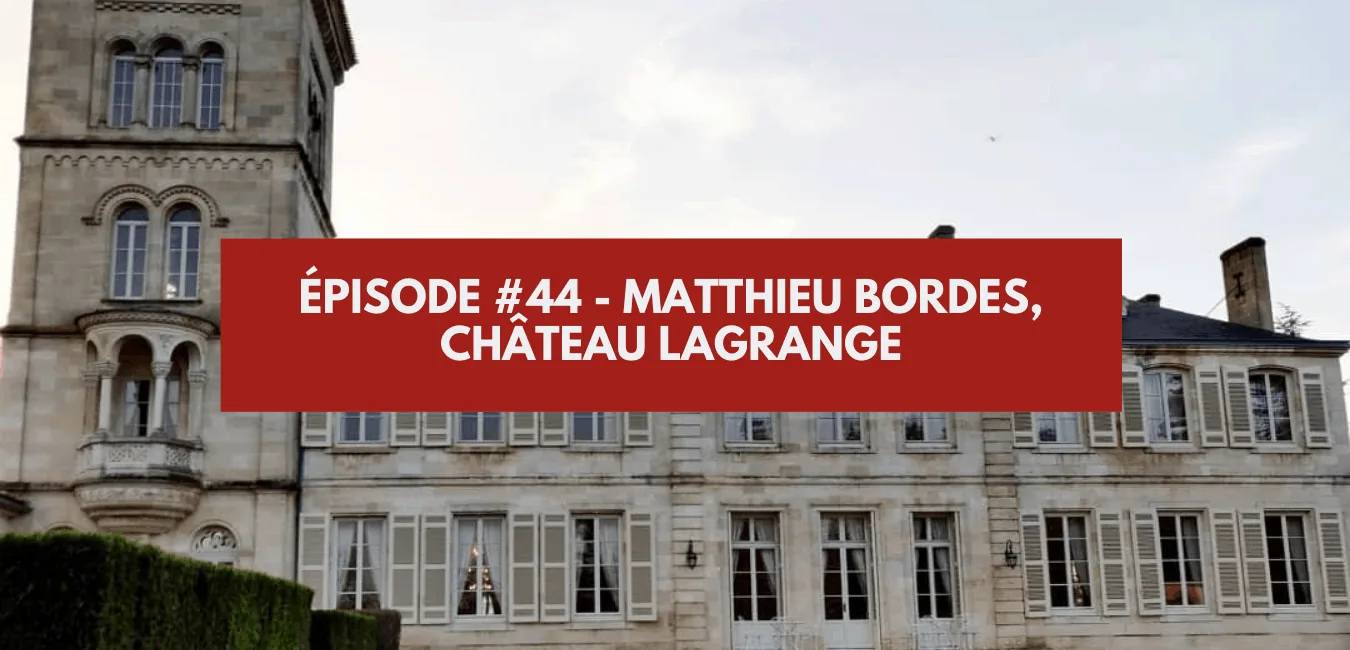
For episode 44 of the Wine Makers Show, your wine podcast, we went to meet Matthieu Bordes, CEO of Château Lagrange in Saint Julien. In a few words: we had an absolute blast and a great moment with Matthieu. Go listen to this episode and discover the wonderful history of this château. By the end of this interview, you’ll definitely want to put a few bottles in your wine cellar.
Can you start by introducing yourself?
Matthieu: Of course. Matthieu Bordes, I’m 47, I was born in Bordeaux. I’m not from a wine background at all, but I’m from Bordeaux and in love with the region. I got into wine pretty quickly because, to be honest, my grandfather had taken on a tiny operation when he retired, doing a bit of mixed farming. There was very little livestock but some mixed crops. He had a few rows of vines that already had agroforestry, with all sorts of plum trees, pear trees. There was magnificent fruit. And we made wine as a family. As far back as I can remember, from the age of 5 or 6, we’d do the harvest with my cousins. In Bordeaux, in Entre-deux-Mers. Not far from Sauveterre-de-Guyenne.
We vinified white, red, and it was wine for friends and family. I’ll be very honest with you, it wasn’t amazing. But we had extraordinary moments, I remember that, I loved it.
I did my studies, my schooling, in Bordeaux. And after the baccalaureate, I already wanted to head toward wine. I first went into university for a degree in cellular biology and plant physiology, to learn a bit about everything living. I was more into biology, less into math, physics. I finished my degree and was lucky to be able to join the oenology faculty in Bordeaux. It wasn’t necessarily a given. There were over a thousand applications and very few candidates accepted, around fifty each year. I had the luck in ‘96 to join the DNO in Bordeaux. A revelation. I was already aware I wanted to work in this field but I didn’t imagine it would be so interesting, so rich. A lot was already known but what I loved about that side was that there were also many very empirical things. I do my two years, I can’t wait to start working. You can’t imagine it, to make wine. And in ‘98, a bridge is created between the oenology faculty and the agriculture engineering school, ENITA Bordeaux at the time, now Bordeaux Sciences Agro. I realize that, ultimately, after the DNO, you know how to make wine, well, you think you know how to make wine. But very quickly I understand that it starts in the vineyard. And the teaching is a bit light at that level. So I have the luck to be able to join ENITA. I continue with 2 more years where you learn agronomy, soil science, much more vineyard-focused. I get the two solid sets of credentials, because again, I have no connections in this world.
I’d focused all my internships on Bordeaux, at a time when many of my classmates were going off to do vinifications in Latin America, in the southern hemisphere, etc. I had it in mind to stay in Bordeaux, so I started my first internship at Château d’Arsac.
A big château by size, close to 130 or 140 hectares at the time, and it was a discovery. Not entirely a discovery because I’d done the harvest and we did a little vinification at my grandfather’s, but it was a discovery at the scale of an estate. Second year, I wanted to do white. Because in Bordeaux there isn’t only red. I decide, on the advice of the director who had become a friend, to go from Château d’Arsac to Château Smith Haut Lafitte. I wanted to change appellation and the great thing at Smith Haut Lafitte is that you can do red, of course, but also white. And a bit of rosé. I see all three colors and validate my engineering diploma at the end of this several-month internship at Smith Haut Lafitte. Antoine: We send a hug their way since Florence Cathiard has been on this podcast. Matthieu: I greet her too. And Gabriel Vialard, who was my supervisor at the time and is now at Haut-Bailly. The next year, I joined Bordeaux Sciences Agro. You have to do mixed crop and livestock farming when you enter Bordeaux Sciences Agro. That means cows, sheep, I knew full well I’d never work in that. I no longer even know how to grow an ear of corn.
I was really focused on wine, already being an oenologist at the time, and I left for Entre-deux-Mers to see something else.
Grand crus classés and beautiful properties are great, but it’s also interesting to see how others work. You learn to work in much smaller, more modest structures, there were seventeen hectares of vines. The owner ran it alone with his wife. The estate had a hectare of corn and wheat to feed his forty cows that I never saw, which were in the meadow. Focused on the vine, that was in ‘98. In ‘99, another year at ENITA and I validate another internship. I wanted to do sweet wine, so I changed appellation and went to Sauternes. There was only one château at the time offering to vinify Sauternes, also dry white, and red wine: Château de Malle in Sauternes, second cru classé. There I met the director at the time who also became a very good friend, Vincent Labergère. And I learn to make Sauternes, a magnificent product, not easy to sell, especially right now. But a sumptuous product. I spent five or six months alongside him and the de Bournazel family, an extraordinary moment. I had to find an internship to validate my final year, a six-month one. I was approached by my professor, also technical director at Château Cheval Blanc at the time, Kees Van Leeuwen. It was a revelation. He had set up tons of trials over the previous six or seven years, since ‘94 if I remember right. We’re in 2000, he’s looking for a student, and the fact that I was already an oenologist interested him a lot, to compile all his data. To do a synthesis, with a publication in mind. I spent six months there gathering data, also measuring vegetative growth data, hydric potential, stem potential. I add an additional year to a database and synthesize all of that. And it’s a total revelation. I learn enormously from being around him, he’s a very intelligent person. I wish you the chance to meet him one day. By the end of that final internship, I feel sufficiently equipped to start considering management, or at least vinification or vineyard work, at an estate. Very quickly I find my first job in Saint Estèphe at a cru bourgeois, at Château Coutelin-Merville, where Monsieur Bernard Estager trusts me. He hires me, and I spend five very formative years alongside him. Twenty-five hectares of vineyards in one block, a pretty nice terroir. And the desire to do better and an incredible piece of luck. He hands me the keys to the truck, as they say, and I can do pretty much what I want from the vine to the cellar. I’m alone with a team of five, we work a lot and move the product forward remarkably.
What does it feel like when you arrive there and you have the keys to the truck?
Matthieu: It’s incredible, it’s a lot of responsibility, a bit of stress, but it’s good to work with some pressure. I’ve always loved that. It’s not paralyzing at all. And at the end of those five years, I want to see something bigger. I’d told him I’d stay four to five years. We had excellent relations. I have the luck to join the technical management of three estates that are today split among several owners: Château Loudenne in the northern Médoc, Château Rouillac in Pessac-Léognan and Château L’Hospital in the Graves. I spend a year and a half alongside Florence Lafragette at the time who, with her parents, oversaw all three properties. Of course, my distant dream was one day to join those magnificent left bank châteaux more than the right bank. To be very honest I’m a Cabernet Sauvignon lover. And an opportunity comes up when Château Lagrange posts a listing and I apply. With a bit of luck and with six and a half years of experience as technical director, I join the property.
How did that go, were the interviews with him? At least the last one I assume. And how did your hiring go? Because the property is huge and the owner is Japanese, so he’s not there all the time.
Matthieu: So it’s a friend who tells me about a listing, he says: “There’s a nice listing for a position that might interest you.” I don’t initially know it’s Château Lagrange. It was through a recruitment firm. Let me tell you a story because it’s pretty juicy. So I get a call from the firm and we chat for fifteen minutes on the phone. The recruiter asks me if I speak English. I say yes, that I did school English, didn’t travel much during my internships, so school English, technical English, a little. But I have to admit I spoke better Médocain than English. And the recruiter tells me: “Monsieur Bordes, we’ll continue the interview in English.” No problem, on the phone. I was about thirty and he asks me a question. I don’t understand the question, I only hear the word “English” in it. And in that moment, things move fast in my head. I told myself: “Do I have him repeat it?” But if I don’t understand, it’s complicated. So I improvise around that word and start with a few sentences. I started speaking English at such-and-such a time, technical acquired later, etc. He cuts me off, so I figure I think it’s blown, I’ve been exposed. A week later he calls me back. And he tells me I have an interview at the property. That’s how it started. The first interview, I did with the team in place. There was a vice president at the time, Monsieur Shiina, and the estate’s management. I had a first interview that went very well. Marcel Ducasse, the director at the time, tells me: “Monsieur Bordes, maybe the adventure will continue. We’ll keep you posted and the next interview will be in English at the property with our vice president, the president of Suntory France but not the president of Suntory Holdings worldwide, so president of Suntory France, president of Suntory Wine International.” It’s very hierarchical. I have 15 days to prepare a bit better for English. And, you know, it went very well, very relaxed, lovely people. And I had the luck to be picked. I do say luck because there’s always a piece of luck in those moments. You have to be there at the right time, you also have to be good on the day. And there also has to be a feeling with the team, to see if you can work with these people or if they can work with you. The fact is, 15 years later I’m still here and I’m thrilled. When I was hired, I told myself: there it is. I’m setting down my bags, I’m going to stay here a while. There’s a playground of more than 100 hectares, several grape varieties, different soil units that we’ve learned to discover.
When you arrive here you’re barely 30, don’t you feel young coming in?
Matthieu: Yes, of course, and it’s a lot of responsibility, you have around fifty people under you. But we’re backed up, we’re a team, that’s the advantage at Lagrange. I have a team of high-performing managers, cellar master, vineyard manager who help me, deputy director… Public relations manager too, that’s a position we created 2 years after I arrived. We’re supported and also much more effective and competent the moment we share. We’re in exchange and collegial mode, I love that. I’m not a dictator, I don’t think, you’d have to ask my teams. I love to discuss, I love to exchange, and decisions are made somewhat by majority, even if sometimes the more clear-cut ones have to be taken. I don’t pretend to know everything and I trust my teams a lot. Especially since we’ve recruited them, we see them as solid supports. Antoine: Yes, you don’t recruit people for nothing. I think it was Steve Jobs who said: “I don’t hire smart people to tell them what to do, I hire smart people so they can tell me what to do.” So if you don’t recruit people who are better than you, or who can support you in specific areas, there’s no point hiring them.
What state did you find the property in when you arrived?
Matthieu: It was already in very good shape. A word about the estate. When the Saji family decided to take over the property in 1983, you have to imagine it had been very hard in the 60s and 70s. In Bordeaux there was a serious shortfall in the vineyard. There were missing vines, parcels that had been ripped out, cellars in poor shape, dirt floors, old barrels. It wasn’t very glamorous, basically, because there was no money. And the early 1980s saw the arrival of the first francs in Bordeaux properties. I’ve often been told that the first thing done was repairing the château roofs, before tackling anything else, even the cellars. Monsieur Saji had huge resources and put them in above all. He buys the estate and immediately invests three times the purchase value to redo everything. With Marcel Ducasse’s team. They redo the cuvier, the barrel cellar, the vineyard, the building of course, basically everything. It was the biggest construction project in Bordeaux, in the mid-80s, lasting about three years. I arrive a little thirty years later. The vineyard had been rethought, replanted and the facilities were operational. I’m in excellent conditions, a well-oiled team, people who have been there thirty years or so for some. And who work in their own areas. There’s already a cellar master who’s also very competent, very high-performing. We move forward bit by bit, learning to know the vineyard. There are many parcels, many terroirs. It’s very big, we don’t have just 3 rows. From the first year, from the 2007 vintage, through observation and spending lots of time in the vineyard, we start a major soil study. I taste the berries regularly, 3 hours a day in the vines, to really get a feel for the parcel and intra-parcel zones. We launch an investment phase at the cuvier to increase the number of tanks. We go from 56 tanks to 102 tanks very quickly to be able to vinify our 103 parcels individually. At that point, it’s pretty extraordinary, this isn’t something I’d experienced before, it’s the privilege of the greatest châteaux when an owner invests solely in quality and tells you “you have carte blanche.” Of the 56 tanks I sell 42, and we bought close to 70-80 to bring back an operational cuvier and a cuvier custom-built to meet the vineyard’s expectations. The result is felt from the first year. We considerably raise the quality level of the parcels. From the second year on, we no longer produce a third wine, that’s over. Les Fiefs, our second wine, takes in all the remaining parcels. We’re also lucky in the selection effort. Our owner allows us to produce very little grand vin if we want. When I say very little it’s only 30%, while 60 to 70% of the estate could potentially make excellent-quality wine. All of that is very stimulating and it’s teamwork. I really stress that. I’m not in Burgundy with three ares, with my son. It’s a family company nonetheless, with strong values. We really emphasize teamwork and everyone’s skills. Today we’re 4 oenologists on the estate. That’s also incredible strength.
On this team you’re many, I think you said about fifty people who work here.
Matthieu: That’s right. We’re 55 permanent staff and when the harvest work arrives, we go up to 250 people who come help us harvest. There are about a million vines. There are 3 strong moments at a property, at least in my view that stand out a bit. Harvest of course. Blending: we finished the new vintage blend two weeks ago, very generous, very accessible, incredible. To me, it’ll be a great vintage. It’ll count in Lagrange’s top 6 wines over 30 years, with a lot of Cabernet Sauvignon of course. It’s the result of the recipe, of the tastings. So this family, this team alongside me and helping me daily. We’re very tight-knit. To me, it’s truly essential. I never take the credit for myself, I always put my colleagues forward. I’m very honored to be behind the mic today, but a bit embarrassed all the same. There could be 2-3 of my colleagues who could join me. Antoine: We send them a hug along the way, obviously. Matthieu: What I love about this job is that you start from a vine and end up sometimes 20,000 km away with smiling customers. And you taste bottles from the estate that are 10, 20 or 30 years old. And that’s unique. I would never have wanted to be behind a desk all day. I’m pretty down to earth at heart. And being able to start from a terroir and a vine and end around a beautiful table, sharing bottles and great vintages and great wines, I find that just extraordinary.
Can you tell us about the grape mix here? Is it something you change gradually?
Matthieu: Yes. I won’t be telling you anything you don’t know if I say the climate is warming a bit. We see it across recent vintages. The phenomenon has been speeding up for fifteen or twenty years. Historically here we had roughly a Merlot-Cabernet parity at first. Then in the mid-80s, Marcel Ducasse planted a lot of Cabernet Sauvignon. Today the estate’s grape mix is roughly 70% Cabernet, 25% Merlot and 5% Petit Verdot. When we restructure the vineyard, we uproot about a hectare and a half every year. We rotate over 60-70 years. I tend to plant more Cabernet Sauvignon, even though 20 years ago we’d never have imagined planting Cabernet Sauvignon on those soils. But today we see that even in those soils, Cabernet is often better than Merlot. I don’t know if we’ll end up at 90% Cabernet. I don’t think so honestly. But it’s not impossible that in the grand vins of Lagrange in coming years we’ll see, like in 2019 for example, 80% Cabernet Sauvignon. That had never happened. The trend is real, it’s a grape that’s the backbone of the wine. It brings enormous freshness. We’re also lucky to have very low pH, around 3.5, which gives the wine a lot of digestibility and tension. To me it’s a fairly heavy trend, and Petit Verdot also helps us a lot. I have more trouble with Merlot which unfortunately reaches almost unmentionable alcohol levels over the years, especially with warm vintages like ‘18, ‘19 and even 2020.
You’ve worked your whole career, you said you’ve been here 14 years? You’ve never wanted to do something else?
Matthieu: No, I don’t know how to do anything else. I don’t know if I know how to make wine, in any case we try, but I don’t know how to do anything else. I wouldn’t change for anything. I love Bordeaux wines, I also love the great names of Burgundy, I love the wines of the Rhône Valley. But I’m a Bordeaux lover and a lover of the region, family and friends. I’m too well here, really. Antoine: Listen, that works for me as an answer, I didn’t have a particular expectation that you’d tell me: “No I absolutely want to move”, especially since you’re in an absolutely magnificent setting. Matthieu: The setting is magnificent, the property is well known of course, but in 2013 we built the entrance you came through. And it’s pretty funny to know that we work with around a hundred négociants in Bordeaux, and most of them didn’t know this approach to the château, or even this view. They rediscovered the estate after 30 years, we’d cross them here a dozen times a year and they didn’t know it. The setting is magnificent: the pond, the lake, we have 40 hectares of wooded park. That’s also a heavy trend today, we’re not going to rip out trees to put in vines or buildings. We’re very careful about all of that. It’s in the DNA of the owner’s family and the DNA of our team, which is young because at 47 I think I’m almost the oldest in management. It hurts me to say that but it’s true. Today, we plant a lot of hedges, we’ll put in lots of relays for bats so they can move around the vineyard. I learned that a bat can eat 10,000 insects, 10,000 moths in a night. So we launched a big project on all that side a year ago.
Speaking of biodiversity and respect for the environment, that’s something really important and you’re doing tons of things. Earlier I think you were telling me about sheep?
Matthieu: Yes we have sheep, we share sheep with our neighbor. These sheep maintain the rabbit warren, the marshes and also come graze the vines in winter. There’s no insecticide, no herbicide on the estate. We work a lot of the soil. The soils are maintained mechanically, that’s one of the aspects of course. The château was also a pioneer in its day for sexual confusion, to also limit insecticide use. Since 2008 we’ve been running trials. We started with a few plots, some of which have moved to the next stage. We run about thirty hectares according to the organic and biodynamic specifications, but we don’t claim certification because we can’t. You’d have to be certified across the whole estate. We have thirty trials, thirty hectares to leave alone. I strongly believe we need to aim for the smallest carbon footprint on the property. Today there are ways to find very interesting solutions in each technical itinerary that allow us to considerably limit the impact on the environment. We’re really on that path.
You mentioned sexual confusion, I’d like you to come back to that.
Matthieu: So sexual confusion is pheromone capsules. The idea dates from the early 90s if I remember right. I think the trials started here in ‘95 with INRA at the time, and you basically had the placement of certain pheromone capsules. It’s a hormone released by the butterfly if I’m not mistaken. I think it’s the female butterfly, and the male ends up in the parcel but under cover of an incredible quantity of pheromones. He can’t find the female and therefore can’t mate and lay eggs on the grapes, which generate grape worms and so create holes in the grapes and trigger fungal disease, like botrytis etc. Hence the name sexual confusion. We confuse the butterfly’s nose, basically. Antoine: We spray it with pheromones and it gets lost.
We also walked past cellars covered with photovoltaic panels.
Matthieu: Yes, indeed. We built that a year and a half ago now. There are 800 square meters of photovoltaic panels covering one of the slopes of our cellars. We have almost 4,200 square meters of cellars. They’re big, it’s pretty magnificent. This building has become self-sufficient. More than that, since it produces more energy than it consumes. That lets us meet 15% of the estate’s annual electricity consumption.
What’s Château Lagrange’s limit? It feels like everything is possible and there’s no limit, is there one?
Matthieu: There are some laws in France even so, we can’t do everything we want, but the limit is what we set for ourselves. I think by recruiting and beefing up our teams with people who are young, motivated, coming from different backgrounds, that brings enormous dynamism and ideas. And that lets us renew ourselves and always see a bit further. And we have an owner who is really at that level, who has put his mark on the estate and pushes us to never give up and always move forward. We don’t do just anything at any cost. It’s quality above all else. That’s been a red thread, a guiding thread here for 35 years: if it’s better, we do it, and we work hard on that.
You were telling me earlier that the owner of the château has one instruction: “Do what you want, but it has to be good.”
Matthieu: Exactly. It has to be good, very good even, there’s a lot of demand at that level. Antoine: Do you talk with him often? Matthieu: We see each other about once a year. They might also come once a year. We haven’t seen him for a year now, but in the first 10 years I didn’t see him much. But you know, it’s very well-structured, there’s an office in Paris. Antoine: It’s also the Japanese company that wants that, it’s the Japanese tradition in a very pyramidal structure. Matthieu: Exactly, so we have intermediaries. If I need to ask a question I get an answer within 48 hours. Even if there are a few levels above me, so it works.
Could we talk a bit about wine tourism and visiting Château Lagrange? You’re welcoming us here with great pleasure but is it also possible for wine lovers to come and discover Château Lagrange from the inside?
Matthieu: Of course. The estate has always been open, of course. It’s true that over the last fifteen, twenty years it’s become more pronounced. We hit the gas in 2007-2008. We created a public relations / wine tourism position at the property. Also the creation of 14 rooms, although it’s not a hotel, they’re private rooms, like the Table de Lagrange, which is a private dining table. It’s not a restaurant. Today we welcome up to 8,000-9,000 visitors every year, from all backgrounds, from many countries. I’d say 15% French-speaking and then it spreads across every continent. We’ve considerably improved this since, with the owner’s agreement, who well understands the value of making the estate known. Beyond the wine tourism side, it’s especially about creating experiences, creating bonds with wine lovers worldwide who love Lagrange or want to discover Lagrange. So thanks to Justine in particular, we’ve expanded this offering and these possibilities. You can host seminars of course, but we have all sorts of thematic tastings. They can be on vintages, grape varieties, blends, on different types of terroirs. The tasting menu is very broad. We also have a lunch option at the property with us, with a Japanese chef who arrived 3 years ago. He comes from a 2-Michelin-star in Kyoto. We poached him and he came with his wife and children. He cooks incredibly, very fusion, and he loves growing vegetables in his own garden. He’s pretty demanding, he’s Japanese, so we grow our own vegetables. Sometimes he goes to pick mushrooms in the woods, he’s just incredible. Very demanding, but incredible. He manages magnificent dishes that really showcase the wines of the property. Whether the whites or the reds. The latest find is the teppanyaki. He’s a chef capable of cooking on a teppanyaki, but also on a kaiseki, the traditional Japanese style. So that lets us offer unique, fully legitimate experiences that stand out at the estate. Antoine: If with all that, you don’t want to come visit Château Lagrange, there’s a problem. Matthieu: People who have the luck to come see us don’t regret it and come back very regularly. There are people who come back every year. They tell me “Matthieu, host us please, do a dinner, we’re absolutely coming.” Whether they’re from Asia, the United States. We have lovers of the place, lovers of our wines and of these good shared moments. You’ll see, it’s nothing but sharing and good memories. We organize roughly 180 lunches or dinners to give you an idea, one every 2 days almost. I don’t do all of them because I travel a lot. But we share these moments with the team. I find it nice to also have the cellar master, the communications manager. We can call them Stéphane, Justine, Benjamin who also share these moments with our customers. Antoine: That’s great.
You travel a lot?
Matthieu: I say I travel a lot but we travel in general a lot more than in the past. Maybe that will change in the future. This year Covid may make us change. We’re doing a lot of live Zoom too, tastings by videoconference. But we used to travel close to a hundred days a year. To give you an idea, two years ago, before this health crisis, we’d done close to 330 events, 335 events outside the estate. On top of the 8,000 visitors and the 180 lunches or dinners. There are five of us who can travel the world. But things may evolve if we want to be a bit consistent with this notion of carbon footprint. Antoine: Clearly, the context makes it a bit difficult.
Do you have projects?
Matthieu: I can’t tell you about them. Antoine: We’ll do an episode 2 then, when does it come out? Matthieu: Maybe within the year. Antoine: OK, so that means a second episode pretty close behind, but well, I hope you’ll at least keep me posted. Not even a little info? Matthieu: Yes, no, I shouldn’t have said it actually, I shouldn’t have brought it up. But it’s a real reflection we’ve had for a while. I’ve made the bet to go against all our customers. We’ve developed these relationships considerably. I really believe in human contact. Today we’ll maintain it but there may be ways to also do it differently and just as well. Antoine: Listen, we can’t wait to discover that.
What’s the profile of a Château Lagrange lover?
Matthieu: It’s very broad. When I arrived here for the interview the director had asked me: “Monsieur Bordes, what is Lagrange to you?” My answer was clear: “To me, Lagrange is the best value for money in Bordeaux, since when I got my first income it was the first cru classé I bought myself.” They all laughed around the table, they said: “True, you’re not wrong, we’d like that to change a bit. Not so much in quality but if you could sell it more, or at least raise its notoriety.” We find that completely in our lovers and the people we meet around the world. It’s every age. Sure, they’re bottles of wine and it’s only wine, we’re not saving lives, it costs several tens of euros. But still, we’re in the environment of Bordeaux crus recognized worldwide as excellent value for money. You can have, it ranges from 17, 18 years old to 77 years old. There’s every profile, really every profile, from executives to upper-middle class to upper-upper-middle class, an enormous number of people.
Especially with the second wine that helps increase accessibility.
Matthieu: The second wine has helped us a lot, helped us a lot since the mid-80s. Because in fact, we produced about 350,000 bottles of second wine at the time. There weren’t many second wines yet and the quality was already there. We were essentially producing much more second wine than grand vin. It’s about two-thirds second wine and one-third grand vin. There was interest in this wine that was easily found around 60-70 francs at the time and with incredible quality. It worked very well and the reputation of Les Fiefs also helped Lagrange’s reputation. And sometimes even slightly tarnished it because I remember a client at a trade show who came to see me and said: “Wonderful, Fief de Lagrange, I love this wine, can I taste it?” I tell him “Of course, that’s why I’m here.” He tastes it and tells me: “It’s magnificent, I have 3-4 vintages in my wine cellar, I love your wine,” and he leaves. I catch up with him and say “Wait, don’t you want to taste Château Lagrange?” He says “What’s that?”, “It’s the first wine,” he didn’t know. It was a surprise for him, he was discovering that Château Lagrange was Château Lagrange and not Les Fiefs de Lagrange. So Les Fiefs brought a lot to the estate and second wines are a bit more difficult in Bordeaux, apparently. Many second wines have ended up in Paris later, always with the goal of improving and raising the quality of the grand vins. But also with prices that have significantly increased for some. So maybe the consumer doesn’t always find their way. Antoine: Since then this enthusiast only drinks Château Lagrange. Matthieu: I don’t know, I never saw him again. He was very young, he was about twenty. Antoine: Beautiful story, very nice.
What you were telling me about the second wine that I find super impressive is that the average age of your vines is already much higher than on a second wine.
Matthieu: Exactly, it represents about two-thirds of the property and the average age of the vines is around 30 years old today for Les Fiefs de Lagrange. I say it’s a second wine because it’s produced on the property with our vines that are in one block around the château but it’s a real wine. It’s a wine that travels through time. Don’t be afraid to let a bottle of Les Fiefs sleep 15 years, 20 years in your cellar, you won’t be disappointed. Trust me. Antoine: Noted, for people buying a bottle of Les Fiefs de Lagrange, don’t worry, you can still keep it a little while.
What’s the future for Château Lagrange?
Matthieu: The future obviously revolves around the environment. It’s a wish from the whole team. So moving forward in that direction, being ever more respectful. It’s something we feel in any case, that the consumer expects. So reducing the carbon footprint as much as possible. If I can do a little more and even better, why not, but mostly do better. That’s the priority, and then we want to develop the link with our customers and wine lovers around the world even more. A lot of things planned to tighten and create even more bonds with our customers. Antoine: Magnificent.
Do you feel a Japanese or Japanese-leaning influence here? In the culture?
Matthieu: You don’t feel it. That is, they don’t want it. It’s always been a wish not to mark the estate too much with a Japanese connotation. Antoine: It’s true the architecture is very French for example. Matthieu: Exactly. So here we’re in the château where Madame Saji renovated the building, with a bit of a fusion ambiance. With old period furniture, but also some Japanese star dyeings. There are a few bamboos around the lake that can recall Asia, but generally that’s where it stops. When I decided to bring on a Japanese chef, that was well accepted, but I wasn’t to push it too far. I was told to stay nicely French. They’ve always been very discreet. There are a few anecdotes because at the time, when it was sold in 1983 to the Japanese family, it made a lot of noise in Bordeaux. I was about ten and I remember it very well. My parents talked about it. It was French heritage going abroad. And they weren’t Belgian. We were going far to Asia, with Japanese. And they were very quickly integrated, because we quickly understood they were there for the long term. What they did, I don’t think anyone would have done at the time. Invest 3 times the purchase value to redo everything with a single instruction: make it good. And 36 years later, they’re still here with the same priorities. I’m admiring of these people. But they’ve always said not too much Japan or Japanese touches. But we’ve taken a bit because we find the cultures pretty close, and the marriage is interesting. The food is magical. There are 3 great culinary nations in the world to me: France, Italy and Japan. You can find other things but there’s enough to have fun for a few years around a plate. Antoine: It’s interesting and you really feel that very French imprint at the estate. Matthieu: It goes very far because even our company vehicles, we had to buy French. And we continue to buy French. No Toyota or Nissan on the property. Antoine: We’re fine, we came in a Renault, I think. So we’re good. Matthieu: It goes that far and 35 years later nothing was set in stone. We could do what we wanted, but we keep respecting those rules. That’s very Japanese. They brought us a lot of rigor in the entire process. And above all mastery, so today we have our vines and we have the bottling. We manage the process from A to Z up to bottling. That was a wish from the start. We’re one of the rare châteaux to be equipped with our own bottling line, very high-tech. Antoine: Great. We’re getting close to the end of the podcast.
Is there a question you would have liked me to ask?
Matthieu: You’ve asked a few already. Not especially, I know you have some in reserve. Antoine: I have 3 left, always, but I wanted to be sure I didn’t forget anything, because the property is so vast and there are so many projects. Matthieu: There would be plenty of things, but no, honestly we’ve covered quite a bit. And I’ve talked too much about myself. Antoine: You’ve also talked a lot about your team, don’t worry, and about wine fortunately.
So at Château Lagrange, there’s a white too?
Matthieu: Yes, it’s true you’re right, there’s a white. 1996 was the trigger for the white. You know that in Bordeaux there have always been properties producing whites. Today there must be about thirty whites in Bordeaux. Lagrange, so the birth of Les Arômes de Lagrange, white flower aroma, located all around the lake, so the wordplay with the aromas, Marcel Ducasse created that in 1996. So that’s 25 years ago. It’s one of the factors, one of the criteria that also made me choose this estate, because it’s great to make white. It’s much more technical, I find, than red. Antoine: Why? Matthieu: Because it’s much more sensitive. The product, the grape, the aromas are much more sensitive to anything oxidative and therefore very technical and it’s interesting. And then it takes us a bit of time, it gets us in the saddle for harvest since we always pick a few days before the reds, before the first Merlots. It’s a foretaste of the vintage and it lets us have a slightly broader range. Today we have about ten hectares of white, sold essentially to Japan. Half of production goes to Japan.
Does that show up in your distribution, that Asian part?
Matthieu: Yes, it’s true we haven’t talked about distribution. I’ve made a lot of progress on that by questioning our négociants, we work with about a hundred négociants as I told you. The idea is to have the map, a bit of the mapping of our distribution to be able to orient, support, promote our wine to the four corners of the planet. Japan represents about 20, 25% on the red wines and 50% on the white. It’s a very important market, I have nothing to do with it, the owner helps us a lot. Antoine: I imagine indeed. It’s interesting and original too for a Bordeaux wine to have so many markets over there. Listen, we’ve done a beautiful tour of the property and of you too, so thanks a lot for your time. I have three questions left that are traditional in this podcast.
First question: do you have a favorite recent tasting?
Matthieu: I have loads, very honestly. Here, we’re lovers of blind tasting. I’ve been tasting blind for 25 years and there’s one I had two weeks ago. Magnificent German Riesling, from Robert Weil, Kriedrich Gräfenberg 2010. Antoine: Thanks for the transcription that’s going to be very easy. Matthieu: I can give you the exact spelling, it’s a magnificent wine. Sumptuous great German Rieslings, I bought a few bottles. Antoine: That works well, listen, if I have a chance to come across one I won’t miss the chance to jump on it and do that tasting.
Do you have a wine book to recommend with easier spelling?
Matthieu: It’s going to be much simpler, you probably know it, it’s the book that made me love this job too. I’m not a big reader, I don’t really have time to read but this book was at home, my mother had it, it’s called The Taste of Wine by Émile Peynaud. It’s a great classic, I read it when I was 8-9. I kept it, I swiped it from my mother. I reread it from time to time, I browse through it and it’s really the book that made me want to taste, to know all this. Antoine: There was still a bit of a wait between that first reading and the first tasting.
Do you have a guest to recommend for my next episodes of this podcast?
Matthieu: You mentioned it to me earlier. I thought about it. There’s someone I’d love to listen to because the few times I’ve been able to chat with him are rare, he’s a great technician of the Médoc, Dominique Arangoits, the technical director of Château Cos d’Estournel Saint Estèphe. He’s very pedagogical but he’s pretty shy, pretty reserved. But he’s an extraordinary person who makes sumptuous wines, so yes I recommend him to you, far more competent than I am, he’s a model.
Amazon links on this page are affiliate links. They cost you nothing extra, and they help me keep this going.