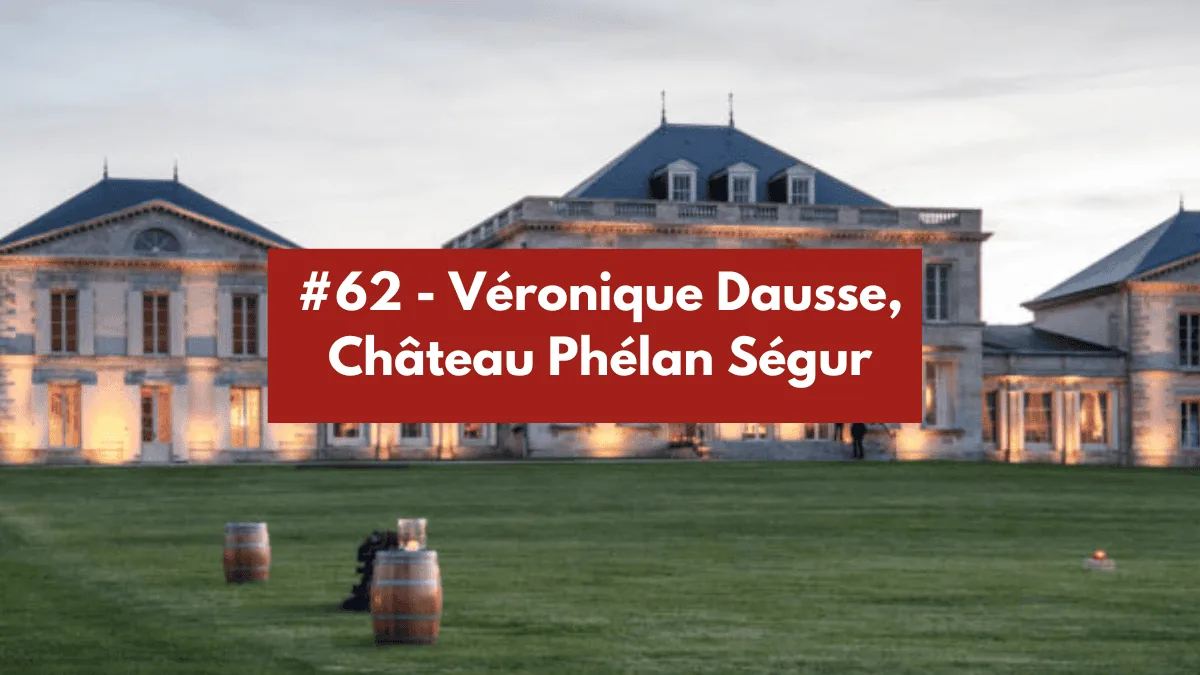
Château Phélan Ségur is one of the great names of Bordeaux wines. What luck for me to be able to meet Véronique Dausse, general manager of the Château, to dive into her journey and the challenges of this great wine. There’s enough here to tickle your taste buds and make you want, without a doubt, to put a few bottles in your wine cellar. I recommend it.
Antoine: Hello Véronique.
Véronique: Hello Antoine.
Antoine: Thank you very much for welcoming me. We’re at the Novotel in Paris.
Véronique: It’s glamorous.
Antoine: We’re taking advantage of your few days in Paris to have this exchange together. I’m delighted to be with you. We’re obviously going to talk about lots of things since lots of things are happening at Phélan Ségur and in Bordeaux. You have a fairly rich career.
Can you start by introducing yourself?
Véronique: I’m Véronique Dausse. I’m fifty-four, I’ll say it, no problem. I was born in Lot et Garonne. I didn’t live there very long, I left when I was seventeen. I did my whole career in wine, completely by chance since I come from a very agricultural family, half Italian immigrants in fact, that had nothing to do with wine. My career took place with a lot of mobility however in this absolutely fascinating, captivating universe of wine. I’ve been in Bordeaux now since 2010 with my family.
You tell me you came into the wine world by chance. Your parents were farmers. You must have already had this attraction for the outdoors, plants, the living world generally. What made you get interested in vines and wine?
Véronique: It was even the opposite if you like. I think I think I wanted to flee that universe because it was a universe where we lived well but it was a universe that was harsh and precarious. I think I wanted to flee that and so I went into the science track. I did a prep class and a business school. When I arrived at this business school, I was so bored. After a year I told my father, who was a bit the tutelary figure of the group with his mother, with my Italian grandmother, that I was going to stop, that it wasn’t possible, that it made no sense. My father told me: “It’s out of the question, you’ve done two years of prep, you go all the way.” And luckily.
It was the mid-80s, it was the start of experiences abroad but it wasn’t standardized at all. That is, there we were told: “If you want to leave to do an internship, but not babysitting, a real corporate internship, you go and we’ll take you back. We don’t really know how it works, but we’ll take you back when you return from this internship.”
It was the 1980 promos at the time. There were three of us who left for three completely different universes. But me when I wanted to leave it was the Reagan years, the United States was the center of the world, we’ve forgotten that. You Antoine, you didn’t live in that world where the world was centered on the US. We were in the Mitterrand years, over there it was the Reagan years. It was inspiring in two different ways. I preferred the American aspiration.
Two atmospheres.
Véronique: Yes, exactly. I thought the United States, and especially the West Coast, were beaches as far as the eye could see with palm trees everywhere and big cars. I started looking for an internship on that side of the United States. There really was this aspiration of “we’re nothing and we can do things.”
At the time, we didn’t send emails. We sent letters. I’d written to quite a few companies in Silicon Valley because it was really the moment when we heard a lot about Silicon in France. And then I also sent, since I was from the Southwest, applications, wine companies, cellars, in Napa. It’s a Frenchman who answered me, Bernard Portet. He’s retired today. He was the manager of a property called Clos du Val, in Napa and he told me: “Done, let’s go. If you find your J-1 visa, well I’ll take you.”
That’s how I arrived, knowing nothing about wine, stammering a few words of school English, in Napa. I have to say that’s it, my life really tipped over that day. It was Napa in 86 or 87, I must have arrived in 86.
The Champenois had invested a lot. Mondavi was at the height of his glory. Napa was very developed, not at all like it is today where it’s become an incredible business and you can’t plant anymore. There was an incredible spirit and there was energy, winemakers from all over the world, Swiss, New Zealanders, Spaniards, French. It was a wonderful community of young people.
Obviously not everyone really lived as a community. It wasn’t Woodstock, but it was fairly close to that. We also lived with people who worked in restaurants but who were dishwashers, as sous-chefs. Everyone lived together and we spent our non-working time tasting.
When I arrived, I participated in a tasting like that. When I saw and lived through, when I felt that passion they all had to have their wines tasted, but not just their wines, that is, also to taste others’ wines, to talk, to remake this world and this vintage, and why, and this flaw, this quality, these aromas, these structures, I told myself: “But this isn’t possible. It’s incredible.” And especially the stake that was, that these people lived when they talked about wine. I told myself this is my life. And it happened naturally. So I had, at least once in my life, the “love at first sight.” And it really was that. That’s how everything started.
Antoine: Incredible. They must have been incredible moments when you were home, in France, sending these letters. You must have had a bit of hope, or did you tell yourself “Well, we’ll see.”?
Véronique: I said “we’ll see.” Really.
Antoine: I think it’s a lesson generally, I’ve noticed that, even today letters work very well actually when you want to exchange with people. Maybe even more so today because we no longer receive letters at all. Generally, it’s quite effective. And actually you tried, we’ll see what happens but you have to go for it?
Véronique: Completely.
How long did you stay there?
Véronique: I stayed three harvests, two years and three harvests.
Antoine: Ah yes. You’d left for an internship.
Véronique: I’d left for a year. I stayed very legal with a J-1. Don’t tell them, the American administration, but for a year.
Antoine: You won’t be able to enter again.
Véronique: Yes I can. I almost asked for the Green Card. I stayed two years and three harvests. I was hiding with the Mexicans in the vines. It was the time, well I don’t know how it is now. But, at the time we had Mexicans working a lot in the vines. There were helicopters that passed on weekends, there were often panic winds.
Really?
Véronique: That’s for the anecdote, because even if they’d kicked me out, I wouldn’t have risked much. I’d gotten my license, I had my ID. The only problem I had was that I wasn’t 21. I had to wait 21 to officially enter bars. That avoided me having to climb all the barriers.
It was great and it literally changed my life. That’s what I tell my children who are exactly at the same period of their life as mine when I left. “Don’t give up. Try all the time. Take all the opportunities because sometimes opportunities are there and you don’t take them.”
It’s really something I’ve been able to notice with all the people I’ve been able to discuss with, it’s the power to seize the opportunity. There are so many that can present themselves to us without us necessarily being aware, without us seeing them.
Antoine: I listen to a lot of entrepreneurship podcasts. I re-listened to a podcast called Nouvelle École which is spectacular. They’ve stopped a long time ago now but it’s a podcast with incredible people. They talk a lot about the weight of determination, how if you’re determined you can succeed at something. I rather agree with that, I think determination plays a lot. But I also think there’s this share of visualization, of luck, of knowing how to seize the opportunity precisely when it passes. It’s determination, but there’s also the capacity to do it that changes a lot of things. You’d left for a year, what happens? They suggest you stay longer, or you tell yourself you want to stay longer?
Véronique: Well I would have stayed, it’s my father who made me come back. I would have stayed, I would have found a way to become legal again, it wasn’t a problem. I had family weight that was still quite important, with this social ladder because in this case I’d done studies. I was the eldest. It’s a bit difficult to say like that, but there were some hopes in me. It wasn’t possible, I had to come back and get back in line. I’d started this school. I had to finish it. I was a bit called to order by the patrol. I came back. I often regretted it. There are forks like that. When you get older, you see the forks.
That one, I have to say I regretted a bit coming back, but I assumed it and I find my life is beautiful and I did lots of other things and that if I’d stayed in the United States obviously my life would have been different. But it perhaps wouldn’t have been better, on the contrary.
There’s another fork I took and retrospectively that one I regret a lot. It’s that in 1994 I spent two months in Chile. I was between two jobs, I was going to leave for Champagne. Chile in 1994 wasn’t as developed as today. I just loved it. When I crossed the Cordillera of the Andes, by bus, drinking maté at night, to switch over to Argentina, there I told myself: “There you’re doing something, and that’s a real choice in your life to leave, not to stay.”
I’d loved that country, the people, the spirit… It was a new adventure for them. The vineyard was developing and was about to explode. The quality of the wines was really developing. There were foreign investors arriving. Lots of incredible things.
I made the decision to leave, to continue my trip that was planned. It was planned not to stay. Often I think of that night, in that bus, when I switch over and leave that country. I think I would have been hyper happy there.
Antoine: It’s not too late.
Véronique: Yes, you don’t shave for free after. It’s not true.
After this experience in Napa, you come back to France and finish your school?
Véronique: Yes, the horror.
Antoine: It must have been super weird. You must have been two years out of sync with everyone, you didn’t know anyone anymore.
Véronique: I only did internships. Every time I could leave for an internship. I did humanitarian work in Burkina Faso. As soon as I could leave, I left.
Antoine: Yes, I understand. At the same time sometimes, these schools are a bit hellish.
Véronique: That’s how it is.
If you go to stay there, it’s a bit of a shame. You have to go to leave precisely, to do other things. It’s a bit of a digression, but it’s a crazy thing in the economic model, these schools. They cost super expensive. Today in any case, they cost an arm. The thing you have to do is try not to stay too much and leave as much as possible.
Véronique: It wasn’t the case in our time. Me I stayed there a long time, between starting and leaving, the school fees still hadn’t doubled but almost. There wasn’t as much, well if you wanted, you could do internships all the time. It wasn’t a problem. You always manage. But, it was you who wanted it. It wasn’t the school that imposed it. I spent hours of class at the school. I think today, it’s less true. It’s not the same in any case.
You finish punctuating with internships and trying to get out. What do you do when you leave?
Véronique: When I leave I head for Languedoc because in the United States, in Napa, I’d met Robert Skalli who was at the time the owner of Saint-Supéry which has just been sold to Wertheimer so to Chanel. In Bordeaux, it’s Rauzan-Ségla and Canon. Now it’s also Domaine de l’Île in Porquerolles. In the meantime, I’d done Vinexpo, I’d gone to see him. He wanted to hire me as an intern, but what he was offering me didn’t please me. He’s the one who came looking for me. I spent four years in Sète with Robert Skalli who was developing a Vin de Pays d’Oc brand first which contributed to the birth of Vins de Pays d’Oc.
At that time you have to know that the Vins de Pays d’Oc that were sold in bulk were more expensive than the AOCs of Languedoc, which is quite incredible. And he was developing a brand. So he was developing two things at once: this concept of varietal wines and the concept of varietal wine brand.
I assure you that at the time you said chardonnay, cabernet, merlot, people said bless you. It was something that was rather of the order precisely of new words than French. And it was an incredible success with real marketing bases since I was in marketing, with incredible things. I’d learned in the United States respect for the customer, consumer expectations, the desire to be pragmatic but to go all the way.
And there, I could do it with a man who had an incredible vision and crazy ambitions. Plus, he had a passion for contemporary art who had, well not a foundation, but a small contemporary art space at Fortan.
We were very close to the whole Sète movement with the Combas and the Di Rosa. And then others too who came to do exhibitions. We bought a work from them, we made special labels. There was a dynamic.
The wines were really worked for consumer tastes. We, I think, listed the greatest importers in the world, but very quickly because it was an incredible concept. The wines were good. They weren’t quite entry level but they were still affordable and there was a real marketing concept.
There was a quality/wine approach behind that was incredible because they were wines that we sourced mainly from cooperative cellars or particular producers, rather cooperative cellars. The qualitative approach with these Languedocian producers was incredible.
The team was made up of Philippe Tolleret, Philippe Giraudon. It was crazy and the team really made Languedoc progress. It was very enthusiastic, very visionary. I’ve only worked, or in any case I’ve only liked working in places where there was an adventure, where there was a project, where we were developing things. If it’s to reproduce what exists it’s less passionning, I find.
In this experience, did you try to draw lessons a bit from what you’d seen in Napa to re-import them? You talked about consumer expectations. What are the main points you took away from Napa and that you tried to set up in France?
Véronique: You know what? It’s often what my children ask me. It’s funny this question. My children ask me: “What did you learn in the United States?” I don’t even know. It’s part of me now.
I think it’s the respect for someone who makes the move to come toward you. Someone who tells you they don’t like, well they don’t like, that’s how it is. After that you can try to make them progress, evolve their taste, make them more technical.
But it’s also in terms of commercial approach, it was crazy. I mean putting on the market in the United States, well now it’s a bit less true, but which is very long. You produce your wines, after that you have an importer. In this case, there was no importer because it was directly with a distributor, but it’s very long. Each time, you have to put your concentration on the commercial, never neglect, animate your whole network, give things that are easy to remember, key C’s Points. It sounds very stupid, but the guys have twenty-five, thirty, forty, fifty, a hundred wines to sell.
You have to make them comfortable, you have to make them experts, you have to make them happy, you have to make them proud. And all that, I find that’s something you see, this management of commerce that exists in the United States.
Me when I meet salespeople I tell them: “I love you.” They’re like: “Oh really?” Yes, I love you, you’re hyper important, you’re the ones who carry the good word, you’re the ones who close deals, I love you.
Antoine: It’s often the case. We were talking a bit about what I do. I founded a company in automotive and actually we exchange quite a bit with other people, industrialists. You often feel a prevalence of intellect and engineering, a bit. I’m not at all questioning, I love my engineers. I love them too and there’s no problem.
But you feel that sometimes commerce is a bit, not a dirty word, but a bit on the side, a bit forgotten. Whereas actually it’s what makes a company move forward. You can’t sell something that doesn’t exist or that isn’t good. But if you don’t sell, nothing happens.
Véronique: You see that’s what I say too. In Napa there’s enormous tourism. Today, you can’t say it’s Walt Disney, but with this little train now that goes up Napa. Me I didn’t know it at the time. I’d learned that at Clos du Val, with Bernard Portet who was a mentor for me, knowing how to be, really, but even sometimes to the extreme, the notion of exemplarity. It was incredible.
He really saved me, I think. You know he’d tell me, Bernard would tell me: “Someone who passes through the door, the gate of Clos du Val, is someone you have to respect, it’s someone who makes the move. And at Phélan, that’s something that for us has been integrated. That is, we personalize the relationship. You have to make an appointment to come, because we’re a very small team and we don’t have a guide, we don’t have a hostess. When we receive, it’s always us who receive because we love it and we think it has more depth. Your name is written on a small board: “Welcome to Antoine,” etc. Me, I respect that a lot because I think the person who makes the move is someone who deserves our attention. For me, it’s very important.
It’s a value I love a lot: hospitality. I find it super important, clearly. How long do you stay, then, in Languedoc?
Véronique: I stayed there four years.
And then, what happens after four years?
Véronique: The general manager of Fortant de France leaves for Champagne. He was very nice, a real intellect. He tells me he’s leaving for Champagne to take over the position of general management of a cooperative, called, well at the time it was called Nicolas Feuillatte, or the Centre Vinicole. We were a tiny core with him, we were very close. He told us: “Are you interested in going to live another experience?” We were super young. I wasn’t married, I had no ties. I’d never set foot in Champagne. I love champagne, the wine of kings.
And so, three of us left to join him there. It was incredible. The Centre Vinicole, at the time, well now they’ve just merged I think with another cooperative cellar, was already one winemaker out of four in Champagne at the time who was concerned, who was a contributor, directly or indirectly to the Centre Vinicole. It was huge, it was a wine production center but just crazy. I know the technical part of Moët often came to visit our installations, it was incredible. There was the strength of supplies, which is a bit the watchword in Champagne.
And then there was this little brand called Nicolas Feuillatte. When I arrived Nicolas Feuillatte was four hundred thousand bottles. We had no file, there was nothing, it was crazy. There was an export director Pierre Clamens, who is a great guy. We arrived there and built up this brand with a technical team that was remarkable. With incredible vinificators and a technical tool to make the biggest brands pale. I spent eleven years there.
You know Champagne like the back of your hand then?
Véronique: I wouldn’t say like the back of my hand. Let’s say I really loved Champagne. I rather know the world like the back of my hand.
In this case, I started in the export team. I dealt a lot with the United States because it was also a bit my country, with someone extraordinary named Martin Sinkoff. He had developed several brands in the United States, including Réserve Saint-Martin. And so he took us under his wing. He now lives partly in Tel Aviv. By the way, he’s setting up a Bordeaux import company, not at all kosher, but just grands crus, in Israel.
I developed the United States, I went there every month. Plus, there was timing that was that the millennium was arriving. Since we were a cooperative, we were already in premier cru by the way at the time. Each time we went to see a customer we said: “No we won’t limit you, we have apros.”
The timing was perfect. We arrived with wines that weren’t very expensive. I remember very well in the United States it was 19.99. We had to be under twenty dollars. We arrived at this consumer price of $19.99. It worked very well. We had a unit that was top of premier cru. It was a bit refreshing. And we progressed in the United States, but in lots of countries in the world.
Little by little I became export director and from export director I took over the commercial marketing communication management. There was an extremely important communication budget in Champagne with very nice ad campaigns, that some perhaps remember. It was Paris, New York, elsewhere, there were animals, decorations. We were completely disruptive. It was the trendy term at the time in those somewhat stilted communications where we saw bottles, well anyway. We had a blast. It was brilliant. It’s a brand today that must do nine or ten million bottles, something like that.
Antoine: Today, it’s gigantic.
Véronique: Yes, that’s it. When I left, we must have been already at eight million, or seven million. With incredible stakes, it was passionning. It was a passionning experience.
You must have seen incredible development. For you, already, you must have laughed. You were talking about a small team. It was a small commando.
Véronique: That’s exactly it. We worked at eleven at night. I had no importer in the United States. I just had this agent who was Martin Sinkoff. That means I actually took care of finding a clearing company. We shipped the wines, they cleared customs, but we weren’t even computerized.
That is, I had to recount the bottles I sent, that they pass me their billing stat to see if it matched. At eleven p.m. we were always still doing everything by hand. It was too funny. At the same time we saw this brand exploding. It was wonderful and very enthusiastic. A real adventure with, at the same time, this side I love in Champagne, even if for me it’s a region that’s a bit harsh, it’s that the product creates connection. I have memories of harvests.
So us, we didn’t harvest, since we went to get the juices, but going to the Champagne presses at eight in the morning, opening a bottle of champagne with lots of cured meats, etc., and talking with people who are extraordinary, who are perhaps a bit harsh at the start but afterwards wonderful. I have lots of excellent memories. And I kept excellent friends there, and I go there with a lot of emotion, always.
Antoine: It’s a region I haven’t visited a lot. I must have done two or three interviews in Champagne. I’d seen Pierre-Emmanuel Taittinger. I’d gone to see Leclerc Briant.
Véronique: They were in tasting last night.
Antoine: Ah well there you go. They’re very nice. By the way they should come on the podcast. And a brand also called EPC, I don’t know if you know them too?
Véronique: It’s new.
Antoine: It’s new. And it’s not bad at all what they’re doing. It’s rather good. They’re doing quite cool stuff. It’s quite funny to see that it’s still dynamic and lots of things are happening and it’s also quite exploded on tourism there, it’s impressive. You stay eleven years. Why do you leave after eleven years?
Véronique: For not very funny family reasons. I bring my three children back, because actually I lived in southern Champagne, in the Aube which is yet another Champagne different from the Marne. And I brought my children back to Bordeaux, well to the southwest. They were tiny. I resettled. I’m very southwest, very rugby, I love hunting, I love bullfighting. Sorry. I’m very southwest.
Antoine: I’m not going to make friends.
Véronique: No, it doesn’t matter.
Antoine: It’s okay, we’re already at twenty-seven minutes.
Véronique: They’ll have left. It doesn’t matter. I assume that pretty well. It was forced. It wasn’t a voluntary departure. Circumstances meant I left Champagne, but I’m very happy to have returned to my beloved southwest. My children consequently have a southwest accent, play rugby, including my two daughters who played rugby. Now they’ve stopped.
In Champagne, they wouldn’t have played rugby.
Véronique: There’s a club, in Épernay. I remember an Épernay/Sancerre derby, well it’s not quite a derby. There was a very nice club in Épernay, I don’t know what they’ve become, but they played rugby a bit. But it didn’t have the same accent.
That’s clear. That’ll teach me to underestimate the rugby playing capacities of the northern part of France. You left for Bordeaux. Do you arrive immediately at Phélan Ségur?
Véronique: No. I did lots of things before.
What year are we in? In the early 2000s, is that it?
Véronique: No, we’re later than that, we’re in 2007. I succumbed to the charm of Antoine Leccia. Antoine Leccia is the chairman of the board of Advini, which for the older ones is Jeanjean in Languedoc, they bought Laroche, Domaine Laroche in Chablis, it’s Gassier in Provence, it’s Rigal in Cahors. I think it’s still them, it’s Antoine Moueix in Bordeaux. What else do they have? It’s part of the big groups in wine.
They have nothing to do with the size of Granger or Castel, but it’s still a fairly important group that sweeps first across lots of segments. Between a Domaine Laroche grand cru and bag-in-box made in Languedoc… It’s not pejorative but it’s a range that’s very high and that sweeps many appellations.
I worked alongside Antoine Leccia. I have to say the work pace while we were based in Saint-Félix-de-Lodez, while my tiny children lived in Bordeaux. It was out of the question that I move them from Bordeaux. It was a bit wearing for me.
These are professions that are very difficult. I had general management of commerce. It was too brutal for me. These are positions with colossal stakes.
I remember a negotiation with a big English operator. When you make prices and look at margins, you’re at the centime, not the euro. It’s at the centime. Often by the way, the margin is made on the purchase of wines and not on the sale. On Gascony whites for example, the buyer’s job is at the limit more important than that of the salesperson. In this case I remember very well having worked on a value analysis in the evening for a nego, the next day I was leaving for England. At the time the general manager of the Jeanjean entity had told me: “If we don’t have this market, we put the factory on technical unemployment for a month.”
The pressure on the plane.
Véronique: That’s it. It was really an absolutely passionning universe. But it was too hard for me. I think it was too difficult for me, plus I was separated from my children. No, it wasn’t made for me. I didn’t have a blast.
It was perhaps a bit far from the product? In what you said, you were on the communication/commerce side, but still very close to “how do you build a wine, how do you respond to consumer expectations”. Whereas there, you were more in volumes, in negotiations.
Véronique: That’s it. It was more techniques than wine. Maybe I didn’t talk about it, but all the companies I went through, even just at Clos du Val at the time in the United States, whether it was Fortant de France in Languedoc or in Champagne. The product as such and its mode of fabrication, its genesis, for me that was a guiding thread. I didn’t do oenology or viti studies, but I lived through lots of different situations in wine. I have it in me, I’m not an oenologist. By the way that’s not the goal. At the limit I could have done a viti/oeno BTS by correspondence.
It’s especially at the property at Phélan that I learn. It’s my twelfth harvest. There’s no technical director at Phélan. There’s a cellar master Fabrice Bacquey, a vineyard manager Luc Peyronnet. We’re stuck together. I couldn’t say it any other way. We live together, we communicate all the time. I learn a lot and they learn a lot from me too. We form a really tight team and with happiness. I think we can talk about happiness. I learn a lot about technique with them.
Among the people I’ve interviewed, there’s a bit of everything. People who realized they had a passion for wine precisely when they were in business school or other. So they went to do a BTS, a viti/oeno just after to have the technical part in apprenticeship. There are others for whom it was much later. Some who only did the viti/oeno BTS, who never did business but who now have general management positions and so necessarily they do business, things like that, oenology degrees but who didn’t do finance, commerce, marketing, etc.
It’s your twelfth harvest at Phélan Ségur, plus all the previous experiences, at some point I think the technical part is more or less okay.
Véronique: I think I acquired, first with experience and with age and with everything I’ve lived through in wine, reflexes that allow me to make good decisions. It’s especially that. That is, it’s this sum of acquisitions, of experiences that means when people ask me questions I won’t have a technical answer, but I’m going to give the means to find the right decision in relation to a technical problem. It’s especially that.
Yes, asking the right questions, understanding what arbitrations to make.
Véronique: A property is a company. Take any CAC40 company, even yours. That’s what you were saying earlier. A boss isn’t necessarily someone who’s been financial director and director, commercial director and engineer, etc. It’s someone who has perhaps had lots of experiences or who has particular technicality, but who has the capacity to bring everyone together and give each one the means to make the right decisions for a final objective.
How long did you stay at Advini?
Véronique: Two years.
That’s still long for such an intense job.
Véronique: Exhausting.
We arrive in 2010. And there, you arrive at Phélan Ségur.
Véronique: It’s quite funny because so, I wanted to stop wine. I was morally exhausted. And there, I told myself why not do something else and I looked at buying a company in groceries. An ice cream company.
We didn’t get along at all with the people who were selling on the figures. I was enjoying my children, I was looking at the file. I was based in Bordeaux. I’d never worked in Bordeaux. I’d done an internship there but I hadn’t worked in Bordeaux. And there friends told me: “Listen, you’re in Bordeaux. You’ve made your life in wine. Take advantage of your free time to go meet the Bordeaux players.”
Because I have to say it’s quite amusing retrospectively. I always said that in Bordeaux people were blessed, and that since they had the best terroirs in the world, they weren’t necessarily the biggest workers.
I learned that’s not very true. Well, very true on terroirs because it’s a crazy thing. There are places in Bordeaux that are magical. But I also learned that in Bordeaux, we work. Well, those who want to work, anyway.
So thanks to them, I made a kind of mapping actually of how Bordeaux works. We talked about Jean-Michel Cazes, so historic players who incredibly moved Bordeaux, going through how the place works. Important négociants, at the time it was François Lévêque who was president of the courtiers.
I met François Lévêque. I made a mapping and then arrived Thierry Gardinier who wasn’t Bordelais but who’d been in Bordeaux for years. His father had bought Phélan Ségur. Plus with a Champagne foothold because he had taken over a Relais et Châteaux “Les Crayères” that their father had created actually, it’s quite funny. I met Thierry Gardinier, but it was really like I’d met all the others. It was really a free-flowing discussion with zero stakes.
You should have recorded podcasts.
Véronique: But that’s it. That’s exactly it. The podcast before its time without recording. It was really a discussion like that, we talked a lot about champagne, a lot about gastronomy since it’s another passion and all that goes together generally, about children since his children are about the same age as mine, about brands, about life.
He had his feet on the desk like he knows so well how to do with a cigar. And then, after a while I don’t know why he tells me: “I’m completely dissatisfied with the organization here at Phélan.” Because him who had lived in Bordeaux, he had taken care of Phélan directly being based in Bordeaux, had returned to Paris since 2005. It’s a property that for five years wasn’t managed daily. Thierry Gardinier was making round trips between Paris and Bordeaux. When he arrived at the property, obviously everyone fell on him. He spent forty-eight painful hours actually. It wasn’t fun. He told me he couldn’t continue and that the property had to be managed.
A property has to be managed, animated, driven both internally and externally. And he tells me: “I’m offering you the general management job.” And I tell myself: “Not even in a dream, I don’t want it, what is this thing.” I told myself: “He’s strange this man, I don’t even know him.”
I said no and then I called back my friend who told me: “But you’re crazy my poor girl, it’s a brilliant property.” I say: “I know, I drink some.” He told me: “But still. It’s your comfort zone wine, what a shame, you realize, taking over the management of a property in Bordeaux is still brilliant. It’s not a small property, you have lots of stakes.”
After three months, I said yes. I had a real fairy tale with Thierry. Especially since the deal had been very simple. I said: “You have to disappear from the Bordeaux place.” It’s very complicated in Bordeaux, there has to be one head, not two, especially in situations where there’s an owner and a management. It’s a choice, it’s one or the other.
He played the game super well and helped me in backstage. Always he was caring, he was adored. He’s still adored by all of Bordeaux by the way. So there was also still this goodwill he had created from the place for the property. It was brilliant.
That’s how I arrived at Phélan. With a team that has both moved a lot and not moved a lot. I arrived for the 2010 harvest. The cellar master left in 2012, but he had developed an extraordinary person named Fabrice Bacquey since 1998 who had entered as a cellar worker. He had trained him and he became an engineer and replaced him in 2012. And the vineyard manager who’s been there since 1993 and is going to retire soon. We’re a small team even if we’ve had to grow. I think we’re thirty-five at the moment.
That’s still quite a lot, but it remains family-like. And it’s a size that allows everyone to know each other.
Véronique: Yes but it wasn’t very simple. When I arrived, I was replacing, well it’s not replacing of course, but I was replacing Thierry Gardinier, owner. And often, particularly with a population of winemakers, the owner is really an important figure, a tutelary figure.
Especially since Thierry Gardinier really had a human management. His father was almost paternalistic, with the advantages and disadvantages of paternalistic management.
But Thierry knew all the winemakers, their stories. He even contributed a lot to helping them sometimes on life accidents that can happen. He was hyper loved. It’s true that on my arrival, before a winemaker looked me in the eye, it took me three or four years.
An anecdote that’s still quite incredible and that’s very recent, since we have a chef in residence, we regularly do, like four or five times a year, a lunch or a dinner with the whole team.
In this case, the winemakers are seated. We spoil them because we love making them happy. They’re still the ones who are out in the vines. Starting now, it’s going to start raining. We pull the wires, after that we’re going to have to start pruning. They’re hyper hard professions.
So there we make them happy. And there, it was for the gerbaude, so the end of harvest that we managed internally because with Covid we unfortunately didn’t do a gerbaude with all the harvesters. We’d put round tables. It was very pretty.
We’d put candles everywhere, it was super cute. We love that, the receiving, it’s something important for us. And you see I’d put my phone on the table and then I’d gone to say hello. And usually, I have trouble having a whole team of winemakers because they’re very “among themselves.” There I turn around, I come back to my table and I only see winemakers. I say: “You know that’s my phone?” They tell me: “Yes ma’am, but we want to be seated at your table.” And that you see, took twelve years. It’s crazy huh?
It must have been cool for you at that moment.
Véronique: I was hyper happy because there’s always been respect, but there it goes beyond respect, you see. I’m not saying I’m entering into intimacy, not at all. There is, I don’t know how to say it, a complicity. It was rather a complicity. Twelve years, it’s crazy huh?
Yes, that’s clear, it’s a thing.
Véronique: Now they’re super proud. “Ma’am, ma’am.”
What evolutions did you see precisely in twelve years at Phélan Ségur? How was it when you arrived and where are you now?
Véronique: It’s huge because, twelve years, plus with the world accelerating, I can tell you it changed a lot.
I’m asking broad questions.
Véronique: Yes you can go for it, because I can talk to you about viticulture, social, commerce, technique, I can do everything if you want.
Listen, already the most important thing, I think we’ve seen arrive, and we contribute a lot to that, women in the vineyard. I really care about that. And then especially the breaking down of barriers between men’s and women’s professions. When I arrived, there wasn’t a woman with us. First, there were very few women. There were four women. And there must have been twelve winemakers, twelve men. And so they never got on a tractor. I long believed it was the men who put pressure on them. So that wasn’t false, because they wanted to keep either their tractor driver job, or their prerogative.
Actually, I realized that no. I realized they self-censored. I was never able to make the women who were there originally evolve. But it’s by recruiting new women, either in retraining, or coming out of school, that all that evolved.
Now I have, I don’t know how many women, three or four who are on tractors. Knowing that tractors are super difficult. Because we’re on vines planted at ten thousand vines per hectare. We have rows that are one meter wide. When a straddler enters the vine… One, you have to know how to aim but that can be learned, but after the quality of work the tractor driver does whether on soil work, on sprayings for treatments, it’s a real job. I understand that in the evening, it requires attention.
Yes, you’re tired after that.
Véronique: Yes, there it is. So that, that’s done. There’s also the integration of training systems because that too, is super important. I don’t know if it’s the case in many vineyards, I think yes. We always said at school back in the day, if you don’t work well at school you’ll go to the vine. Frankly, first they have salaries that are rather nice but they deserve it because they work like crazy. And then the vine, it’s incredible. We participate in two systems to revalue this work in the vine which is super technical. It’s of incredible nobility.
There’s one called: “Les vignerons, l’école de la vigne” with several châteaux, for employment, etc., which is a kind of companionship. Each property takes an intern and it lasts eighteen months. Actually, you have them in your company and they do everything. They do from cellar to vine, from vine to cellar but also they participate in the life of other properties and they take academic courses. That’s top.
It’s the fourth year we’re doing this. After we hire them. Sometimes, there are problems of soft skills, more than hard skills. Hard skills in the end, we almost all get there. But soft skills, it’s a big subject. A winemaker, when you’re alone in your parcel, or on the contrary when you’re in a group, you have to be able to know how to do everything. Have enough determination, obstinacy, autonomy to work alone, when you’re pruning, for example. But there are also lots of jobs where we’re together. You have to have this capacity to do both, it’s not obvious.
And then we have another system I love, that we integrated this year for the first time called “Les Vignerons du Vivant.” It’s a system that’s backed by the Apprentis d’Auteuil at Pôle Emploi, a family house in Saint-Yzans which is just north of the Médoc.
There, it’s a training that’s a bit shorter but that’s very “green” connotation. Call it whatever you want. There it’s the same, they’re kids who are either a bit adrift, who are a bit put back on a path, or people who are a bit less kids but who are in retraining.
There it’s the same. There’s one per property. What’s extraordinary in this system is at the origin of incredible people in the Médoc, for example Antony, who are people who are in biodynamics or who have another philosophical vision of their vines and cellars. And so there we have speakers but who are extraordinary. By the way, I won’t reveal it but it’s the book I’m currently reading by Marc-André Selosse who speaks for everything mycorrhiza and soil life and tannins. I don’t know if you’ve met him?
Not yet.
Véronique: It’s a must, you have to. The guy is just fascinating. He’s a great scientist but he’s a huge popularizer.
I’ll tell him I come from you.
Véronique: You can go for it. Today and yesterday, we had Alain Canet. We go from agroforestry, to cover crops, to the notion of mycorrhiza… We’re entering a universe of changes, of paradigm, that too is another big word, of paradigm of viticulture, that’s incredible. In twelve years we went from night to day.
Of course, us at Phélan we no longer chemically weed for years. We were one of the first properties to use sexual confusion to avoid everything insecticide. It started in 1998 or 1999. But we were always in soil work still quite marked insofar as if you like, for a vineyard manager seeing a blade of grass in a vineyard, it’s true that when you have magnificent gravels, you want to see the gravels and not the grass. I can understand. You want it to be a French garden more than English. Very well. Now all that’s over, it evolves. It’s a revolution.
That is, now anyway, we’ve understood that everything went through soil life, beyond organic. There it’s the same, I’m perhaps not going to make friends. But since I arrived, we managed ten hectares organic to know if we could organize ourselves, because organic is organization. And this year, which is the most difficult year, I had ten more hectares put in organic. We’re at twenty hectares organic. We don’t have certification, of course because we have seventy hectares of vines and that’s not the goal.
It’s to see how we manage to organize men. Because that’s it, it’s reactivity, observation. Since we only use products that are surface treatment products like copper or sulfur, if you like, as soon as it rains necessarily it doesn’t work anymore. You have to follow your vineyard permanently.
That is, you need tractors to enter, and you need an organization where the guys can right away there, because it’s starting to be nice weather, get on a tractor and treat your property. It’s a big organization, but that aside, we what we work on full throttle, but I think that’s a wave that’s about to take all of Bordeaux, and I imagine lots of other vineyards in France, it’s the notion of preservation and life of the soil. Everything goes through that.
We bought seeders and we just sowed rye, oats with all these decompacting qualities. Then, we’ll have a cereal that will fight against couch grass, after that we’ll either mow it, or roll it. There’s obviously carbon input in soils. It takes ten years to balance a vine, it doesn’t happen in the blink of an eye.
After that, we always have the under-vine row problem. How do we do not to have grass under the under-vine row that forces us to enter the vine for it to be hilled or opened, or pass blades. But we pass less, and the goal is to enter less in the vine.
You have to imagine that a straddler at our place weighs five tons or six tons, so you have to go as little as possible. And this plant has to regain a balance thanks to its soil, it’s hyper important. We’re full throttle on that.
In twelve years I see it too, we’re full throttle on all resource preservation. We have a new owner for three and a half years named Philippe Van de Vijvere who is a Belgian Flemish industry captain. He’s very aware of all this resource issue at very important levels. One of the questions he asked me on arriving was: “How do you do for your water management?” “I do, well. I open a tap.” He told me: “No, I’d like to draw your attention to the fact that water, today doesn’t cost you much and is available, but tomorrow it won’t even be a price problem, it’ll be an availability problem.”
We’re doing all the studies on that. We did zero points to see how much water we consumed per liter of wine produced. You see during the harvests we already did, we recovered water. In the evening you wash your harvest reception, you wash all the piping, and water that was roughly clean, from the end of piping we recovered it and that allowed us to wash the floors. We don’t reinject it into the vat room. It seems trivial but we recovered a hundred cubic meters. It’s nothing a hundred cubic meters, but it’s again precisely a drop of water.
Same on solar. Since we have a big renovation project of the vat room and cellar, we’re looking precisely with an engineering company that belongs to Mr. Van de Vijvere’s group. Whether we do geothermal, whether we do solar, all that has completely changed. Before you ran your vineyard squarely. There mustn’t be a blade of grass. You harvested you vinified, you did things a bit standardized but you didn’t worry about much.
Today we’re at 360 degrees. We worry about our soils, we have a property that’s brilliant because with our hundred fourteen hectares but only seventy hectares of vines we’re in the Gironde phase. We have wetlands, Natura 2000 zones, meadows, ponds, low walls, we have six hectares of woods. I don’t know anymore, I think we’re at five or six kilometers of hedges per year. We plant a kilometer of hedges per year.
You see, we have a person who only deals with that who’s a former viti/oeno teacher, I call him “my itching pole” because he’s responsible for all the 360 degrees sustainability on the property. We planted a small Miyawaki forest. It’s an urban forest with high densities on bumps, you know bits of parcels to recreate life points precisely in the parcels. Lots of things like that. Since we have a chef in residence, we obviously have a chicken coop. We have hives, an orchard. It’s a real little ecosystem.
I don’t know if there’s a direct link between each action and wine quality, a causal link. But I think each action you do is good and that goes actually in the right direction, can only contribute to making something better. We talked about soil composition and all that’s obvious, there are papers, books on it, it’s documented, there’s no problem.
But even if some actions don’t scientifically contribute to improving wines, I think there’s also a psychological and personal aspect for all the people who work to say: “Our goal is to do things well. Since we do that we too are going to be ultra attentive with the grapes and with the vine, and then with vinifs, etc., because actually it would be stupid to waste all this work.” I don’t know if for you it’s something you’ve felt over the twelve years, a progression?
Véronique: You see it’s funny, because it was giving meaning and happiness. Careful with this notion of happiness. In work it’s something complicated. We all spend time on it after all. And that it’s not a meaning solely economic, that it’s something that makes people grow or in any case that fulfills them in one way or another, somewhere, that makes them better, and that they realize it. I’m not preaching, it’s not at all that.
And I think it’s the case, you see. For example, we have them do things that are contrary to what we had them do twenty years ago. We tell them: “Why is there grass left there?” So now it’s: “This grass, not only is it important, but you’re going to plant it on top of that.” They evolved with us, they understand. By the way I think they’re more in phase now with this new context and they understand everything. For example there we were talking about electricity. There’s a renegotiation of all electricity contracts recently, last week in this case, and we told them now you have to be super vigilant.
Before they would have told us: “Yes of course. Keep talking.” Now those are things that are integrated. That has also changed a lot. Mutual respect, and it’s more than respect, it’s caring, has become a reality. It’s very important.
And there we’re talking about the vine and the winemakers, and even the pride they can have working at Phélan but there’s also, you see in the evolution of the past twelve years in the cellar, it’s colossal. The precision we put, the detail, the analyses to have the cleanest possible wines. And careful, clean, because I know the lobby, the pressure… it’s a quality to be clean. Clean wines, it’s important. Why? Because we want the fruit and the purity of the fruit to be there. It’s something important.
For four years we’ve been lowering SO2 doses. We have lots of trials, especially in vatting and we do something because my obsession is making stereotyped wines. I think we, at our cru levels, have to gain identity and each one has to have a strong identity.
We all have different terroirs, we haven’t talked about Phélan’s terroirs but we have incredible terroirs in Saint-Estèphe, of Graves and superb clayey Graves, with cabernets. Because for me Graves is the temple of cabernet with this Stéphanois specificity of clay, so quite a bit of merlot.
For example, four or five years ago, I fought to plant petit verdot. There was no petit verdot at Phélan because Thierry Gardinier, well I take responsibility for my words since we have this discussion regularly, didn’t want petit verdot because it’s true it’s hard to manage for a winemaker, it’s flourishing. But also because indeed it only ripens once in five and once it ripens you only have half a day to harvest otherwise it gives way.
We planted this hectare of petit verdot and it’s the first year last year in the grand vin and I can promise you it’s going to enter the grand vin this year too. That, that gives identity. We have a hectare of petit verdot, we have a hectare of cabernet franc, all that didn’t exist before.
And we do something that’s very nice for two years. We vinify, not in spontaneous fermentation start but with yeasts from the parcel. That, we did on three parcels. Last year we did it on one parcel, this year we did it on three parcels.
There’s a lab that comes to take grapes three weeks before the harvest and that’s quite simply going to launch a fermentation from these grapes. They’re going to select, look, analyze what’s in this starter vat, what types of yeasts, what types of bacteria and that’s going to select the yeasts able to launch a fermentation on a larger scale. They’re obviously going to make a killer of everything that’s not good.
They bring us back a small bottle called a “yeast cream.” You’re going to seed the grapes of your parcel with the yeast of your parcel. We have lots of trials, we have sixty barrels of five hundred liters so we do integral vinifs on sixty barrels of five hundred liters. Each time, it’s a mini vat actually, a microvat room.
We have the capacity to compare the yeasts of the parcel 2020 that we’d had preserved in nitrogen, the yeasts of the parcel 2021 and a vinif with commercial yeasts. And all that from the same grapes since, randomly since one crate enters one barrel, another in another and the last in the third.
We see the difference. I can say it’s spectacular. The commercial yeast is hyper efficient, you feel you have a wine that is, we did this on merlots and cabernets, but yesterday I was having that tasted, we talked about it earlier, by Laure Gasparotto who we were talking about earlier.
We hug her like we always do in this podcast.
Véronique: Yes, she’s just a wonderful woman. Laure Gasparotto, we love you. The commercial yeast on these cabernets gives a powerful cabernet. There are incredible tannins. And then you have the parcel yeast. And there, you have something much more defined, of a complexity, I don’t know. It’s much more defined.
Obviously, there’s the impact of knowledge but us we do it blind because otherwise it’s not fun, to try not to be influenced. It’s really extraordinary. We try to give identity to each of our parcels. We won’t do it on all parcels because it’s a lot of work, and also a lot of money. I think on certain incredible parcels I think we’re going to continue developing that.
That before, we wouldn’t have even had the idea to do it. The goal is to develop the identity of our wines so a Phélan wine isn’t just another Saint-Estèphe wine. Even if at Phélan we have a quite particular style, because Saint-Estèphe gives wines that are very tannic, that are powerful. Me I always said it’s not worth giving boxing gloves to someone who’s already super muscular. Let’s put on our dance slippers, and try precisely to give as much finesse, refinement to Saint-Estèphe wines. That’s why I find it’s an appellation that’s wonderful because, thanks to these clays we still go through an incredible drought period and we get out very well.
I think it’s really an appellation of the future with this climate change. I don’t know how to define it but we have a boulevard ahead of us at Saint-Estèphe of wine evolutions, it’s crazy. Forty, fifty years ago we planted cabernet sauvignons that are late at the bottom of slopes in the most fragile places because we didn’t want to put merlots in places that are more precocious.
We had cabernets that never ripened, or then hyper poorly. Now, all that’s over. We’re capable of bringing our, including our cabernets, to full maturity. And we have another vision of maturity. We also know how to limit degrees by foliage heights, by lots of things. And then, we know how to do it, we have grapes that are super ripe. I think we now all manage our vineyard with really much more precision, with micro parcel work so we know how to do our vatting plans better, treat each vat better. In any case at Phélan it’s certain, I find we’ve gained in precision. It’s crazy.
I retaste 2010s and we all tell ourselves, with Fabrice and Luc we were saying: “If we redid 2010 today, we’d redo it but ten times better.” It’s a sumptuous wine, it’s a tannic machine and I think we’d still have this depth, this density and this incredible wine, but with much more finesse and precision while keeping a bit of this power. That’s what we have in 2019. The 2019 is a wine that’s crazy. It’s ripe, it’s deep, it’s fresh at the same time, it’s powerful, the tannins are of incredible quality. We have an obsession with tannin quality at Phélan. There are lots of things that have evolved, it’s crazy. And I’m not even talking to you about commerce, com. It’s a revolution, it’s yet another thing.
Antoine: Yes, lots of things are happening, we’ll surely do an episode two together, Véronique, in a few years.
Véronique: We can talk all day.
If you had the opportunity to slip a word to yourself at the moment you leave for Napa Valley, just after your first year of business school, what would you tell yourself?
Véronique: “Have confidence in yourself.”
You lacked it?
Véronique: Maybe. Due to my social environment. Yes, maybe. At the same time I think I’d made this decision, in my home no one had ever traveled. I’ll always remember my father crying on the train station platform. Never again did I see him cry.
It was perhaps a way for me to leave, more than determination or confidence. “Don’t give up, have confidence, but also don’t pick the wrong battle.” That is, there’s something that’s more important than everything before success, it’s life. Obviously success is part of life, but go look for moments of fulfillment.
If you have a personality where you only fulfill yourself in business, very well, there’s nothing wrong with that. That too I fight a lot against people who say: “Ah no, but there you work too much.” But when you work and you love it and your life is your work because you’re lucky to evolve in a universe that, wine isn’t a job. Wine is a life. We’re talking about pleasure, gastronomy, economy, lots of things too but it’s crazy. Fulfill yourself where you want to fulfill yourself, there’s no diktat especially. It’s really that, “have confidence.”
The message has come through. I have three questions left that are quite traditional in this podcast. Do you have a wine book to recommend?
Véronique: I thought it wasn’t a wine book. I was going to talk to you about a book on bullfighting, but I won’t do it, no. That said, I recommend it, not because it’s bullfighting in the bullfighting sense, but I just read a book by Henri de Montherlant called “Les Bestiaires.”
He must have written it in early 1915, it’s a bit autobiographical. And he talks about his trip to Andalusia and his fascination for bulls, and then his love story with a young Andalusian but there are a few pages, about ten pages on his confrontation with the animal. Not the confrontation of combat, just the confrontation of man and animal that are sumptuous. I recommend Les Bestiaires by Henry de Montherlant. Well, that’s done.
But in books on wine, I’m currently reading one precisely called, by Marc-André Selosse who is revolutionizing my life. This man is revolutionizing my life, I’m not sure he knows it but one day I’ll tell him. In recommendations it’s saying things to people. That’s important, being able to tell them, when they’re big, when they’re not big. You have to talk, you have to be careful with words, they’re super important, but you have to talk. It’s called “Les Goûts et les Couleurs du Monde.” I don’t know if it’s his first, but well it’s not the most recent in any case and he talks about tannins.
So us, tannins, it’s our daily life tannins. But it goes beyond wine tannins, it’s tannins in everything, there are some everywhere. I’m right in it. It’s too good because plus it’s illustrated, it’s too cute. Him, he’s an immense popularizer, actually. He’s capable of talking about mycorrhiza to kids for a day, and the kids are fascinated and giving them classes with very well-done visuals, but also taking them to the forest and explaining to them. It’s top, it’s really, I love it. We should do nature science classes like that, it’s not called nature science anymore, it’s SVT. That’s what we should make kids experience.
Antoine: I agree, that would be cool. I have not too bad a memory of my SVT classes, but it’s true things like that would have been nice. In any case the recommendation has been made. The book link will obviously be in the description, in the article that goes with it, if you want to read it. Me I add it to my reading list.
And the last question, well we’ve already talked about it before starting this episode, but who should I interview for my next episodes?
Véronique: I must have given you what, fifteen names, a bit more.
Roughly. You filled my season three.
Véronique: So I’ll tell you Jean-Luc Lavatine, Pierre Bérot, Julien Viaud, Michel Rolland who is our consultant since 2006. Julien more recently, since 2012 or 2013, who is an extra guy and who vinifies pretty much around the world and who is capable of listening. As he says, he’s a doctor in psychology, because being a consultant in a property is also a lot of psychology. I don’t remember anymore who I told you. Antoine Pétrus, did you meet Antoine Pétrus?
No, I haven’t met Antoine Pétrus yet. He’s at Taillevent?
Véronique: Antoine Pétrus who’s at Taillevent, exactly.
I don’t mind going to visit him.
Véronique: Well, I don’t know, the world is so, well I don’t know anymore who, I don’t remember anymore who we discussed. I don’t know, lots of people who aren’t necessarily producers but who evolve in this magnificent universe of wine and who each contribute either to buying, or recommending, or producing, or talking about it. In all cases to making it live.
Antoine: Got it. The invitations are almost taken, almost made so stay tuned to this podcast. You’ll surely have the opportunity to listen to all these beautiful people. So it’ll surely be in the rest of 2022, but stay tuned obviously.
Véronique, thank you very much for this exchange, it was a great pleasure to chat with you, to get to know you.
For the people listening to us, if you’re still here it’s because this episode necessarily pleased you. Share it around you, send it to two people with whom you want to discover Phélan Ségur. Go discover this property. You heard, make an appointment to go visit them.
Don’t forget to give five stars to this podcast. More and more of you are doing it. Each week new comments arrive. Give five stars, it’s important. It makes more people discover it, it makes it climb in the rankings, do it. I’ll tell you in two weeks and Véronique, see you soon.