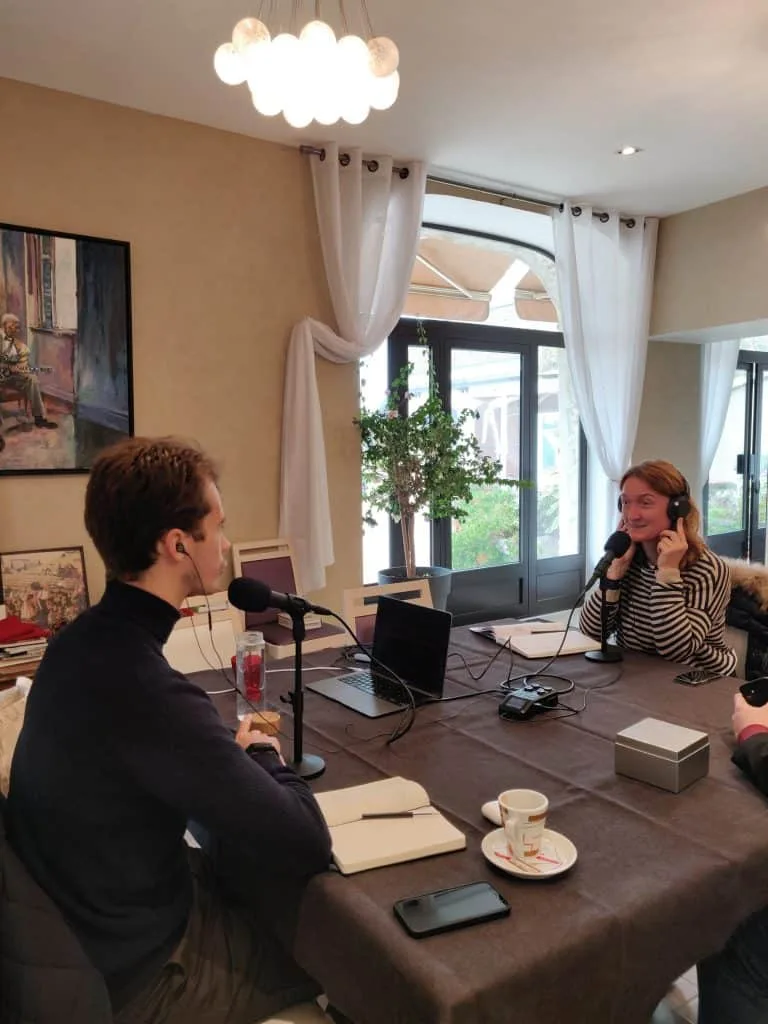
For the 58th episode of the Wine Makers Show, your wine podcast, we headed out to meet Laurence Danel at the Domaine Jean Féry & Fils. The least we can say is that we had a great time and were thrilled with this discovery. Laurence gave us her time and let us really understand the inner workings of her job. Let’s continue our discovery of Burgundy wine together.
Antoine: Hi Laurence. Laurence: Hi. Antoine: Thank you so much for having us here, Domaine Jean Féry & Fils. We arrived a tiny bit late. It was a bit hard to leave Beaune this morning but we’re very well welcomed, so all is good. Laurence: Thank you.
We’re going to talk about lots of things obviously: your background, what you do here, the wines made here, the property and hopefully lots of other things, but first can you start by introducing yourself?
Laurence: Yes, absolutely, thank you. Laurence Danel, I’m the Domaine’s oenologist and I arrived in 2017, in June. I’m an oenologist by training. I got my diploma in Montpellier in 2003, so that was the year of my graduating class. Before arriving at my DNO training in Montpellier in 2003, I’m originally from the Pas-de-Calais and I did scientific studies in Lille in biochemistry. Through recurring visits to Burgundy during the harvests, it started from the 90s, I had the chance to meet superb people who worked at the time at Antonin Rodet, very renowned, very well-known oenologist Nadine Gublin who today still continues but with the Domaine Jacques Prieur which has other Domaines to its credit. She’s the one who launched me a bit on the roads of oenology, into the trade of oenologist with also someone very close, Robert Vernizeau. It’s the whole team, a hard core that worked at Antonin Rodet that I discovered by doing the harvests, simply put. It was great. I discovered the Domaine des Perdrix which had just been acquired, Domaine de Villard and I started discovering the wine universe in a vat room all in intimacy, a small vat room. The people who were at the vine could just as well work in the cellar as work in the vine. It started like this. After a few years I launched myself to study oenology, to leave, to be accepted at the Montpellier oenology school and then there you go, off it went.
A lot more sun than in the Pas-de-Calais. I can testify, I’m also from Lille originally.
Laurence: It’s for sure a beautiful destination to study oenology. It’s a superb school too. It’s the Montpellier pharmacy faculty. There’s an oenology center over there. We were a beautiful graduating class. It’s still current, there are always graduating classes of about 50 to 60 people with many foreigners who come study with us. A bit from all horizons of the world: Chinese, Canadians, Greeks. It’s a beautiful heterogeneity, a beautiful mixity, a beautiful discovery full of cultures meeting around wine and the vine.
We’ll come back to the DNO because it’s interesting to dig into this part of the studies, but tell me about this universe of harvests you did a bit like a student job?
Laurence: That’s it.
How did you get the idea to do that because in itself, there are plenty of student jobs, then harvests are well-known and great. Why did you want to do this and especially, from what I understand, how did you do them, several consecutive years?
Laurence: Yes.
What gave you the desire to keep coming back to this?
Laurence: Well it was the atmosphere created within the Domaine and within the people who welcomed us to go pick the grapes. Then, as a student job, in the north, we talk a lot about these seasonal jobs, harvests. It was a way to go, to come back to university having done two weeks of harvest. It made an income that was rather pleasant and we also had the festive spirit that turned around and that was quite current, it still is a bit. Discoveries too, with other young people. And work outside, when it’s sunny, it’s rather pleasant, very sunny days, you cut grapes without worrying too much about other things. You cut grapes, you put aside your contribution to do the work well. And then little by little coming back, digging a bit more, you see the universe of the Domaine. When the grapes come in, at the end of the day, you can go see a bit how it goes. And when you’re in a beautiful team, where everyone gets along well, where you see there’s work, there’s good humor in fact. When you bring grapes in, it’s a bit like when you bring in the harvests, it’s the work of a whole year. In general, we’re rather happy to see grapes arriving. There you go, the fruit finally arrives at destination. And once it’s in everyone is relieved and enthusiastic that it goes well. It came a bit like that too. I had the chance too to meet nice people who make you want to work and want to make beautiful things too.
During the day you pick the grape, you harvest and in the evening you stop by the vats, you watch what happens. It’s a bit there that you have this initiation. You knew a bit about wine too, you knew it before?
Laurence: Yes, a little. My parents always loved having a cellar, then it’s more the Bordeaux culture in the Pas-de-Calais. They were a bit initiated into Bordeaux, into Burgundy, sorry. I have family who lives in the Yonne. We rubbed shoulders with Burgundy a bit nonetheless. Antoine: Okay. It’s not very far. Laurence: So there were these harvests. The day indeed we started, I cut grapes and little by little, with the people who supervised us, they suggested we come sort the grapes. After, as the harvests went on, the years after, it was more the work of staying in the vat room than doing grape sorting. We had a team that was always a bit the same for a few years. Later I stopped doing it, but it was about staying to sort the grapes. We were proud to have this requirement to make beautiful grapes and then they showed us afterwards in the vat how, since we’re all together in fact. The sorting tables are right next to the vats so you see what’s harvested, what we put in the vat after. There was already this commitment to quality that was instilled in us.
Was there a moment when you had a click telling yourself: “I want to work in wine”, or did it happen little by little and you had this opportunity to apply for the DNO and where you said: “Why not?”. How did that moment happen? Because it’s still a crossroads, you had the choice to do it or not, what made you want to do it?
Laurence: Yes, it came little by little in fact. I can’t say that one year, after doing the harvests I told myself: “Hey, I want to become an oenologist”. No, I came back several times to the same place. Talking and seeing other works too, visiting other Domaines too, close to my colleagues, close to the people who supervised us and seeing other structures I learned, I saw the trade of oenologist with a lot of openness and opportunities in this oenologist work, in this work of wine and vine.
So there it was off, direction the DNO, the sun, we talked about it. You did two years there?
Laurence: Two years, yes. At the time it was two years. After it became a Bac+5 a few years later but there you go it’s a well-finished training with lots of studies, lots of wine chemistry, vine biology. But it’s very enriching, indeed. You have to go through that to then well apprehend the work of wine, aging and the vine because you have to orient yourself, look at what happens in the vine to then understand what arrives in the crates, to understand the grapes.
Over these two years, two years at school, what happens for you afterwards?
Laurence: During these two years, there are two fairly substantial internships you do at Domaines. I did them not necessarily in Burgundy, quite the contrary. What’s good too is going to see other regions. I stayed in the south. There’s also another work in the south, with other grapes, other grape variety types we work with, that we discover, other equipment. All this means we open our minds to other ways of doing things than in Burgundy. We see new technologies. After they engage us to leave, to try to do work abroad, to open our minds and ask what’s important, how am I going to work, where am I going to orient myself? Am I going to do laboratory? The trade of oenologist is also working in a laboratory, or being a consulting oenologist. It’s also following winemakers to help them bring the best of what they want to their vines or their wines. It’s working on wine adjuvants. We can work on the cork, on the barrel, on oenological products… At the end of these two years, you see several facets of the trade of oenologist. You see for yourself what it is to work in a big structure, in a small Domaine, in a cooperative cellar. Afterwards you launch yourself according to your feeling, according to where you’re most at ease. You tell yourself you want to go more in this sector. And me I wanted, I already felt I wanted to go rather into production. In fact stay on the field of the cellar, of the vat room. First contract, it’s return to Burgundy in fact, in Côte d’Or, at Bouchard Père et Fils. Plus with a quite particular year, in 2003. The earliest year we’ve ever known. So already I come back to Burgundy, superb vinification with a big Domaine, lots of means, lots of vines. Enormous capacity in hectares too. After I left for Australia.
Okay, super. Far from Burgundy.
Laurence: Contracts aren’t always easy to perpetuate, the first years of the DNO. You have to make experience for yourself, make your hole as they say, especially since I came from the Pas-de-Calais, not even from a family of winegrowers. You start to know people, contact good people, build a network. But it’s less obvious than when you’re from the region, it’s still less easy. But it’s done, the proof.
You leave for Australia. Can you tell us? How did you find?
Laurence: They’re contacts, in fact always through the Montpellier DNO. There are other students who left. We communicate information, small tricks among ourselves. It’s more than a trick, but it’s the way to find work, to exchange about maisons where it’s nice to go, where they’re looking for work, in short. So it came like that, through colleagues who had already left, friends from my graduating class who gave me the info. And so I left for Australia. There on the other hand change, big structures, more than twenty thousand tons per day of grape reception, in January, plus. It was in 2004. From January to June I was near Sydney. It was a more manual work. We were more, let’s say, a bit less left to discover. We were more in fairly recurring tasks. But it allowed us to see impressive techniques, very industrialized. It allows at the same time to see what you want to do or not do later.
What do you take from this experience, if you had one or two lessons or things you take?
Laurence: It opens your mind anyway. And then travel, it was so cool to be able to discover another culture and know that yes, there’s wine being made in Australia, why not. After it’s another way of doing things. It’s also a vine culture that’s specific to them. They have a history too, it’s nice to be able to exchange with them, discover English, Australia. You immerse yourself completely. You discover another culture, it’s cool. After it makes them want to come to our place and see what we do and tell themselves it’s nice too. Antoine: There aren’t twenty thousand tons per day, but it’s nice. Laurence: They also see the way we work the terroir, things that at the time weren’t done much in Australia but there are some Domaines that are starting to work the terroir more in fact, to think, to favor certain grape varieties more than others.
It must have been ultra interesting, this experience in Australia. I think it’s one of the riches of the wine world, it’s how much in fact you’re very anchored on a place, as such, but for that, these magical places, there are some all over the world in fact. There’s of course Burgundy, Bordeaux, all the wine regions of France, but there are some elsewhere in Europe, in Greece, in Italy etcetera.
Laurence: In Canada, in New Zealand.
Antoine: In Oregon, Napa, even in South Africa.
Laurence: Yes, there are plenty of magnificent, superb places. I only did Australia, but there are so many. There are people who are itinerant oenologists.
I had done an interview by the way, which was super, with Jean-Baptiste Ancelot, who created something called “Wine Explorer”. He toured wines for four years and documented everything in a book also called “Wine Explorer”, I think. He did eighty countries I think, world tour, it’s impressive. It’s clear that going abroad when you want to make wine is, I find it ultra interesting in any case.
Laurence: Well yes, completely. I have a friend I see less but who was a graduating class before me in Montpellier, who does that since, in fact he’s always been itinerant, Zane Katsikis. He’s of Greek origin and also has American nationality. Today, he’s over 58 and he continues, I don’t know if we should say his age, but he’s a man! He’s all the time, every year, he changes hemisphere in fact. Antoine: Ah yes, so he doesn’t have winter. Laurence: Yes, it’s impressive, but he loves it. He’s roamed all the wine lands let’s say. Antoine: It’s incredible I find as adventure.
You do these moments in Australia and then come back to Burgundy?
Laurence: Yes, I come back to Burgundy, well more in the Mâconnais, as a consulting oenologist in fact. It’s an opportunity that came to me. I did before a season in the Bordeaux region as a consulting oenologist. I was more in the Saint-Emilion land, so superb work, experience. I was well surrounded, I had people from the Grézillac laboratory, with the director, Denis Galabert, who’s perhaps retired today, a whole bunch of consulting oenologists. The whole 2004 season was spent there with the discovery of the Bordeaux grape variety with an approach to the Saint-Emilion terroir. Beautiful things to discover. The year after I arrived in the Mâconnais where I did a passage of two years as consulting oenologist. I always had in mind to come back to Burgundy to set up shop in a Domaine, in a cooperative cellar for example, to find a position in production, come back to work the grape. I had been for some time consulting rather, it’s not the same. I was passing through cellars, I saw people doing and I told myself I’d love to be in their place, I’d like to come back. Rather than advise them, I’d like to do it again. I came back in 2007 to Domaine Faiveley and there I put a foot back in Burgundy for good to arrive until 2017 at Féry’s.
You’ve already done ten years there. How did your arrival here go, at the Domaine Féry et Fils?
Laurence: Very well!
I mean how did you arrive at the Domaine Féry?
Laurence: It was simply a concourse of circumstances. They were looking for a new oenologist. I saw the announcement pass on oenology networks, specialized sites and I applied, simply. It was as if we were waiting for each other. There you go, it’s a meeting, a beautiful meeting.
What seduced you precisely to come work here? What made the difference?
Laurence: At Faiveley, I stayed until 2008. Then, I arrived in a more négoce structure in the côte chalonnaise, in Rully, at Delorme. There, in fact I was an oenologist but I was buying grapes. We had unfortunately little production, vines that were attached to the Domaine. It happens that the announcement of Domaine Féry which was looking for an oenologist with fifteen hectares in property nonetheless, that changes everything. With a multitude of appellations, but lovely appellations. From the côte chalonnaise we go through Chassagne Meursault, Puligny we go up by Savigny, by Pernand-Vergelesses and we arrive, passing through the Côte de Nuits to Gevrey-Chambertin. We had all this diversity of terroirs that’s specific to the Domaine and they were looking for an oenologist. So I tell myself: “I have to go.” If it’s to do even better the work of oenologist of always following the same years, the same parcels, the same terroir and seeing over the years how to work it well according to vintages, it’s even better.
Can you describe your work for us? What do your different days look like? What are the different tasks you have to perform? What’s the daily life of an oenologist in Burgundy?
Laurence: I won’t say what time I arrive. I take care of making wine, of bringing it to bottling as best as possible. It starts by doing the harvests as best as possible, triggering the harvest date and harvests at the right moment, with the right ripeness on the whole mosaic of parcels we have. Choosing the right moment also induces working on the parcel, looking upstream in the vines how it goes at the grape level, how it ripens. If there isn’t a bit too much in such a parcel or on the contrary if there’s a slightly lesser load that means the parcels will ripen better, that the soil induces more important ripeness in some vines than others. There’s all this upstream part that I work on too, with Jean-Louis Féry, who takes care more of the vineyard. We work together, what I discover, the small extra in each parcel we have in relation to the grape. It’s working in the vat room too, making wine with my team of pieceworkers who join me. Working each vat, vinifying as best we can. Then, aging. Everything is vinified, everything is aged in oak barrels here, within Domaine Féry, whether in red or white. After, there’s a whole work of cooper choice, of new barrel choice that’s done. Then, you have to follow these wines until the completion of aging, which differs according to the vintage and that’s what I take care of. It lasts from 14 to 16 months for some appellations. According to the vintage, perhaps two or three appellations will be triggered a bit earlier because in tasting we tell ourselves that we’re reaching the end of what’s good for the wine and so we can trigger bottling. After I pass the hand to Michaël who has a big work of putting everything also in good hands.
What you say about your daily life is ultra interesting because in fact it encompasses many different tasks. There’s a bit at the vine to understand each terroir, what happens there, what’s the potential you’ll count on then and after it’s a very different work according to the moment in the year, between vinifications, aging…
Laurence: Yes, aging, then preparation for bottling.
You arrived in 2017, is that right?
Laurence: Yes.
That means with aging and bottling etcetera, your first wines came out in 2019 or 2020?
Laurence: Yes, that’s it.
How did it go, a bit of stress at the time of release of these first vintages?
Laurence: Yes. It’s especially after vinifications that I tell myself I hope it’s going to be beautiful harvests, lovely wines. But already, from the end of vinification I was happy already with what was arriving in the barrels. Already there we can predict a bit what will be later in the bottle. But I was thrilled. I had grapes for which all this ripeness work for me was already completed. I was able to reason to make beautiful things as best as possible from the grape reception. It’s more the stress of finding the right harvest date the first year. You had to quickly understand the parcel, quickly understand which were the ripe or unripe parcels or what they had a bit in their belly, let’s say.
And how do we do that?
Laurence: Move around as much as possible to go understand with the pieceworkers the vines and see how the grape evolves over the weeks. After with the years passing, I spend a bit more time going to see the parcels and discussing more with the pieceworkers about what to improve, what could be a plus when the grape arrives at the cellar. Today I realize that there’s, that we already do, we work with Domaine Féry already at the grape level, at the vinification level on really competent things, really top. Now it’s more reasoning in relation to the vine, making grape that arrives as best as possible. Climatic hazards don’t help us, so we really need to be in this search of how to do to have things as beautiful as possible. It’s better to have a more beautiful grape where we have finally little sorting to do and have healthy stems. That’s what makes all the difference to have a lovely wine.
Grape quality is the foundation. Can you describe the wines of Domaine Jean Féry & Fils for us a bit? The different wines you make all here and tell us a bit more about each of them.
Laurence: In fact, let’s say the Domaine breaks down between the côte chalonnaise, côte de Beaune and côte de Nuit. On the côte chalonnaise and côte de Beaune we’re majoritarily on white wine, so on chardonnay, on appellations, so we have Rully, we make a bit of Bouzeron. Then we have Chassagne premier cru, Puligny, Meursault. These wines I have at heart to vinify in oak barrels, they vinify very quickly. The juice is placed in the barrels and everything happens in the barrel. After I reason on a blend of new barrels, of more or less new barrels in fact according to the appellation and vintage, with a particularity that I’m fond of light toasts on the wood. Which allows, for me, to be able to extract, rather put forward, beautiful things from chardonnay, fruit, tension, all depending on the vine sectors but to put forward what makes the wine, what makes the terroir in relation to the appellations. Then we arrive in côte de Beaune. We have quite a bit of white but we also have, on Savigny, a beautiful parcel of red, of Pinot Noir. On Pernand-Vergelesses we also have quite a bit of Pinot Noir and a bit of chardonnay, which allows us to compare let’s say, to have different wines even if it’s the same grape variety. Meursault is chardonnay, Pernand is chardonnay too but we already have slightly different terroirs, always vinified with oak barrel. We already have diversities at this level, it’s quite magic. The Pinot Noir of the Côte de Beaune is the same. In relation to the Côte de Nuits we also have natural diversities in relation to the terroir. The Pinot Noir I work it in open vat, in concrete vats that are temperature-controlled. So we arrive on another approach in relation to chardonnay. There we work much more in vats. We talk about cuvaison. It lasts twenty days according to the years, up to twenty-five days when there’s potential there and that takes time to come. I work a lot on pigeage, all the time. It’s not systematic, we reason, one pigeage per day according to the vintage, sometimes two. At the end of cuvaison, I don’t pige much anymore. We let it cuver as we say, we let the grape macerate. They’re grape variety approaches that are nice, different, chardonnay is more a juice that you press and put in barrel. You have to reason more on barrel blends and let’s say Pinot Noir is cuvaisons, it’s macerations before placing in oak barrels after for aging. There’s a diversity that’s impressive but that’s super interesting.
It’s really something I find fascinating in Burgundy. There you tell me, it’s fifteen hectares?
Laurence: Yes, now we’re at a bit more. Since this year we acquired more vines on Givry, it’s a great first and so there we’re at almost twenty hectares, it’s great.
Yes, that’s top. You have twenty hectares and you have about ten different wines, no?
Laurence: We’re almost reaching twenty-eight.
You see, that’s what’s crazy. On twenty hectares, twenty-eight appellations, twenty-eight bottles in the end, twenty-eight different labels.
Laurence: That’s what there will be, yes.
It’s incredible. It’s the richness of Burgundy, having this respect for the parcel, all this heritage.
Laurence: It’s typical of Burgundy, indeed. Well I mean it’s really a characteristic of the region.
It comes from this heritage of the climats?
Laurence: The Burgundy climats they put forward not long ago, but it’s heritage.
It’s incredible. To find your way around, good luck because there are still quite a few different things.
Laurence: Yes, appellations, premiers crus, classifications, but I find it’s quite logical in Burgundy. I don’t want to say it’s not logical elsewhere but we arrive at a village, for example Pernand-Vergelesses, everything around Pernand-Vergelesses is Pernand-Vergelesses. The bottom of slopes is rather Village, mid-slope is premier cru, after we don’t have grand cru on Pernand-Vergelesses but we have the bois de Corton which is just behind and there we know it’s classified grand cru, everything that’s in good exposure. There’s a logic of exposure, of soil too.
Yes, there’s such diversity that sometimes it’s a bit difficult for the first comer to find their way. You have to come several times to start getting used to it.
Laurence: Yes, you have to discover the villages that are important. There are many.
Yes, there’s plenty to do. You have to take a car or bikes and spend some time there.
Laurence: At the same time we follow too and it’s a discovery let’s say visual, because we observe and see that the vineyard breaks down on a small part we call the mountain. In fact it’s a slope that goes down from Dijon, that goes to côte chalonnaise and that goes down. It’s at the geological level in fact that you see where the vine draws a bit everywhere in France.
It’s the soil composition, their exposure that made all this. We talked precisely a bit before, when you described the different wines and how you made them, the different vinifications, the different aging modes. Is that something you changed when arriving here or something that was already done and what’s your degree of freedom to be able to change things, add new techniques? How does it work?
Laurence: Already before, I was working, well at Delorme, on toast barrels, the choice of new barrels with light toasts. I had discovered coopers who practiced this type of toast. I worked in partnership with Nadine Gublin who does consulting, who continues, but who already did at the time. We worked together on this technique of light barrel toast where the wood doesn’t stay toasted at all, not seeking to burn which for me, that we discovered, was eating the wine a bit and meaning we no longer felt the fruit at all. You had to wait several months before finding the wine again. In aging you had to find these aromas that came very late or sometimes that were even a bit too masked. Already I was working on this, on these light toasts. When I arrived here, I told myself: “We’ll surely work on barrel aging but much less pushed.” let’s say. The first year, I arrived and we bought many more new barrels, because we lacked a bit of barrels. We had a harvest that was announced lovely, much more quantity in relation to 2016 which was quite catastrophic that year. There was a barrel park to renew. I went off on this and tried to keep this work line on light toast barrels. I had total freedom, as long as it made wonderful things and we found the terroir. Because that too, that the wines don’t resemble each other between Puligny, Meursault, Chassagne, between Savigny, between Pernand… And that the Côte de Nuits expresses itself too, that we find, that we know we have a Vosne-Romanée in front of us. That when we taste a Gevrey Chambertin, we don’t say: “What is it? It’s the same.”, especially not.
Can you explain to us what light toast is? Already toast just of a barrel, and what’s light toast?
Laurence: In barrel making, to finalize their good hold, so the wine can be in there without leaking, you have to heat the inside so everything is well arranged. The more or less strong toast is also for the oak tannins, so they marry well with the wine so there can be ripeness of these tannins. That’s the cooper who explains it. It’s a big work for them, impressive, to make a barrel that delivers what the winemaker wants to have in their wines. After there are more or less toasted toasts as we say, more or less marked. The longer you toast a barrel the inside is either more burnt, more brown in fact and there they know how to tell us that there we’ll have more toasted aromas, more mocha. Which will give a slightly more syrupy side to the wine, even aromatically, more vanilla if it’s toasted very strongly. After there are also durations, very strong, little time, you can have more mocha aromas, more coffee, more spicy, a bit American. If it toasts very long, very strong, then there we play more on the wine structure. We’ll bring more rounder things, more sweet things, more sugared to the wine. After if you toast long but very little, the barrel is less marked, the inside is less burnt. Burnt is perhaps not the right term but less marked, less brown and we’ll put the fruit forward more. It will flourish more, reveal itself more. We’ll respect the wine’s acidity more, put it more in value in fact. On a Chardonnay, we’ll have a tension that will be more present on this type of barrel.
How did you discover?
Laurence: It’s the coopers who come taste who get involved much more for quite a few years and who guide us. We do tests, we choose one or two barrels of a different toast and we manage to see these results that are there indeed. Antoine: We need to go interview a cooper. I’ve been told for a long time. We really need to do it because it’s a trade that’s super interesting, that’s connected to the wine world and that’s ultra important. We don’t put it forward much, we talk about it relatively little while it has an impact on the wine that’s important. Laurence: Yes, I have several to recommend.
What should we wish you here? What should we wish the Domaine? What are the ambitions?
Laurence: We’d like to have other even more beautiful appellations of Burgundy. We’d like perhaps to have even more Côte de Nuit. There, we put a foot in the Côte Chalonnaise with Givry, well why not continue.
And like that you continue exploring new terroirs.
Laurence: Other terroirs. Discover, because they’re not all here, so why not a grand cru. There we manage to have a grand cru that we for the moment bought, but in white, in grape, but that’s coming to us there at the Domaine. It’s also a beautiful advance. In addition to Givry, village and premier cru, we have terroirs from the côte chalonnaise that are there. We need to continue discovering them because it’s the first year. Little by little if we can still nibble other parcels and discover other things from Burgundy, well let’s go. We’ll push the walls, we’ll put other barrels, no worries. Antoine: There’s room here. Even where we are, we can add a wall. Laurence: It’s always possible, we put some aerations. Temperature is mastered. After we put some sub-brands as we say then come on, hop.
The Domaine’s wines, it’s a bit of a cliché question, but we find them at all good wine shops, big restaurants, good restaurants, hotels?
Laurence: Yes, from the region, from Paris, that’s more my colleague Michaël who would tell you about it but there’s a beautiful distribution network at wine shops throughout France but a lot in Paris and the region, in Alsace. We have this chance to be more and more well represented. After in restaurants and wine shops in Beaune, there are some who distribute us. We have beautiful tables. Are you waiting for a name, names perhaps? Antoine: No, not particularly. It’s more to orient listeners if they want to taste, go discover these wines. Laurence: At wine shops. Antoine: Run to your wine shop, ask for Domaine Féry and if they don’t have them you call me and I’ll give you Michaël’s number. Laurence: At wine shops, yes, Féry et Fils. With pleasure, he’ll know how to orient. There will always be a good wine shop near you. The holidays are coming, so you have to enjoy yourself, and even without the holidays. You have to warm your heart because it’s starting to be a bit gloomy outside.
You have a journey that’s still impressive from Lille to today. If you had the chance to slip a small word to yourself when you leave for the first time to do the harvests, what would you tell yourself?
Laurence: I don’t know. I went there instinctively, I felt there was a joy of living in fact and good atmosphere around wine and harvest. On the other hand I didn’t think I’d get this far, but great. It’s an instinct you follow. You feel you’re well so you go where things go well, where you feel you’re well. Maybe I told myself I could perhaps bring something extra, bring the best of myself. It was where I felt I was making beautiful things.
Is that advice you’d give to a young oenologist starting out?
Laurence: Yes, to trust yourself and tell yourself you have to go where you feel good, as best as possible and where you want to learn and bring the best of yourself.
The message is passed. For all the young oenologists listening, follow your instincts. I suppose we can come see you here at the property if discovery and people want?
Laurence: Thank you, yes. By appointment. You have to call us and then we take, we set appointments together with Michaël and with me too. Antoine: That works. Links are obviously in the podcast description if you want to come discover a beautiful part of Burgundy and its Domaines. You just have to follow these links and come here.
Is there a question I didn’t ask you and that you would have liked me to ask?
Laurence: Well no. Listen, I had a good time, I let myself be guided. We could indeed perhaps have talked about our work of organic agriculture we lead at the Domaine for a very long time, well before me. I have at heart to continue in this lineage, to talk about organic agriculture too in nurseries. Today they work in this too, in this horizon. I really like that. So I even discovered a nursery like Bérillon. It’s a work I had also discovered, that I had read a few years ago and so it allowed me to meet them. I find that working organic both in wines and in vines too, in vine plants, I find that’s surely the future.
Has it been long?
Laurence: Since 2011, a lovely Domaine that has solid experience in the matter. It’s beautiful.
A decade, that’s not bad at all. I suppose it can’t be easy some years?
Laurence: It’s done quite naturally I’d say, it’s done well. After, we’ll always have moments where the grape is less opulent than at other moments but is that linked to organic, I don’t think at all but it’s like that. Antoine: It’s also a kind of price to pay, in quotes, for making beautiful things, respecting the earth, the vine, plants, etcetera. In the end it can only be positive and bring something good. Laurence: Yes, absolutely.
You never wanted to leave Burgundy, since you came back?
Laurence: Ah no, me I’m well here, the whole family is here too. My family is well anchored in Burgundy. After, leaving for stays, that’s different, but staying at the sources of Burgundy. Antoine: That’s understandable. It’s a very beautiful region. I haven’t yet come enough to Burgundy but it’s starting to enter. It’s top. Laurence: Thank you. Antoine: Thank you.
I have three questions that are quite traditional at the end. The first is, do you have a book on wine to recommend to me?
Laurence: Precisely, I was talking about the book that was written by Laure Gasparotto and Lilian Bérillon, it’s: “Le jour où il n’y aura plus de vin”. It’s something I read a few years ago. I found it really nice to read and it opens to other horizons. It talks a lot about the vine, nurseries. It’s true I didn’t know their fight and their work too while it’s well linked to our vineyard. We talk more and more about vine sustainability and diseases, the way to preserve our terroirs so I found it’s a beautiful work.
Buy Le jour où il n’y aura plus de vin
Antoine: Yes, it’s a very beautiful work. I read it too not very long ago, 6 or 8 months. I found it was super well written and I’m not saying that because I really like Laure, but because it was the case, I had a great time reading it. If you have the chance to read it, “Le jour où il n’y aura plus de vin” by Laure Gasparotto and Lilian Bérillon, excellent work.
You were talking just about vine sustainability, it’s a subject that interests me a lot. Do you feel that working precisely on new woods. How do you see things?
Laurence: Like more and more nurseries. They work on massal selection. It’s not cloning. It’s looking for the individual that’s naturally tough, that can resist plenty of climatic hazards and that will from year to year, always be that same individual that will stand out and it’s an observation work more than looking for cloning techniques. It’s more observation in nature, in the terroirs too of different vineyards. So that means in Burgundy they come look for old pinot noir plants that are over 100 years old or thereabouts and that perpetuate and continue to live well, not be sick, be healthy. They have this approach in fact of looking for these individuals. It’s beautiful because they’re individuals who grew all the time in the same terroir. They enriched themselves with all that, who aren’t sick. That can allow precisely to make small plants that are more vigorous and that come out of this good terroir.
They’re a bit the children of these individuals, of these few stocks that resist well. Do you have a recent favorite tasting?
Laurence: So, within the Domaine I have several. I love almost all of them, at different moments, at different periods of the year. I would already recommend to apprehend the Domaine with the Clos de Magny. It’s a Côte de Nuits Village, in pinot noir. It’s a red that’s absolutely sublime in any occasion, let’s say almost all year. I also have the Savigny rouge Sous la Cabotte which is also a wonderful wine. We’re a lot on fruit with a beautiful texture, finer tannins. In white, I have so many, but I love them all. What could I recommend? We have our Meursault Dressolles which is a beautiful parcel with tension and wonderful energy. There’s also a subtle wood at the finish, for example. But come back in a few months, I’ll tell you about other wines. Antoine: That’s the joy of the trade.
And finally, last question, who’s the next person I interview on this podcast?
Laurence: I have several. There’s always my emblematic friend Nadine Gublin, who’s well anchored in Burgundy, who’s an exceptional woman. After I was talking about my itinerant oenologist friend who’s currently in the United States, Zane Katsikis. He’ll make you travel through all continents, but he also worked a lot in Burgundy. After it’s, there you go, very diverse personalities, why not? Antoine: That works, why not. Maybe Zane Katsikis we’ll have to catch him if he’s still moving. We’ll arrange, we’ll do something. And with Nadine, with great pleasure to come back and discover a bit more Burgundy, it’s the occasion. Thank you very much for this exchange, it was a great pleasure. Laurence: Thank you, it’s very nice. I’m discovering the podcast but I find it formidable. Antoine: I hope it gave you the desire to listen to all the other episodes, and future ones. Laurence: Completely. Antoine: Thank you very much. Thanks to all the people listening. Obviously if you’re still here at the end of these 56 minutes of exchange it’s because this episode pleased you. Share it around you, rate it. Follow Domaines Jean Féry et Fils, come see them or try to discover their wines. I think it’s the most beautiful thing you can do after listening to this podcast. Take advantage of it to do it and put a few bottles in your wine cellar and I’ll see you in two weeks. Thanks again and see you soon. Laurence: Thank you.
Amazon links on this page are affiliate links. They cost you nothing extra, and they help me keep this going.