Beef stew wants a dry red with fresh acidity and medium tannin. A Northern Rhône Syrah like Crozes-Hermitage, a Côtes du Rhône Villages, or a Beaujolais cru such as Morgon all work. For a tomato-heavy stew, go to Chianti Classico. Serve at 16°C. The leaner French pot-au-feu goes lighter: a Morgon, a Chinon, or a Jura white with the broth.
Beef stew is one of the most cooked dishes in any home kitchen and one of the least planned for on the wine side. Everybody has a version: the Sunday braise with carrots and potatoes, boeuf bourguignon, Irish stew, oxtail, or the French original, pot-au-feu. Here is what actually works with each of them, and why.
Why is beef stew tricky to pair?
A stew does three things at once. It gives you long-cooked beef that has gone soft and slightly gelatinous, a broth that is salty and deeply savoury, and root vegetables that are quietly sweet. That combination is heavier than it looks, and it punishes wines at both extremes.
Too much tannin and the wine turns chalky and bitter against the lean, poached parts of the meat. If tannins are new to you, think of them as the drying grip you feel on your gums after strong tea. Too little structure and the wine simply disappears under the broth. What you want in the middle is acidity, because acidity is what cuts through fat and resets your palate between mouthfuls, plus enough tannin to give the wine some backbone.
Which bottles actually work with beef stew?
These are the appellations we come back to, with rough shop prices in euros.
| Appellation | Why it works | Rough price |
|---|---|---|
| Côtes du Rhône Villages | Grenache-led warmth, ripe red fruit, soft tannin. The safest weeknight bet with any beef stew. | €8 to €14 |
| Crozes-Hermitage | Northern Rhône Syrah, peppery and savoury, medium tannin. Cuts the fat without drying the meat. | €12 to €18 |
| Morgon or Moulin-à-Vent | Gamay with real depth. Juicy, high acid, low tannin, brilliant with boiled and braised beef alike. | €12 to €20 |
| Chorey-lès-Beaune or Savigny-lès-Beaune | Affordable red Burgundy. Pinot Noir acidity lifts a heavy broth better than anything else. | €20 to €30 |
| Saint-Émilion or Fronsac | Merlot roundness with enough structure for bacon, marrow and a long red-wine braise. | €15 to €25 |
| Chinon or Saumur-Champigny | Loire Cabernet Franc, light-bodied and herbal. The red that suits lamb-based stews. | €10 to €18 |
| Madiran or Cahors | Tannat and Malbec, serious tannin. Save these for oxtail and the fattiest cuts only. | €10 to €18 |
If you want one rule to carry around, it is this: match the weight of the wine to the weight of the stew, and let acidity do the rest. A delicate broth wants Gamay or Cabernet Franc. A dark, sticky braise wants Syrah or Malbec.
What wine goes with boeuf bourguignon?
Boeuf bourguignon, or beef bourguignon if you prefer, is beef braised in red wine with bacon lardons, mushrooms and small onions. The sauce is already winey, glossy and slightly sweet from the reduction, so the glass needs to bring freshness rather than more richness.
The obvious answer is Burgundy, and it is a genuinely good one. A village-level Pinot Noir from Savigny-lès-Beaune or Mercurey has the acidity to slice through that sauce. The honest caveat is price. Decent Burgundy starts around €25 and climbs fast. A Morgon at €15 gets you eighty percent of the way there, and a Crozes-Hermitage gets you somewhere different but equally good, with a peppery edge that plays well with the bacon. We go deeper on this dish in our guide to what wine goes with beef bourguignon.
What wine goes with Irish stew?
Irish stew is the outlier in this family. Lamb, potato, onion, sometimes barley, and crucially nothing is browned first, so the whole dish stays pale and gentle. Open a big oaky Cabernet here and you flatten it completely.
Go lighter and a little greener. Loire Cabernet Franc, Chinon or Saumur-Champigny, has a leafy, peppery note that meets lamb halfway, with light tannin that leaves the broth alone. A Beaujolais cru does the same job with more fruit. If your version is a Guinness beef stew rather than a true lamb Irish stew, you have a much darker, sweeter, more roasted dish on your hands, and you should move up to a Syrah or a Malbec.
What wine goes with oxtail stew?
Oxtail is the richest thing in this article. Hours of slow cooking turn all that connective tissue into something unctuous, and the sauce ends up dark, sticky and intense. This is the one stew where you can go big without wrecking the balance.
Madiran and Cahors are made for it, and both are cheap for the quality. Châteauneuf-du-Pape works if you want warmth and spice. A Rioja Reserva with a few years on it brings a savoury, leathery quality that suits oxtail perfectly, and so does a mature Saint-Estèphe if you have one waiting. If you are cooking oxtail South African style in a potjie, a Swartland Syrah is the local answer and a very good one.
What wine goes with pot-au-feu, the French beef stew?
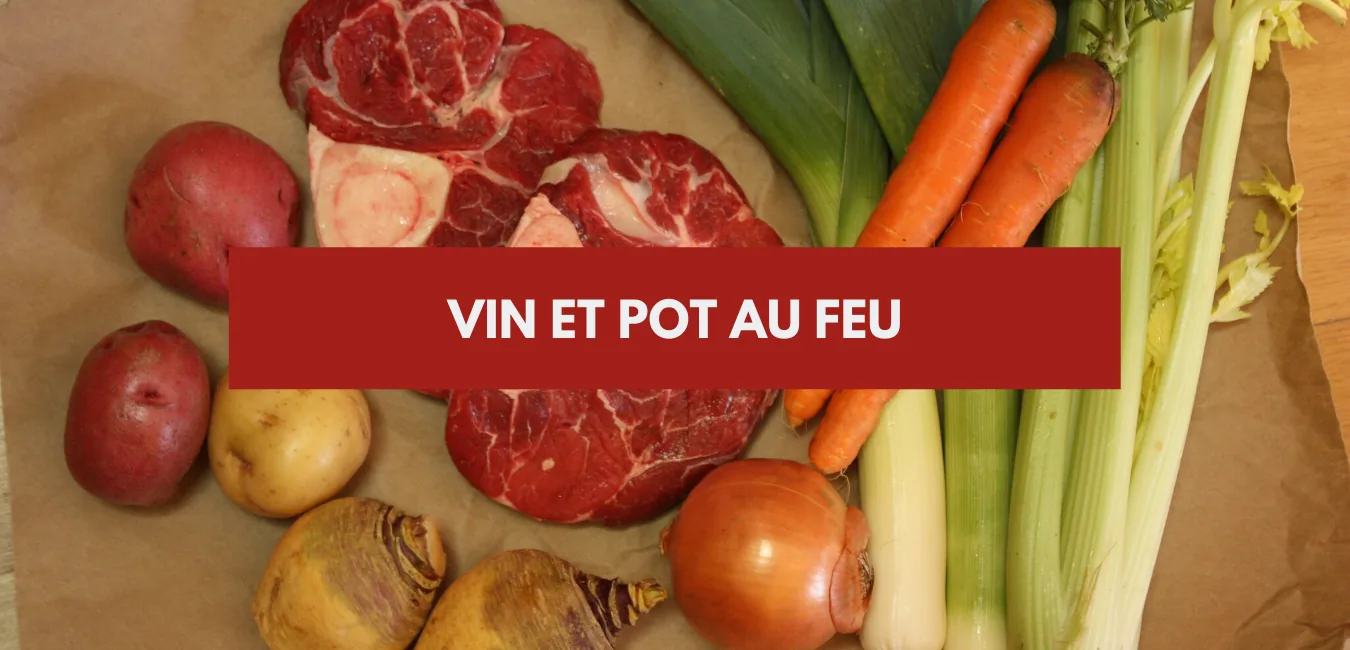
Pot-au-feu is the ancestor of every dish here, and it is the leanest of them. Nothing is browned, nothing is thickened. Beef cuts are poached slowly with carrots, leeks, turnips and a bone for the marrow, and you eat the broth first, then the meat with coarse salt, strong mustard and cornichons.
Those condiments are the real pairing problem. Mustard and vinegar pickles wipe out soft, fruity wines, so you need acidity to fight back. Our picks are a light red Burgundy, a Saint-Joseph, a Morgon or a Chinon. In the Jura, where this dish is a religion, they pour Trousseau or Poulsard, both pale and mouth-wateringly fresh, and it is a revelation if you have never tried it. Skip anything heavy, oaked or over 14% alcohol, because pot-au-feu is a subtle dish and big wine simply steamrolls it.
If your version is made with duck and a slice of foie gras added at the table, the calculation changes and you want a rounder Burgundy such as Volnay or a Chambolle-Musigny. Our notes on wine and duck apply from there.
Do you have to drink the wine you cooked with?
No, and this is the most repeated piece of bad advice in food and wine. Cooking boils off the alcohol and concentrates everything else, so a cheap bottle that made a superb braise is often thin and hollow in a glass.
Our rule: cook with a decent, dry, unoaked red of the same broad style as the one you plan to drink, then drink something a step up from it. Never buy anything sold as cooking wine, since it is usually salted and poor. And never tip an expensive bottle into a pot that will simmer for three hours, because everything you paid for evaporates.
Can you drink white wine with beef stew?
Rarely with a red-wine braise, and more often than you would expect with a poached one. That distinction matters more than the colour in the glass. A bourguignon or an oxtail arrives with a dark, reduced sauce built on red wine, and the umami of a long-cooked broth makes any wine taste drier and less fruity, so a light, aromatic white ends up thin. Whether a white has any tannin structure is beside the point, because texture is what decides.
Pot-au-feu is where whites shine: nothing is browned, there is no sauce, only clean broth and poached beef. A Côtes du Jura in chardonnay or savagnin, a Saint-Péray or a Mâcon-Villages has the body to keep up, and a Jura Savagnin aged under its yeast veil, or a Vin Jaune, is one of the great matches in France. What fails is oaky or loudly aromatic white wine, not white wine itself. With a dark braise, stay with red.
What if the stew is tomato-heavy or spicy?
Tomato brings acidity into the dish itself, and a wine with lower acidity will taste flabby next to it. Match it: Chianti Classico, Barbera d’Alba or Montepulciano d’Abruzzo are all built for tomato and all sit under €20.
If your stew leans on paprika, like a goulash, look at Blaufränkisch from Austria or Kékfrankos from Hungary, which have the peppery bite and freshness the dish wants. Where there is genuine chilli heat, avoid high-alcohol, heavily oaked reds. Chilli sharpens the burn of alcohol and pushes bitterness and astringency forward, so the pairing turns harsh very quickly. A soft, low-oak Grenache is far kinder.
How should you serve it?
Serve your red at around 16°C, not at modern room temperature, which is closer to 21°C and makes everything taste alcoholic and soupy. Twenty minutes in the fridge before pouring is usually enough, and our guide to red wine serving temperature has the numbers by style. If you have opened something young and tannic like a Madiran, decant it an hour ahead.
For more matches like this one, our wine pairing guide covers the whole method rather than one dish at a time, and if you are still working out what to buy, start with how to choose your wine. Once the bottle is open, tasting it properly will tell you more in two minutes than any label ever will.
Tell us which bottle you opened and how it went with your stew. We update this article with reader pairings.
About to put our advice into practice? Use the moment to fill out a tasting sheet. Good news, we’re giving you one.
Frequently asked questions
What red wine goes best with beef stew?
A dry red with fresh acidity and medium tannin. Crozes-Hermitage or Saint-Joseph from the Northern Rhône, a Côtes du Rhône Villages, or a Beaujolais cru such as Morgon or Moulin-à-Vent all work beautifully. Tomato-heavy stews want matching acidity, so Chianti Classico or Barbera d'Alba, while a rich bacon-and-wine braise suits a Saint-Émilion or a Fronsac. The wine needs enough grip to stand up to braised beef, but not so much tannin that it dries your mouth out.
Should I drink the same wine I cooked the stew with?
Not the same bottle, but the same family. Cooking concentrates a wine and boils off its alcohol, so the €6 bottle that made a great braise is usually thin in a glass. Our rule is simple. Cook with a decent, dry, unoaked red of the same broad style, then drink something one step up from it. Never buy anything labelled cooking wine, and never pour a treasured bottle into the pot.
Can you drink white wine with beef stew?
It depends on the stew. With a dark red-wine braise like a bourguignon, usually no, since the reduced sauce is deep and winey and most whites vanish underneath it. With a poached pot-au-feu, yes, as long as the white has body and a savoury line rather than loud fruit. A Côtes du Jura, a Saint-Péray or a Mâcon-Villages keeps up, and a Vin Jaune with the broth is a great French match. Oaky, aromatic whites are what fail, not the colour.
What wine goes with Irish stew?
Irish stew is lamb, potato and onion with nothing browned, so the flavours are gentler than a beef stew and a big Bordeaux will flatten them. Go lighter and greener. A Loire Cabernet Franc like Chinon or Saumur-Champigny is our first choice, with its herbal edge and light tannin. A Beaujolais cru or a simple Côtes du Rhône works just as well.
What is the best cheap wine for beef stew?
Côtes du Rhône Villages is the best value pairing we know for beef stew, usually around €8 to €14. It is Grenache-led, warm, low in aggressive tannin, and it flatters almost any braise. Beaujolais Villages and Chilean Carménère are the other reliable budget picks. Spending more rarely improves a stew pairing, because the dish is rustic and rewards honesty over prestige.