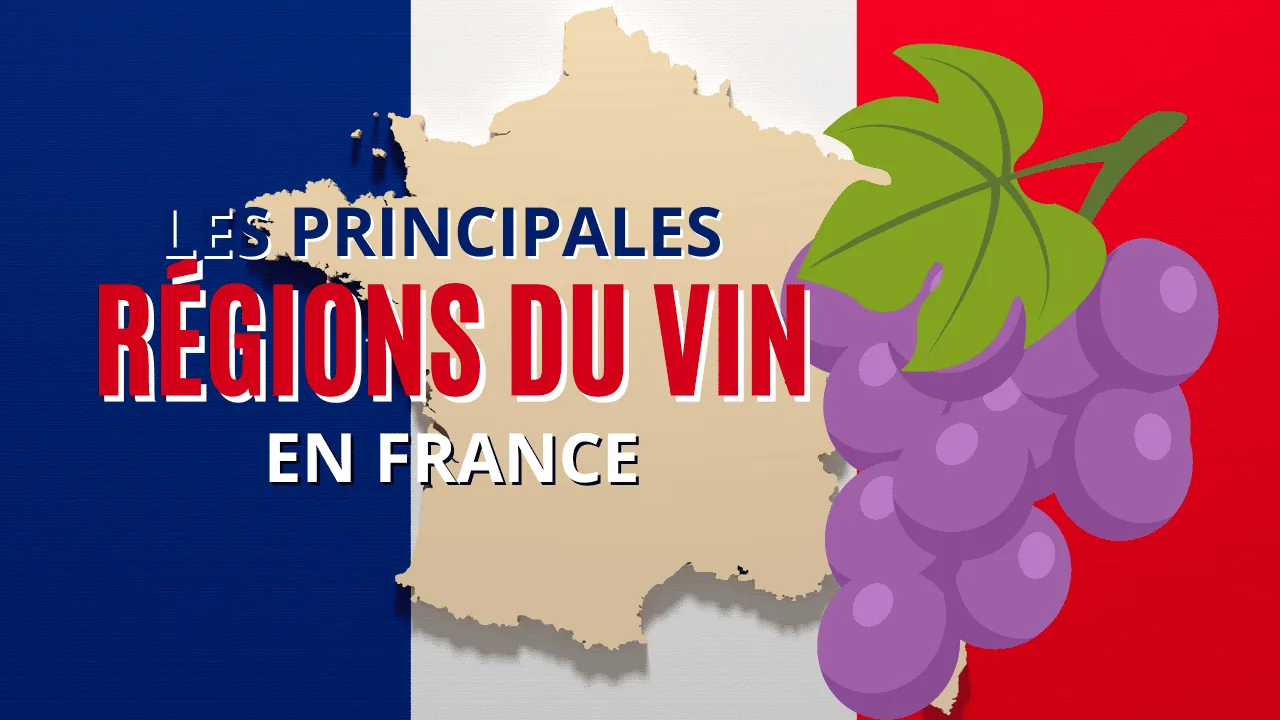
France makes between 43 and 50 million hectoliters of wine a year, that’s 5 to 7 billion bottles, or roughly 17% of global production. But to stop there would be to miss what makes the French vineyard so special: it’s one of the most varied, and almost certainly the most recognized, in the world.
In this video, we’re running through France’s main wine regions. The goal is to give you a panorama of what’s happening in French wine and lay down the basics on each region. France is big and broad, so we’ll have to take a few shortcuts and won’t dive into every specific subregion, but no worries, that’s what dedicated videos are for.
Bordeaux
We’re starting with Bordeaux. It’s where many of you first started your wine journey. Yes, the region gets pointed at sometimes and isn’t always in fashion. But like everything, it deserves nuance, and the people we’ve met on the podcast are the proof.
The Bordeaux vineyard is 15% of France’s total wine production. 90% of that is red wine, made primarily from three grapes: Merlot, Cabernet Sauvignon, and Cabernet Franc.
There are also superb whites built on Sauvignon and Sémillon that deserve more attention. Personally, we love the whites from Pessac-Léognan.
Bordeaux is also famous for some of its classifications and appellations you’ve definitely seen before, the 1855 Grands Crus, the Saint-Émilion classification, the Crus Bourgeois. We’ll dig into those, and what’s happening outside of them, in another video.
Champagne
On to another iconic region: Champagne. You’ve probably had it at festive moments, as an aperitif, with dessert, at dinners, there’s no other sparkling like it.
Today Champagne is roughly 300 million bottles a year, with 55% drunk abroad and 45% in France. There are three main grapes: Pinot Noir, Pinot Meunier, and Chardonnay.
Champagne is made via a very precise method called the méthode champenoise, defined by a second fermentation in the bottle, that’s where the bubbles come from.
And like other big French regions, Champagne is full of diversity. Behind the appellation hides a wide range of producers and approaches, plus a variety of terroirs that let certain grapes really shine.
We’ll dig into Champagne in another video, it’s a lot more than a noisy cork.
Burgundy
Now to Burgundy. It’s a smaller, more grounded region, and absolutely magnificent. We really recommend you visit. For us, it’s a total favorite, and we’re always smiling when we’re there.
Burgundy stretches 230 km north to south. That alone hints at differences in climate and terroir.
The region is roughly 30,000 hectares and produces 185 million bottles a year on average. White wine, of course, at 60%. Reds at 30%. And sparkling, the famous Crémant de Bourgogne, at 10%.
Three main grapes: Pinot Noir for the reds, Chardonnay and Aligoté for the whites.
Alsace
We continue our French tour with Alsace, a vineyard still under-recognized in France but absolutely worth knowing, there are real gems here.
The vineyard makes around 150 million bottles a year, 92% of them white, with grapes like Riesling, Pinot Blanc, Gewürztraminer, Pinot Gris, Sylvaner, and Muscat. There are also some reds, Pinot Noir, that are well worth the detour.
What strikes us most about Alsace is the shape: very long, but not wide at all. Width sits between 1.5 and 3 km, but it runs about 170 km north to south. That gives you fascinating climate and terroir variations.
Jura
Jura is a tiny wine region, just 2,100 hectares, but it makes incredible things. We haven’t been yet, but it’s planned. Annual production is around 85,000 hectoliters, just over 11 million bottles.
For grapes: Chardonnay and Savagnin for the whites, Poulsard, Trousseau, and Pinot Noir for the reds.
The Jura is famous for its vin jaune, a unique wine aged under a film of yeast for at least 6 years and 3 months. We’ll come back to it.
Savoie
Same story for Savoie, another tiny French region. 2,100 hectares for around 12 million bottles a year. The main grapes are Jacquère, Altesse (also called Roussette), Mondeuse, and Gamay. Savoie wines are mostly white. Small region, big interest, especially because of its mountain climate.
Beaujolais
On to Beaujolais, most famous in November for the Beaujolais Nouveau release. But Beaujolais goes way beyond that with deeply interesting wines we drink very often. Production is mostly red, made from Gamay. Beaujolais’s 16,000 hectares yield around 133 million bottles a year.
Rhône
Back to a heavyweight region: the Rhône, with 71,000 hectares and 400 million bottles a year. The reds are blends, team Syrah, Grenache, Mourvèdre. The whites, Viognier, Roussanne, Marsanne.
The Rhône is vast, with very different characteristics from north to south, very precise appellations, and unmatched styles in both red and white. We’ll come back to it, count on us.
Loire
The Loire is one of the most impressive French wine regions for sheer scale. It runs from Nantes on the Atlantic to the volcanoes of Auvergne. Suffice to say the wines come in enormous diversity. With 70,000 hectares and 530 million bottles a year, the Loire isn’t done surprising and delighting us.
The grapes: Chenin, of course. Also Sauvignon Blanc. For the reds, Cabernet Franc rules the region.
The Loire is often called France’s garden, with picturesque landscapes and châteaux. It’s absolutely sublime, and the wines live up to it. We haven’t been enough, but each visit has been a joy, go.
Languedoc
Heading for the sun: Languedoc. It’s the largest French wine region by surface area, 240,000 hectares, and annual production of, brace yourself, 1.73 billion bottles. Mostly red and rosé. Mostly blends, with the classics: Grenache, Syrah, Mourvèdre, Carignan for reds. A bit of white from Chardonnay, Sauvignon, and Viognier.
Sud-Ouest
When we said in the intro we couldn’t dive into every region, the Sud-Ouest is unfortunately one of those. Its 60,000 hectares span very varied terroirs. The Sud-Ouest produces 400 million bottles a year. The region is known as the cradle of many grapes, including Malbec, now famous in Argentina.
We’ll come back to the Sud-Ouest, and we hope to take you there, because it’s a region we love and where exciting things are happening. We’ll definitely talk about it again.
Corsica
Of course we couldn’t forget Corsica. First, to avoid trouble. But also because Corsica makes remarkable wines from native grapes that are absolutely delicious. And most of the time, the value is exceptional and seriously underrated.
The vineyard is around 7,000 hectares, producing 40 million bottles a year. For reds: Niellucciu, Sciaccarellu, and Grenache. For whites: mostly Vermentino.
Climate change impact
Finally, climate change is shaping the make-up of vineyards and the methods used to grow grapes.
We’re hearing more and more about new French wine regions. For some, Brittany is the new wine El Dorado. For others, it’s the north of France, even Belgium. Nothing’s certain on this front, but it’s always a pleasure to discover wines from new regions and see new bottles arrive on our tables. We recorded a podcast with a Belgian winemaker who tells the whole story, link in the description.