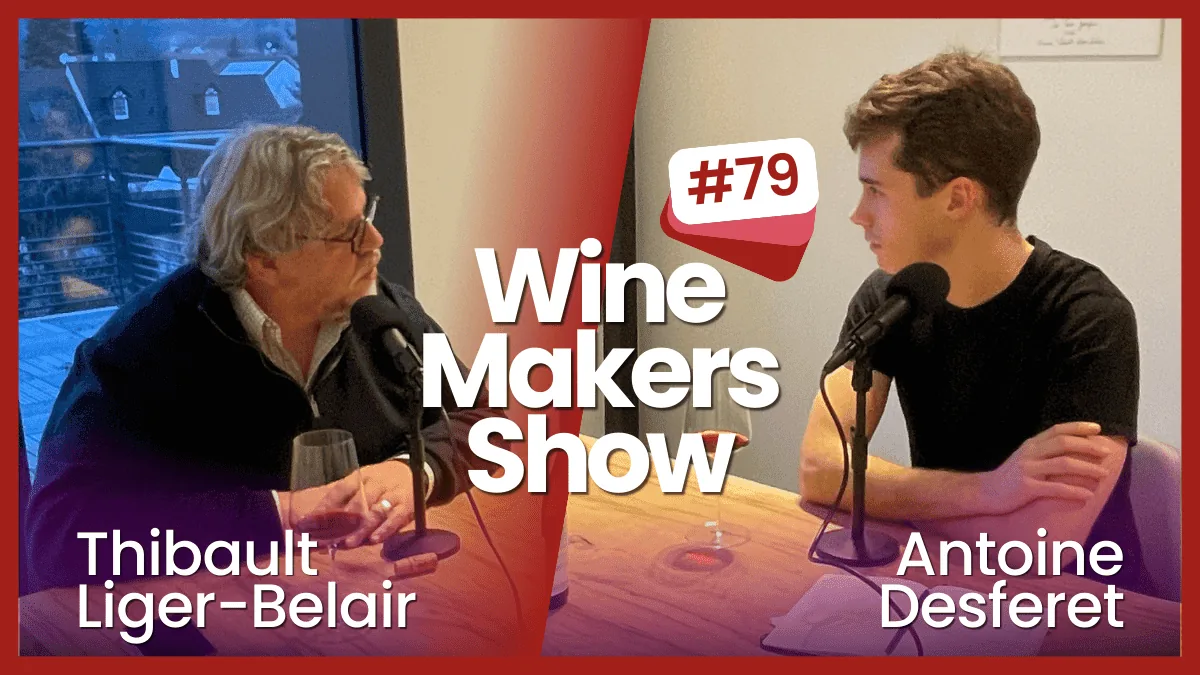
Thibault Liger-Belair opened the doors of his home for an in-depth conversation with us. We had a great time together over a glass of wine and rich discussions. We hope you enjoy this episode. If you do, don’t forget to share it with those around you.
Before we start, we invite you to discover the Domaine des Jeunes Pousses and Obora. It supports the launch of young winemakers and brings real pleasure: useful and enjoyable rolled into one.
Antoine
Thanks for having us here in Nuit Saint Georges. It’s a pleasure to come and meet you and spend a bit of time here. Just before the interview, we opened a bottle and chatted a little. We’ll come back to it of course, but it eased us in and gave us something to taste while we discuss. We’re going to talk about a lot of things. And I want to thank Ivan Massonnat for the assist, recommending I come meet you when I went to see him. Before anything else, can you introduce yourself?
Introducing Thibault Liger-Belair
Thibault Liger-Belair
I’m Thibault Liger-Belair, I’ve been a winemaker in Nuit Saint Georges since the Domaine was founded in 2001. I have a slightly unusual family history, since my family has been in Bourgogne for 300 years now. Since 1720, the founding of the négociant house in Bourgogne. In these old Bourguignon families, you didn’t become a winemaker, it was considered a peasant’s job. So most of the time, the father decided what the children would become. The eldest generally took over, the second usually went into the army, the third became a priest. And for daughters it was less fun. They were asked to marry the neighboring vineyard’s son. The father would say love comes after. Sometimes that was true, sometimes it didn’t come at all, but in any case it kept the Domaines prosperous.
That was another era. Thankfully, it’s a bit behind us. As I was saying, I have a slightly unusual path, because in the 70s, during the oil crisis when wine really wasn’t selling, my grandfather told my father: “whatever you do, don’t go into wine, there’s no future in it.” So I decided on my own to recreate the Domaine, and that’s why the Domaine is called Thibault Liger-Belair and not simply Domaine Liger-Belair. The story is that I was something of a slacker. I didn’t do much at school, it didn’t interest me. I was at boarding school in Dole, in the Jura, about 60 kilometers from here, in the plains. And every weekend I came back to my grandmother’s. Instead of being with my grandmother, which wasn’t much fun with a 60-year age gap unless you love Scrabble.
I spent my life walking through the garden to the cellar of an old friend of my father’s, Bertrand, who was really my mentor. In any case, the one who made me understand that this profession was made for me. I went there at 14 like a little mouse, opening the door wondering if he was there. He was always there on weekends, he never stopped working. One day I asked him a question, and that question really changed my life. I said: why don’t you stop on weekends? Why don’t you take a break? At 14, I was asking that question. He gave me a quite astonishing answer.
He told me: but Thibaut, am I working? Probably not. Do I need to rest? Certainly, yes. Do I need to be in front of my TV, on a couch, watching TV doing nothing? Certainly not. Where I am, I’m well. My work is my life. Whether it’s the weekend or the week, it doesn’t change anything. The rhythm of my life is the rhythm of my work. That really shook me. At 16 I told dad, that’s what I want to do. My father works in finance. I was born in Paris, came to Bourgogne at 14, and started my studies very quickly since at 16 I studied in Beaune, then in the Mâconnais, then in the Beaujolais.
I finished with a BTS Viti in the Beaujolais, which left its mark on me since I returned a few years later, in 2008 with the creation of the Domaine in Moulin à Vent, then a bit later with the creation of the Domaine des Jeunes Pousses in 2015 with Ivan Massonnat. After my studies, I did other things because I told myself it’s good to have learned the basics of wine knowledge, oenology, viticulture. But what’s even more important is also knowing how to sell it. Someone can make the most beautiful wines in the world but if they don’t know how to sell them, no one can enjoy them. So I wanted to understand a bit, to cross to the other side of the fence. So I worked for two years for a company called FICOFI, which puts on extremely high-end wine events, where I handled purchasing and presenting wines.
Then I had the chance to meet one of my very good friends, Marc Perrin, of the Perrin family of Castel, who suggested I join him on an adventure: creating an online wine sales site in 99, which was Wine and Co. I joined him with my eyes closed, you might say. We started in a tiny office with a few people, and a year later we were in a huge open space in Aix en Provence with 65 people, on an extraordinary adventure that allowed all of us to really understand the entrepreneurial approach. Because to be a winemaker, you have to be a farmer, an oenologist, a wine seller, a marketing director, an export director, and a CEO. So being able to manage that company with him, with my partners, was a great experience that I could apply in a slightly different way, with maybe more of a startup view than a family Domaine view.
That said, one doesn’t exclude the other. You can have a more modern view in managing the company without necessarily losing the traditional side of a company like ours, which is a Domaine above all and which has to remain very traditional in the end.
Antoine
That’s quite the panorama of activities and a lot to come back to. I’d like to come back to the start. So your grandfather tells your father don’t go into wine. So what happens? Does the family house come to an end then?
The end of the family house
Thibault Liger-Belair
That’s a good question, because the family house, the négociant house, unfortunately collapsed. My grandfather, rest his soul, wasn’t a great wine enthusiast, but his father put him there and his great-grandfather was a real enthusiast. Unfortunately, the various crises of the 70s were quite complicated years. The house didn’t survive the oil crisis and was sold. So it was a liquidation in 78. The négociant house as such was liquidated. Luckily, the vineyards were in his own name and were already leased out. So when I wanted to take back the Domaine, I recovered vineyards that had been leased for about sixty years. The Liger-Belair name had also been sold. Buildings were sold. The old house in the center of the village, which is a big house, was bought back at auction by my father after the judicial liquidation.
It must have been quite epic, I was too small to remember. Luckily, the vineyards were still in his own name and could be kept within the family fold.
Antoine
Ok, so that means when you came back to Bourgogne a bit later, you had all the experience baggage, which we’ll come back to, and entrepreneurial adventure, and vineyards too to start with.
Thibault Liger-Belair
That’s it. I often say I was born with a huge gold spoon in my mouth, not a silver spoon but really a gold one. I had the chance when I set up to have very beautiful vineyards, like Nuit Saint Georges, Romanée. I also bought back Nuit Saint Georges, Clos Vougeot, Richebourg. Honestly it’s the dream when you start. I knew that what I had in my hands was a precious asset that didn’t yet have the valuation it has today in Bourgogne, which is crazy and exceeds anything we could have imagined, and which unfortunately is becoming more of a curse than good news for Bourgogne. The objective was to be able to rebuild. It’s not because we have grand crus that we have a bigger responsibility than if we simply had Bourgognes or Hautes Côtes. And in fact, I rushed to buy, because it was still possible at the time, some Bourgognes and Hautes Côtes de Nuit.
Because I think the balance of a Domaine comes through the entry-level wines and not necessarily through the grand crus. People may expect so much from a grand cru that they can be disappointed. They don’t expect as much from a Bourgogne and can have a lovely surprise. You have to create a story. When you create a Domaine, you have to write a story. I had the luck of having a family history but one that had unfortunately disappeared a bit and needed to be rewritten. So we really had to redo the preface, and the preface was already a lot of hard work in the vineyard.
Antoine
So we’ll come back to the arrival and the start of this Domaine. How does your father react when you tell him you know, every Saturday I actually take pleasure in going to the cellar, seeing how it works and so on. I’d really like to go into wine. How does he react?
Thibault Liger-Belair’s beginnings in the world of wine
Thibault Liger-Belair
He’s someone very far removed from the wine world, even though thanks to him the Domaine still exists. He saw his father who wasn’t necessarily fulfilled in this profession, so he didn’t necessarily want to go into it. He managed, he led the Domaine more as an owner, leaving, leasing the vineyards to sharecroppers, selling half of the harvest to another négociant, more saying I’ll come during harvest at my place. That’s what he did: count the number of crates and see the number of barrels there were at the end. That’s what mattered to him, and less the quality since in the end he wasn’t going to handle the aging. So necessarily, he was a bit removed. When I started talking to him about it, he was a bit surprised, not surprised in a bad way but saying: “are you sure?”
Because it’s still a difficult job and there are beautiful vineyards. And I was 16. At 16, you’re not necessarily seasoned, you don’t necessarily have all your ideas in place and you bubble with all kinds of projects. Sometimes today’s project is replaced by tomorrow’s. But it was strongly anchored. He saw that I’m not an intellectual, I’m hands-on, so I always wanted to work with my hands, to make something with my hands and I always have something in my hands. I always wanted to do something with them, so working the soil, working a vineyard, working and being a bit of an engineer too in our profession, in the sense that things need to be built. At first when you don’t have the money to buy it, you build it.
I did a lot, I bought a welder, I made many things myself, things that broke, things that worked, but it’s all that that I liked about this profession, and that side where you create something with your hands. When he saw that, he probably thought: “that’s what he wants to do.” I’m pretty stubborn so he understood that’s what I wanted. He finally said go for it, and we’ll see. But it wasn’t just my father, it was also mom who pushed saying: “I think he’s made for this,” even though she didn’t know the wine world at all. I have this ambiguity of being born to a Bourguignon father and a Bordelais mother. So I’m either a sweet blend or a bastard.
I don’t know but in any case it leaves traces. It was something anchored in me and I had understood that it was something I was passionate about. In any case, if I wasn’t passionate about it, I wanted to be, which is very different. I think we’re all made to have a passion and when we find it, it’s absolutely amazing. I wish for everyone I know who doesn’t have a passion to find one because there’s nothing better, because it brings us a lot of happiness.
Antoine
So we talked about the motivation to go into wine. You said your mother spotted it. She saw it was something you wanted. There were signs. Did she talk to you about it one day?
Thibault Liger-Belair
No, no, not necessarily. It was just that since I was in Nuit Saint Georges and they were in Paris, I saw them once a month. She saw I was starting to talk about it and that I really wanted to go in that direction.
Antoine
So studies in wine with a BTS Viti Oeno: a fairly traditional path to work in wine and right after FICOFI. Can you come back to that?
Thibault Liger-Belair
That was rather a slightly unusual company whose vocation was a real educational work around wine and which worked a lot with the finance world, through tastings, through corporate gifts. I was in charge of buying wines. What’s interesting when you buy wines and you wear a hat that’s a bit more future-winemaker, is that you visit the Domaines with a hat that’s a bit more oenologist than just buyer. I was young at the time, I was 22 or 23, and I just wanted to learn from all these Domaines. I had the greatest luck of working with FICOFI and tasting the greatest wines in the world. When people ask me about the great emotions I’ve had tasting wines, it was at a FICOFI dinner with wines from my illustrious neighbor at Romanée-Conti.
I found myself alone doing a tasting, well opening the bottles for a tasting of Romanée-Conti wines, the entire series of wines from the 91 vintage. So I’m talking about that. We were in 97 or 98. And Aubert de Villaine comes to see me saying: “you’re the only Bourguignon in the room, you’ll handle opening all the bottles, you’ll taste everything, you’ll see if there are no faults, then we’ll serve them.” I found myself in a small room, a small reserve, next to the big room, with about sixty bottles of Romanée-Conti in front of me, opening everything and tasting everything. I was able to taste everything and I had extraordinary emotions. Because I wasn’t looking to see if there was a corked taste or not. I was just looking at the depth of the wines and I found myself in a room that was four square meters.
So it was quite astonishing. I often say that a great emotion of a wine is often experienced with others, and there I experienced it alone, a kind of suspended moment. It really allowed me to taste the greatest wines in the world, whether in Bordeaux, in Bourgogne, in the Rhône, anywhere in the world, even foreign wines. I had the opportunity to travel quite a bit too thanks to them and to meet absolutely extraordinary personalities because they were often very avant-garde. What taught me the most during that time at FICOFI wasn’t just the seller’s or buyer’s job, or presenting wines, it was especially the opportunity to meet some of the best winemakers. I’m talking about the mid-90s, so there wasn’t yet all the celebrity status of winemakers we know today. They were really avant-garde people and they had a desire to exchange and give.
I often say I didn’t have a mentor as such in my profession, I had someone who inspired me, Bertrand, but the reality of building my taste and what I wanted to do, I got it through tasting and meeting all these winemakers who inspired me a lot.
Antoine
At the time, did you already know you wanted to make wine?
Thibault Liger-Belair
I had already done my studies, I had already planned to take back the Domaine, but nothing was ready yet. I was 22, so I told myself it was way too early, I was going to make mistakes.
Antoine
It’s good to have that maturity and tell yourself it’s too early.
Thibault Liger-Belair
It’s not that simple, because when there are vineyards, there’s also the legislation that goes with it. There are leases you can’t break overnight. And at one point, my father also told me: “I don’t think you’re ready yet.” I think he was right saying: “do something else, go make your mistakes elsewhere.” As fathers often say: “do something else, see something else before taking back the vineyards. Because once you have them, you’ll be tied hand and foot to them and you won’t be able to do anything else for a while.” He was right.
Antoine
It’s true that making your first mistakes somewhere isn’t a bad idea.
Thibault Liger-Belair
It’s not for that reason that you don’t make any. You make some after too. They’re maybe a bit smaller, but they’re still mistakes.
Antoine
So right after Wine and co. What an idea to sell wine online in 1999?
Thibault Liger-Belair
It’s a bit out there. I agree, it’s a bit out there. It’s not an idea that came from my head, it’s rather an idea that came from Marc Perrin’s head and that I found pretty brilliant because obviously it was the start of the Internet. We were in the middle of the start-up era, it was flourishing in every direction. There was a kind of, how to say, euphoria around all that. At one point, we said me too I want to be part of it, I want to be part of this adventure. Eventually we started to understand what people wanted. That is? There’s obviously this slightly annoying word called marketing, but understanding the market and trying to bring something other than what a wine merchant can bring. So actually, doing the same job as the wine merchant with exactly the same advice. Except being able to bring that advice on not 150 wines, but on 1500 wines.
That was the idea actually. Simply to say we’ll offer more wine, and we even started setting up something that’s extremely common today, which is targeted marketing. We set up a system called Broad Vision at the time which spotted each user’s journey and allowed us to make targeted offers. We’re talking about 1999. Today, it seems common. In 1999 it was quite avant-garde and we had set that up. We weren’t profitable at all. And there was Bernard Arnault who had invested in the company in February 2000, just before the Nasdaq crash. He believed in our project. Sometimes we asked ourselves the question because we were pulling all-nighters, we said but we’re doing this, why don’t we have profitability?
But in the end, it was a great adventure. It was a bit of an adventure in a student life, while working like crazy trying to keep that company and make sure the project was viable. And I was a buyer. I had that buyer-of-wine role too, in the same spirit as FICOFI, but with much larger volumes and also much more diversified. It allowed me again to meet many winemakers, many producers. And to go with the future-producer hat that was becoming clearer than at FICOFI since the deadline was summer 2001. I had already programmed the idea of starting the Domaine in 2001, while thinking I could do a bit of Wine and Co and the Domaine in the first years. It turned out we decided to sell Wine and Co at the end of 2001, beginning of 2002, mid-vintage.
It was actually a good deadline because right after I started setting up myself in November 2001 and Wine and Co had to be sold late January early February. So things fell well. Wine and Co allowed me both that entrepreneurial work, business management, HR management too. It’s important, it’s essential and it’s often things you’re not at all prepared for. When you study viti oeno and you’re destined to take back a Domaine, you have no idea how to manage staff and know what to tell them. That taught me a lot in management and personnel management.
The place of humans in wine
Antoine
It’s the case in many studies I think too. I saw it, I didn’t do viti oeno or a similar path at all, but I don’t remember learning to manage human situations of team management. I think it’s learned either on the job, or with coaching. Generally, it’s a bit of both.
Thibault Liger-Belair
I think the human side isn’t learned, it’s lived, and I think you have to be very, very open, very listening actually. But like in everything. I think you can draw an analogy between the human and the plant, we work with a plant, with a vine. I often tell all the people who work with me, I tell them: don’t forget we have two eyes, two ears, only one mouth, that’s a sign. At one point, we have to look, we have to listen more than we speak. I think that’s the key, listening, listening to what people have to tell you. When you listen, you understand. When you look at the soil, when you look at the vine, you understand. It’s observation from every point of view, with all our senses. That’s what allows us at one point to integrate information. In the end, we’re all intelligent enough to compile this information and tell ourselves maybe that’s what we should do.
We arrive, I think, at a form of intuitive understanding of things. Intuitive understanding is just what allows us at one point to say I don’t know why I’m doing it, but I’m doing it because I think it’s good to do. Sometimes we mess up, but it doesn’t matter. To say we think that’s what we’re going to do, we’ll do it thinking we’ll do good and that’s what’s important. It’s not telling yourself we’re going to do something just for our personal benefit, you have to be very generous in our profession and not always tell yourself I’ll make wine to make money because then we mess up. So I’ll employ someone, they’re great and I’ll pay rock bottom because I made a lot of money with them. That doesn’t work. Building management is exactly the same as the closeness we can have with us, our way of working, our soils, our way of being a farmer.
In the end, if we give to the vine, if we give to the soil, it gives back, it’s always an exchange. It’s never one-way. It’s the same with the way we manage people, the way we manage our life or make our wines. It’s never one-way, there’s always give, receive. That’s how it works. That’s how I live my life.
Antoine
I was listening to a podcast not long ago with an athlete. I think it’s a cycling champion or something. Anyway. He said, if you race for money, you’ll never win. But if you race to win the race, in the end you’ll win money.
Thibault Liger-Belair
Yes, it’s not the lure of gain. And besides, if there were only that, on the one hand it wouldn’t work, and on the other hand, we’d quickly realize that if we did this profession only for that, we wouldn’t do it. We have the great chance to be in one of the vineyards that works the best. The wine market today isn’t extraordinary and the Bourgogne market is just incredible. When we discuss it, we tend to be a bit embarrassed today when we talk about it, when we’re on export markets and with several winemakers from different regions or different countries who all tell us it’s a bit complicated. We stay a bit quiet because we have to be discreet, because indeed, Bourgogne still works very well, but for how much longer? That’s a real question. You have to be attentive and not let yourself be intoxicated by a success that came very fast and could also fall very fast.
There are so many examples. That’s what I was saying earlier when we opened a bottle, it’s made to be opened, it’s made to be drunk and we don’t try to make more money with a bottle, we already make enough and we have the chance to sell our wines well. That’s not the goal, the goal is for it to be drunk. I was saying earlier the best bottle is an empty bottle. So you have to make sure the wines are drunk and especially aren’t tools of speculation. We fight against that daily.
Antoine
That’s clear. There’s also just one point to come back to what you were saying before, because there was basically doing things not for money or for gain in general, but to do well, there was also listening or feeling or observing. I realize it’s much harder than it seems to say you have to know how to listen. It’s terrible because we often want to bring an answer. Sometimes when you listen to someone, you formulate in your head the answer you’ll give them. I think it must be the same when you’re in the vineyard, maybe you go in either with a preconceived idea saying it rained, I’ll have to treat in such or such a way or we’re at this stage of maturity. You anticipate something whereas it’s the opposite of knowing how to listen or knowing how to look. How do you handle that?
Thibault Liger-Belair
I don’t handle it. I think indeed our profession as farmer, viticulturist allows us in the end to have a certain capacity for introspection and to tell ourselves we have to listen. Because what you say is quite right. When you discuss with someone and you maybe want to bring an answer and you think of the answer before the question is even asked, because actually you’re sure you already have the answer, when you don’t expect to have an answer other than the one you’d like to give, because you sometimes consider that you hold the truth. We’re all alike. We’re all convinced we hold a certain part of the truth, maybe not the whole truth. The only difference is that when you do something, especially with the vine, with the plant, with the soil, you don’t have the answer right away.
The answers often come later, they often come a year later, they sometimes come four years later, so we’re often in this waiting. I think one of the most important notions in our profession is the notion of time, that is, long time. This long time is something you can’t compress, you can’t reduce. Even if today, in modern, in so-called “modern” viticulture, you can have faster solutions, in the end we realize these solutions are never good solutions in the long run. This answer will only come because you go look for it and it won’t come to you. The problem is often when you ask the question, you expect to have a ready-made answer and sometimes no.
Sometimes the answer allows us to broaden the field of possibilities, to broaden our field of vision or our state of mind on a particular point and which actually takes us to other spheres or other chapters. There’s nothing I hate more in my profession than the winemaker who says: “I can’t tell you because it’s a secret.” I think that’s the worst stupidity in our profession. There are no secrets, we all work the same way. We all work towards the same goal which is both making grapes every year and creating a tool, our vineyard, that’s as enduring as possible. When there’s a winemaker who says: “no but I can’t tell you because it’s my secret and all that.”
Honestly, mea culpa, because I did it too, because we make our barrels, we go into the forest. I had, a bit like mushrooms, our spots and I told myself no, I won’t say it. After I told myself but you’re just a big idiot. If it can help some to improve or because I understood something about the woods. Give it. It would be too bad if they couldn’t do it. I think there’s something very important in our life, our life is largely driven by money. We talk about money above all and when we give money we get poorer. When we give knowledge, we get richer.
Giving knowledge actually means enriching yourself even more than if you had kept it for yourself. Unlike giving money, you say no, I give you yes, but I don’t have it anymore. Whereas when I give knowledge, I still have it and on the other hand I gave it to someone who will also give back to me. Because when you give it, it’s also to think with a certain form of generosity that they will probably be able to use it and move forward maybe in another direction, but which will look for something else and which necessarily comes back.
It’s cyclical and that’s how I live my life. That’s how I live my life as a winemaker. It’s a journey, it’s a quest, where we know very well one life won’t be enough to understand everything. But that’s not bad, it’s not a frustration, on the contrary. It’s constantly a search, an adventure. Each little step tells us: “ah yes, I understood something, I took 15 years to understand,” I understood wines I took 18 years to understand. I think the day I made them so differently in 2018, where I told myself stop stopping at very specific points, go a bit further than what you imagined because I was scared of having that. The problem is we make one a year. If we mess up, we pay for it for years. So you can’t be afraid of messing up either.
It’s like biodynamics, I’m slipping a bit, but biodynamics, when I started in 2004, I was certified, I stopped certification since. Why? When I started, I was making my little brew and I was alone in my vines bringing my preparations and a winemaker came to see me and said “what are you doing? Are you playing with the sun?” And I said “no, I don’t really know what I’m doing but I don’t have the impression I’m doing harm.” In any case, if I’m not doing good, I’m definitely not doing harm. That’s what you have to keep in mind. Whether for the vine but also for people. It’s telling yourself we’re trying, if it works great, if it doesn’t work too bad, but we’ll have tried. That’s a bit what drives me.
Doing things in order
Antoine
I’d like to come back to one point. You mention very precise details but what’s interesting is that you also mention that it’s surely part of the 1% that will transform something and take it to another dimension. But before that, there’s an enormous amount of work.
Thibault Liger-Belai
Exactly, no, but it’s obvious. Our profession is a sum of small things that allows us to arrive sometimes at a result. There are little things, well things that don’t require much energy and that will radically change a wine. There are little things where the average person tasting a wine obviously won’t feel it, but we’ll feel it and we’ll see an evolution in our wines over 10, 15, 20 years, especially on the vineyard side. It’s the long time again. If the foundation isn’t good at the start and if you didn’t take things from the base, there’s no point putting on a nice barrel.
There’s no wine that can support that nice barrel. Yes indeed, it’s a journey and it’s stages. And these stages, you can’t miss one.
I was talking about biodynamics earlier, many people went into it, probably a bit by trend, throwing themselves into it body and soul saying it’s great, it’s the future and all that, maybe in a convinced way, maybe a bit less convinced, for somewhat commercial reasons. Some probably. Who am I to judge, but I met people and I told myself, indeed, you can feel there’s not necessarily a sensitivity or a desire to want to do things well, but rather to brag about how they did it. Anyway, that’s another subject we unfortunately find often a bit, but not necessarily only in our profession. So it’s telling yourself, it’s all these little things put end to end that allow us to arrive at a result from the moment when indeed there’s this will, this desire to want to do things well from the start, so you have to start at the base.
I often say when I took back, I took back the Domaine in 2001, I found vineyards that were in bad shape, gray soils, soils that were emaciated, compact soils. I told myself what do I have here? So necessarily, I decided from the first vintage to switch the entire Domaine to organic farming. From 2002 then, since I took back the Domaine in November 2001, telling myself let’s not ask whether it’s good, whether I’ll put it on the bottles. There’s never organic farming written on the bottle, I don’t want to put it. And yet we’re certified, and that for about 20 years now. It was just the will to say I think it’s the only way I have quickly to bring life back to my soils. I didn’t, I didn’t learn that, I heard it.
All the people I met in the four years that preceded taking back the Domaine in my two other professions, I had the opportunity to meet people who explained all that to me, who explained what they had experienced, people who were really pioneers of organic farming in France, abroad, in Bourgogne. And I told myself there’s no other path to follow than that one, it’s clearly that one and nothing else. So that’s why I went into it head first. Actually, I realized we shouldn’t be looking after the plant. The plant didn’t need us to tell it that it knows how to feed itself, it knows what it needs, it knows what it needs to survive. What we need to take care of, as farmers, is cultivating the soil. We have to ask ourselves the question of the soil’s needs, not the plant’s needs.
For the past 40 years, we’ve asked ourselves the plant’s needs, saying what does the plant need? So we’ll give the soil what the plant needs without really worrying about the soil’s needs. As if we considered the soil as a kind of large storage element, a kind of large building? And go on, go on. Give it nitrogen, phosphorus or potassium, which was the most total aberration. And it still exists, but less and less thankfully. I told myself but the soil is like a factory, the soil needs raw material to transform into a finished material, available or not, to the plant and the culture. The plant will naturally make a kind of communication, if we can call it that.
Probably there’s one, we don’t know it yet. You know we know simply, of what we can say today, 15% of what happens in a soil. 15%, that’s infinitesimal compared to everything that can happen in a soil. So in the end, we have to use our intuition since the 15% of scientific knowledge allows us to barely scratch the surface of something that’s much more complex than we think. So I told myself I have to apply myself to the soil. The plant isn’t doing very well, but that’s not the cause. The cause is its substrate, where it is. Why does the same plant do well here and not well there? So I tried to understand, to do tests, to apply composts, apply herbal teas, do slightly different ploughing.
I got caught by grass, I got insulted by other winemakers from whom I had taken back vineyards, who told me I didn’t deserve to have these vineyards. Anyway, I went through tons of stages, which were more or less pleasant, but which forged me a bit in my conviction that what I was doing was probably a path that I want to follow. If it’s the right one, well so much the better. I’m happy to have followed it and today, with a bit of hindsight, it’s been more than 20 years that I created this, I tell myself there were truths. There are things that were right and things that were less right. And especially I keep learning. I never stop. So much the better because that’s happiness.
Antoine
But it must have been hard. So in 2001 and 2002, to start carrying your convictions.
Thibault Liger-Belair
It wasn’t, it wasn’t convictions, I wasn’t at all convinced. It was intuitions, it was just telling myself it’s what I learned, or in any case what I heard or listened from people who for me were people who counted, in any case in what I had tasted. Because it’s the same, you can listen for two hours to a person and you taste the wines and the wines don’t please. Do you reconsider the speech? Is the way the person spoke consistent with the wine you tasted? When both work, it’s great because you tell yourself there, he talked about that. And there, in the wines, there’s something. You tell yourself: “ah yes, there’s something that works.” And unfortunately, most of the time, it didn’t work. There was a nice speech and behind, in the wines, it was super technical, super worked, with tons of artifices. We told ourselves no, there’s the pseudo-agricultural speech and after there’s a dialogue behind, that made wines and that didn’t respect the identity of a place.
Antoine
It’s consistent. So we talked about the arrival in 2001, taking back existing vineyards, changing the farming method, concern for the land. You also talked about buying nearby vineyards.
Thibault Liger-Belair
Yes, I bought Bourgognes, I bought Haute-Côte, I bought a bit of vines on Nuit Saint Georges with Nuit Saint Georges village, La Charmotte. I have the chance to have premiers crus and grands crus, but there was still this desire to also be able to make entry-level wines. I think the entry-level is the most important wine of the Domaine. Often, when I have my Bourgogne tasted, I’ll have pride in having my Bourgogne tasted. It’s the everyday wine for me and I want to make sure that all the work we do on a grand cru is the same on an entry-level wine. I simply asked myself the question but are the vineyards different?
No, the vineyards aren’t different, the soils are different, give less complex wines, give less aging wines, less long-aging wines, less depth, clearly. But on the other hand, the vine must have exactly the same treatment, and the soil must have the same attention. So I decided to do exactly the same thing on a Bourgogne as on a grand cru. Also when you do experiments, because I’m always testing 40,000 things, I told myself it might not be stupid to do tests on a Bourgogne rather than on a grand cru.
When you start, you invest a lot. You know, when you start a Domaine, you invest. Actually for two years, you spend a lot of money without anything coming in. You prune the first vine, you take it to harvest, you harvest it, you pay the harvesters, you pay the vinifications, you pay the barrels and then you start another harvest, another year where you do it again, and you start to sell the result of the first pruning that was in November 2001, in November 2024. Three years then between the moment you pruned the first vine and you got the financial result of selling that harvest. So for three years, you also had to hold on a bit.
I had the chance to have beautiful appellations and especially to have done something else before and to have sold an internet site that allowed me to hold on.
Domaine des Jeunes Pousses
Antoine
It’s a fairly perfect transition to the Domaine des Jeunes Pousses?
Thibault Liger-Belair
I had already set up in the Beaujolais because in 2008, I decided to create a Domaine in Moulin à Vent. I did my studies in Moulins à Vent, and every morning, I opened my shutters, I rented a house in Morgon, on the beauty of this Beaujolais landscape. I told myself: “but how come the landscapes are so beautiful and the wines so mediocre?” We were in the mid-90s and so the Beaujolais wasn’t at its best, at its peak in terms of quality. There was this gap. Actually, I believe in this when I buy vineyards. If the place is beautiful, the wines are rarely bad. The Beaujolais hills are really magnificent. It’s much more beautiful than Bourgogne.
Bourgogne is beautiful, but the Beaujolais is sumptuous. So I always kept in the back of my mind the fact of going to set up in the Beaujolais. So in 2008, I decided to drop my bags in Moulin à Vent, to buy three hectares. Today, it’s a Domaine that has twelve. In 2015, I had the opportunity to buy back a Domaine of ten hectares with quite a few vineyards in Moulin à Vent. Extremely beautiful, very fine quality, and in the bride’s basket, there were also five and a half hectares of Beaujolais village. My goal when I created the Domaine was Moulin à Vent: I wasn’t looking to go elsewhere. So I told myself well, I don’t necessarily want to do that, I don’t want to do Beaujolais Village, not right away or in any case it wasn’t my goal. And my market wasn’t ready for that anyway.
In 2008, we didn’t talk much about the Beaujolais when I created this and the winemakers here, my buddies told me Thibault, you’re crazy. In the Beaujolais, as if it was a horrible thing, like when it was the chain gang. But these vineyards were so beautiful, in Moulin à Vent, that I told myself I’ll buy the whole thing and then I’ll do something with these five hectares of Beaujolais Village. That’s where I talked to Ivan about it. I told him if it interests you, if you want to come become a partner, come buy this vineyard and we’ll have fun together.
There were these five hectares and I told him these five hectares. I might have a project. The genesis of the Domaine des Jeunes Pousses is that every year, I receive many interns. I like training, I like having people who come, who aren’t necessarily students, who are people from France but also from elsewhere, and each time, well not each time, but often, I had young people with a bit of the same spark I had at the start. Well I always was, maybe a bit more excited at the time, when you start. I tell myself these young people, they have this desire to do something, but they don’t have the chance I had to have family vineyards and to have been able to express my passion thanks to family vineyards. I tell myself it’s a shame that we can’t give these young people a tool.
I told him here’s the Domaine, I thought of a name: Domaine des Jeunes Pousses, what do you think? He generally takes decisions very quickly. He said oh, that’s great, let’s do it. It happened over a glass, over a lunch, as many things sometimes happen in the cellar over a glass. So at first, it was five hectares that we converted entirely to organic farming because it was really a desire. So actually, my Moulin à Vent team worked these five hectares in addition to the Domaine’s vineyards from 2015 to 2019. We started giving these vineyards for the first vintage at the 2019 harvest. We had the vineyards, but we lacked a place because the idea was to make a nursery, really, to give a leg up to young winemakers and at the same time to have vineyards in organic farming but already certified, so they could use the certification and put the agro-organic certification on the label, and so they could have a place to live, a place for vinification.
Tools, the working tool, the tractor, everything you need to work. So we needed all these elements and necessarily, the vineyards we found. But we lacked the place and I wanted a local place. I really wanted to be in the village where the vineyards are. It’s the village of Berges which is a magnificent place. It feels like a little Tuscany so we found this place in 2019. As soon as we had found this place, I had in mind a person I had met who was Angela, who worked at the Hospices de Beaune, well who was an intern, who was leaving DNO. When she came, she asked me for an internship. She came during the 2018 vinifications and I made her a proposal. I said here, I have a project, what do you think? There was no answer and honestly, that surprised me a bit too.
A bit disappointed, I said why isn’t she giving me an answer? It’s incredible. So she thought about it and came back to me. She said but here why are you doing this project? Explain to me a bit more, it’s still strange, it’s not normal. And I said but no, there’s nothing, there’s nothing strange. I’m giving you five hectares, you have a place to live, you become co-manager with me, you have a winery. We’ll do the work, we call it a “cuvage” not a winery. It’s important and we’ll do this project, we’ll do this project together. I have Hugo who was working at the time as an intern at the Domaine de la Romanée-Conti. I say being two is good, a couple, that’s OK, super.
Actually, she explained to me, after, that she had hesitated a lot because she found the bride too beautiful. It’s not normal. There’s a winemaker who arrives, who gives five hectares of vineyards with a place to live, a winery, a tractor. And the only thing we asked was for them to work and for me to be behind to help them, to train them on the tractor, to be there during vinifications. So the idea was really to tell ourselves we’ll give them this for three years, three vintages, they’ll cut their teeth, make their mistakes, find their style too. They’ll obviously handle the viticultural part, the oenology part, but also the marketing part which is no small matter. We’re not all sales people.
It’s super time-consuming actually. I think indeed, whether it’s a couple, by the way now it’s also a couple of two young women who met in parallel studies and one of them offered to become her apprentice and who in the end is now a partner. It’s interesting then to have this objective of being able to see telling yourself you do everything from A to Z, you create your own label and especially you make your customer base. When you’ve made your customer base, after three years, you leave, you create your Domaine with what you earned at the Domaine. For you, that gives you a small running account, that allows you to create your Domaine. So Angela and Hugo created their own Domaine called Obora, which works well by the way, who got the honors of quite a few nice wine reviews and gastronomic reviews.
Recently on France Inter, a very nice highlight by On va déguster with François-Régis Gaudry. So nice highlights and who today are launched. It’s also a project we’d like to repeat. But that requires time. I give a lot to this project because I want to also help them. I want to be there when they need it. But I lack time, days are only 24 hours. So there. We also receive a lot. There’s a desire from a young generation, the second Thaïs and Juliette, they’re 26 and 28 years old, so they’re young.
So the desires or their taste is different from mine which is approaching fifty. So necessarily we don’t have the same expectations. It’s a super open discussion and I try to understand why they want to go in this direction. Not that they’re right or wrong, it’s just their point of view which is super interesting because it’s a more generational point of view. So this project makes sense, it’s making little ones. We had to set up a management, well a slightly unusual co-management that didn’t exist before. With a notary, we managed to find legal texts. And especially, what was extremely important, is that each winemaker, since when you set up as a young winemaker, you have the right to aid, aid for young farmers.
If she became, if he or she became co-operators as they are, they lost the fact that they were primo-operators and so they lost the aid for young farmers, the subsidized loans. For me, that was out of the question. They had to be able to claim this to be able to create their Domaine after, since the goal is also to be able to create their Domaine. And I’d like these young people to stay in the Beaujolais. Because the Beaujolais also needs us to put a bit of focus on this region, to focus because it’s a fascinating region and which needs renewal among winemakers too.
Antoine
The message has gotten through in any case. If you’re a winemaker and you want to duplicate this Jeunes Pousses initiative. The model is stabilized, stable and just needs to take flight.
Thibault Liger-Belair
Stable but not profitable.
Antoine
Well so the message has gotten through, be careful.
Thibault Liger-Belair
No, no, it’s not profitable and it should be. But it’s not profitable for the moment. But that wasn’t the goal either.
Antoine
It’s a kind of business angel vision that you might have on other sectors.
The Beaujolais: new destination for Thibault Liger Belair
Thibault Liger-Belair
Without any will to gain anything from it, except training young people. What we gain from it, it’s just between Ivan and me. It’s simply having had the will to do something for young people. And that’s already huge.
So heading to the Beaujolais.
With very nice quality and indeed accessible today. I think that’s also a generation maybe a bit younger that’s maybe more curious than the generation of our parents, than the 50-60 generation maybe more like sixty-something today, who’s still a bit with fixed ideas about the region. But again, you can’t blame them, because when they started tasting Beaujolais wines a few years ago, it wasn’t necessarily the definition of wine, of terroir and identity wine. So apart from some big names that are still talked about today and who have a very different vision. That’s why most of the time, when you think of Lapierres, you know them more than the wines they make. It’s true. Sometimes I’ve asked people the question, saying Lapierre, but what do you like?
I like the Untel cuvée, it’s Morgon, so it’s Beaujolais this Beaujolais. Lapierre, yes yes, it’s Beaujolais. “It’s good for Beaujolais.” There, that was the answer. That’s often what happens. There are still people who say it’s good for Beaujolais. The idea is really to get that out of people’s minds. I don’t produce Beaujolais, I produce Moulin à Vent and with a rather Bourguignon model, with the idea of putting forward terroirs. And if I wanted to stay only on Moulin à Vent, it was also to be able to try to discover and explore this terroir a bit by doing a Bourguignon model since we make six different wines from six different places that allow us to explore a bit the diversity of these terroirs. That’s what’s interesting. Because above all, obviously, we’re here to make wine and sell, but above all to have a blast saying we’re doing different things and that’s what’s fun.
Antoine
And then to set out to discover this terroir, I think it’s much less well delineated than what there can be in Bourgogne.
Thibault Liger-Belair
It’s not less well delineated, it’s less hierarchical. We don’t necessarily have the Cistercian monks who did the work they did here. But it’s especially that, in fact, the Beaujolais took another direction, especially after the 29 crisis where Bourgogne decided to hierarchize with the village premiers crus and grands crus in 1936 and premier cru in 1944. And in Beaujolais, they said we’ll make crus du Beaujolais. They made between the early 30s, late 30s and the 80s, even early 90s, they created ten crus in the Beaujolais, without worrying about saying there are better terroirs than others. Actually, it’s a real anomaly. The anomaly is being repaired in a certain way, since there’s a file that has been going on for seven or eight years now, which is to make premiers crus or “têtes de cuvées.”
It’s not yet decided, but in any case to highlight the best terroirs on Moulin à Vent, on Fleury, on Morgon in any case, cuvées, well terroirs that everyone knows as terroirs, what we call high places and to be able to give them a different hierarchy than the one that exists today, which doesn’t exist today.
The evolution of Bourgogne
Antoine
I’ll ask a silly question but how do you avoid losing your head when the price of land soars? How do you tell yourself well actually I keep my hectares, I continue.
Thibault Liger-Belair
It depends, it depends. It depends on the life you want. If what you want is just to die rich or you want to die with knowledge and have the feeling of duty fulfilled? Actually, the answer is there. It’s easy to say when you’re, when you have the chance like me to have had nice vineyards and to live comfortably. We live comfortably in Bourgogne anyway. We live comfortably from our work, we make sure our collaborators live comfortably too. So we have that chance.
Antoine
Isn’t it a bit frustrating sometimes not to be able to extend the Domaine as you did in the past?
Thibault Liger-Belair
It’s the biggest frustration. The biggest frustration is rather the biggest fear. Not frustration, it’s telling yourself can I keep my Domaine as I have it, knowing that prices are such that I’m not sure I can, at one point, both keep it or pass it on to the next generation. That’s the biggest fear.
In twenty years, the prices of certain hectares have increased by 400%. I think the agricultural environment, because we mustn’t forget we’re in the agricultural environment, that the vine is agricultural land and that today when we see vine values on grands crus that can be worth up to 100 million euros per hectare, we tell ourselves indeed it’s scary. And again, you must never throw stones at those who do it. Each person has good reasons to do it. To say I’m selling everything because it’s expensive and because I’ll be able to live very quietly from selling something that took years to build. And I don’t want to be that generation. My children will do what they want. I make sure that if one of my children wants to take over, they do it and they do it with pleasure and passion.
If they don’t have the passion, they shouldn’t do it out of duty. If I can just say I managed to keep the Domaine and pass it on, and you can do something with it, do it and do it because you want to. If you don’t want to and want to sell it, you’ll sell it and that will allow you to live correctly the rest of your life. Actually, I’ll have the sensation, the feeling of having accomplished, of having done my duty. Who am I to judge? Today, indeed, the frustration is telling yourself we’d love to be able to develop our Domaine, we have demand, we’re passionate about making more wines from different appellations, things like that. And today, indeed, we don’t have the possibility of enriching ourselves with additional plots. But I say enriching, enriching from an oenological point of view, that is, I would love to be able to make a bit more Chambolle, I would love to be able to make a Morey because I love these appellations, they’re appellations I love.
From an organoleptic point of view, I find it super interesting and that’s my taste. I don’t make any because I don’t have any. But again, that’s not bad, it’s just that after, we can’t necessarily satisfy all our desires. After today, indeed, the value, the base of the base of the vines is so much that in Bourgogne we can’t. We can do it elsewhere, we can do it in Beaujolais, we can do it on Bourgognes, we can do it on Hautes Côtes, we can still do it on villages. After, again, we do it at the level we’re allowed to do it relative to our financial capacities. If we can’t do it, we don’t do it. After, I don’t find it dangerous that there are investors arriving on the Bourguignon vineyard in the sense that Bourgogne has always been cyclical, there’s always really been a form of selling, buying back.
The Liger-Belair family after the 29 crisis had to sell La Tâche. La Tâche was the property of the Liger-Belair family, was sold to the Domaine de la Romanée-Conti and that’s not bad. There are many who tell me: “ah yes, you must be disappointed not to have La Tâche.”
No, no, I’m just. I have just incredible luck to have Clos Vougeot, Richebourg, Saint Georges, etc.
But many people say: ah, you must be disappointed. But no, actually, on the contrary you always have to see the glass half full and not half empty. Indeed, I’m extremely happy to be able to have what I have, what I say. Again, I have a huge gold spoon in my mouth. After, the real question is preservation, conservation. We’re here to pass the baton, we have to pass the torch. That’s our role. It’s not telling yourself yeah, I could have I’m sitting on a pile of gold, and if I sold it, I could buy myself a big boat. I could have a huge house in the south of France. You know, I won’t betray secrets saying this. But I met several big banks, Parisian banks a bit removed from our profession, who were sure they held the financial truths, which weren’t necessarily our truths.
But well, that, everyone sees noon at their door. This bank one day told me but Thibaut, don’t you have a dream? There was a will to sell things like that. My dream? No. I have a family, I have four children, I have a Domaine, I have employees who are great and passionate. A real job, a real beautiful job. Actually, my dream is there. After, do I want more materially? Maybe, but I have everything to be happy. So again, better. Yeah, but if you sold, it would allow you to have a bit more, to do more things. And my answer is always the same, I try to have a form, it’s not always the case, but a form of slightly peasant wisdom that’s not necessarily a nasty word, which is to say better a small home of one’s own than a big one with others.
I would prefer to reduce my standard of living, be at home and do what I want rather than have too much and in the end not be able to do what I want. Be under the thumb of someone who’ll explain to me how to do it, maybe rightly or wrongly, it doesn’t matter, but in any case I won’t have that freedom. I think my greatest wealth is my freedom.
Antoine
I really agree with that. It’s something I also try to invest a lot in, being able to do what I want. Well that’s a slightly silly example, but we have a Friday afternoon and I can be here and share a moment together. For me, it’s much more precious than your real life. It’s true, it’s much more precious than I’m on foot besides, so. Than an additional day of work on something else. So yes, I ultra agree on that. Earlier too, we talked about stopping biodynamic certification. Why? Why stop then? Is the practice of biodynamics still there?
Thibault Liger-Belair
So it’s organic, yes, organic wine. Well the practice of organic and biodynamics in the modern sense we know it, yes, it’s still there. From a certification point of view because it’s always the same, there’s the agricultural and the administrative, so the agricultural is still there. The administrative is a bit less there. I wanted to keep this organic certification because I think it’s important in practices. I don’t want to have winemakers sometimes who tell me yes, I do organic, but when it doesn’t work, I switch back to chemicals. I think it’s a safeguard that’s not uninteresting and that’s why I want to keep it. Biodynamics is much more, it’s much more a problem actually of personal convictions. I started in 2004, a bit with the siren song of certain circles and again, we didn’t talk about it much in 2004, it wasn’t something that was very common.
It was something very ancient, but not everyone talked about it exactly. So I met winemakers who explained to me and said here, it’s super interesting because I found that with organic I had, I made a kind of applied recipe, whereas biodynamics opened up the field of possibilities for me with an opening, a broader vision. Actually, I realized when I started this, I had certification in 2007. In 2012, I decided to stop this certification because I realized doing a bit of work on myself. It’s the year of the birth of my third child and I told myself actually, what do I believe in life? Because often winemakers or those who maybe thought they were giving a kind of good word about biodynamics said Thibaut, you have to believe in it, you have to believe in what you’re doing. Actually I believe in two things in life.
I believe in God and in science. In any case, a higher being brings an answer that science can’t bring. But science is very important to understand a number of things which allows us at one point to put a kind of analysis, of quantification on something we observed and which proves to us that finally what we observed is right or not, but in any case there’s something tangible because we are all, even if we believe in higher beings, even if we believe in God or not, we all remain with a very Cartesian mind. Man, with a capital M, is Cartesian by nature. So it really takes effort to believe something we don’t see. So I told myself I don’t necessarily need to believe in biodynamics because I believe in God and I think the whole universe is set in a way to the millimeter. I had the chance to try to read Steiner, it’s unreadable, it’s a heap of nonsense.
There are things that have a lot of common sense and things, you say but he was a bit illuminated and I don’t want to follow that. It’s like we say precepts because there were some who told me yes but I’m from the Steiner school. No, I’m not at all from that school. I don’t want to be in that school because I think agriculture doesn’t necessarily need that, doesn’t necessarily need gurus and especially doesn’t need a common sense specification. If you remove the word biodynamics or if you remove the precepts or the biodynamics specifications. Finally, the word biodynamics has a lot of meaning because it’s simply what we could call peasant common sense. I often tell my employees, my collaborators, I tell them but look forward, always with an eye behind and look a bit at the past while looking ahead.
It’s not easy. All new things can be good, but the things that were done before can also be much better because they allow us to never go too fast. I think biodynamics, many went into it a bit headlong saying we have to do biodynamics because it’s good. No, it’s not necessarily good, it’s not necessarily good, it all depends how we do it. I’ll give you a very concrete example. I have a Domaine here in Bourgogne on clay-limestone, so basic soils, so pH above seven, and I have soils in the Beaujolais, sandy granitic soils, pH below six, so acidic soils. Well believe it or not, the application advice for biodynamics is exactly the same, whether on basic clay-limestone soils or acidic, granitic, sandy, sandy, granitic soils.
That’s also a bit what got me out of it because it was three years after creating the Domaine in the Beaujolais and I told myself there, there’s a non-sense, they’re laying out a kind of specification, but it doesn’t work. So I got much closer to plant knowledge, and so we make a lot of herbal teas at the Domaine, plant associations. I also got much closer to the works of Hildegarde de Bingen who was a saint of the 15th century, who had worked a lot on the effects of plants on humans. Actually, we realized that plants, regardless of the cell, whether animal, human or plant, have effects, complementary effects. So I told myself, that’s not uninteresting because at least it’s something quite gentle and I had the impression that the combination of a number of plants gave me much more life and especially immune defense in the vines.
So there. So I went rather in this direction, while making sure to still apply certain so-called biodynamic preparations which to me seem interesting, but without any certification cover which to me doesn’t make much sense. I think just like a lunar calendar, it’s very interesting, but you just have to look at the Christian calendar and you have the lunar calendar. Actually, Jesus wasn’t born, he wasn’t born December 25, it’s the Equinox. Easter changes every year because it’s the 13 moons and it’s spring equinoxes. Well, everything is based on that. We didn’t invent anything. We just said our rhythm was the rhythm of the seasons. And this rhythm of the seasons was indeed linked to these solstices and these equinoxes. Actually, from the moment we know that December 21 is the winter solstice and that March 21 is the spring solstice, well yeah, well it’s just common sense actually, there’s nothing else.
Antoine
So I have two reactions to that. Rather on the time spent doing something and on peasant common sense. Actually, I don’t remember who said that, but he said there’s a high probability that something that has existed for X years will continue to exist for the same duration. Actually, if we’ve been sitting on chairs for 2000 years, there’s a good chance that in 2000 years, there will still be chairs. Actually, I have a bit of the impression that sometimes and especially talking together, that biodynamics came, the word biodynamics came a bit to respond to abuses we made of chemical agriculture. Actually, chemical agriculture has existed for fifteen or 20 years, maybe a bit more than 30 years. It has chances of existing for the same duration, fifteen years. But traditional or empirical agriculture, actually, has existed forever and has good chances of existing for the next 4000 years, I hope.
Thibault Liger-Belair
I’m an eternal optimist. I remain probably convinced that the world won’t end immediately. So unlike some who predict the end of the world in 30 years, no, I think you’re right. Something that’s empirical and that’s been there since man needs to feed himself and take fruits from a tree or grow wheat to make his bread. I dare hope that in 2000 years he’ll continue making his bread, because 2000 years on the scale of the earth, it’s not much.
So after indeed, I think chemical farming or in any case agriculture substitutes are finally a lot of smoke and mirrors to make farmers believe who have lost a lot of peasant sense, in any case a lot of common sense. They were told it was great in difficult periods, they took advantage of their weakness. I don’t blame the farmers at all, I would maybe have been exactly the same if I had been born 20 years earlier, probably. So it’s just at one point, you have to relearn. Finally, again, I’ll say it again, looking, observing and making the right gesture at the right time. So the right gesture at the right moment and being able to simply understand what’s good. I fundamentally believe we have the capacity to be in connection with the soil and to understand what our land where we were born needs without necessarily resorting to analyses.
We see what’s happening and all the gluten-free issues and others. All this disturbance is simply linked at one point to modifications, I won’t say genetic, but in any case to forms of disturbances linked to practices that aren’t practices that go in the direction of the natural organization of things. So necessarily nature defends itself and does things that are less consumable and less good for us, than they are naturally. Indeed, there are more of us on the planet. Many people could say ah yes, but you’re and we have to produce more because there are more people to feed and all that. Yeah, but feed them, let’s feed them better and they’ll be, they’ll be better, they’ll be better off.
So after, can we reverse this trend? Again, I don’t know. In any case, I remain an eternal optimist and I assume that everything we can do, we have to do. It’s Mother Teresa, she said each thing, each effect, it’s maybe a drop in the ocean, but without this drop of water, the ocean wouldn’t be complete. Well I think we’re drops of water, but we all have our role to play. That’s what drives me daily. I’m here too maybe to lay a small stone, maybe a pebble, a gravel or a grain of sand, no matter, I don’t care, but in any case, I tend to be able to do it, to also take my children, maybe in this direction by telling myself be careful, sort, be careful not to open a tap, turn off your lights, I take them to the vineyards and see how it’s done.
Ah well yes, in summer I get up at 5 a.m. and come back home at 9 p.m. In winter, I leave at 8 a.m. and then I come back at 7 p.m. or 6 p.m. because it’s our farmer’s life and also because it’s the normal rhythm. So the normal rhythm. It’s the rhythm that’s like that. Maybe you just have to relearn it. It’s silly, it can seem, it can seem obvious, but it’s simply learning the rhythm of the seasons and of true time.
Antoine
It’s and that’s also embodied, that kind of thing.
Thibault Liger-Belair
That is?
Antoine
Actually, I find that waiting for everything to change in order to change yourself, it’s a bit easy.
Thibault Liger-Belair
A bit selfish.
Antoine
Yes, completely.
Thibault Liger-Belair
It’s a bit selfish.
Antoine
To say well actually I want us to be in a society where we eat well. I’ll make the choice to, if I can do it of course, buy good products or head toward certain products.
Thibault Liger-Belair
Because I’m a gourmand. From a purely personal point of view, and it’s true that I can’t lie, I’m a gourmand.
Antoine
I admit that my good cheesemaker, I send him hello, I’ll try to do a special episode with my cheesemaker because I treat myself, I treat myself. We’ve made a good tour together. Thank you very much for all these exchanges. We’ve evoked many subjects, philosophical, personal subjects. We’ve talked very little about wine actually.
Talking about wine isn’t necessary
Thibault Liger-Belair
There’s no need, but there’s no need. That’s what is, that’s what’s beautiful.
I could talk to you about wine, I could talk about terroirs, I could. But finally, I think you know, often, when people come tasting at the cellar, I start talking about a terroir. The terroir for example, of the Saint Georges we’re tasting. And people sometimes tell me, quite rarely, but can you describe this wine to us? I say no, especially not describe this wine to you. My description won’t be yours. I can talk to you about the soil, I can talk to you about the work we did, I can talk to you about my understanding of this terroir. Maybe that will guide you on how you taste this wine. But I especially won’t tell you it smells of blackcurrant, raspberry or hare’s belly at 6 a.m. in the wet meadow. So that already happened to me. It’s quite funny, that tasting didn’t last long to be quite frank.
We had a very good time and it’s always interesting to be able to have a person opposite who asks questions and which allows us, maybe to go a bit further in our reflections too because there are things we think about and there are things we say and maybe sometimes we say them in the moment, when it’s something we couldn’t necessarily formulate before. So, there are things I say with you, that I tell myself well, that’s not stupid or it’s a big stupidity, or well I said that before and it’s maybe not necessarily the way I formulate it and maybe more right. So we’re constantly thinking about that. Finally the result, it’s probably found in the bottle. In any case I hope with the lot of vintages, the lot of different terroirs that taste, that will be more or less successful depending on each one.
I often say wine has the look of the place and that’s what I like. I don’t want people to taste my wines telling me here, that’s a Thibault Liger-Belair wine. I want them to taste the wines saying here, that’s a Nuit Saint Georges wine. Maybe it’s the Saint Georges and maybe it’s 2019. That’s the goal, it’s not to put yourself forward. The vines were here before us, they’re here after us. Again, the long time, a bit the chair. He sits there, he sits on a chair. For 2000 years, he still sits on a chair in 2000 years. And the Saint Georges, they were here 1000 years ago and 1000 years ago, they were already making wine.
So in the Saint Georges it was already called Saint Georges. I have the chance to be just the keeper of the temple for 40 or 50 years and maybe more, maybe less and to tell myself there, I shouldn’t sign, I shouldn’t leave my mark, I just need to make sure the vines I took back in one state, I give them back in a better state and I make sure the wines produced on this vine are good simply. Make good wine, that’s all. That’s it, we can rack our brains in every direction. Our goal is to make good wine that people love and that people enjoy. Indeed, we can talk about emotion in a wine. Emotion is our quest, but we don’t necessarily, we don’t necessarily, we don’t have the recipe. On the other hand, sometimes it happens.
Antoine
We don’t have control either. On that, it would be looking for something that doesn’t depend completely on you.
Thibault Liger-Belair
So if we’re looking, we’re constantly looking for that. It really is if we could constantly, well manage to make an emotional wine each time and each year, that would be great. The most beautiful emotion you have on a wine, I’m sure you remember the wine, but you remember with whom you remember the place. Actually, it’s a set of things. It’s not just the bottle, the bottle was the vector.
Antoine
That’s why when I talk about no control, actually, it would be being unsatisfied forever. Because maybe if in the reserve of that dinner, it hadn’t been Romanée-Conti wines, but at someone else’s, it would have maybe been the same emotion, maybe a different emotion.
Thibault Liger-Belair
I think that, there’s no recipe. But on the other hand, when it arrives, you say here, that’s nice. For me, it happened several times, quite few, not often, but from time to time of people who had a small tear tasting a wine in the cellar, I tell myself here, I do this profession for that. Not for people to cry, obviously of pleasure. People say here, they brought something else than just a wine. We’ll describe the wine like how to analyze it rather than just talking about it. I often say you have to talk about wine, not with your head, but with your heart. You have to give back the sound, the feeling and not the analysis. I think it’s often things much truer than just sometimes literary cultures that don’t necessarily give the reality of what people feel in a wine.
Again, it’s up to us to make sure the wines are alive, bring an emotion and a wine that’s alive, sometimes it’s a bit too alive, it can go the wrong way and not necessarily be good. Sometimes it makes you enter another dimension and we don’t know why. So much the better that we don’t know.
Conclusion
Antoine
So the transition isn’t perfect this time since I’m going to say the exact opposite. But maybe. Do you have a wine book to recommend to me?
Thibault Liger-Belair
A wine book to recommend to you.
Antoine
It surely won’t be Steiner. I think we got it.
Thibault Liger-Belair
So I’m not someone who reads much. Honestly, I read much more technical and things like that. I don’t have a book like that that comes to me, that comes right away. Unfortunately, that doesn’t answer your question and it’s a bit of a flop at the end because I don’t necessarily have a book as such and beyond that, I would tend to, I would tend to think of Jérémie Cukierman’s last book which makes the ode to the great wines of Bourgogne, to great wines and terroir wines, where I find there’s an approach that’s an aesthetic and not analytical approach. In something quite accessible, I find we’re on a subject today a bit a format that’s maybe too framed, especially in journalists who write in Bourgogne, I find we find a bit the same things and I find it a shame today that there isn’t a book that’s a bit more dedicated to sensitivity and emotion rather than to a rating.
There’s one who started doing that, it’s Jasper Morris in his guides. I find it very well done. We engage more again in tastings but we put less the emotional aspect or in any case the feeling saying here, this wine reminds me of that and I find, I’d love for us to find again, I don’t have at all the capacity, I’m not at all a literary person and I read quite little unfortunately. Well, I read a lot, I have many things, but lots of snippets. But if I had the possibility of doing being able to express the emotions of wine, I think it would be interesting. And I don’t think this book exists.
Well, if you know of one, let me know, I think I’d read it.
Antoine
Maybe it’s up to us, up to us to write it.
Do you have a recent favorite tasting?
Thibault Liger-Belair
Recent favorite tasting. So I have a winemaker I love a lot and who has a way of living his wines that’s quite astonishing. Who is Boris Champy and who took back a Domaine in the Hautes Côtes. I tasted. I tasted recently a wine, one of his wines. I had tasted rather wines during aging. There, I told myself here, I’m going to the restaurant, I’ll taste one of his wines. I found there was a depth in the wines that went beyond just the balanced side. That, that was. It was really a revelation because I told myself wow, it’s how does he manage to have both a revelation, maybe a certain jealousy, saying he really manages to bring out something quite astonishing on these terroirs.
I found this wine quite, quite stunning. So Domaine Boris Champy in Hautes Côtes de Beaune and I find it’s for me a real beautiful surprise.
Antoine
Cool, if we cross paths with that at the restaurant, I’ll try to find some.
Thibault Liger-Belair
Try to find some because it’s really worth the detour.
Antoine
We’re going for it.
Thibault Liger-Belair
It’s and it’s very accessible. That, that’s nice.
Antoine
Totally. And last question …
Thibault Liger-Belair
I think there are no more batteries.
Antoine
There are no more batteries, there’s no more battery.
Thibault Liger-Belair
I talked a lot, I talk way too much. I’m sorry.
Antoine
No, no, no problem. That’s also what makes the beauty of the podcast I think. That’s what people love, being able to go to the end of an interview and go into the exchange with someone, enter the depth and not just a few lines or things where we cut each other off. So I’m very attached to that in any case. So I’m happy that it lasts long because it’s the synonym of a good discussion. But to conclude, who is the next person I should interview?
Thibault Liger-Belair
The next person you should interview? So, there are many people I have in mind, but there’s I’m thinking maybe. I’m doing something too cerebral, but because you also need people who can express. I think I don’t know if you’ve already interviewed Guillaume or Anselme Selosse?
Antoine
No, not yet.
Thibault Liger-Belair
I think these are people who have a philosophical vision of things, that’s astonishing and is obviously very well known. They don’t necessarily need us to put them forward, and I think they’ll maybe hate me when they receive an email from you saying it’s Thibaut, ok let’s say yes. But I find that he has an attachment to beautiful things and with a vision that inspired me a lot. Anselme is someone I’ve had the opportunity to meet several times. I’m pretty buddy with him now. I’m also thinking of someone I love a lot, who has a vision of things, Pascal Agrapart. He has a lot of common sense. He’s someone I adore and I find he has absolutely incredible common sense. There’s not a word that comes out of his mouth that’s useless. I find he has a very pragmatic view of things. Very, very true, very right, without showing off. I find we find that in his wines too.
Antoine
Got it. Count on me to contact them.
Thibault Liger-Belair
And say hello from me.
Antoine
Got it. I’ll pass it on. And for the people listening, stay tuned to this podcast obviously, since you’ll surely have the opportunity to have these new guests in your ears. Thibault, thank you very much.
Thibault Liger-Belair
How long did it last?
Antoine
I have no idea. Quite a while. I think it’s close to the record. We’ll have to check, but we’re not far off. We could have continued but it’ll be for a next episode, an episode in a few years. If you enjoyed this episode, obviously, don’t forget to share it with those around you. Find a bottle of Thibault Liger-Belair to taste at the same time or to listen to this podcast again in passing.
Thibault Liger-Belair
And from Jeunes Pousses.
Antoine
Of course, Jeunes Pousses.
Thibault Liger-Belair
Obviously, there are wines to sell and you have to come discover this beautiful project and support this project. The wines of Thaïs and Juliette which are, I think, wines with a lot of energy and quite emotional. So to discover, to discover clearly.
Antoine
Domaine des Jeunes Pousses and what’s the name of the previous Jeunes Pousses Domaine too?
Thibault Liger-Belair
So it’s the Domaine Obora.
Antoine
Obora then.
Thibault Liger-Belair
Exactly Angela and Hugo who are on Chenin and Juliénas and who make very nice wines and with also a lot of depth and precision so to discover.
Antoine
And there it is. So now you have the list, normally it’s all good. I wish you the best Thibaut. Thank you very much and see you soon.
Thibault Liger-Belair
A big thank you, and see you soon.
We hope you enjoyed this interview. If you did, don’t forget to share it with those around you and to discover the wines of Thibault Liger-Belair, of Domaine des Jeunes Pousses and Obora. If you want to support me, discover the wine cards of The Wine Galaxy and these wine glasses which will be perfect for your tastings.