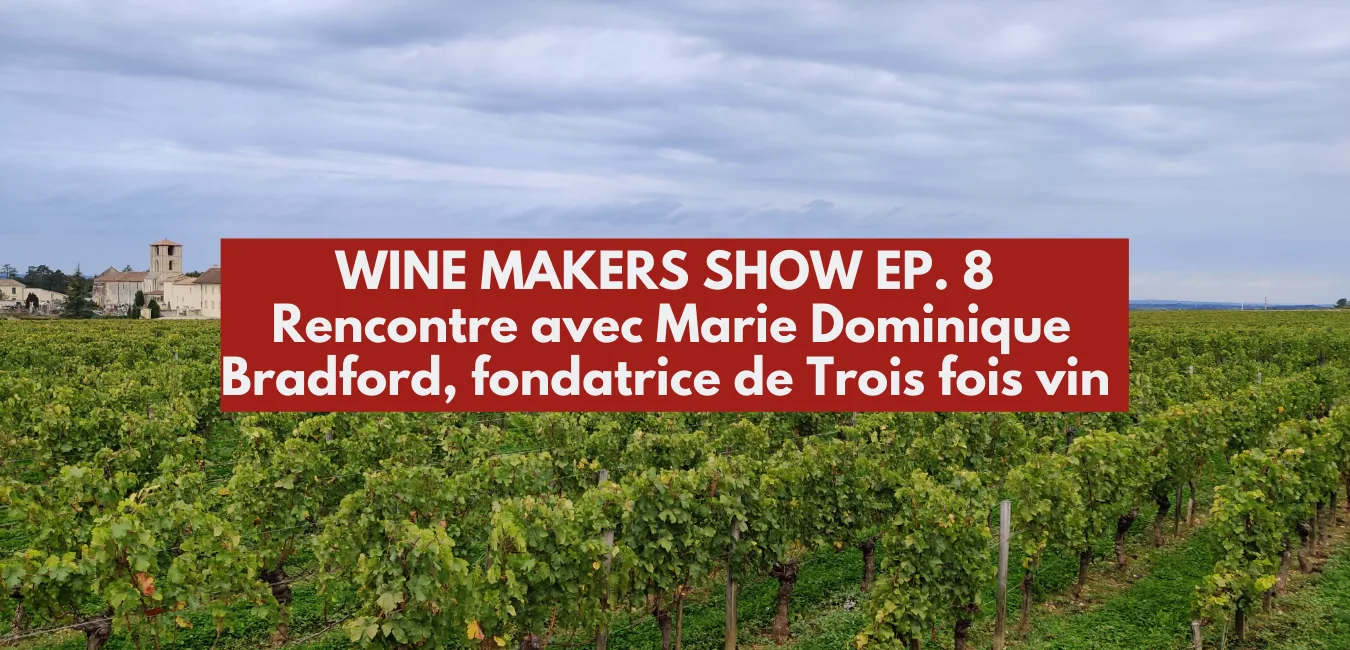
To get your gifts ready for under the tree, we’re putting together a series on wine boxes. To kick it off, we met Marie-Dominique Bradford, who created Trois Fois Vin.
Can you introduce yourself?
I’m Marie-Dominique Bradford, I’m 55 and I’ve been working in wine for a solid twenty years now after a career in film. I lived in the United States, in Los Angeles. After about six years, I came back to France and my Burgundian roots resurfaced. I moved from film to another passion: wine. I started training myself because it’s hard to sell wine without knowing it. I got a stack of diplomas and went for it. Then I sold wine to the United States, closing the loop in the other direction. I was sourcing winemakers from my home region, the Côte Chalonnaise. I then found importers because selling wine in the US isn’t easy thanks to the 3-tier system that mandates a separation between importer, distributor and retailer.
How did you start?
I started with a first full-time training program for 6 months. After that initial foundation that gives you confidence, I started going out to meet winemakers. That wasn’t enough. Stepping into the world of wine is a trap: you keep wanting to know more. Bit by bit I wanted to learn more. So I looked for other training. The WSET courses felt like the obvious next step. Today it’s become the must-have program. I worked through every level until I became a trainer myself. The nice thing about that program is you learn by yourself. I could keep my professional activity going in parallel.
How did your US business develop?
The first orders started coming in. I built up a relationship of trust. The importers are far from the product geographically. I served as the bridge between importers and winemakers. I sought out lesser-known, lesser-distributed winemakers.
You avoid all the logistical headaches with this activity
Absolutely. The importers handled all the transport. They were in charge of getting the containers there and shipping the wine. I have some incredible examples of how hard wine logistics can be. They put a kind of tracker on the containers to make sure the temperature inside stays stable. The person in charge of temperature regulation turned the dial the wrong way. The wine cooked. There were a lot of bottles, the wine had to be distilled. That’s mandatory and you have to prove to the insurer that the wine couldn’t be sold. Logistics are a very big deal.
Back to the training programs
These programs aren’t only about winegrowing. They’re very comprehensive and cover all the knowledge of wine. You learn a ton of things about wines from around the world. You also need to taste a lot of wine. That’s how you build your benchmarks. Region by region, grape by grape. Once I’d cleared every level of WSET, I joined the Master of Wine program. That’s even more demanding. Both in the solo study part and in the seminars. WSET has four levels. The fourth level takes two years. The more you learn, the more you want to learn. There was only one option left: the MW. I signed up immediately. I spent three years on it. I didn’t finish it but it was a wonderful grind for knowledge. By the end, you’re supposed to know everything about every wine in the world. I spent three years enriching myself, meeting even more people. Learning to taste in a factual, precise way is a huge help today when selecting producers.
What was the impact of these programs on your business with importers?
There was one. They knew about the training I was doing. It brings real credibility. I also learned to be even more demanding and rigorous in my selections. They benefited too, as did I. It’s a virtuous circle that let them have even more trust in the role I was playing.
What happened next?
The 2008 crisis hits. Consumption stops entirely. The importers I worked with stop buying and are uncertain. They decide to live off their inventory. At that point, I feel orders are no longer coming in. They’re deeply worried and sitting on millions of dollars of stock. I told myself it was time to rethink my business model. I figured I had to capitalize on the sourcing I’d built up over a decade in the field. That’s when an idea I’d seen in the United States resurfaced: wine boxes. I told myself it would be possible to build the same model in France. I spent 18 months thinking through the project and figuring out how to set it up. The business model didn’t exist at all. There were very few subscription services. When building the website, there was no subscription payment solution. Everything had to be developed.
It was still a big risk to launch that in 2008
How could I technically deliver this recurring service? How do I set up a subscription? I really wanted people to subscribe and receive their bottles at home. We managed to find a workaround with a developer. The whole design took a solid year. I already had a company and we did everything on our own funds. It was a huge risk: a real bet. My big stroke of luck was that over the previous ten years I’d built up a real community. I had a pool of potential customers in France.
How did the first sale go?
I had no idea about SEO or referencing or anything else. We built a site, talked about it, and crossed our fingers. I went live in October 2010. The Christmas months helped a lot. Since it was very innovative, the press quickly covered it. There were a lot of articles on the subject. The first customer came in pretty quickly. I’m still proud today to have customers who subscribed in October 2010. That first box had a dry Jurançon. Since then, there have been 600 wines. The wines are always different.
What do you find in the Trois Fois Vin box?
We have several box formats. All our prices include delivery. The entry box is 24.90€ and then it goes up. There are four formats. An additional option is available: the Intégrale, which combines wines from all the boxes. Almost 35% of our subscribers are on monthly direct debit, paying for their wine box. In each box, there’s a leaflet that explains, wine by wine, the story of the estate, food and wine pairings, and a recipe. Today we have 12,000 customers and only a 2% cancellation rate. We notice that a customer is rarely a customer just once: they buy boxes for friends and family.
Do you interact with your subscribers?
We have a lot of exchanges with subscribers. We really try to spark all of that. We want them to have a good time and to live through tasting experiences out of the ordinary. People come to Trois Fois Vin and they feel a real, palpable, taste-based difference. We chose not to put our subscribers’ money into marketing but into the wine. Combined with my expertise in choosing wines, our customers get a striking taste experience. Trois Fois Vin lets you taste high-quality wines. We support our customers throughout their subscription, of course, by providing content and looking after their comfort. We check there are no issues. Our boxes are very sturdy and built by us to avoid breakage. So the experience is very high quality. If subscribers like a wine they’ve tasted, they can buy it again from us at a lower price.
Why Trois Fois Vin?
The concept was to receive three bottles of wine each month. Hence the name Trois Fois Vin. No other meaning behind it. Trois Fois Vin is a play on “trois fois rien” (almost nothing), but it’s still a lot.
Are you present in other European countries?
Yes, in French-speaking countries. We also sell to expats abroad. Their families back in France sometimes give them a gift. We mostly send French wines but you’ll often find foreign wines in there too. I have a great experience with these wines. It’s hard to pick a foreign wine on your own. Thanks to us, you discover confidential wines.
What happens when you arrive at a winemaker?
I never buy wine on the first visit. The wine can please me but I need to soak up the personality and how they work. I have to tell the story to subscribers. Just because a wine is very good doesn’t mean I’ll take it. I have to see the vines. That’s essential for me. There are winemakers who aren’t organic but who work as if they were. I usually have a small idea. We do a tour of the vines, a tour of the cellar, I ask technical questions. I need to know the age of the barrels, where they come from, etc. Then I taste the wines in élevage, the finished wines. That helps confirm my choice. I often go alone.
What relationship do you keep with the producer?
I know every producer of every bottle I put in the boxes. It’s essential. I keep a strong relationship with them. I cultivate each new face and we maintain a connection.
You also have a cellar in Paris?
In 2010 the website launches and I start thinking it would be interesting to have a physical location to welcome subscribers. Wine is meant to be shared. So it’s a way to interact with subscribers. The cellar opened in 2013 and it’s kind of the flagship. We welcome our subscribers and any curious visitors. Each month, we organize a tasting with the winemakers. A wine merchant is like a bookseller: they know the contents of every book they sell. I love telling the stories of each bottle.
What book would you recommend to a wine lover?
I’m going to plug my own thing. In 2017, the publisher Dunod asked me to write an oenology course. I launched with them an oenology course in 38 lessons with lots of exercises. As soon as you learn a section, there are exercises to apply what you’ve learned. You learn wine sip by sip with this wine book. It’s very playful.
Do you have a favorite wine right now?
With a box, I have a favorite every month. This month I have a soft spot for a Mercurey that’s excellent. It has a beautiful story because it’s the second vintage of a brand new estate. It’s a couple preparing for retirement. It’s a typically confidential wine. We don’t negotiate prices to let them launch and continue on their adventure.
Who should I interview next?
It would be interesting to go see Olivier Thiénot at École du Vin or to interview a Master of Wine like Christophe Macra. To follow Trois Fois Vin:
About to order a box from Trois Fois Vin? Take the opportunity to fill out a tasting sheet for your discoveries. You’ll keep a memento of your wine tastings. And good news, you can get one for free.
Amazon links on this page are affiliate links. They cost you nothing extra, and they help me keep this going.