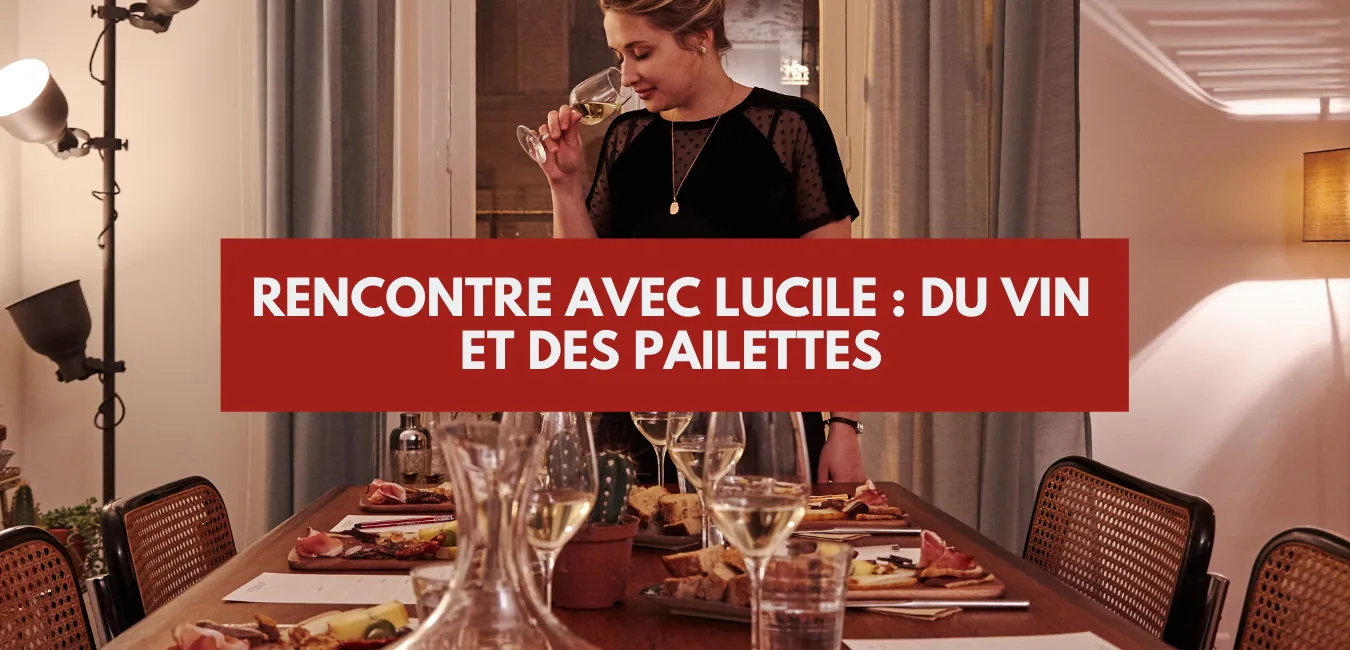
Today we’re sitting down with Lucile of Du Vin et des Paillettes. Lucile is a very friendly sommelier who decided to turn her passion into her career. After business school, she chose to move into wine. She’s now an at-home sommelier and offers to come to you. Whether you’re a company or a private host, Lucile can bring you wine and sparkles. Let’s go meet her in this episode. Enjoy.
Can you start by introducing yourself?
I’m an independent sommelier. I’ve been a wine fan forever, I’ve always loved it and I decided to make my life around wine. I set up my company called Du Vin et des Paillettes and I run tastings for individuals and companies, made to measure and à la carte. I’m completely nomadic. I come to you with the wines, glasses, charcuterie boards, and for two hours I run a tasting in your living room with your family, colleagues, or friends.
I created the company a year ago. The corporate side is growing. It’s much more structured but you can do things that wouldn’t be possible at someone’s home, with more budget and more people. With private clients I have a lot of fun and it’s really the chance to share.
How did your passion for wine come about?
The little story dates back a long time. My great uncle, my grandmother’s little brother, when I was little, saw me getting bored at an adults’ meal. He took pity on me and brought me down to his cellar. He had me pick a wine of each colour: a white, a red and a rosé. He set me up in the kitchen, took out three wine glasses and let me taste a bit of each. For all three I said “mmm, it’s good”. Since that age (I was 7) I’ve always been allowed to taste wine at the table. I’m always tucked in the kitchen, I love cooking and tasting wine.
I always thought I’d make a career of it one day, but not this early. I went to business school, I specialised in marketing and communication, but wine wasn’t an initial plan. In the end, after business school, I was offered a job at a wine merchant which I accepted right away.
Was that already at Le Barav?
No, it was at a wine merchant called Nulle part ailleurs where I cut my teeth for three years. I was able to discover the merchant trade, train extensively, read a lot, and taste enormously.
After a year, I did a training on top of the job: a CQP sommelier with Franck Thomas Formation. He’s the best sommelier in Europe and created his wine school. I had a lot of fun.
Then comes Le Barav with Théodore, who you’ve already interviewed.
You studied marketing, why not go work at a château or a big house to start?
That was the plan. I was looking for a marketing job in wine. But it’s a closed world where you need connections. Lots of experience in the field was required. I didn’t have those keys at the time, and I got the offer to become a wine merchant.
How did you end up at the wine merchant?
It’s a pretty funny story. I was doing my final-year internship right next to the shop. I brought my internship supervisor in there and recommended a bottle. The merchant heard me and said “come chat tonight”. And that’s how it happened. We always sell wine and I had the right pitch. I’d recommended a Chablis premier cru by Jean-Paul and Benoit Droin.
How does the first day go?
I’m very methodical and organised. So I scrutinised the cellar. I did lots of research. I wanted to map the cellar and really make it my own. It was impressive, but it wasn’t my first time in sales. I really wanted to give the right advice, and when you arrive you haven’t necessarily tasted anything. So I really wanted to soak in the cellar and advise the customer well.
Then you train more?
Yes, I did a Certificat de Qualification Professionnelle Sommelier (CQP Sommelier) with Franck Thomas Formation. That training really helped me on world wines. We were a great group of about fifteen people. The exchange with the others was really pleasant. Building confidence and credibility was very important. I realised I wasn’t off the mark. Blind tasting, I wasn’t doing too badly.
We’re all still in touch, I sometimes do shifts at some of their wine bars. Especially Reed in Oberkampf and Sentier, which is a very good address.
What did you do after that experience?
After that experience I joined Théodore at Le Barav where I’m his merchant-sommelier assistant. It was a great experience with Théo, who has phenomenal wine culture. Thanks to him, I tasted things you don’t taste every day. I had a great welcome at Le Barav: I really wanted to work in a team. Le Barav was really a small family. I missed the restaurant side at the merchant too. I’ve always been the queen of the dinner-apéro at home. So discovering the restaurant side and on-the-spot advising was great.
It was pretty intense. You have to advise the customer immediately with something they’ll like that fits what they enjoy. By the end of a Saturday night at Le Barav, you’re pretty wiped.
Then we get to Du Vin et des Paillettes, which you create just after
I created Du Vin et des Paillettes in November 2018. It’s already been over a year. I had the chance to get a training from the city of Paris to obtain a CAP cuisine. I started in September 2018, so I went to see my managers right away to explain, and I couldn’t refuse the training. It couldn’t fit with my schedule at Le Barav. I told myself it was the springboard.
I started the CAP cuisine in October 2018 and obtained it in June 2019. It was very useful, especially on the hygiene side. With Du Vin et des Paillettes, I’m the one who cooks everything, so I wanted it to be tight.
In parallel I was building my company. Waiting for it to take off, I worked freelance for wine event companies. So my first real clients are the wine event companies. Then, my first real clients are my friends. They figure that now that it’s all set up, we’ll organise a real tasting. Meaning we don’t do an apéro at home but a true tasting. Several groups of friends do tastings, and one group even decided to create a wine club. Every month I travel to give them a little class. Then family supports me a lot. The network is of course important since I’ve been doing this for 5 years now. Finally, word of mouth is very important.
How does the first tasting you organise professionally go?
The first one, you’re a bit hot. You jump in. But it’s a lot of fun. I plan a lot of time in advance to set up, prepare the boards and so on. The moment you launch the tasting is a bit stressful, but at the same time it’s something you know. When I get home after, it’s pure happiness.
Lots of people loosen up and ask all the questions they never dared ask before. That’s why coming to people’s homes is important to me. It creates a real cocoon that makes those discussions easier. My goal is really to put people at ease and then give them the right words to describe what they like to their merchant or when they go out.
What questions do you get most often?
A question that comes back often is about serving temperature for wine. I often explain there’s a serving temperature and a tasting temperature. When I explain that, people have lots of questions. Decanting wine is also a big question.
Then I often get the question: “how do I tell if a wine is good?”. My answer is often to start by going to a wine merchant to buy your wine. The merchant selects wines well and lets you buy bottles that match you. How to choose your wine is also a frequent question. They want to find a balance between time invested, having a good wine (often organic) and at the same time getting advice.
How do you select the wines you offer in tastings?
I’ve been in wine for 5 years and there are obviously winemakers I love. I offer entry-level so I don’t use grands crus. The goal is to understand wine progressively. I try to find small winemakers and clean things (organic ideally). I also try to stay in good value-for-money so people who enjoyed the wine can buy it afterwards. The tastings I organise are à la carte. I ask for some indications but I handle everything so clients don’t bring biases to what we taste.
I try to work directly with winemakers. I also try to go visit them. During the summer I did a one-month internship at the Château de Jonquières. It was an excellent experience where I learned a lot: from harvest preparation to vinification. It also lets you see again that a bottle is 3 years of work, from the vine’s growth to the bottling.
How do you find your clients?
I’ve kept a great network and I lean on word of mouth as much as possible. I communicate a lot on Instagram, I have my website. I’m really into the human side, so I try to give as much as possible and then be recommended by someone.
I can travel, that’s not an issue. I do bespoke and à la carte.
What packages do you offer?
The base offer is for individuals at home, it’s the introduction. I offer it at €39 per person and the group has to be at least eight. Ideally, no more than 12. I come with five wines and the charcuterie boards. No need to do the shopping, no need to do the dishes. Then I can answer specific requests from individuals. In that case I provide a quote.
Do you have a story from a tasting?
The strongest is managing to get someone to love red wine through wine and chocolate pairings. I managed to get three women who hated red wine to love it. The husbands were particularly thrilled. They were happy to finally drink red wine with their wives, and they bought more in the process.
Where can we follow you?
I’m available on Instagram, my website. I also have a Facebook page and on LinkedIn you can find me for more professional matters: Lucile Coiffard.
Do you have a wine book to recommend?
I love food and wine pairings. I really enjoyed the book “Mon cours d’accords mets et vins” by Fabrizio de Bucella (editor’s note 1: we’re working on an article about this book; editor’s note 2: we also recommend Pourquoi boit-on du vin?).
What’s your latest favourite tasting?
The latest bottle that really gave me emotion is the Saint Joseph from Domaine Gonon. It’s a Syrah of incredible purity and elegance. The mouthfeel is magnificent. We were able to meet the winemaker with Théodore from Le Barav.
Who do you recommend I interview in a future episode?
I’d advise you to turn to a winemaker. So I recommend Antoine Foucault of Domaine du Collier in the Loire Valley. I don’t cry at the cinema, but I felt like crying after that tasting, it was so emotional.
Cover photo credit @marionparez
Amazon links on this page are affiliate links. They cost you nothing extra, and they help me keep this going.