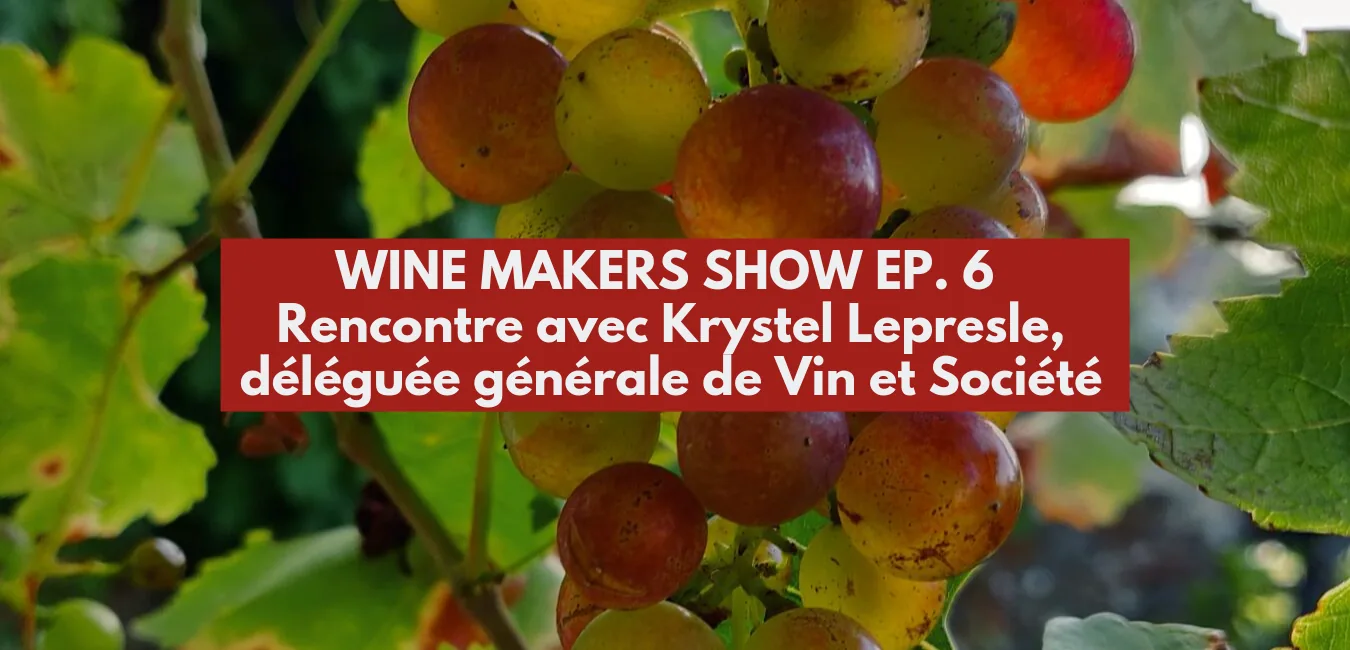
For this sixth episode of the Wine Makers Show, I’m welcoming Krystel Lepresle, managing director of Vin et Société. She reveals everything to us about the UNESCO listing of the climats of Burgundy, her role at Vin et Société and the work Vin et Société does for the wine industry!
Could you start by introducing yourself?
I’m not at all originally familiar with the viticultural and winemaking milieu. My specialty, originally, is the protection of cultural heritage in times of armed conflict. Only the heritage dimension is common. I worked for 5 years at UNESCO. At the end of those five years, I came across an announcement to leave for Burgundy. The region was looking for a project manager for the UNESCO World Heritage listing of the climats of Burgundy. I started this adventure in 2008 as director of the association in charge of the application file for World Heritage listing. Aubert de Villaine, the co-manager of the Romanée Conti, was the president. We then launched together into this adventure that was new for both of us: for me because I knew few things in the wine world, and for him because UNESCO was an unprecedented adventure.
Is that how you got to know the wine world a bit more?
I’m originally from the Nièvre. We necessarily have an education, in childhood, in the viti/vinicultural dimension. And when you’re French, it’s complicated not to be close to this product culturally. I’ve been interested in wine since adolescence: my grandfather was a wine enthusiast. When I arrived in Burgundy, I had the chance to have the best ambassadors around me to train me in this dimension. I realized that wine isn’t just a product you drink. Wine has a strong territorial dimension, it shapes landscapes, it was also a very specific history for each region. The file for the UNESCO listing of the climats of Burgundy gave me the opportunity to write some beautiful pages on its history. That’s how I became aware of the historical and cultural depth for Burgundy wine and, more globally, throughout France.
Could you tell us more about the UNESCO World Heritage listing of the climats of Burgundy?
Burgundy, in 2007, had the ambition to list the Côte de Beaune, the Côte de Nuits, the cities of Beaune and Dijon as UNESCO World Heritage. When you launch into such an adventure, you have to find what UNESCO calls “outstanding universal value”. It’s the backbone of the file. It must be very specific to distinguish itself from others already inscribed on this famous list. For France, some vineyards were already listed and, in particular, the jurisdiction of Saint Emilion. We then had to prove a distinctive character in the eyes of French vineyards and other vineyards of the world. You have to make a comparative list and you have to establish the specific character of the candidacy. We found this specific character in the term “climat”. This term defines a parcel, an identity, a specific terroir designed by men over the centuries. It’s a unique term that designates a unique situation as well. Burgundy has 1,247 climats, and it’s the know-how and the incredible work of men through the centuries, from the monks to the dukes of Burgundy, through current winemakers, who identified over more than a millennium a specific terroir that expresses itself through the single grape variety. The winemaker is the interpreter of this terroir.
Now that the vineyard is inscribed on the list, what are the effects?
This listing was sought to preserve the territory and have the specific expression of Burgundy in its essence and its terroir recognized. The objective is to preserve this specific identity. It’s thus a legal tool for heritage protection. On goods, like vineyards, the classification of listed sites applies. Some villages are also protected with rules of architectural protection, urbanism, etc. Human activity in the vineyards is reflected in the villages with a very specific identity in the architecture.
Since this listing, do you observe an even more important development of this vineyard?
I left at the end of the file submission. However, what I can measure is the awareness of working on something exceptional. You’re working on something the whole world envies you for. Suddenly, taking a bit of distance from the winemaker’s work is incredible. UNESCO brings this distance and makes you feel that you’re working on more than a parcel, but a parcel of humanity’s heritage. It changed mentalities. On a daily basis, there’s an empowerment in the way of working the terroirs: for example on the preservation of dry stone walls.
What did you do after this experience?
For about a year, I worked in a company that makes custom cellars for people with very premium means. What I missed was the collective dimension of projects. The climats of Burgundy was a territorial dynamic that brought everyone together: residents, politicians, communes, etc. We felt carried and we carried! This collective dimension was missing for me and I needed to find projects in the general interest, which I find here, at Vin et Société!
Could you tell us what Vin et Société is?
I’m managing director of Vin et Société. Vin et Société is an association that brings together the 500,000 actors of the vine and wine. It groups production and trade. It’s the federation of 21 regional inter-professions. Through Vin et Société, it’s the entire industry that’s represented. The defense of the industry’s interests is done through promoting responsible consumption. Vin et Société is the contact point for public authorities on everything concerning the health dimension, wine tourism, the Évin law, road safety, etc.
So you’re a kind of sounding board with public authorities?
I like to talk about the term transmission belt, between what we can have as feedback from territories and the initiatives the government wishes to take. Communication happens in both directions. We bring back to the government the needs in terms of legislative evolution. At the same time, we are the contact point for public authorities to discuss the evolutions that are presented. We thus ensure the link between inter-professions and public authorities.
You’re managing director of Vin et Société, what does that mean?
The term managing director represents both the management and, at the same time, highlights the fact that you’re a spokesperson. When you address public authorities, you carry the voice of the entire industry.
You’ve been in this position for two years, are there subjects that have been particularly close to your heart?
One of the major subjects for Vin et Société concerns a letter from the Presidency of the Republic inviting alcoholic beverage producers to work, in consultation, on the development of a prevention plan. It was completely new: public authorities then recognized a place in prevention for industry actors. Following this letter from the President of the Republic, who, through this position, reconciles the economic interests of the industry and public health, we submitted a prevention plan after six months of work. We identified 30 measures structured around two main axes. The first axis concerns prevention with populations at risk in alcohol consumption. The second axis is based on the promotion of responsible consumption.
What measures did you propose?
One of the first areas was responsible consumption. We realized that consumers, and in particular the 10 million tourists in viti/vinicultural territories, weren’t aware of the final gesture of spitting. We then decided to give the consumer the user manual for our product. This rests on the gesture of spitting wine during a wine tasting. This allows you to appreciate all its qualities, and to discover the entire range of the winemaker. Democratizing the gesture of spitting wine through the words of industry professionals truly promotes this gesture. We noticed that consumers often feel embarrassed to spit wine. That’s one of the reasons why we chose to do this communication campaign. For the winemaker, spitting wine is a daily gesture, his life is made of tests. The gesture of spitting is a technical and professional gesture. So you also have to understand its codes. You have to swallow a bit of air for example. Through this campaign, the consumer appropriates wine in a fun way. We see quite a few thirty-somethings having fun around this gesture with the impression of carrying a slightly noble gesture. This campaign therefore had an interesting effect. Le Petit Ballon, for example, did a whole communication on the gesture of spitting.
What are the other measures for consuming wine responsibly?
We also committed to raising awareness among pregnant women. The vast majority of women already know that consuming wine during pregnancy poses a significant risk for their child and their own health. We wanted to position ourselves on this subject because it’s important for communication to be done by a clear discourse from the industry. From October 10, we’re launching an important communication on this subject.
At Vin et Société, you also produce studies on consumption habits. Could you tell us more?
Our subject is the health aspect. We therefore want to know consumption trends. What quantities are drunk? What audiences consume? In what settings? What products? On what occasions? We work on subjects that allow us to be at the cutting edge of this theme like wine and Generation Y, or wine and digital. We need to know our audience widely. We thus have a fairly broad vision of wine consumers.
You spoke of winemakers and digital, could you tell us a bit more?
Contrary to received ideas, winemakers are ultra-connected people. They greatly appropriate technology. We sometimes have an offset image of the activity. The digital character has integrated the industry in a very anchored way. It breaks the codes of representation a bit and seeing how much innovation is part of this industry.
On consumption habits, what evolutions have you observed?
We have a perception that’s sometimes out of step with the reality of French consumption. 90% of the population consumes less than 10 glasses per week. We have 6% of the population that consumes 40% of the volumes: the market is very concentrated. We have a huge majority of French people who consume responsibly in France. Our objective is to make people understand that moderate consumption is the future of the industry and the consumer. We don’t know any winemakers who make wines so they can be drunk in a few minutes. Wine is a product that’s shared. We try to make everyone aware that we’ve arrived at a mature relationship between French people and wine.
Have you observed a recent decrease in consumption?
Alcohol consumption in France has dropped by 60% in 60 years. We consumed 100 liters of wine per year per inhabitant compared to 42 today. Eating habits have greatly evolved, meal duration has shortened, meals are increasingly taken outside. Historically, wine is rather consumed at home with friends. These consumption trends also affect what we eat: the reduction of meat consumption for more plant-based food. There’s also a questioning with these foods: what am I going to drink with these foods? While red wine remains majority in terms of consumption, we see a very nice resurgence of rosés and white wines.
We also see the development of natural wine, do you observe it?
Yes, naturalness and pleasure are two very important elements. Naturalness is making a very important entrance in the wine field and the industry largely responds to it, with environmental progress approaches. These are also subjects that allow meeting a new generation that has changed its consumption modes.
What are the wine consumption trends for Generation Y?
Wine is consumed mostly at the table. Young people have re-appropriated the French-style meal and do dinner-style aperitifs. Much more than forty-somethings. Wine remains present but integrates this lifestyle. We also see that wine accompanies life. Wine takes a very important place around 25/26 years old, when these young people settle down. They then consume more of it with more traditional consumption modes. The transmission mode happens a lot between peers. It’s your circle of friends that initiates you to wine. Young people have re-appropriated this knowledge. Mostly, wine is consumed at home, with family or friends. We see an evolution towards consumption in restaurants, linked to the itinerancy of lifestyle. On bottle purchases, 5 are bought in supermarkets, 3 consumed at the restaurant, 1 bought at the wine merchant or online, and 1 at the winemaker’s. That gives a fairly good representation of what the wine market is.
Let’s go back to the Évin law we mentioned
The Évin law is a law that regulates communication on wine. There was a confusion between communication on wine and communication from territories on wine tourism activity. This subject mobilized Vin et Société in 2015. The law was clarified to distinguish wine tourism activity. It’s following this change that we gave birth to a program like “one minute, one vineyard”.
Do you have counterparts abroad?
It happens at the European level. We all find ourselves around the same philosophy: the good consumption mode is moderation. It’s not the product that poses a problem but the way you consume it. There are national particularities that are very different but what brings us together is the promotion of moderation and the development of this art of living.
For the future of Vin et Société, should we wish you something?
We work a lot to develop responsible consumption further. We want to bring our product closer to food. We’re going to work on bringing wine and food closer. We’re also working on implementing a web platform on the lifestyle dimension of wine to be closer to the consumer, like you experiment in your activities.
Would you have a reading recommendation on wine?
I recently read the book Pourquoi boit-on du vin? by Fabrizio Bucella. The book, in investigative mode, gives a very multiple vision on why we consume wine. It’s rather amusing, and very pedagogical.
Does a wine evoke a particular memory for you?
I’m quite a fan of Pinot noir. It’s a very revealing grape variety of the terroir and it’s my favorite.
If there were one person to recommend for this podcast, who would it be?
I think it’s someone who really brings something to wine in the world: it’s Aubert de Villaine, the co-manager of the Romanée Conti. Everyone knows the Romanée Conti but the man I discovered knows heritage, has a vision of viticulture, a look on the past and has seen the great evolutions of wine. He’s a great man of viticulture.
Amazon links on this page are affiliate links. They cost you nothing extra, and they help me keep this going.