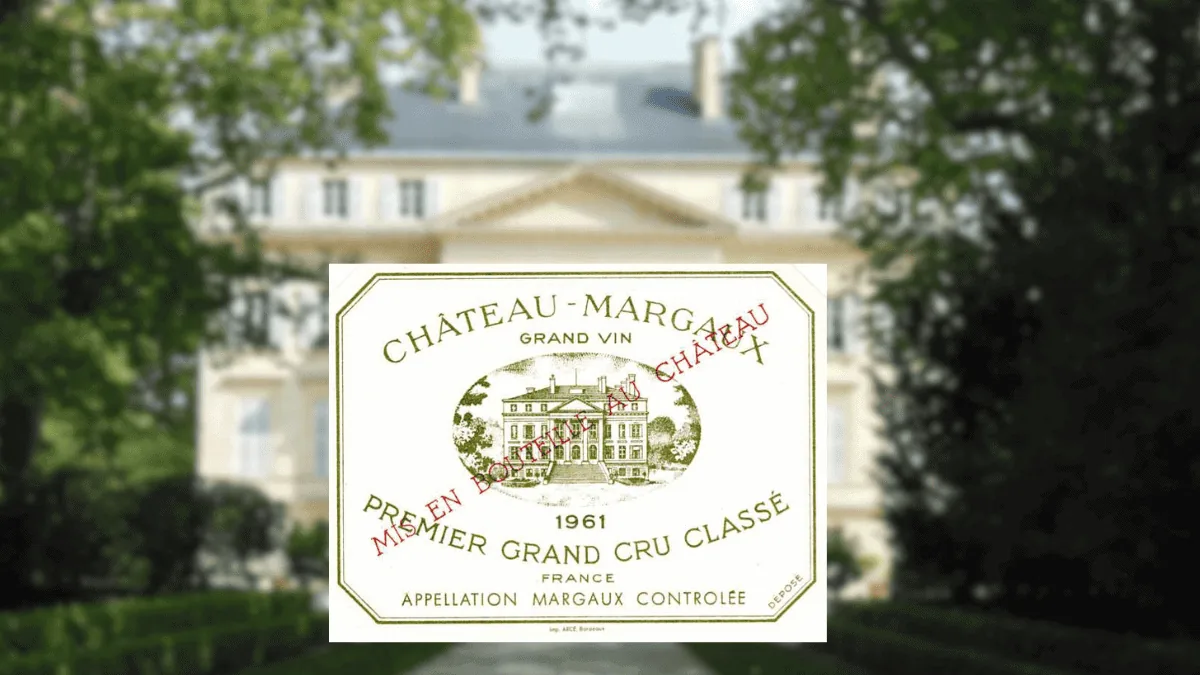
When I started my podcast, I told myself: ‘Imagine, one day you might get to interview the owners of Château Margaux.’ Well, it’s done. Château Margaux is one of those iconic names in the world of wine. Everyone knows it, and some have been lucky enough to taste it. I’m thrilled to have shared this special moment with Corinne Mentzelopoulos, and I’m now bringing it to you in podcast form and in this article.
Antoine
Hello, Madame Mentzelopoulos. Thank you so much for welcoming me here, it’s a pleasure to come and meet you. I waited a long time for this meeting because I was really happy to have started a first exchange with you and to have the chance to gather this testimony. I don’t grow grapes yet, but episode after episode of my podcast, I’m growing testimonies.
So obviously we’re going to discuss many things today, we’ll dive back into the history of Château Margaux, but first, can you start by introducing yourself?
Corinne Mentzelopoulos
Well, my name is Corinne Mentzelopoulos, I’m 71 years old, which I’m not particularly proud to say, but that’s how it is, to be honest with you. For 43 years, maybe 44 because I haven’t recalculated, I’ve been taking care of Margaux.
I sort of stepped back last fall, it’ll soon be a year, to hand over the power and responsibilities to my son, who’s 31 years old, who’s named Alexis and who does this very well. As for me, I had no oenology training at all. I did hypokhâgne and khâgne at the École Normale Supérieure, which I loved because I love culture above all, and we were stuffed with culture, it was extraordinary.
I had a teacher who used to say, and he was right, “remember, children, that what remains when you’re old is culture,” and he was right. And I realized it from that time on.
Then I went to Sciences Po to give myself credibility in the business world. Because we had lost my brother, meaning I was the only heir, and I didn’t want to disappoint my father and tell him that all the work he had done with such genius, perspicacity, will, and tenacity, I didn’t want to tell him that there was no one to come after, it would have broken his heart. He died five years after my brother’s death and I found myself alone running this exceptional cru.
Before we continue, I have a surprise for you! If you love this interview, you’ll love this cap:
Corinne Mentzelopoulos
I was helped a lot in my early days by the people around me who understood.
Going back a bit, when my father took over the estate, everyone laughed, if I dare say so, since he was Greek with a foreign accent. The Médoc wasn’t what it is today, it wasn’t open at all, there were only Médocains, and it was a very particular atmosphere.
At the time, and that’s already old news, there was no enthusiasm, there were no experiments like now where everyone tries to make the best wine possible. So everyone smiled a bit when my father took over. And in two years, he started the works and improvements that were necessary since the château had been a bit neglected until then, and everyone realized he was extraordinary.
And in two years, everyone was blown away, if I may use that word, by his competence. Of course, he relied on many experts, and he did absolutely extraordinary things. Unfortunately, he died two years after his acquisition. And then, as much as people had smiled when he took it over, the Bordeaux world was devastated by his departure because in two years, he had shown his competence and especially his love of Château Margaux.
Corinne Mentzelopoulos
And that’s when I took over, I won’t say I was forced, I did it spontaneously without a second thought, and thanks to youth, without telling myself I might fail. I was never afraid. When you’re young, you’re crazy, you go for it. And then I told myself, we’ll see. I didn’t tell myself anything at all, actually, I worked so much.
Corinne Mentzelopoulos
So I worked in this magnificent property, for this magnificent property, for 43 years and I congratulate myself every day. And it’s my son, as I told you, who has taken the reins, but he keeps me informed, so I always feel like I’m living in Margaux, through Margaux, thanks to Margaux.
Not to mention we’re the only ones to have the same name as the appellation. We’re called Château Margaux, appellation Margaux, whereas Château Latour is an appellation Pauillac. So that reinforces Margaux’s renown, and at the same time, it obligates us. Not that we need that, but it obligates us to make the best wine possible every year, because we have to live up to that reputation.
Antoine
I think Château Margaux is one of the wines that has entered culture. Everyone knows Château Margaux.
I’m interrupting your reading for a few seconds, for a good cause.
Thanks to my podcast, I spend a lot of time in the vineyards and I have the chance to discover incredible things: from the most well-known estates to very confidential places. What if I let you in on it?
If you’d like to build a beautiful wine cellar, leave me your email.
Corinne Mentzelopoulos
There’s a very famous novel by William Styron, the American writer, that talks about Château Margaux. And yes, we’re a premier grand cru classé, it’s a classification that took place in 1855. Napoléon III wanted to bring all the best French products out of the rut, if I may say so.
We owe him a lot. There were five firsts, and we were one of the five premiers grands crus classés. There were blind tastings to confirm it, but actually, when you see the price curve over the centuries, you see that Margaux is always with the others, the firsts being superior to the other grands crus classés.
So it’s a very beautiful story. We also realize that we are only at the service of Château Margaux, that is to say Margaux is so much more important, will last so much longer than us, that we feel obligated, if I may say so, to give the maximum of ourselves to be worthy of this estate.
Antoine
In the introduction and in the answer you gave earlier, you spoke of your father’s Greek origins. Earlier you told me that your Greek origins were also something close to your heart, would you like us to come back to that?
Corinne Mentzelopoulos
Well, I think Greece is the cradle of Western civilization. I studied ancient Greek, I studied Latin. My friends who were doing Spanish, I totally despised them. You see, because I was obviously doing ancient Greek, and it’s quite paradoxical because I wasn’t good at ancient Greek and I was very good at Latin, which shows it wasn’t genetic.
And yes, my Greek roots: first, I’m half Greek, I have a Greek passport, I go there every year, I’m part of the École française d’Athènes. And yes, I’m proud to be half Greek because it brought us a lot.
This country brought us everything, really. And then the Romans, whom I love just as much, I go to Rome for Christmas. The Romans continued and transmitted this culture to us. Thank God for the Romans, you see. So I love Italy as much as I love Greece, but I feel Greek whereas I obviously don’t feel Italian.
Listen, walking around the Acropolis, you never get tired of it. You absolutely have to find a hotel, no matter how shabby or not shabby, to have the view. It’s been there for 2,500 years, almost more, but it’s incredible.
I’m originally from the Peloponnese. Greece has had a lot of misfortunes. It’s a country that has suffered a lot. We were occupied by the Turks for four centuries, and a Turkish occupation is no small thing. We kept our culture and our pride, if I may say so, thanks to the teaching of the Popes who had children study in caves. And also thanks to that ancient glory that makes Greeks very proud.
It’s a very proud people, but we keep bad memories. We were invaded in the Second World War by the Italians. The Italians couldn’t occupy us. I had an aunt, she’s dead now, but I loved her very much, she used to tell us memories and she remembered an Italian who was singing, you can roughly see the kind of occupation it was. Then the Germans came and there it was not at all the same song, they killed both Italians and Greeks.
So we suffered a lot during the occupation, and after the liberation, if I may say so, we almost got the communists because the Soviet Union took advantage to take all the Balkans, and it was Winston Churchill who saved us. He came at Christmas and said: out of the question. Churchill, we took him seriously, so Greece remained free.
And the Balkans, even today, you know, they suffered from the Turkish occupation, then communism, it’s not very cheerful where they are now. We see that we, well, we are still a free country. The Greeks are expansive, they dance, they sing. It’s not a country that succeeds enormously, but there’s an extraordinary lifestyle, absolutely extraordinary weather and climate. And then excavations, antiquities everywhere, everywhere, everywhere.
Antoine
Yeah, I should go back. I was in Turkey recently and it was interesting to measure the differences and the proximity between the two cultures.
Corinne Mentzelopoulos
Me, for example, I no longer go to Turkey. I was on a boat two years ago right next door, next door, it must have been Rhodes, but we could see Turkey and I wanted to go because I photograph all the time. I love photography, I have my Nikon which is as old as Herod, but it’s my buddy, and I wanted to go to Turkey to take pictures, and my husband forbade me. He said, you’re not going, especially since you have a Greek name, you never know. It’s true that with Erdogan, you have to be a bit wary.
So I didn’t go to Turkey and I won’t go back. Another tragedy for the Greeks: Istanbul.
You know it was called Constantinople, since it was Constantine who founded the city. And another tragedy is that we have a sacred church, Hagia Sophia, which served Greek Orthodox culture, and it has now become, well, you know. And for us, that’s like Notre-Dame becoming a mosque.
It breaks our hearts, really, it breaks our hearts. Well, there I went a bit Greek, but in my daily life I’m very French obviously, I was born here and I was educated here.
I’m typically Parisian. For me, even the idea of considering living elsewhere, whether Athens or London, seems absolutely impossible if you will. I grew up here, I studied here, I worked here. Paris for me, well I live in a small village actually, in my little arrondissement, it’s a village.
Antoine
I agree with you that Paris is a village sometimes, less so on the desire to stay there.
Corinne Mentzelopoulos
No, that, I understand you, but you’re young. So you, you must certainly leave because Europe isn’t in a very good state, to put things plainly.
So you have to leave, the only problem is where. Personally I’m very Americanized because I spent a lot of time in summer camps for young people, and I had become a professional in many sports, and I learned another culture, another approach, and I love America since then, I admire it greatly.
Plus, I’m grateful to it for saving us from two world wars and from communism. We mustn’t forget that because I, I remember very well when I was young, we had the feeling the Bolsheviks could arrive at any moment, and if there hadn’t been the American umbrella, they wouldn’t have hesitated. If they stopped at Berlin, it’s thanks to the liberation, thanks to the Americans.
So why am I talking to you about the Americans? First because they’re absolutely extraordinary clients and I love this country in addition, but the English, well, it’s the English who in fact, as always, discovered the Bordeaux crus. Richard the Lionheart was already drinking what they called Clarets, that is to say the wine wasn’t yet aged in barrels, so it was clear.
I live a lot in English because we have many English clients and especially American clients, we have Chinese clients, we have Russian clients, we have everything. But I made many friends in the United States because I have a thing with Americans, I can’t explain why, that’s how it is, and then I always went to that camp, so I learned the lifestyle that I appreciate a lot. There’s nothing that pleases me more than eating a hot dog in the middle of New York sitting on a staircase or anywhere, it’s intense happiness. When people tell me it’s absolutely disgusting for your health, I tell them listen, if I eat one or two a year, I don’t think it’s going to damage anything.
And there you go. So let’s get back to Château Margaux because I’m wandering off.
Antoine
Yes, but I contributed a lot to it by talking about Greece and all that. So when you arrive at Château Margaux, you’re 25 years old?
Corinne Mentzelopoulos
Twenty-seven years old. Twenty-seven. Exactly.
Antoine
How did you find the château at that moment?
Corinne Mentzelopoulos
I went there several times, and I especially remember the first visit, because what’s quite amusing, my father traveled a lot for his business, and there, I followed him. Because when he told us, I’m going to see if Château Margaux, whether to buy it or not, I felt I had to go even though I wasn’t following my father at all. And I went, and all my life, I’ll remember the first sight of the chai. All my life, all my life. It’s spectacular, this chai, with a simplicity because all our architecture is inherited from Palladio, the famous Italian Renaissance architect, and we are one of the rare examples of neo-Palladian architecture, if I may say so, in France. The English are full of them, you see, the columns, the slightly austere look, a bit Latin, a bit Greek.
My father was extremely proud, if you will, because it looked like a Greek building. So Margaux, when my father arrived, since he’s the one who gave the first push, and I remember, was decrepit, it was dirty. The walls of the château weren’t black but grayish. The chai was almost black, you couldn’t see anything. The cuvier had vats, but ones that seemed antediluvian. You felt it was a château that had been left abandoned.
Be careful, however, everyone was in the same state in Bordeaux. Don’t think it was just Château Margaux.
It was a total crisis. We had atrocious vintages like ‘72, ‘73, ‘74. ‘75, we were told it was very good, but in fact nobody tastes ‘75 today because it aged badly. ‘76 was so-so and ‘77 was a catastrophe. So everyone laughed when my father took over because the first vintage he knew was bad.
And since we were listed on the stock exchange at the time, he didn’t dare go to the shareholders’ meeting. He thought, I’m going to get yelled at because everyone thought it was a stupid acquisition.
You see, it was really decrepit, I especially remember the colors whereas now the original yellow stone is magnificent. Everything we did was in respect of the origins and the soul of Château Margaux. You see, it would never have crossed our minds to change the color of anything. We didn’t change the chai, careful, we did a lot, a lot of work, but it doesn’t show.
For example, we helped cool the chai through the ceiling, but nothing shows in everything we do. And if you asked me now what we did, I forget because there’s been so much over 40 years that now when you arrive, you forget.
The château was in a sorry state. So my father in two years transformed this château. When he died at 65, so very young, he didn’t have time to enjoy what he had created. I took over and I had the chance at the beginning to be able to follow on his momentum because he had lots of programs. He had planned everything for the next two, three years. For example, he had planned an underground chai, which was something quite new at the time, and I’m the one who built it afterwards.
And I almost made a big mistake. I said “it’s too big” and I almost made it smaller, but my God, what foolishness. I should have understood that when my father decided something, it was perfect. Well, fortunately, I came to my senses. Now it’s the perfect size for production, not in 2024 because of the rain, we’ll have a small production, but for some years when we have a stronger production.
So I had this planning, if I may say so, and especially the people around me redoubled their efforts because they realized that now that André Mentzelopoulos was gone, things might fall to ruin, and that’s why we all, me first, redoubled our efforts.
I really worked all my life, by the way, like a beast, it’s not very pretty but that’s what I want to say, because we had to be at the service of Château Margaux. It’s not him who works for us, it’s us who work for him to be worthy of his reputation, his quality, his history since the 16th century.
It was called La Motte because all the grands crus classés of Bordeaux, well, most of them, let’s say the best, are on a small slope, always because it drains the vines better when it rains. I love this kind of little thing because it shows the attention all the owners have given to this estate.
Antoine
You also experienced a moment of transformation in those years in the marketing of wine since in the eighties, so just after your arrival, that’s also when the United States opened up a lot.
I’m interrupting your reading for a few seconds. Stay informed about the publication of upcoming episodes and access my list of 10 wine books to read by leaving me your email:
Corinne Mentzelopoulos
So we had incredible luck. In ‘82, we had very precisely an American taster called Robert Parker, whom you’ve certainly heard of, who wrote: “you have to buy this ‘82, Bordeaux has never made anything so wonderful”. And then sales exploded and after that it continued, year in year out. Parker came every year to taste. He was a very nice and very sensitive man.
And he told me one day, it pleased me. He told me, it’s funny how every time I see you, I learn something. That’s because we talked about everything and nothing, you see, not necessarily about Margaux, but he had an absolutely extraordinary tasting capacity. He said, he explained that it burst in his mouth and that he felt the tannin, the sweetness, the alcohol, the juice, everything.
He was really an exceptional taster, exceptional, and he was rather kind to us. Well, we try not to fail in our reputation, and what’s essential to us, what everyone forgets, and yet what is the basis of everything, is that the ancients, like the moderns, created the best terroir.
So terroir means a combination of climate and soil, and these people. That’s what I explained to you earlier: “you mustn’t plant there because it’s not good, it freezes. You mustn’t plant there, but on the other hand, you plant there”. That’s the heart of the estate.
It was just empiricism. So now, we know we have absolutely extraordinary gravels. The first time I visited Margaux and they showed me the gravels which are roughly just stones, I told myself, they’re making fun of me. Yet that’s it, the vine has to suffer to produce great wines. You’ll never have a great vineyard in the meadows of Normandy for example. In fact, we say, and we’re right, that nothing grows except the vine.
And the garden, I left it a bit wild, it’s a big word because it still requires a lot of maintenance. But we didn’t make extraordinary plantings, flowers everywhere, fields of roses, things like that, because the garden isn’t the point. The point is the chai, it’s the wine, you see. So the château is absolutely magnificent, but we obviously haven’t touched it, except the inside to refresh it a little. But the garden, sometimes I’m told you should make a beautiful garden.
I don’t think that’s the point. I think that, well, we’re rustic, it’s a big word, but it’s true that we’re first rustic, we’re peasants. You mustn’t forget. If it rains all the time, our harvest is ruined.
So nobody realizes, they tell me: you’re a luxury product.
It’s not true, I’m not a luxury product because I depend on rain and good weather. A luxury product, you can multiply it infinitely, but I can’t. I have no control over the quantity or the quality. You see, I often compare Château Margaux to Hermès for example, but Hermès can open boutiques throughout the world and that’s what they do, I admire them a lot, but nothing will stop them except perhaps production capacity, but I suppose they planned that long ago. Whereas we, we’re limited first in terroir because we’re not going to plant at the neighbor’s, it’s not as good.
So when we’re offered a hectare and a half, that happened recently, we tell ourselves it’ll be less good, it’s pointless.
Antoine
Many crus classés don’t deny themselves though.
Corinne Mentzelopoulos
In Margaux, we’re the appellation with the most crus classés. I think from memory there are 61 grands crus classés in Margaux, I forget, but we have the largest number, and it varies a lot in quality obviously. In Pauillac, which is to the north, there are three premiers grands crus, there’s Latour, Mouton and Lafite, whereas we, we’re all alone in our little corner.
Antoine
And many grands crus in general don’t deny themselves adding hectares to their production.
Corinne Mentzelopoulos
Exactly, and that I’ve always refused.
I’ve always refused because we’re the only premier grand cru classé in the appellation. So by definition, our terroir, it’s not us who are smarter, is better. It’s not us who created it, it’s the ancients, so we have no reason to be pretentious, but nonetheless our terroir is better. So going to look for hectares outside is to diminish the quality by definition.
In any case, that’s what seems to us. And we’re not here to increase production. You know, we already have enough work with our hectares. We don’t need to expand, I’m convinced we’d lose in quality on those zones. So if it’s to make second or third wine, it’s not worth it, that’s it.
Corinne Mentzelopoulos
So we have another particularity about sales, I almost forgot to mention it, it’s very important, which is that we only sell to the Bordeaux négoce.
That is to say we’re not obligated, but it’s a great strength of Bordeaux. And the place de Bordeaux is internationally known, it’s made up of merchants who are specialists in the great Bordeaux wines. And there are some foreign crus that have come to be listed in Bordeaux, which is still extraordinary as a tribute. And we, we sell the entirety of what we have to sell to the Bordeaux négoce. We consider that if we have to start going to Colombia, Russia, South Africa, we won’t be able to. You can’t be at the four corners of the world and at the chai at the same time in this profession.
And the merchants have a considerable advance over us because they have many decades of market knowledge. So the advantage, what is it? It’s that we don’t have to deal with the commercial side, which is fabulous. So we sell to merchants. Be careful, we watch attentively whether they’ve done silly things, whether they’ve put our wines in a supermarket. We pay attention and sometimes we cut one off because they’ve done silly things. But the advantage is also that we don’t need to deal with that.
On the other hand, we don’t quite control the distribution. So with modern means and the work we do, we know roughly what each merchant does. So we can say be careful, you see. And then the punishment, if I may say so, is that they’ll have less wine the following year. So that’s how we can control more or less.
Antoine
In the regions whose opening you’ve witnessed, there’s the United States we talked about a bit, but there’s also China and Asia in general.
Corinne Mentzelopoulos
Exactly. Which has completely opened up. So that’s an extraordinary market. It’s going less well at the moment because China is making a lot of import restrictions for reasons that are unknown to me, and so at the moment it’s less present.
Antoine
When did you first go to China?
Advertisement
Zalto glasses are the best glasses to accompany your tastings and your exceptional moments. Made in Austria, these glasses are those of exceptional wines. It’s not for nothing that you find them in the greatest Michelin-starred restaurants and the most prestigious hotels. From a personal standpoint, I love them, and I know that every tasting moment will be enhanced by Zalto glasses.
By the way, to taste Château Margaux, what’s better than the Zalto Bordeaux glass.
Corinne Mentzelopoulos
Well, listen, I had absolutely incredible luck. I went for the first time in 1973. Even before having Margaux. My father was very close to the President of Pakistan, and the President of Pakistan that year was making an official visit to China because, roughly, India is very close to Russia and Pakistan very close to China. I’m giving you a very, very broad picture, and we went there with Mister Bhutto, the President of Pakistan, and we were of course received as VIPs, it was extraordinary, but it was frightening.
There wasn’t a car in the street. Everyone was dressed the same. Everyone had the same glasses. Everyone had the same suit. And then you felt the poverty. Me being a photographer, I have photos of houses where it looks like water is dripping along the walls, and people looked at us because we had two cars. It was poverty, well it was communism, it was communism. And when I revisited China, I don’t remember the year exactly, I saw that the storefront was transformed, but I walked around with my camera and behind, it was the same thing as in 1973.
You see, there’s the Bella Figura, they show you a thing, but behind, it’s just as pathetic. So I’m not judging China today, and it’s certainly transformed. But what’s funny is that I noticed thanks to my photos that we had been somewhere on a skyscraper, well if you can call it a skyscraper. We had gone to the People’s House, I don’t know what, we had been received like that, and there was sticky plastic at every window. There were grilles.
We were surrounded, each white, if I may say so, at a table, was surrounded by young communists who were all dressed the same, who had the same glasses and who were drinking. All my life, I’ll remember: Ganbei, Ganbei. They were sweating so much their glasses were dripping, it was something, that’s under communism, I’ll remember it all my life. And at one point, I had a sore leg, I don’t know why, I’ve never had sore legs, and my father said to me, listen, I beg you, don’t go to a Chinese hospital, you’ll never come out. Well, it’s not just that they were bad doctors, but maybe they would have liked to take a hostage.
So I limped a little and then there you go, it resolved itself. But it’s true that on the surface, the China I visited twice since is nothing compared to 1973, but you have to scratch behind. So once again, I don’t know what it is in 2024, so I measure my words to what I know.
Antoine
When did you go for the last time?
Corinne Mentzelopoulos
Not so long ago, we went for a tasting where we were very well received, the Chinese are very funny compared to the Japanese. So I have very fond memories, in particular I had sat next to an Italian journalist, first because I love Italy, and he had the same camera as me. He had lots of lenses.
So he could lend me his lenses, you understand, it was the time when zooms weren’t yet as good. Now I have a zoom because I’ve become a bit lazy, but it’s of very good quality besides.
And so like that, we became very good friends, just the two of us, he told me to call him Nano, I think. It means uncle. Well, it’s something like that.
And at one point, we were at the table together, we were always huddled together, always for the camera. And we see a thing arrive that was floating in some sort of soup, and it looked like jellyfish. Then I had a problem there, indeed. Then I must say, as much as I love sharing everything, knowing everything, etc. But jellyfish… So I turned to the Italian, I said: “but what is this?” He said: “Medusa”, I’ll remember it all my life.
I don’t think I ate it. They were things floating, jellyfish is also disgusting. I thought maybe with luck it was octopus or I don’t know what, but not at all, it was jellyfish. I didn’t taste it, I’ll never know, and besides I don’t really care what jellyfish tastes like. And frankly, I don’t want to know.
Antoine
Did you have similar tasting anecdotes during your travels or at Château Margaux? Have you been welcomed at moments or in slightly strange contexts?
Corinne Mentzelopoulos
No, that is to say from time to time, we felt that we were in a country or a place that knew nothing.
Well, or we had a very pretentious presenter who said he knew everything etc., and we could clearly see he knew nothing. But apart from that, I don’t have things that would make us laugh, and yet I laughed a lot through these tastings. And then I especially had the nice surprise, it was very moving, that people applauded at the end for the Margaux because it was extraordinary. Especially the new regions, Russia for example where I went, they took me to a dacha the next day so I could see, Russia was very poor too, you saw oxen pulling carts, it was something.
When you do a tasting, you have several glasses in front of you, you have the bottles, or the bottles are served for the rest to the others because you don’t want to waste the wine either. And you’re very serious, very focused. So I don’t have the memory, yet I’ve seen lots of people.
So at dinner, it’s different if we invite them to dinner or lunch, well with wine, tongues loosen, and we did laugh a lot at these meals because people relax. And then people came to taste, they’re happy to be there. And we have nothing to do with it, and we know that it’s this century, this terroir which has centuries, which makes it very moving.
Antoine
It’s really magnificent in wine how much it brings people closer together.
Corinne Mentzelopoulos
Oh but it’s incredible. Absolutely. So there are great and lesser vintages. So obviously, we tend to serve the great ones.
Antoine
Sometimes in the discussion, you talked about Château Margaux almost like a person.
Corinne Mentzelopoulos
By its grandeur, by its history, by its terroir, it is bigger than us, it will last longer than us, it’s been there since well before us, and we, I think I told you, we are only a link in the chain.
So it’s the third generation now with my son. How long will Margaux remain in the family? It’s impossible to know because of children afterwards, there are many. It’s true that its majesty and its reputation impress me, that is to say I’m behind that reputation. I contribute to it perhaps right now, but the others contributed for centuries, and it’ll continue, all things being equal, for centuries. So Margaux is bigger than all of us combined. On the other hand, we’re very proud to work for it. The whole team is very proud to work for Château Margaux because to work for Château Margaux is still to work for a premier grand cru classé.
Corinne Mentzelopoulos
You’re too young to have known him, Hemingway, he’s a great American author you’ve certainly heard of, and his granddaughter was named Margaux. And she came several times to see us because she wanted to advertise for us. And we always refused because she was extraordinarily beautiful, funny, very American. And we refused because it was up to us to do the promotion.
Follow my adventures on YouTube!
If you enjoy this interview, you’ll definitely have a great time on my YouTube channel. I can’t wait to see you there.
Antoine’s YouTube channel
Antoine
We could say that you could do otherwise, you could benefit from this influence.
Corinne Mentzelopoulos
I’m in wine, I’m not in politics. At one time, I wanted to do politics when I was, when I was your age. Oh yes, it was fun. I did Giscard’s and Chirac’s campaigns, I went to the Champs-Élysées with posters, etc.
And there were three guys who tore up a poster I had once, they threw it in my face, they were Greeks. When I heard them speak, you’re not Greek anyway, they told me yes, me too. They told me, well, that’s not a reason to be there. Well, it was quite an amusing coincidence. But no, I quickly abandoned politics, well, or the little I did, because I understood you couldn’t mix business and politics. Or else, you’ll undoubtedly give in to the ease of using one for the other, if you will.
You’ll notice that all the premiers grands crus have bought other châteaux. Me, I don’t want to, I want us to remain pure, and especially not to disperse our efforts because it already represents so much work. And especially, if you don’t have another premier grand cru classé, it makes wine that’s less good than Château Margaux, so it’s not worth it.
Everyone does that, but we have the strength to say “I have Margaux, period.” I never believed in declining, and yet everyone has done it, everyone went to invest in California, Italy, Spain, Chile, etc., etc., but I don’t feel it. I don’t feel it because we already have so much work, if on top of that we have to go check what’s happening in Chile, I don’t feel it, I don’t feel it.
Antoine
You were one of the first women to run an estate, a château, especially of this scale.
Corinne Mentzelopoulos
I never asked myself the question. I always wanted to be the best in everything I did. In my studies, I wanted to beat the boys whatever happened. I never thought of myself as a woman. I replaced my father, and I tried to do the same.
I didn’t play on femininity, in any case I’m not very feminine to start with, so it’s not worth trying to be what one is not.
You see, I’m rather sporty, very, very perfectionist, and especially very ambitious. I have to be the first. So I had this extraordinary luck of working for a premier grand cru classé. I think it would have interested me less if it had been a cru bourgeois.
You see, it’s silly to say, but I just realized it. It was a premier.
Antoine
Is it your father who instilled that in you? This will to always be ahead?
Corinne Mentzelopoulos
I was very good at school, so he was very proud of me. I lost my brother, he lost his son, and he died five years later. I think he had transferred a lot of affection and a lot of esteem onto me. And since I was good at school, he had esteem for me. That was my luck.
I only knew him for five years after my brother’s death, but he never showed anything. He wanted to be stoic like the ancient Greeks.
Antoine
Is that something you changed with your children?
Corinne Mentzelopoulos
Listen my son, you’ll have to meet him one day, stoic is a big word because it seems like a permanent effort, he’s not Seneca after all, but I think he realizes the particularity of Château Margaux and he feels no pretension, no pride about it. And that’s very important.
Antoine
Stoicism is a philosophy that’s difficult to apply because it’s a difficult balance to find.
Corinne Mentzelopoulos
You know, it’s a word that’s very nice, it comes from, which means the column. The first philosophers were always leaning against a column. There’s where the word comes from.
I studied ancient Greek and I speak Greek so it gives me a lot of clarity in things. If a doctor tells me you have an epi-something, I understand.
Because I redo the words and I understand because they’re only Greek words actually.
Antoine
If you had the chance to see yourself again at the moment you enter Château Margaux for the first time and slip a little word in your ear, what would you say at that moment?
Corinne Mentzelopoulos
I didn’t ask myself questions.
You’re full of energy, of enthusiasm, etc., but really, do you realize what you’re undertaking?
And I never took a step back to tell myself wait. I took a lot of advice. I never decided, especially during the early years, anything important without asking around. That was my lifeboat, my buoy, if I may say so.
There are two kinds of young people: there are young people who want to change everything because they think they know better than the rest, and young people who just want to stick quietly to the success of their predecessors, and I was of that ilk. So I think it was the right thing to do. And don’t forget that my whole team redoubled their effort when my father died and we really worked a lot, we worked a lot, a lot, but when you’re young, you’re never tired.
Antoine
There’s a lesson I understood recently which is not to question the established order before having truly understood and integrated it.
Corinne Mentzelopoulos
Well yes, obviously, obviously, because we think we know everything when we’re precious.
Listen, I’ll tell you, when I started Château Margaux, I was careful not to bring in novelties. It’s been there for centuries and I especially had a very competent team, so I leaned on them, let’s be a bit honest and clear-sighted, and I trusted. I felt they were good people. I had that luck too.
The director of the time stayed until 1990, that is to say ten years after my father’s death, he wasn’t pretentious at all but he did extraordinary work. So I was accompanied. I wasn’t all alone and especially I listened.
Corinne Mentzelopoulos
I never questioned because I told myself, but it’s a centuries-old science, I’m not going to go say you shouldn’t put new barrels, because, because. You see what I mean.
And then, while benefiting from the terroir and the grapes it produces. That’s it especially, that’s where it begins and nobody understands. For years, we had Americans coming to see us all the time to talk about our chais, that is to say how we did the vinification.
They didn’t understand, it’s not in the chais you had to come, it was outside. Now they’ve understood, but they thought we were magicians. We’re not magicians, we take the grape, the grape is sublime. Well, provided we don’t make big mistakes, we’ll make good wine if you will. But it’s first the terroir and the grape that count. Now, people realize it, but at the time, they thought we were vinification gurus.
Antoine
What did you say to Alexis on his first day at Château Margaux?
Corinne Mentzelopoulos
I don’t remember. I think I told him he had all the abilities to do it. And I rarely went at the same time as him so he wouldn’t tell himself mom is checking, etc., etc.
So it’s been more than a year since I went, to let him develop. And from the feedback I have because he’s done tastings abroad too, he’s very good. He’s very good. So he’s 31, he has time to improve too.
But I’ve never caught him saying something silly, and he sends me things all the time, it’s nice because I know what’s happening, but when he passes somewhere, he also sends me what he was saying, and it’s very good, very good.
I’m very proud of him and I tell him especially.
Antoine
Yes, that’s important.
Corinne Mentzelopoulos
It’s seriously important, and it’s true on top of that. I had a lot of luck because you know, people who have such a treasure aren’t necessarily followed by their children. But there, he understood it was something absolutely exceptional and that all our family’s efforts are for Château Margaux. That’s why I haven’t invested elsewhere.
Antoine
Earlier, you were talking about books. And about wine books too. Do you have a wine book to recommend?
Corinne Mentzelopoulos
So one of the first great books is Émile Peynaud: Le Goût du Vin. He worked for us for a long time because my father obviously took him as a consultant**.** He was the best, and frankly, I think it’s not complicated and that it’s very readable.
He’s an extraordinary man who had a rough accent, but who had extraordinary finesse. So one day apparently, he had been offered in California to vinify the wines there, and he said “no because Corinne would be disappointed”. It’s cute, it’s nice.
Antoine
And you shared many moments with him?
Corinne Mentzelopoulos
Oh, but he stayed for at least ten years of course. He was my bible.
Antoine
Do you have a recent tasting favorite? You told me about a Roquefort with a white wine I suppose?
Corinne Mentzelopoulos
A sweet wine. Yes, with a Sauternes obviously. That, that was a great moment, and yet it’s not a Margaux. The great moments with Margaux, that happens to me from time to time. We tell ourselves exceptionally, we’re going to take out a bottle from the cellar.
It’s extraordinary, it’s just extraordinary. So it happens to me almost every time because it’s relatively rare, not compared to other people, but it’s not, it’s not frequent, let’s say.
When you open a Margaux, yes, it’s a great moment because you have to pay attention to what you eat. We’re not going to go gorge on Burgundy snails for example, even though I love that, but that’s another problem, you see.
Antoine
Finally, who is the next person I should interview, in your opinion?
Corinne Mentzelopoulos
My son.
Antoine
Very good idea, super.
Amazon links on this page are affiliate links. They cost you nothing extra, and they help me keep this going.