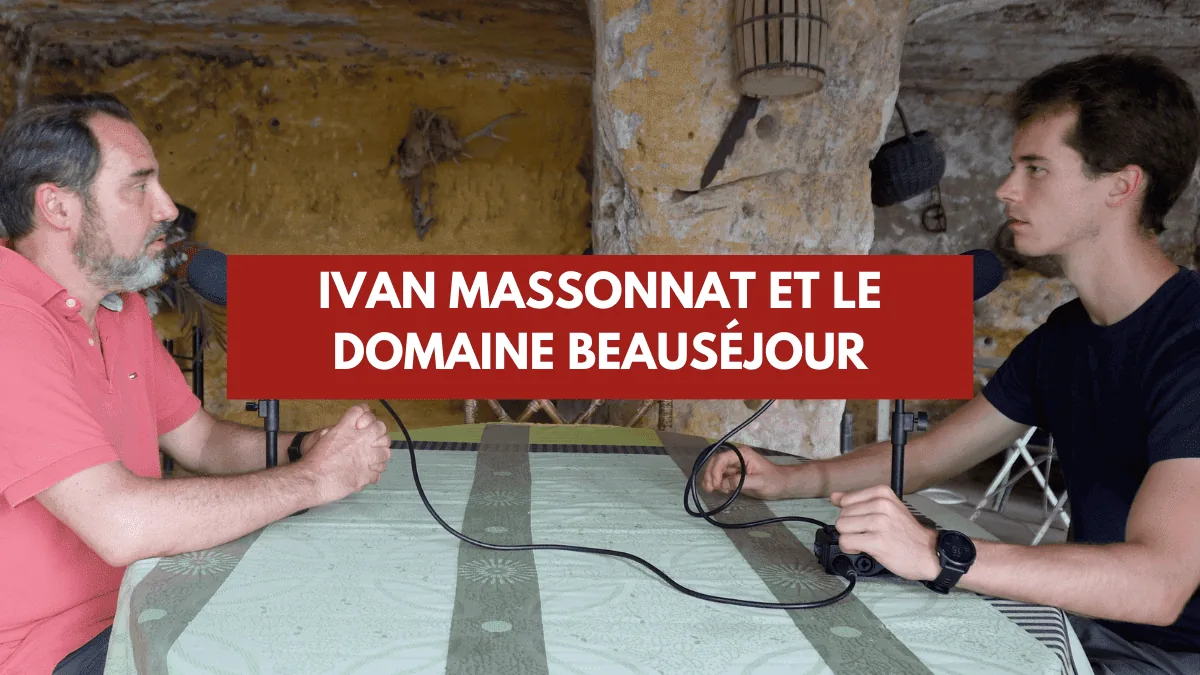
Welcome to this new episode of the Wine Makers Show, where we sit down with Ivan Massonnat for a second time. After interviewing him on his Belargus adventure, we head off to discover a whole new winemaker challenge. It would seem Ivan is well on his way to filling every shelf of our wine cellar, and we won’t complain. Wishing you a very good read, listen or watch and excellent tastings.
Introducing Ivan Massonnat
Antoine
Ivan, thanks so much for having me, I’ll let you introduce yourself.
Ivan Massonnat
Thanks Antoine, it’s nice to see each other again. When you took the initiative to contact me, I thought to myself, why not, let’s see each other again, in a place that’s very dear to me. So, to introduce myself, I’m a neo-winemaker. That’s actually one of the differences from when we saw each other a few years ago: at the time I still had my old job in finance, which I no longer have today. So I became 100% winemaker around turning 50. To introduce myself, I probably need to explain why I have this connection to wine that has guided my whole adult life, like many important things in life. It’s tied to my childhood. I lived in Savoie in a tiny village called Les Molettes, with 300 inhabitants. My grandfather lived in this village and until I was 18, I was at his side, and he took care of the family vines.
So he wasn’t a winemaker, but he made the family wine. And those weren’t just moments of huge joy for me as a kid. The harvests we did as a family one weekend a year, that was the best weekend of the year for me. Then through the seasons, I’d go along with him and somehow, I lived through certain works, but I also felt the smells, the cellar atmospheres, of vinification, etc. In short, wine, I didn’t take an interest in it until almost age 25. I never tasted his wine, by the way he passed away before. On the other hand, the moment I took an interest, it became my great passion. So it guided my adult life. I had done studies, so I worked in worlds that had nothing to do with it. But I had as a guiding thread, I’d say, the discovery of the world of wines. Right away, I wanted to know how it was made, to reconnect somehow with this childhood. The region that made me, somehow, is Bourgogne.
At the time, it was very accessible, in every sense of the term. Winemakers were available and their wines were affordable. At their side, I shaped my palate, which is rather drawn to fine wines, you might say northern, rather made in the northern half of France for French wines, and almost always single-variety, what we call wines of place. That fascinated me in Bourgogne for many years. But I discovered 20 years ago, and here we link to where we are today. We’re around Chinon today, and in fact, almost 20 years ago, my wife and I were looking for a country house with our children who were very young at the time, and we came across a small commune in the valley between Chinon and Richelieu, a commune called Champigny-sur-Veude. We found this house so pleasant that we spent enormous amounts of time there for almost 20 years.
And somehow, that’s what triggered my love story with the Loire. Because indeed we met a few years ago when I was commercially launching my first wines. It’s perhaps a story we’ll talk about. It’s called Domaine Belargus, an hour and a half from here. It’s in a region of the Loire that’s completely different, called Anjou. We’re around the city of Angers and once again, it has nothing to do with Touraine, but it was a whole series of twists and turns. But what’s certain is that it all started here, and for many years, I considered myself a Tourangeau by adoption. Today, I’m half Angevin by adoption and especially Ligérien at heart. So voilà, the Loire grabbed me. This region is fascinating. It’s fascinating for its history, for its heritage in the broad sense: heritage of beautiful stones, cultural heritage, historical heritage. And of course, for anyone interested in wine. It’s an extremely rich, dense, complex region too.
It has two great single grape varieties like Bourgogne. Here, it’s Chenin and Cabernet Franc. All this guided the new part of my professional life that opened a few years ago, a winemaker’s life. So sorry for this very long introduction, but I think it deserved that we explain how we go from a small Savoyard village to ending up, after living in London or New York, here in Panzoult, in the heart of Rabelais country.
Ivan Massonnat and Domaine Belargus
Antoine
So the last time we saw each other, it was precisely the commercial launch of Belargus. So for those listening, if you want to know what happened between Ivan’s career and the arrival at Belargus, I direct you to that episode. Can you tell us first of all what happened at Belargus since the launch, since you’ve lived an incredible adventure?
Ivan Massonnat
I think we have to make the link with where we find ourselves, because honestly, my love story with the Loire, after a while, transformed into an idea: “Ah but if one day I became a winemaker?” Ah well yes, of course, it would be in the Loire. And in fact, the first idea I had wasn’t at all Anjou, and wasn’t at all Belargus. And somehow, we’re here today through friendship, I opened the door, but for now, you’re the person who came here, so I thank you for making the effort to contact me. I’m someone who likes to talk and explain finally what we’re trying to do. And in fact, I first wanted to buy Domaine Beauséjour which is here in Panzoult, where we are. We were in 2015 and I already had a certain number of ideas and convictions about the Loire, and this estate made me dream for plenty of reasons we’ll talk about again.
This estate made me dream. It had been for sale for a very long time, and I tried to acquire it, and I spent almost a year on it. And in fact, by not managing to acquire it. Maybe because I wasn’t ready. Maybe because the sellers weren’t ready. That’s how I told myself: “Actually no, Ivan, it won’t be here.” If it’s not Beauséjour, it won’t be Chinon. If it’s not Chinon, it won’t be the reds. If it’s not the reds, it has to be the whites. But where are the great white terroirs? And especially, where are great terroirs that we can actually buy, that is, not regions where vines are passed down locally, but regions where there really are vines for sale. And that’s how, while I knew Anjou poorly, that’s how I ended up taking enormous interest in this region 20 kilometers south of Angers, which we today call Anjou Noir, because it’s an appellation.
Or rather, it’s a designation that’s starting to make its mark in the market, that is, it’s the part of Anjou on the schists. It’s the part of the Loire actually on the schists, hence the color of the rock. And indeed, we were in 2016. I sensed that ultimately, Chenin probably had the most evident wine adventure to write because the market today is rather oriented toward whites. And especially, I saw in these great terroirs that were historically terroirs of sweet wines. I saw enormous numbers of magnificent vines for sale. And I told myself actually, you who want, in quotes, somewhat exceptional vines, in any case vines that come out of the ordinary. If there’s one region where you might have a chance of finding some, it’s Anjou Noir, since there are so many estates for sale. And in fact, that guided me for two years, from 2016 to 2018, within a 20-kilometer radius around Angers. I looked at roughly everything that was for sale.
There were many, many estates that have all been sold since. And then I was in search of this voice, this spark, this moment when you say ah well that’s it. And in fact, it came after two years. It’s one of the local winemakers, Patrick Beaudouin, who kindly introduced me to another winemaker, Jo Pithon, who was selling vines. And among the vines Jo was selling, there was his great work called Le Coteau des Treilles, an absolutely magnificent parcel, one of the most beautiful vine parcels I know. He had spent 20 years of his life on it. He had given it new life. It’s a hillside that had been abandoned after the war because it was too steep, 70% slope. It’s an absolutely magical place in Anjou and in short, it was the starting point of the whole adventure. But in fact, as you said, I didn’t just take Jo’s vines.
So this is really an alignment of the planets that happened. I bought two other vineyards in six months’ time, one in Quarts de Chaume which is today the heart of Domaine Belargus. We managed to take ten hectares out of the appellation’s 40, so the historic heart of the appellation. Quarts de Chaume which is the Loire’s grand cru, the only one. And then vines also on Saint Pierre. In short, by constituting an estate dedicated to Chenin, I wanted it to make only Chenin, plot by plot. We have a bit more than 20 hectares today in production, mainly on hillsides. It’s one of Domaine Belargus’s specificities and we try to express each of these places as precisely as possible, so the most sensitive viticulture possible. We’re lucky in Anjou to be in completely preserved landscapes. And so voilà, we try vintage after vintage, it’s already five vintages we’ve been working, to express Le Coteau des Treilles, Les Bonnes Blanches, Les Quarts, Les Rouères, Les Gaudrets, Les Ruchères with as much precision as possible, every year in dry.
And then the great years for sweet wines that are dear to us because they’re the ones that made Anjou’s reputation. And we have five sweet wine cuvées that express a few somewhat mythical places of the region. So that’s what Domaine Belargus is. I created it in 2018. The name Belargus is the name of a butterfly. It happens that we have this blue butterfly on our hillsides. It’s magnificent. So I found that this evocation of nature went very well with the vision I had. And I set up a very young team, a good dozen people, all young, with the idea of sharing the passion for wine and trying to give it value collectively. That’s something we’ll talk about again perhaps. I believe a lot in the collective dimension of the wine adventure and I think it’s indispensable in the Loire. And we try to fit into a regional dynamic that has gained a lot of momentum in recent years. Objectively, even when I look at what happened in the region between 2018 and 2023, I think we’re really on the right path.
Ivan Massonnat
And voilà. So Belargus has given me a lot of joy and satisfaction. To be honest, it’s a confidence, but I think we had a little bit of luck in our journey. We certainly had success since our first vintage, we already pulled it off. That’s not nothing, that’s already a lot, that’s already pretty good. And especially, we managed to find an echo in the market. It wasn’t easy because in the Belargus project, I had an ambition for the region, for the Loire, that was a significant ambition. I wanted to contribute to trying to break this glass ceiling that I find a kind of strong injustice. When I compare the Loire with other French wine regions. And I’m not talking about star regions like Bourgogne where prices are at levels that aren’t even explainable. No, no, I’m talking about all the other wine regions, I’m talking about Alsace, I’m talking about the Côtes du Rhône, I’m talking about Bordeaux, etc.
And in the price range in the Loire, I found there was an injustice that this range was compressed between two and three times, between entry-level and top-tier, and that even the very great Loire wines that collectors snapped up, no one dared to value these wines. And I think a region only exists if it’s capable of offering wines on a very wide range, including wines with very demanding terroirs that give very low yields, very long aging that are still the sign of great aging wines. And to do all that, you have to find a valuation. In short, in the Belargus project, I tried to put this ambition in the project from the start, by assuming an ambitious positioning for the region and prices that had never been practiced. And I was preparing for it to be long and painful. To be honest, I had the chance at the time to still have my profession that fed me. So I told myself if I don’t do it, who can do it?
It’s me. I have the luxury of being able to wait. If I have to wait five years or ten years, that’s not a problem, I’ll wait until we find our place in the market. And in fact, and that’s perhaps one of the elements of our success, is that we launched. We met in late 2020, we were launching, there was a small, a tiny critter that appeared in China that was turning the planet upside down. And this Covid period, in fact, paradoxically, I think helped us because it’s a period when people, somehow, took off the blinders they sometimes have in the wine world. Many people felt the need to go toward fundamentals, and somehow, on our tiny scale, our micro scale of a small estate in deep Anjou. And finally, we offered something that pleased people we hadn’t anticipated, and notably professionals and lovers of Bourgogne wines who had felt orphaned for years because they could no longer afford the grands crus, the premiers crus they were used to affording.
And in fact, all these people said but the Loire? But it’s an incredible country. That is, you can make very, very great white wines, in this case with very long aging. We did three-year agings, etc. Things that were the prerogative of great wines. And in fact the market said yes, there’s room for a range in a Loire offer that’s increasingly rich, increasingly sophisticated. There’s also room for wines that are more highly valued. And so it’s the main development, I’d say, since this launch, that in fact we found our place in the market much more quickly than I’d planned. We helped of course by this regional dynamic that’s today a tremendous pull for Loire wines. They correspond fully, especially on whites, to what the consumer wants. And I think in Anjou, we’re very, very well positioned to give that.
So we have the estate, we’re still at the beginning of the Belargus adventure, we have a big project, well lots of big projects, but there’s one bigger than the others that mobilizes us more, the construction of a new winery. And voilà, we have lots and lots of projects there, but honestly, we still found a place and now we’re in a position to contribute to this message. A bottle in hand each time and to explain what the great terroirs of Anjou are. It’s work that will still require decades. I often joke, but it’s a half-joke saying that Belargus is a 100-year project, that is, our time horizon. And I take 100 years to be sure it’s true. It’s a horizon when the Loire has regained its rank. That is, this vineyard which in the 20th century turned rather toward productivist viticulture that produced excellent value-for-money and very good wines, many of which were counter wines and everyday wines.
Fresh, light, fruity. In fact, this region had a much older history and, in quotes, also more noble. Until the phylloxera crisis, there was a story around the two great single grape varieties, Cabernet and Chenin, on terroirs that had been identified for centuries. And as for Quarts de Chaume for example, more than 1,000 years, we already know that more than 1,000 years ago, the Quarts de Chaume vineyard already existed and the best quart of the harvest went to the owner who was the Ronceray Abbey. Anyway, we’re talking about a vineyard at this level. It’s the Loire vineyard, right? And somehow, I found with Belargus a way to bring my stone to this edifice. Without forgetting, of course, that this edifice we’re building over the coming generations, we’re not the ones who started the work. The work, it’s the generation of what I call the pioneers who started it in the 80s, essentially the 80s, 90s let’s say.
For Anjou, that’s already Pithon. Those marks are Marc Angeli and Richard Leroy. We’ve named, voilà, those people, it wasn’t only in the Loire, but they, in Anjou, were the first to do this work of revaluing Chenin, which was the great grape variety, but which was the grape variety that had suffered. We mustn’t forget that Chenin until the 19th century was 80 to 90% of the grape varieties. Today it’s 20 to 25% of the grape varieties. So they were the first to say the great grape variety we have is Chenin. Then we have great hillsides and viticulture somehow, that settled on plateaus or much richer lands, that allowed yields to increase, etc.
They set off again to conquer these hillsides and they were the first to believe themselves in their wines and to make great wines. And so they showed us the way. Today, we’re much more numerous. There are many projects somehow. All share the same ambition. And one of the great differences is that today many of us work together and the collective is starting to set in motion to get Anjou recognized, while Anjou was a bit the poor parent of the Loire, if we’re honest. Anjou Noir in particular, was really, because this region, more than others actually, had diversified its viticulture, had gone into very different wines, rosés, sweet rosés, reds, whites, sparkling wines, again sweet wines, but not always well made. In short, this region, more than others somehow, had the stigmata of this vision of the Loire. And more than others, I think this region wanted to show what it was capable of.
And we had the chance to be there at the right moment. A few fairies leaned over our cradle, so that’s how I managed to constitute the estate. I often say if I had wanted to buy vines where I ultimately bought them in Anjou, it would never have worked. They’re all confidential micro-appellations. It’s not at all easy to find vines under that appellation. The fact is we had the chance to be able to do it and that today the least we can do is try to push that with the others in this collective logic. So there too, I gave a slightly long answer to your question. A lot has happened. Every day, we have people coming to see us at the estate to see how we work, to discover our landscapes. Anjou has very preserved landscapes. That’s the strength of this region. Its landscapes are preserved and so they’re magnificent.
Antoine
So indeed, a lot has happened, but actually, what I take away a bit, from discussions we’ve been able to have. You made a bet a few years ago for which you had time to hope to win it. In fact, it was won a bit faster than expected.
Ivan Massonnat
Yes voilà, that’s the luck dimension of life I’d say.
Antoine
You were telling me earlier for example, well I don’t know if you want to talk about it, but your first, one of your first scores. So your first vintage, you said you’d pulled it off. It’s a success that’s personal, collective in the sense of the estate, that did good work. But it’s also a success that was recognized by critics.
Ivan Massonnat
We had the chance, we had the chance indeed of having critics.
And which are for putting on the market, which are quite indispensable, especially for export. We, the first markets that are positioned on our wines, even though today I’m very proud to say that we managed to reorient our distribution more toward France, almost half-half. At the start, it was 80% export. So the idea was indeed to manage to convince the microcosm that Anjou wines were great and that they had their place in the most beautiful restaurants and the most beautiful cellars. And it’s true that critics helped us a lot, but the great international critics gave us scores. Even though we’re not in search of scores, we’re not at school. Honestly, we have to recognize that the commercial impact is very important and it helped us, of course.
Showing the way for the Loire
Antoine
And it’s an impact also in terms of showing the way for a region or in any case showing that it’s possible.
Ivan Massonnat
Yes, it’s the dimension. Actually, what to remember is the dimension of breaking the glass ceiling. Indeed, when we got 100 Parker points on a first vintage, it’s especially to say voilà 100 Parker points in Anjou, it’s possible, of course. So that means the elite of world viticulture is also accessible to the Loire’s sub-regions, including Anjou which was this kind of decried poor parent. That’s why this change in dimension of the Loire is really at work. And I really see how things are changing fast. In fact, I don’t think we’ll need 100 years to be honest. I think it’ll happen on the scale of our generation. I think the Loire is really changing dimension, that is, it’s taking on in the market’s eyes a somewhat unavoidable dimension, which it wasn’t before. There’s a whole segment of the market, especially the great collectors, especially the people interested in the most, the most complex wines, the greatest aging wines, the most, the wines that have collectible value, etc.
This part of the market wasn’t interested in the Loire, except for a few estates or a few winemakers. But it’s very different to consider that a region is, in quotes, negligible. Less a few star winemakers. It’s very different from a paradigm where the region becomes unavoidable because there are so many good winemakers and so many great terroirs that actually you have to have it in your cellar, you have to see it on your list, and that’s the change of dimension that’s happening. And I think in a generation, there’s no starred list without a long list of Loire wines, when actually and in the Loire, the Loire isn’t reduced to Pouilly, Sancerre, the Loire is also Touraine, it’s also Anjou, it’s also Muscadet, and in Muscadet there are crus and in Anjou there’s Anjou Noir and Anjou Blanc. You see what I mean? That is, it’s this dimension and it’s in this that it’s a change. And it’s in this that we’re going to have to work and that it’s not going to happen overnight.
That is, we’re not going to change a market that today considers there’s Bourgogne, Bordeaux, Champagne and the rest of France, that’s still it. We’re not going to change that by saying actually, there’s a fourth place up there in the first division, it’s the Loire. The Loire is a top vineyard and it deserves us to dedicate the necessary attention to it. That’s not going to happen instantly. So we’ll all have to work.
Antoine
How do you do that exactly?
Ivan Massonnat
I think the way to do it is really at the collective scale. It’s not an estate, whatever the quality of its wines, its history, its infrastructure, etc., that can on its own, somehow, move a market. It’s not possible in this vision, this estate would be a UFO in an ocean of mediocrity. No, the only way to carry this message is collectively. Because in fact the collective, somehow, imposes itself. That is, if I just take at the scale of Anjou, what we managed to do in a few years with La Paulée d’Anjou, it’s today an event that gathers professionals. But it’s 5 to 600 each year in one of the sub-regions of Anjou. Today, Anjou is three sub-regions, Anjou Noir, so the schists around Angers and what we call Anjou Blanc, Saumurois which is very well known and Bourgueil. Until the French Revolution it was part of the province of Anjou and so in fact the hundred or so estates that constitute the members of La Paulée d’Anjou and they all put themselves together.
But it’s very impressive. That is, you have to taste the same day Clos Rougeard, but also the latest little winemaker who arrived on her three hectares and who makes wines that move everyone. And in fact, it’s this collective dimension that makes you say ah yes, these are great terroirs. Ah yes, it’s a great vineyard, it’s a vineyard with enormous numbers of very good winemakers and that’s where the market is forced to say ah yes, I have to know, I have to put, I have to understand more, etc. And there we’re in a position, when we’re collective, we’re in a position to make these arguments. And I think it’s this little machine that’s starting to be activated and that, I hope, will work. And me, I see that it’s moving pretty fast, actually.
Something is happening at Beauséjour
Antoine
Let’s come to Beauséjour. You go off to create Belargus and we’ve come back a bit on the history and what happened in the meantime. What happened so that you came back here and what are you doing here?
Ivan Massonnat
So it wasn’t planned. This whole thing wasn’t quite planned. In fact, life is made that way. Across the valley, there’s my country house. Even though along the way, I’d taken an interest in Anjou. Along the way, I’d created Belargus and I had plenty to occupy me. Honestly, my free time was largely spent in a country house and so I was always Tourangeau and still a bit Chinonais. And so this estate which is, that we’ll end up describing later, unique. I knew it very well and every time I passed in front, I do a fair bit of cycling, I’d pass in front by bike. Well voilà, I’d think about it, I think about it. And in fact, once again when I studied it in 2015, it had already been for sale for a very, very long time.
So actually, it’s an estate that many people have been looking at for a very long time on the appellation. And the fact is that the patriarch Gérard Chauveau, the man, the builder behind this estate, we’ll perhaps tell the story. I think it’s an interesting story. It’s a very beautiful family story. Unfortunately, he passed away at 95. He had a very rich life but he died in 2021. And in fact, learning that, I had kept contact with the family. I learned that a bit by chance. There, I found myself in a moral dilemma and I told myself ah yes, in fact, the family had wanted to sell for a very, very, very, very long time. Well he was, that was his whole life, so he was the most inflexible. But I knew his wife and his son who managed the estate daily, it was a big estate for them and they had wanted to turn the page for a long time. So I told myself this estate is going to sell very, very fast.
There are so many people who tried to buy it for so long and it’s so obvious on the appellation that it’s going to sell very, very fast. And so I have two choices, that is, either I continue my path, voilà I attach myself to Belargus and I do only that and that’s very good. But if I do that all my life somehow, I’ll think back to these days, and exactly, it’s called the Route des Coteaux, it’s not for nothing. So it’s a road we like to take by bike. So either I let the thing pass, but that means voilà, I could only blame myself, or I try. After all, it was my first love. After all, the great Chinon reds made me dream. It’s, I think, the greatest red wine I drank in my life. It was a Chinon. We can talk about it again if you wish. And I told myself but you have to make reds. And then if there’s one place where you want to make some, it’s at Beauséjour and voilà.
And so of course, since we knew each other, the family, I wasn’t the only one in the running. To be clear, there were other suitors. I wasn’t necessarily the highest bidder, on the other hand, I was the one who knew the family and was known to the family. And especially, I proposed something. I’d say in a logic of transmission, that is, not a logic of rupture. I think the notion of transmission with a capital T is one of the cardinal values of the wine world. We’re passing through, we’re all passing through on this planet. What remains is the great terroirs. It’s wine that has accompanied humanity for 8,000 years already. We already know that, at least for 8,000 years, wine has accompanied humanity. So if there’s one cardinal value, it’s the value of transmission. That’s why, in Anjou, I still work with Jo and Jo, even though he’s retired, follows the Belargus adventure daily.
And here, it would never have crossed my mind to buy this estate that was built by Gérard Chauveau without doing it with the family. So I proposed something where Madame Chauveau, Marie-Claude, stays in her house that I bought but that she can use ad vitam aeternam. And then something where David Chauveau, her son who was the manager of the estate, accompanies us in the adventure. So it’s an adventure that, of course, leads us to make many, many transformations, but he’s totally aligned with that and willingly accompanies this movement. And so it’s in continuity. But obviously, it’s an immense rupture compared to certain practices and there’s a level of attention to details and investment that’s indeed new compared to the estate’s history over the last 20 or 30 years. So we set off on a great adventure, a beautiful adventure. The transaction was made almost two years ago, late 2021 in December, and then voilà, in 2022, I built the team.
I applied the same recipes as at Belargus and I made the choice of youth. The person who makes the wines here, her name is Sarah. She’s very young, she was 26, so she’s 27 today. Earlier, you crossed paths with Guillaume who’ll be the next vineyard manager. Guillaume just turned 25. So we’re in this same dimension, I’d say, of breathing new energy into this estate that I’ll end up describing, working it the same way as in Anjou. That is, of course in respect for nature and biodiversity. It’s one of the estate’s main assets. What makes it a unique estate is that there are 25 hectares of vines. It’s a big square like that, in one piece. But these vines are themselves in an estate of 100 hectares, and in fact, there are 100 hectares in one piece that were constituted through successive purchases by Gérard Chauveau.
In fact, they’re on one of the most beautiful hillsides of the appellation. It’s the property that makes the junction between the two communes and so there are 50 hectares of vines above us that are the end of the Chinon state forest, an immense 1,500-hectare forest I think. And then there are vines on the hillside and then there are meadows, twenty or so hectares and all that. And on a hillside that overlooks the Vienne valley, we’re exposed full south and so at 180 degrees, we have an unobstructed view of hillsides that are magnificent, with absolutely crazy lights and a place that has a very particular energy. Here, we’re in cellars that are ageless. We know that no one really knows when the troglodytes were dug. They’re ageless, but you feel good there, you feel protected, you feel calm, you’re surrounded by nature and voilà.
And I think there isn’t enough of one life to savor actually, all the moments you can imagine here, whether by the pool, whether on the terrace, or whether working in the vines. Voilà, so it’s a place that has always spoken to me a lot. So it’s pretty obvious, because once again, when you pass in front of it from the road, you say ah yes look, that’s beautiful, it’s called Beauséjour. OK, there’s something obvious, but there’s also a lot, a lot of work. That’s why we’ve been working flat out for two years. You’re the first person to come. And frankly, at least two more years will pass before we have any bottle to sell. Because I went for long agings. Our first vintage is ‘22. We tasted it together earlier, but that’s not the idea. The idea isn’t to commercialize wines right away.
The idea is rather to give Cabernet Franc what it needs most, I think, what makes it most noble, that is, time. And that, you can’t replace it. So we set off on this kind of project that’s a patient, complete project, because here there are very beautiful buildings, as you saw, everything is set. For the history of the estate, what is it actually? It all starts from an 18th-century farmhouse in the middle of the hillside.
His father had bought this farmhouse, his father was a doctor. He inherited it. But he told himself: actually, this farm that was in mixed farming, it was the late 50s/60s. It was the moment when the Chinon appellation, the Chinon appellation was in full renewal. So we were in another vision than today’s wines. But honestly, it was in renewal. There were a lot of vines being planted at that time and he told himself on a magnificent hillside of course we’ll plant vines. And so he created the estate. The vines were planted in the late 60s. That’s why when we walked in the vines, you saw enormous vine stocks. That is, voilà, we have vines that are 50 or 60 years old.
Which are really very, very old vine stocks. So he plants the estate and then especially, he also buys back the parcels he didn’t yet have around to constitute this single block. And that’s what makes, I think a bit. In any case, it’s in my eyes. That’s what makes Beauséjour interesting, it’s that it’s a place where last week, we went to gather vine shoots since summer was pretty rainy in the forest. It’s extraordinary. We can imagine that one day the oaks of the forest, we could very well have our own barrels coming from them. We can certainly make stakes, we have quite a few acacias, we can very well make stakes, we’re autonomous in water, we have meadows. So if we want to have sheep, if we want to have horses. Today, we’re starting to work part of the vineyard with horses.
Actually, anything is possible, anything is possible and in one piece. That’s what seems interesting to me. So, to continue the story of the estate, Gérard actually, you should know he was an architect, he worked in Paris, that’s what allowed him to finance somehow this whole project. And he was a builder actually, just in front of the troglodytes, even those watching us won’t be able to see it. But he built a magnificent villa with old materials that overlooks the hillside. But he also built similarly at the top of the property at the edge of the forest. He dug fifteen meters into the rock to build there a semi-buried gravity-flow winery. We’re in the late 70s, before the word gravity-flow, in my opinion, was used in the vineyard. That was totally visionary, without air conditioning, dug into the rock, buried. And he told himself since I dug now, I’ll dig galleries to make aging galleries.
And so he dug galleries to be able to age wines with perfect hygrometric and temperature conditions. Voilà, he did all that, he was a builder in the 80s. It was really one of the estates that shone in the Chinon appellation. It was the Chinon you’d find at Nicolas. It’s a property that sold more than 100,000 bottles each year at Nicolas. It’s probably one of the first Chinons I’d drunk actually in my life, with a fairly recognizable label, red and black, that he had himself designed. He was someone fairly exceptional. Voilà. And there, from the late 80s, unfortunately, that coincided with a moment when the market evolved a bit. Earlier, we were talking about these Loire pioneers, somehow, these pioneers, they’re also part of a revolution, the consumer revolution. That is, in the 80s-90s, wine started to change dimension.
People said: “But actually, wines aren’t a foodstuff.” Wine, we’re not going to drink it every day, certainly not every meal. It’s a pleasure product. So we want great wines and so we want wines from vines that respect the soils. So you need organic and then you want more precise vinifications, etc. And this turn, the family didn’t take it, partly because Mr. Chauveau had had health problems, partly because voilà, you also have to, there are perhaps choices to make. In short, this turn wasn’t taken, so the organic turn wasn’t taken and the wines stayed pretty classic in their style. So the wines that by the way you can still get at Nicolas today up to the 2021 vintage are wines of good style, that are very good, but that are not, from my point of view, at the optimum of what this terroir can give.
We’re on one of the great terroirs of the appellation. We can try to make finer wines, more sensitive viticulture that launched the conversion to organic two years ago. Of course, organic is a bit sine qua non today in a qualitative vision of wine, but also a parcel-by-parcel approach, micro-parcel, that we’ll perhaps talk about, to manage to read these terroirs even if the parcel is in one piece. In fact, the micro-terroirs that compose it are super different. It’s something we can come back to in more detail, and so we’re going to try to come back to this much more precise vinification to express the place in a finer way.
The expression of terroir at Beauséjour
Antoine
Precisely, let’s continue on the expression of this place and the detail of the parcels. You were explaining to me earlier that one of the first elements when we arrived here is to conduct a soil study.
Ivan Massonnat
To begin with, mapping work. Yes, it was obvious. The property, the vines are on either side of the road and just visually when you walk in the vines, between what’s under the road and above the road, already it’s completely different. And then above the road, when you go up the hillside, there too it’s different. That is, you see on the surface already surfaces that are completely different. There are very sandy places and places where there are pebbles and places where there are stones. So in short, we said well yes, there’s necessarily a diversity. So we said we’re going to already cut up, we made eight parcels, eight cuvées in quotes out of seven on this large vine surface, going to the most obvious, that is, really taking the islets that were that looked very different.
And immediately, of course, we surrounded ourselves with specialists and we said indeed, let’s do the precise terroir study. So it started with the asymmetry that allows you to identify finally the zones where it can be interesting, where we see homogeneity, and where it can be interesting therefore to dig pits. Actually, concretely, what does that mean? It means that at some point you take the map drawn this way that doesn’t look at all like the map you see like this? It’s really what’s in the soils that we see come out. And then we’ll dig a pit there, a pit there, a pit there, a pit there, we draw the places where we’ll dig pits. We decided to do a good twenty, almost 25 I think, on the property. And so they’re pits two meters deep, and we look at what’s in there. And there, we knew it would be heterogeneous, but we didn’t think it would be to that extent.
We found about fifteen totally different facies and especially all the facies of the appellation. That is, the parcel, somehow, is so big that actually we have all the geological eras of the appellation. So this Vienne valley which is very, very flat, very deeply carved over time, actually has parts that are obviously rather alluvial, but the alluvium is sometimes sands, but they’re sands like at the beach, that is, very, very fine, without any pebbles. In other places it’s gravels and in other places it’s stones and you have the impression of being almost at Châteauneuf, but in other places, when you’re in the heart of the hillside, there we’re more on the sands, we’re rather on the clays, on flint clays. We have much heavier clays also in some places. And then as soon as we go up the hillside, there we start to find the limestones again. And here we have two types of limestone. So what we see behind us is the ones at the top of the hillside.
It’s what we call millarges or faluns, that is, recent limestones. That’s why they’re orange like that, in fact, they’re hard, but if you take a tool, you’ll be able to scrape them and they’ll decompose into sand actually, and that’s what we call faluns. And then we have other limestones. It was one of our great surprises that are classic white limestones of chalk. But like in Champagne, that is, complete blocks of chalk. And so we found these fifteen facets. So there we are in the process and that’s what will guide us for the 2023 harvest which is the second harvest. There we’ll do not eight cuvées, but a good twelve where we chose of course the places that seemed to us most interesting. From next year, the vine itself will be managed differently, especially on the inter-row, to manage vigor questions, etc.
To adapt as closely as possible to each sub-terroir. And that, that will give us a dozen vinifications. So that led us of course to change the winery. We’re in the process of changing everything in the winery to be able to vinify in small containers. So we chose cement, but we chose small cubes of different volumes to be able to be as close as possible precisely to this parcel approach. And then to zoom in as close as possible to what seems to us to be the primary components of Beauséjour. You tasted with me, so the cuvées we made in 2022, they’re at the beginning of their life since we’re going to do long agings. But we already see very important differences between terroirs that will give wines with absolutely radiant fruit. Others, on the contrary, we’re going to have a zone almost the opposite, with enormous density of clay terroirs, with a kind of compactness of tannins that we’ll have to tame with time, others much more on finesse I think.
Generally, on a good half of the hillside, we have these very fine wines that are, I think, the signature of millarge wines and clay-sand wines that we have on a large part of the property. And then the limestone parts which are the most, the most racing parts with the most chalky mouth. Today, it’s a bit like a patchwork, so we’re going to refine this from vintage to vintage. Because of course, we can’t base ourselves on a single 2022 vintage. It’s an extreme vintage of maturity, concentration, etc. Even though we managed to make extremely fine wines and it was really excellent, because even with means that weren’t easy last year, we managed, I think, to express in a fine way and keeping a freshness and fruit in these wines that wasn’t easy for the vintage. But we already see a bit the palettes that are starting to be highlighted, brought to the fore. And voilà. We’ll still need two or three vintages, I think, to refine all this, this understanding by seeing different vintages.
We also work on agings because I’m pretty obsessed with the notion of aging and we try different containers. So the great direction we’re taking is the same one I took at Belargus, foudres, so large containers. There you saw 60-hectoliter foudres, so 6,000 liters. And the idea is to really go on these large containers to be able to accompany the wine for as long as possible without marking it. So that’s the goal. We have of course barrels too and demi-muids, but we also have cement vats that we kept for aging. But voilà, we’re going to revolve around that to try to find the right containers for the right parcels. And at some point will be born in our minds the desire to do, to express these wines through one or several cuvées. That, that’s part of the things we’ll define over time. We’re not in a hurry once again, today, it’s raw material.
That’s why you’re the very first to come here. The only interest today is to see a bit of the making of, that is, to see the preliminary stages to constituting an estate and a range.
Antoine
That’s exactly what I was going to say. And it’s perhaps also what is, what will be a bit frustrating for those listening, that, both there are many things, there’s vine, grape, magnificent terroir, incredible landscapes, a winemaking tool that’s evolving and that you’ve started to change, first juices. But at the same time, there’s no wine.
Ivan Massonnat
No, not for many years.
Antoine
Earlier you were telling me actually, we don’t yet know what we’re going to do.
Ivan Massonnat
Let’s say we keep our freedom. The fundamentals, we already know, we know we want to do micro-parcel work. Now, we have our dozen parcels. The map is drawn this year, we walked in the rows, you saw the markers, etc. So our route, now, we know it, that is, it’s this micro vinification, it’s this expression of the terroir through all its components. What we haven’t decided, and I want to say all the better that we haven’t decided, is how we’re going to express that in terms of range and in a finished product, voilà. Because that, I’d say, there’s no urgency, there’s no urgency.
Ivan Massonnat
I’d say one important thing because in real life, I have twins, real twins, my two sons are twins. And I’m in the habit of saying that actually, Belargus and Beauséjour are two twins, it’s the same thing. They’re two totally complementary visions, but of the same aesthetic of Loire wines, of the same desire. My ambition for Loire wines, but on two completely different terroirs: there’s one Belargus that expresses itself on schists and Chenin Blanc on schists. We’ve been observing for centuries that it has made very great dry and sweet wines and we managed at Belargus to find terroirs that are among the most beautiful terroirs of this place. And here, we’re in the kingdom of Cabernet: Chinon, Bourgueil, these are historic appellations of Cabernet. I think I learned recently that the first Cabernet plant was planted at the abbey of Bourgueil, in the Clos de l’Abbaye in 1990.
True or not? We’re clearly in the kingdom of Cabernet Franc and it’s the same desire to express this quintessence of Cabernet Franc, this quintessence of the Loire on one of the historic terroirs. So in this, Belargus and Beauséjour are two twin brothers, these two twin projects, but at the same time, everything opposes them. Belargus is a constellation of vines, so the vines are within a ten-kilometer radius. But honestly, it’s, in quotes, Burgundian. That is, it’s a constellation, you have to go to the commune, the other commune. And then there there’s a hillside like this, then there there’s a hillside like that. Here, you saw the vines, it’s in one piece and it’s very, in quotes, much easier to work, etc. Then, the grape variety has nothing to do with it, that is, when you try to make red wines with a grape variety like Cabernet, the vinification work has nothing to do with the work we do on Chenin.
And then there’s the human dimension of the project, which is that Belargus was still essentially a blank page, even though Jo had stayed in the adventure. In operational terms, it was almost 100% the team recreated. From the first day, we were really starting from a blank page with a vision that was as simple as possible. That is, I choose the dozen parcels that are most expressive and we push our vinifications as precisely as possible to express these terroirs. And somehow, we trust these terroirs to be able to have an interesting result. Here, it’s completely different. We compose somehow with an existing setup around David, the manager. There were two other people who worked the vines. There were people in the office, but there were at least two other people who worked the vine. So, and they’re people who are in the project but who also need to be brought along in the project. So we go. Once again, the idea is to break nothing, so we go in accompaniment.
And then we have to go through this observation phase because I want to find the most pertinent way to express Beauséjour. It’s a really unique place. I know how we’re going to work, but I want to keep until the last moment, somehow in reflection and inspired by the discussions we have as a team, etc. And once again, to have a few vintages of perspective to say voilà, this is how we’re going to express Beauséjour. And I think it would be, it would be a mistake to rush.
Beauséjour is well-named
Antoine
Beyond the wine itself and the finished product, it’s also a place that’s particularly pleasant. Beauséjour is well-named. We have moreover opposite where we’re recording a pool that’s apparently emblematic for people who have watched the series Emily in Paris.
Ivan Massonnat
I learned that by chance.
Antoine
But indeed, I don’t know if there are many among my listeners who watched Emily in Paris. Tell me in the comments, I’m interested to know the intersection between these audiences. But, but if you watched that, I think it’s an episode of eight times. You said.
Ivan Massonnat
It’s season one, episode eight which is supposedly filmed in Champagne. Actually, it’s filmed at Beauséjour in the vines and in the pool.
Antoine
That’s very, very funny. But so yes, it’s a place that’s incredible. We saw the troglodytes which are magnificent, the farm which is also very beautiful below. Do you have a project for reception, welcoming the public a bit more broadly? I think that won’t be tomorrow. First, priority one the wines obviously, but is it something you have in mind? And how do you see it coming?
Ivan Massonnat
I’d say it’s, also, a bit obvious. On the other hand, the horizon, I don’t know, I don’t know how to define it, I don’t know if it’s ten years, but it’s obvious. Yes, it’s obvious that this place is a place where we arrive. By the way, the Chauveau family, it’s something we put on hold for now, but historically had cottages and bed and breakfasts, etc. And it’s an estate that welcomed many, many people until early 2022. So it’s obviously a place where we can imagine things. It’s at the scale of the project. It will really be in a second phase. It’s not at all something we’re thinking about today because we have too much to do. And it’s true that the bulk of the work, paradoxically, the work in the vine was done much more simply than I thought. Already, the vineyard was in excellent condition. I’m hugely admiring of what he did with frankly very, very, very, very few means.
Really antediluvian equipment. They kept a vineyard in excellent condition. Pretty few missing plants on the beautiful parts of the hillside, pretty few missing. It was conventional, but very well maintained in grass. Frankly, we found a vineyard in super condition. And since the vines are in one piece on a hillside, with no slope, etc. Actually, the reality is that the conversion to organic last year was pretty easy, which was an easy year in organic because there was very little disease pressure. Obviously, it went well. But this year, which was an extremely difficult year in winemaker memory on the Chinon appellation, there was never a year with so much mildew. And it’s true that there are many vines where unfortunately there won’t even be a harvest to gather. Well we actually, thanks to the team’s extraordinary work, managed to very, very well protect the vineyard.
The vineyard part is rather the good surprise. Frankly, it’s happening faster than I thought, the better. We didn’t talk about biodiversity, but the only person who’s common between Belargus and Beauséjour is Augustin, our biodiversity manager. That’ll be a discussion for another day. But in short, we do a lot of work here that’s facilitated because the vine, finally, was done pretty easily. The most difficult part, I think, because there are enormous things to change, is the winery. Because indeed, historically, the property’s wines, they were made like a lot of wine on Chinon, that is, machine-harvested and vinified in very large containers. Obviously, we’re the opposite. So the idea is to do hand harvests and vinify in tiny containers.
So you have to change everything and honestly, changing isn’t like in Excel where you say well look, we’ll change this line there. There, we no longer like to work in large 160-hectoliter vats. We need to work in small 45-hectoliter cement vats. No, in real life, you have to make space, you have to move things, you have to find, you have to secure things. So it’s been a big, big work. Voilà the suppliers, the right suppliers, etc. So there, we did enormous work over twelve months, essentially restructuring the winery. Last year, we did it in camping mode. This year, we’ll work in almost good conditions, that is, we’ll have the vat room we need, the machines we need. I continued Gérard Chauveau’s work since I dug galleries, I dug my first gallery. We dug a gallery over twenty meters to be able to store our famous foudres that didn’t fit in the previous galleries.
And so we got out I don’t know how many thousands of tons of faluns. So we started on these big works. So I’d say on the cellar and vinification part broadly, that’s probably where we have the most work. So the work is launched, but it’s only our second harvest, there, looming in a month. And so voilà, we’re going to put all the attention there.
Recruiting the right team
Antoine
How did you recruit your team, exactly?
Ivan Massonnat
So, I’d say I applied a bit the same approach as at Belargus. Already by making the choice of youth which is a bit a prerequisite. And then I did like Belargus, that is, for the key role that seems to me one of the key roles on the estate, that is, the vinification part. There I went through a hunter, so a specialized headhunter. There are a few in the profession and I took the same and it’s thanks to him that I found in this case a person. So Sarah is from Saumur. So she’s a girl from the region, but she had never really worked in the region except for a tiny stint. But otherwise she had especially worked in Bordeaux and abroad, New Zealand and a little in Canada. She was very young, but she had accumulated a lot of very different experiences in beautiful estates in Bordeaux. And in fact, she felt ready for a project like this.
And I remember very well the interviews we had where she told me but I multiplied all these experiences for one day to do something really good, ambitious, where I would really be in command of the vinifications, and Beauséjour: I want it, I want it to be my project. And voilà. So that was the starting point. After, there are other people we recruited on the local market, I’d say, and then to renew the position of vineyard manager because we had one in place but who, a few years from retirement, there, it’s rather through the network.
The thing that makes me most proud is our team which is extraordinary. But I know it also takes time to build a team. That is, it takes several years and people have to learn to know each other. There are people by the way who’ll do the adventure long-term. There are people who do the adventure for a part of the adventure and then at some point, this magic intervenes. It takes a few years for the team to really soak up the project. I never say I. That is, when I talk about what we do in the vineyards, it’s always we, it’s always a collective adventure. There’s a moment when this we, this nous, I don’t know how to say, we go from words to truth. Actually, there’s a moment when yes, the team has appropriated the project and today, Belargus, I consider it’s not at all my project. It’s as much Adrien’s project as Amaury’s, as Franck’s, Anne-Sophie’s, as Edwin’s, and that each member of the team, that Thomas, each member of the team has appropriated his piece of Belargus.
And that’s what I find wonderful here. We’re at the beginning, but I sense that I have at heart, of course, to make sure it’s the same alchemy that progressively happens. There’s this additional complexity of generations, indeed, of having people who are really, I’d say, of the old generation and who work daily with people who are very young. And so there’s an alloy dimension that’s pretty interesting. So it’s different. Once again, Belargus and Beauséjour are two very different projects. Even though they have this same DNA, they’re very different and it’s actually interesting to confront two different human realities. I find that very, very interesting. The only annoyance, if I may, is that they’re 1 hour and a half from each other.
I have a scoop for you, there will be no third estate in the Loire. No, certainly not. When I say I have ten years to do what I want to do, that’s that the beginning of the story is here, there’s a lifetime of work.
Antoine
We’ll talk about it again in a few years anyway because now I’m starting to know you a bit and in a few years, I’m sure you’ll tell me: well precisely, something happened. Still on the question of the team, how does your family react when you told them: “Let’s go for Beauséjour”?
Ivan Massonnat
Actually, as always, I never make this kind of decision alone. It’s always with my wife Sylvie that we discuss these things. I would never have launched into the Belargus adventure without her accepting, because she’s the one who made the most sacrifices. That is, at the start of Belargus, I still had for several years, I had my other job, so I had two professional lives in one. That is, all my free time, all my evenings, all my weekends and my vacations were spent leaving the home to go work in Belargus. So it’s obviously with my wife. After, I wouldn’t go so far as to say she pushed me to do it, not at all. On the other hand, she already knew the desire I had to really make it my profession, the passion I had for the Loire. And especially what Beauséjour represented for me. Presented with the opportunity, and I think we both arrived at the same conclusion saying well no, it’s now we have to do it.
I admit there’s something else that crossed my mind at that moment. It was the moment when I still had my profession. We were in 2021 and somehow, I wanted to go 100% winemaker. And somehow, I knew that by acquiring Beauséjour, I would be forced to go 100%, which was what I wanted. And it was somehow, unconsciously, perhaps a bit also to put the sword in the back saying but voilà, you go and that’s it. And I had so much luck also to have an estate, Belargus, that’s working faster than expected somehow, that I told myself I don’t have the right to let this pass. So it’s rather like that we arrived at the conclusion, it’s, I wouldn’t say it was she who encouraged me, certainly not. On the other hand, she arrived at the same conclusion as me at the same moment saying well yes, we have to do it. And voilà, that’s how I did it.
Antoine
We’ve already done a beautiful overview. You keep a link with your previous life a bit, exactly?
Ivan Massonnat
I hope. With a few. With a few. No, of course. Already, it’s a milieu in which I worked for over 20 years. For 20 years, I was in this milieu, so I have friends there. And so, of course I keep the link with them. Quite a few of them are interested in what I do. It’s not just wine fans who are interested in what I do because there are many who do me the friendship of following me, because they find it great that I had the courage to abandon that life for this one. There are many people there too, because yes, there are still many people who at a pivotal era for humanity. Humanity is starting to realize actually that its relationship with nature needs to be reviewed.
There was a whole pretty long period unfortunately where we said we dominated nature and that was going very well since humanity could without problem do that. And there, we’re in the generation that realizes it’s not at all true and that it’s nature that will have the last word. So actually, I also have a lot of people interested in the projects in this dimension, in this nature dimension, return to nature, composing with the climate. So yes, yes, I kept of course contact.
Antoine
Are there lessons from your previous work that you put back into application or that you revisit here?
Ivan Massonnat
Yes, actually. I have an expression I use, that there are 1,001 ways to be a winemaker. That’s what I deeply believe true. We’re all winemakers, but between the person who does their two hectares by hand, who knows each of his vine stocks by first name and who refuses to work with the slightest service provider or whatever. And me, on Domaine Belargus and Beauséjour, it’s two completely different worlds. So we each have our vision. My way of living this winemaker’s job is to see myself a bit as the conductor of teamwork and to try to surround myself. That’s why it’s hard, because it takes time to try to surround myself with really qualified, sharp people, so the organization we put in place is an organization where we have, in quotes, the best possible people in each of the positions. And God knows the winemaker’s job is complex, that is, you have to, you have to be a farmer, you have to be a vinifier, that is, vinification is still a process, but you also have to be commercial. You also have to do marketing, but you also have to be pretty rigorous in management, etc. There’s an operational dimension that’s often underestimated in estates, the order preparations, the stuff, etc. I don’t believe in the providential man or the one-man orchestra. We all have things where we’re better than others. And so what I probably retained from my old job is that actually already you have to put resources behind things and after you have to find the best possible people or in the most precisely defined position, and that people do their best in that field, in that position, working as a team, when we manage to create this alchemy. And frankly, I think whatever the size of the company, it remains valid. What I’ll say is a company that has 100,000 employees, a company that has ten, I think, it remains valid for the company to be effective. Each employee has to be good in their position and themselves have their own personal trajectory of development.
They have to say but yeah, this position is brilliant for me, I’m made for it. And then it’s not worth me going to another company because it’ll be less good for me. And on top of that beyond this individual dimension, they have to have understood the collective project. I’m pretty fascinated by the entrepreneurial world, the company spirit. You have to manage to irrigate so each one says yes, but it’s also a bit my company. And that’s really the world of investment that I knew, and I think it’s a good mode of governance and that is little practiced in the wine world actually. So after there are other ways of doing it and I’m not saying this is the best at all, but it’s what I probably drew from my old life.
Becoming a winemaker for Ivan
Antoine
What would you say to people who want to become winemakers?
Ivan Massonnat
The main thing I tell them is really not to underestimate the difficulty. That is, there are so many people who simplify the wine world and consider that actually it’ll be enough to make a great wine to succeed. And nothing is more false. That is, you have to launch into this kind of adventure with the greatest humility. Objectively, a hell of a starting capital. Because there too, there are many people who underestimate a bit the investments.
Antoine
The time it takes too.
Ivan Massonnat
The time it takes. Belargus, once again, we had a lot of luck that it worked so quickly. It should have taken much longer. So I try rather to tell them voilà, it’s complex, it’s a complex world. Everything you’ve done before will serve you. But don’t believe you’ll be able to roll out recipes and listen to the people who’ve been doing this since forever. Be inspired! I drew inspiration from an endless number of mentors. I learn every day, but I drew a lot of inspiration from people who were very, very different in their approach to vinification, to commerce in their region, etc. And so this advice I give is to go meet as many winemakers as you can, ask yourself tons of questions, and after you go cautiously. Anyway, you’ll have the climate hazard. Just that in itself is something that should encourage you to caution. Because when you lose 80% of the harvest with one frost night, you realize that voilà, everything becomes complicated.
So voilà, there’s no recipe that’s replicable in the wine world. Each story is somehow unique. That’s what makes this world pretty interesting, pretty diverse. There are many very different people. And voilà.
Conclusion
Antoine
I have three questions left to finish this episode. I have three pretty traditional questions. The first is, do you have a recent tasting that blew you away?
Ivan Massonnat
So I can cheat a little because I tasted it recently. But since it’s this year, well since it’s recent somehow, I allow myself to talk about it because it echoes what I was saying earlier on the greatest wine I’ve drunk in my life. I tasted it again recently and it gave me emotion. It’s a Chinon, the franc-de-pied 1989 of Charles Joguet. I drank this wine for the first time with my wife in our country house.
It was that. It was a Saturday evening on a pasta dish by the fireplace. In short, there was the fire, that I remember. And I took out, I had this bottle and voilà. And I was telling myself this is great, I like aged wines a bit, etc. And I didn’t think this wine would give me so much emotion. And I found myself in front of this wine like in front of a kind of concentrate of civilization. I told myself but this wine, it has everything I love in wine. It was patinated by time. It was already quite a few years ago. It was patinated by time, but it had this finesse. But it also had everything that civilization is. That is, to arrive at wines like that, it took centuries, not to say thousands of years of observing nature, of developing gestures, etc. And it happens to have been a Chinon.
And it’s funny because I tasted it again recently in the context of a Cabernet Franc tasting, and it was a mystery wine, it was the mystery wine of the evening, etc. All the wines were tasted blind, but it gave me enormous emotion. So unfortunately, there were no more than two or three bottles that had been opened that evening. They weren’t all at the same level, but the ones I drank were top and they gave me the same emotion. So my answer is: Les Varennes by Charles Joguet.
Antoine
Do you have a wine book that struck you?
Ivan Massonnat
I’ve read many and many in my library. I don’t know if there’s one that struck me to be honest. There are authors I love a lot, like Jacky Rigaud. I think Pascaline Lepeltier’s book, objectively, is major. But I won’t be very original in saying that.
Antoine
And finally, who’s the next person I should interview in your opinion?
Ivan Massonnat
That’s a very hard question! Plus, I’m sure you asked me that at the time. I’ve totally forgotten what I’d said.
Well, I talked about my mentors, so there were tons. I won’t list them. There’s one I can willingly suggest if you don’t know him and if you’ve never interviewed him. It’s Thibault Liger-Belair.
Thibault. Voilà, that’s part of, on my amateur path. Because for me, Belargus is the realization of an amateur’s dream. Our paths had the chance to cross. So for me it was extraordinarily luminous each time I was in his cellar and I tasted. And he’s part of the people who inspired me a fair bit. We became pretty buddies with him. I bought vines in Beaujolais. One of the reasons that would almost justify you spending time with him is that he explains the Domaine des Jeunes Pousses which is something we created together on his idea at a moment when there were vines to buy.
Antoine
With great pleasure. Listen, I’d be delighted to go meet him, talk about Les Jeunes Pousses and the rest. And then it’ll be the chance to return to Bourgogne. It’s been a few months since I’ve been there, so it’s always a happiness to return there. Even though the Loire is magnificent and very large too. There are no jealousies on that. Ivan, thanks so much for the welcome, it was a pleasure to come back to see you here.
I hope you enjoyed this interview, if so, don’t forget to share it around you and discover Ivan’s wines. If you want to support me, discover the wine maps of The Wine Galaxy and these wine glasses that will be perfect for your tastings.