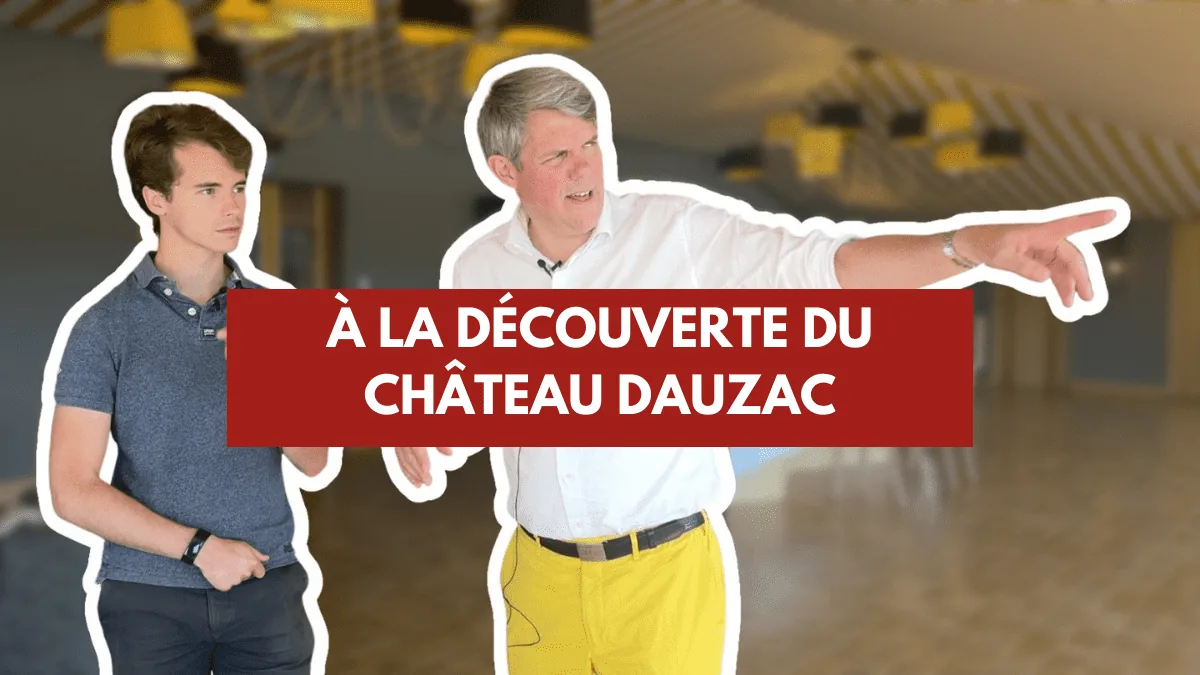
Château Dauzac is a 1855 grand cru classé located in Margaux that I had the chance to visit this summer. For this occasion, I take you to meet Laurent Fortin, the director of this sublime estate that should fill your wine cellar by the end of this interview. For the first time, I also filmed the visit of the château which you’ll find within the article. I hope you’ll enjoy this interview and see you soon!
Introduction: discovering Château Dauzac
Antoine
Hi Laurent.
Laurent
Hi. Very happy to welcome you to Château Dauzac.
Antoine
Listen, it’s a pleasure. Thanks so much for hosting us. We’ve been here since this morning. We arrived at the end of the morning to be fair, and we’re now recording this podcast. We visited a tiny bit, we haven’t gone to the vines yet but we visited a bit of the estate. We tasted together, we had lunch together and now we’re recording together. It’s the logical sequence of all that. We’re obviously going to talk about a lot of things. On one hand because you have a career that’s extremely rich on your side. We talked about it a bit at lunch, without going too deep into the detail because I’m not going to spoil myself. And also because, at Château Dauzac you do tons of things today. But before all that, can you start by introducing yourself?
Laurent
With great pleasure. Laurent Fortin. I’m 55 years old, I’ve been at Dauzac since 2013 and I run this grand cru classé with much happiness.
Watch the interview with Laurent Fortin, General Manager of Château Dauzac (1855 grand cru classé)
Laurent
A lot of things have changed since my arrival and it’s a grand cru classé that continues to evolve, that doesn’t move backwards. So we keep moving forward at Dauzac. Innovation has always been part of Château Dauzac, so we try to be innovative in the vine, in the cellar, in business, in marketing. But we’ll talk about all that together.
Antoine
It’s clear. For the people listening to us, this is one of the first times this podcast is filmed. There’s a small video on Dauzac before, but there’s also normally the entirety of the podcast available on YouTube. So go check it out. And conversely, if you’re watching, know that you can stop now and listen to this conversation with Laurent directly on your podcast app.
Laurent Fortin’s beginnings in wine, general manager of Château Dauzac
Antoine
Laurent, when did you start taking an interest in wine?
Laurent
A very long time ago. A very, very long time ago, I was lucky to have a grandfather, a father who were lovers of wine, who introduced me to wine in small doses and with moderation, it must be said, always I think in France. And I was lucky to enter a group called the Pernod Ricard group after my studies, or during my studies I should say. And that made me much more aware of both wines and spirits, mixology, all this French art of living.
Antoine
So it came to you both very young and during your studies. Was there a moment when you said you wanted it to really be part of your life? Or did it happen more by chance through the encounters and discoveries you made?
Laurent
So it happened by chance through encounters or depending on the discoveries of the various positions I had within the Pernod Ricard group. The trigger? The real big trigger. I’d already been in wine for many years. I had already built an import and distribution house in the United States, but it was the first estate I managed, in Sonoma. The trigger of production, the trigger of terroir, the trigger of discovering everything wine can be. We can talk about wines, we can sell them, we can market them as much as we don’t live a real season that starts with pruning and ends with the harvest. We don’t know wine. We talked about it at the table together. You’re a few decades younger than me. With wine, you never learn everything, and that’s what’s extremely interesting.
Laurent
Because what I discovered at Sonoma wasn’t applicable to the estates we then had at Napa, wasn’t applicable to what I managed in Argentina, in Chile or what I’m experiencing here at Château Dauzac or what I’m about to experience at La Bégude, in Bandol.
Antoine
Yes, it’s clear. I often talk about it because it’s really one of the elements that struck me most in this wine world. When I really started taking an interest, I told myself that after ten interviews, I would have done the rounds. And in fact, that’s far from the case. And especially, every time I meet new people, it’s always a lesson in humility, new discoveries. We’re far from knowing everything, we don’t know everything. We still have lots of things to learn each time and I think it does me good as a person. But it’s also super refreshing each time we travel because we realize there are tons of things to discover, tons of things to do all the time.
So you discovered that gradually. You had the opportunity to direct this first estate. How did that happen?
Laurent
Acquisition circumstances, asset diversification, external growth. And there you go, you’re French at the other end of the world managing your career on import, distribution, marketing, etc. And then you’re one of the few to fully understand both commercialization and distribution and then they put you at the head of the estate. And there you have to learn very fast because you have technicians in front of you, in front of you people who spent their lives in the vineyard. So you dive into the books, you sleep little, you work a lot, but you said something very true. It’s humility. You have to be extremely humble in front of the terroir. I often say and it makes people laugh, “we’re peasants.” It’s true, we’re peasants. Even in a grand cru classé, we’re peasants, we’re not safe from a storm, we’re not safe from hail, we’re not safe from frost. Whatever the estate, whether it’s a premier grand cru classé or a tiny vineyard in the depths of Aveyron.
Laurent
So humility must be the key, respect for the terroir, respect for the people working on the terroir. The terroir, what is it? It’s the place, it’s the climate and it’s the knowledge of the professionals who have been there for decades taming this terroir. And our role is to give each year to each vintage the quintessence of the terroir. Do everything that’s best, everything that’s possible to do best on this terroir on a given vintage.
Antoine
Yes, it’s clear. For the people listening to us, that’s a beautiful first lesson we can draw from this podcast, that terroir isn’t just geology or geography, it’s not just a place, it’s a place combined with necessarily the climate, the weather and what can happen, the temperature, the exposure, the more or less recurring climatic hazards that can happen on it. But it’s also the hand of man who has shaped this terroir for years and years, whether through a viticultural technique that influenced the vine or through the type of grape variety that’s planted, the type of treatment we can apply. In Burgundy, there’s the delimitation of clos. Here, in the Bordeaux region, there’s even the limitation of the appellations. We talked about it earlier. But you typically have an example on the range of wines from parcels that are more or less on one side of the road, that make it so there are different categories.
Antoine
How old were you when you took over the direction of an estate?
Laurent
About thirty years old.
Antoine
What does that do to you at that age?
Laurent
Very afraid. Yes, yes, you’re asking me a question. It’s going to be very, very afraid. Because you’re facing agricultural workers, viticultural workers, technicians who have been there for some, two or three generations. Which was the case here when I took over Château Dauzac. We had for example here at Dauzac two generations of the same family who worked in the vines, you’re not going to teach them anything, you have to listen to them. We’re lucky to be born with two ears and one mouth. It’s to listen twice as much as we speak and you have to listen to the winemaker. It’s a management method I’ve had for years and years. I’m absolutely not in an ivory tower. I never stopped being close to the winemakers, close to the men and women of the cellar. We learn a lot by listening, by listening, because they’ve lived through countless vintages. They know all the parcels, they know. We talk about intra-parcellaire. Here, we vinify, we harvest intra-parcellaire.
Laurent
But the parcellaire, they’ve known it for 40 years. They know full well that the rows at the end ripen faster than the rows in the middle of the parcel.
Laurent
They don’t need tools, multiplexes, electronic tools to know that. So you have to listen and use something I quite like, which is peasant common sense. So humility, peasant common sense. We’ll add other elements during the podcast.
Antoine
It’s funny because it’s sometimes something we lose, peasant sense, particularly in some fields, in some industries, we sometimes want to go look much further, capture much more data or things like that. Whereas in fact knowing that a parcel or a piece of parcel that ripens more than others and so we have to harvest it first. In fact, obvious, but it’s at the same time sometimes hard to justify.
Antoine
So you were in the United States at that time? Is there something you learned in the United States 20 years ago now that serves you today? What do you take from that experience, from those first experiences?
Laurent
Oh my god, the podcast won’t be long enough to express everything I learned during my career until now and everything I still have to learn. I’m a partisan of what’s called, we’re going to change place, kaizen. Kaizen is a Japanese philosophy of perpetual improvement. What you learn, speaking of humility, is in contact with people. It’s in listening to people. It’s in tasting your colleagues’ properties. It’s in listening to your colleagues, it’s in getting out of your comfort zone and going to taste other wines once you’ve tasted the surrounding properties. The wine world is a global world. We talk a lot about globalization. The wine world, we’re really in globalization. You take a cru like Château Dauzac. A Château Dauzac, that’s 87% export these days, 39 countries some of which are wine producers. You have to go taste what these countries do. You have to go discover what these countries do. We’re sometimes on the same grape varieties, different terroirs, but vinification methods that are sometimes quite similar. What did I learn? I learned to be close to others and to listen to and discover others.
Laurent
I’ll take a concrete example. I was lucky to manage the southernmost vineyard in South America at Vallée Perdido. It’s a site in Argentina, a pinot noir, a pinot noir when you taste it that resembles a rosé so much it’s clear, mounted at southern temperatures. The climatology is absolutely perfect for a pinot noir. So understanding how far a pinot noir can go, to what level you can vinify a pinot noir? To what tasting degree? What organoleptic degree? Maybe a pinot noir. But for that, you need to know the basics a bit. You need to know Burgundy, you need to know other great regions of the world where pinot noir is made, Oregon for example, where you discover lots of things. And we talked about that a bit at lunch. The wine world is an extremely complex world. And again, humility and listening.
Antoine
So, in what you’re telling me, you were in Sonoma and just after you went to South America.
Laurent
Same company that had done external growth. And in the United States, it’s good form to have a fairly extensive portfolio. So effectively, we had French wines, we had American wines, Napa and Sonoma, etc. We had Argentinian wines, Chilean. But Argentina, that’s not just Mendoza, it’s not just cot, what’s called malbec. There are other, there are other terroirs. We’re talking about a country that’s absolutely gigantic, so you have to discover them and you have to go offer our American clients at the time different wines. You have to go. I don’t really like the term educate, but you have to go make different grape varieties, methodologies, terroirs discovered by our consumers.
Antoine
It’s funny because from the outside, I have the impression that making wine in Western Europe, but generally in the United States, you’re on cultures that can be ultra close. But I have the impression that South America, in terms of production, must be completely different.
Laurent
You have both. You have in production the very high couture on the small terroir. We were talking about Vallée Perdido, it’s a tiny vineyard, and you have the big bodegas that do more than 1,000 hectares found in the Mendoza plain. It’s two diametrically opposed approaches. It’s the peasant of the Beauce and the peasant of Tarn. Both make wheat and don’t really work the same way. They don’t necessarily have the same tools. There’s no value judgment at all, at all. There’s one in productivism, the other more in a slightly more boutique approach.
Antoine
Yes, it’s clear. So United States, South America, you told me a bit earlier that you also traveled a lot in Asia or worked, in any case, in Asia. That was after?
Laurent
It was before. I started my career in Asia within the Pernod Ricard group. So I left the Pernod Ricard group at the end of 93 to set up my own import and distribution house in the United States.
Antoine
And it’s when you were in Asia that you got close to Japan a bit?
Laurent
Absolutely, absolutely a Japanese philosophy. It’s a philosophy of both work, but it’s also a life philosophy. We’re all at one level, whatever it is, and we all try to progress and you have to know how to always build and always progress. You have to move forward. Whether for wine or for life. We’re not going to do a podcast on philosophy, but we’re not far from it though.
Antoine
We could. Subscribe, it’s a new podcast coming. You came back to France just after Argentina?
Laurent
I spent 20 years in the United States. So I have dual citizenship. I’m Franco-American, I have the small blue passport. The great class is when you arrive there. You don’t need to wait in line and we don’t need to wait in line either. In France, when you come back to France, you take your French passport. Notwithstanding that, the United States taught me a lot of things including pragmatism. It’s a people that acts with a lot of pragmatism. It’s a people that questions itself. It’s a people that’s in the movement. So you have to be able to be innovative. You have to be able to think differently. You have to adapt to methodologies, whether management, life, that are different. We’re very far from old Europe.
Antoine
It’s clear, it’s clear. In any case, from a business standpoint. We regularly bring things from there and I think the podcast in France became a trend two or three years ago, we really started having the emergence of really big podcasts. The emergence even of podcast consumption whereas in the US it had already been seven, eight years.
Laurent
I’ve been listening to podcasts on NPR for ten years that I downloaded back then on Apple, now on Spotify. Yes, it’s been more than ten years that it exists but we’re getting there in France. A bit later. But ours are very qualitative, especially yours.
Antoine
They don’t have ones like that in the US because they can’t go as easily into vineyards as beautiful as ours. So you spend 20 years in the United States, you come back to France. Is that when the Dauzac opportunity is born?
Return to France and arrival at Château Dauzac
Laurent
No, it was only 24 months after my return to France, I came back to France to help a union of cooperative cellars. We were talking about productivism. There, in this case, we were in productivism, a union of cooperative cellars that’s in the Gers, that does extremely qualitative things. But with 5,300 hectares of vines, here, I have 49; 200 employees, here I have 40 and that vinified 450,000 hectoliters of wine per year, that’s 70 million bottles. Here, I make 300,000. That taught me the world of cooperatives, full of lessons, and other ways of managing big production units. It’s not uninteresting at all. On the contrary, you have to know how to do both.
Antoine
I’m not as involved in this milieu, but I have the impression even that it’s ultra interesting for smaller surfaces or smaller volumes. Because I have the impression that in those companies you learn to do the same level of quality at scale on big volume, to really have processes that are framed ultra-precisely and on which you can have no deviation because you make volumes that are so important.
Laurent
We have processes here too in châteaux that are really, really, really scrupulously respected obviously.
Antoine
OK that’s fine. But what I can say is that I think you learn a production process you don’t especially have in all small châteaux. Here, it’s château, we agree because 50 hectares is already a lot, but in smaller units in which it’s a bit less respected or a bit more done by feeling, less documented year after year, etc. And I think these are things you learn that are ultra ultra useful for this kind of structure.
Laurent
And then there are bridges. There are things I have and that I learned at Plaimont to name it, which is this union of cooperative cellars that’s an excellent excellent union, but we’re on volumes that are totally different. After it’s other functions, it makes a whole production basin live, it puts forward several appellations. We’re not at all in the same approach to wine that we can be on a grand cru. And there, again, there’s no value judgment. That’s not at all the point, we’re not at all in the same, in the same court.
Antoine
Speaking of which, you planted ungrafted vines here, was that your initiative?
Laurent
Yes, that was my initiative. You should know that at Château Dauzac, we have exactly the same parcels as at the time of the 1855 classification. With the exception of two hectares that were bought back in 2015. We’ll go back a little bit to my arrival at Dauzac in 2013. I’m passionate about terroir, I’m passionate about ampelography and the two go hand in hand. If you don’t put the right vine in the right place, you’re not going to do much. So we did electrical resistivity tests to really understand the composition of our terroir. Which made us evolve a bit and step out of the framework of what Bordeaux usually does with a second wine, we’ll talk about it again. So same approach, we had the opportunity to buy on top of the Labarde plateau, an exceptional Margaux terroir. Two hectares so, same thing. We buy. Electrical resistance test. It turns out that on one of the parcels that hadn’t been planted since 1954, totally isolated from the other parcels and I think you’ll do a video later of these parcels. We have fine, deep gravels, we do some core samples, no phylloxera, so we take the risk of planting ungrafted vines from massal selections of our best cabernet sauvignon. Plant heritage that’s accustomed, I should say, to our terroirs.
Visit of Château Dauzac
Laurent
And we replant, it’s ungrafted vines. First vintage 2021 that we just vinified, that we started having tasted. So there, we’re talking about tiny, tiny, tiny volume, fifteen hundred bottles. We’re far from hundreds of thousands of hectoliters. We did it originally absolutely not for needs or basely mercantile desires. No one has tasted an original cabernet sauvignon. The rootstock, as you know which goes in the ground, is a filter, so you don’t have the quintessence of the terroir. And the rootstock sometimes works in dichotomy with the graft. You take an example, you take your rootstock, you do the graft to the foliar surface that takes off all of a sudden. You have the root system that takes off on this side. When you plant ungrafted vines, you notice that the ungrafted vine will first develop its root system, its hairy roots, and two or three years later, the foliar surface will start to come out. There isn’t one that works to the detriment of the other. It’s the same plant. So by definition, it works for itself, it anchors in the soil. And there you have mouth feels on these wines that are unlike any other. So it’s true that the idea of planting ungrafted vines came to me following what I saw on the pre-phylloxera vines of the Pyrenean Piedmont. Undeniably. I had the unbelievable luck to find this hectare of vines, to be able to understand that we have an exceptional terroir and to be able to plant ungrafted vines there, moreover with the emblematic grape variety of the Médoc which is cabernet sauvignon.
Antoine
It’s an experience that’s incredible.
Laurent
It’s incredible and we learn. We learn a lot, we learn through observation. I’m telling you about the vine that will first develop its hairy roots, then its root system, then its foliar surface. And we notice that at the very beginning, we have very small clusters, the first years, very small clusters, with very small grains, very compact clusters, but clusters that resist mildew, but with little productivity. And I think year after year, we’ll learn and learn and learn. The goal? So yes, it’s true that wine, we sell it. It will be put on sale in 2023 for the 2021 vintage. But year after year, we discover something different and new with this parcel. And I think that eventually, it’ll help us for the rest of our parcels. So we were talking about electrical resistivity tests. I did it on the estate as a whole in 2013. A vineyard of 49 hectares, Château Dauzac is 120 hectares of one piece. It’s one of the largest properties of the Médoc. We’re 25 kilometers from the center of Bordeaux.
Laurent
Understanding a 49-hectare terroir, it wasn’t coherent to me to have a terroir of one piece where we make the same wine everywhere. It’s not logical actually, you have the Labarde plateau, you have water descents, you have an orientation facing the Gironde. It wasn’t logical to have the same terroir. So electrical resistivity test, it works like a radar. It’s the radar principle. We send electricity into the soil, there’s a resonance that happens. And you know where the water table is. You know the composition of your soil. So immediately, we understood that the great wine Château Dauzac is made on top of the Labarde plateau, 20 hectares. These are complex gravelly soils that are about fifteen meters deep.
Laurent
When you move a bit away from the Labarde plateau, you have sandy gravels that form a crescent around the Labarde plateau. There, we have another Margaux called Aurore de Dauzac, which is more on fruit, more on lightness. You tasted it. When you get closer to the property, there, you’re still on gravels, but gravels that are a bit more clayey. And there, you make another Margaux which is La Bastide de Dauzac. So on this 49-hectare terroir, it wasn’t logical to make a first, 2nd wine, 3rd wine, 15th wine, I don’t know what. We had to work the Burgundian way. We learn from everyone, we learned from Burgundy. Talking about Burgundian climats, that’s exactly it. So we learned from our Burgundian colleagues. And at Dauzac, since the 2013 vintage now, we make Château Dauzac, Aurore de Dauzac and La Bastide de Dauzac which are the two parcel selections, our Haut-Médoc. And now of course, the original cabernet sauvignon which is our ungrafted vines.
Antoine
I find it pretty spectacular because we have rather the vision of the opposite movement, particularly in the great properties of the Médoc, and particularly when changes of owners: I buy the château and the vines. I try to see if there aren’t vines around that I can buy to incorporate into the great wines, increase my production volumes and keep the same price and so keep a market launch that’s rather efficient. Whereas there, I have the impression that with you, it’s rather the opposite movement of, I’m going to analyze my terroir, my soil, divide. I assume it wasn’t easy at the start to work like this? How did it come to you? And how did the market then react to that?
Laurent
The question to ask is, what are we looking for? What do we want to do? We’re on heritage investments, durable investments. What we want to do is the best Château Dauzac, on each vintage. We have no volume constraints. We’re grand cru classé in 1855. That brings more obligations, more duties. We must be different, we must do better. Year after year, I’m telling you about kaizen. We’re on learning and permanent improvement. No one would prevent me from doing the 49 hectares and putting a Château Dauzac label. But you see, when there’s the name Château Dauzac I want the consumer who’s in Paris, in Vesoul, in Shanghai or in New York, to know they have the best of Château Dauzac terroir. So very simply, we’re not here to do volume. We’re here to make a great wine and parcel selections that are tasted at other moments than the great wine.
Laurent
You tasted our Haut-Médoc and there’s no cultural or vinification difference with the Margaux. We make the best Dauzac possible. Château Dauzac is a brand, it’s a quality commitment. When you drink a Château Dauzac, an Aurore de Dauzac, a La Bastide de Dauzac, the Haut-Médoc de Dauzac, it’s quality you drink first.
Antoine
So there was a change of owner when you arrived. It happened almost at the same time?
Laurent
No, I arrived in 2013. The property belonged to the Maif group, the mutual insurance of French school teachers, which was the owner since 1988. They self-managed from 1988 to 1992. In 1992, there was a frost that decimated all of Bordeaux. So they created an operating company that they gave to a well-known Bordeaux winemaker, André Lurton, who was at the origin of Pessac-Léognan. Great great great man of vine and wine. And the Maif decided to take back control upon my arrival in 2013. And the cession of the Dauzac asset to Christian Roulleau and his family took place in 2019. I’d already been there for some time and I’m still here. The vision of Christian Roulleau and his family is to continue what was undertaken by the Maif, to continue with the same management team of which I’m part, to continue making quality. What interests us is always quality. We have no obligation of volume, it’s that we make the best Château Dauzac possible every year, that we make the best Aurore, the best La Bastide and the best Haut-Médoc.
Laurent
And if to my mind, it’s not good enough to have the Château Dauzac stamp, it’s sold in bulk.
The relationship with Christian Roulleau: owner of Château Dauzac
Antoine
How did the meeting with Christian Roulleau go?
Laurent
I gave you his book that he wrote and I encourage your listeners and viewers to get this book which is full of lessons. The book is called Oser ou la force d’entreprendre. Because he’s self-taught. Christian Roulleau comes from an extremely humble family and managed to build the Samsic group which has, as of today, 100,000 employees. We’re talking about a real French success story. But Christian Roulleau is a man of the earth. He’s not one of those super wealthy who wants to buy a château to please himself. It’s really heritage. It’s really something he’s attached to, that his children are attached to. So the meeting with Christian Roulleau, it was the meeting of men who want to make a terroir endure, a quality terroir, who want to invest in this terroir to make the best Château Dauzac possible on an appellation that’s still extremely prestigious which is the Margaux appellation.
Antoine
What did he say when he took over this property? Did you have an exchange already on your personalities, but also on what you wanted to do together? What are the messages he wanted to pass on or the emotion he wanted to make you feel at that moment?
Laurent
So already, the exchanges with Christian Roulleau before the acquisition lasted two years. We had the time, we had the time to sniff each other out widely. We had the same philosophy. We always have the same philosophy and his mantra was, “you continue, you don’t change anything, you continue and you continue to progress,” that’s it. There you go, it’s very simple, you continue to make the best wine possible at Château Dauzac, you continue to make the brand shine. When I arrived at Château Dauzac, the wines were sold 80% in France, 20% to export. Today, we’re 87% to export. So the wine produced, between Château Dauzac and Haut-Médoc, represents in big masses 300,000 bottles. We’re not going to flood the world with 300,000 bottles. Nevertheless, the brand resonance is in 39 countries. So the brand is diffused. It works admirably well, so we continue to supply our clients. We’re finishing the primeurs campaign of the 2021 vintage.
Laurent
It’s true that for several vintages now, we’re victims of our success, that is, we sell it. The wine sells without any problem. We pass through the place de Bordeaux which has a capillarity unlike any other and which allows us to be in a multitude of countries. Whether it’s the commercial director who’s been with me for two years now or me, we travel 3 to 4 months a year to make the brand shine. So we strictly haven’t changed anything. We continue to do the same thing with the same means, because we’re extremely coherent in our economic model and in balance. We’re a small business with 40 collaborators. We continue to try to make the best wine possible, on each given vintage.
Innovation at Château Dauzac
Antoine
There’s a story Château Dauzac fits into 100%, it’s a story of innovation. Or this will to innovate, to do better, obviously, but also to discover things. Can you tell us the story of the invention of Bordeaux mixture in these vines? And can you also tell us what you do today in terms of innovation?
Laurent
So at Dauzac, innovation has always been and is always in our DNA. The Bordeaux mixture that saved French viticulture, it’s true that it was invented at Château Dauzac, with this mixture of copper and lime. We have a stele just outside that commemorates this event that really helped Bordeaux viticulture and that was created by accident at the time. We’re on the chemin de Labarde that connects Bordeaux to Pauillac. The cultivation master, Ernest David, was tired of seeing the clusters by the roadside being eaten by various passersby going up to Pauillac. And one day, he said, “I’m fed up, I’m going to put copper on it.” Vines all blue, that’s not very appetizing. He noticed that these blue vines were protected from mildew. So he started thinking. How to incorporate lime. And the Bordeaux mixture was born like that. So it was a bit born by accident.
Laurent
But there are other innovations at Dauzac. The refrigeration of the harvest for example. We were at Château Dauzac, property of the Berna family which was an industrial ice maker in the 1930s. I think the 1931 or 1932 vintage, an extremely hot vintage where it was going into fermentation faster than it should, ice loaves in jute bags were placed in the middle of the harvest to refresh the harvest. That was invented at Dauzac. The transparent double staves you saw in the cellar. Everyone told us but it’s useless to have to see what’s happening in a 100-hectoliter vat. It’s a gadget? Yes, but we’ve always worked by empiricism. And there, it’s not at all a gadget. We notice that it’s extremely useful to see where fermentation starts, to apprehend the pumping over. And it’s so little a gadget that now many grands crus classés and even almost all of them, when they redo their cellars, take this option of transparent double staves that was invented here with the design office of Seguin Moreau, a great cooper, and your humble servant present here.
Laurent
So we’ve always been in innovation. We’ve always been in innovation, both in the vine, in the cellars, in marketing, in wine tourism. It’s in the DNA of Château Dauzac and I push the teams to have ideas. When we recruit a collaborator, I prefer a collaborator who comes to see me ten times a week with ideas that are more outlandish than each other rather than a collaborator who stays in their office or in the cellar. Out of the 100 they’ll suggest to me, if one day there’s a good one, well that changes everything. So we encourage our collaborators, men and women - because I’m pretty proud to be at near gender parity here including in the vine - to share ideas with us because we learn from everyone, we learn from winemakers, we learn from cellar masters, we learn from everyone.
Antoine
We often say that to ourselves, we talked about it earlier. But I created a company with four partners. I have more of an entrepreneur background and in fact, I tell myself that there’s an element I notice in the most successful people around me, which is they manage to test constantly, quickly. If it works, it works. And in fact, I think this speed of execution, this speed to say this works, this doesn’t work. This, we go for it, if we don’t go for it. Out of 100 ideas tested, 50 a year and at the end we have two that work every ten years but that are incredible successes. But that’s it, you’ve folded a market like no one would have done until now.
Laurent
You have to change the status quo, get out of your comfort zone, and that’s been a leitmotif of my career. But it’s also been a leitmotif here at Château Dauzac.
Distribution of Dauzac in the world
Antoine
You were talking earlier about the inversion of this ratio between distribution in France, distribution abroad. When you arrived, excessively majority French distribution versus foreign. Today the opposite. How do you explain that and how did you do at Château Dauzac to get there?
Laurent
So how do I explain that? First, the place de Bordeaux and the négociants of the place de Bordeaux helped us enormously. That is, the economic model linked to the place de Bordeaux and its hundred or so négociants, each having on average about ten salespeople, brings you a capillarity unlike any other. It’s one of the best commercialization tools that exist in the world, to such a point that great Californian wines, great Italian wines, champagnes now come to the place de Bordeaux to gain from this capillarity. Alongside that, the place de Bordeaux, you have to accompany it. You have to spend time, you have to accompany the market. You have to be innovative in marketing, in communication. You have to be able to have a bit of marketing budget for marketing and not a dirty word, far from it, in order to accompany them, to communicate in the local press at the other end of the world. That allows distribution to evolve and somewhere, to change your economic model.
Laurent
When we were Franco-French, we were dependent on restaurants, on mass distribution, on all these market players where the change at 0.50€ or 1€, it’s the end of the world. It’s much simpler to increase prices by 2, 3, 4 or 5€ in China, in the United States, in Canada or wherever. Rather than doing it when you’re in negotiation facing a purchasing center.
Antoine
49 hectares of vines, but in total 120 hectares in the estate. We talked about it earlier since you were showing me a biodiversity reserve, the beehives, the birds, the carp too, you were talking to me about, it’s something you’re ultra attached to. Can you tell me a bit more about precisely, about everything you do in favor of preserving the environment, sustainable development.
Laurent
A vineyard doesn’t live alone. A vineyard doesn’t live alone. A vineyard must be part of an agronomy bubble, so it’s true that at Dauzac we’re lucky to have a property that’s 120 hectares and to have devoted almost 60 hectares to a biodiversity reserve. A buffer between us and the Gironde. As, as they say in Bordeaux, all great wines face the Gironde. And Dauzac is absolutely no exception to the rule. But this biodiversity zone, which for almost ten years now, hunting reserve where you have storks that come down during migration. You have hare reproductive elements, you have the 18 beehives. I’m passionate about beekeeping. I discovered beekeeping in Sonoma when I worked there. When I arrived, I put three beehives here at Dauzac, today we have 18. We have sheep, that seems very nice. Sheep, yes, but sheep, we didn’t invent anything.
Laurent
Versailles, the lawns of Versailles were maintained by sheep in the 18th century. So the sheep at our place maintain everything in front of the château, which leaves more time for our gardener to do tasks much more rewarding for him. Again, the human is very important at our place, the human is at the center of the system. We’re one of the only grand classés to have a real quantifiable CSR policy, and that for years, years. So somehow, all this is an ecosystem, Dauzac is an ecosystem. We can’t be the champions of biodynamics, of biodiversity and for example, continue to fine our wines with animal proteins coming from egg whites. So we found solutions, we fine with vegetable proteins. Dauzac is the only one of the grands crus classés to be vegan. So a vegan wine is very good with a rib of beef, so there’s no zero issue with that. But always always in this will not to be different, but to go further in reflection.
Laurent
And when you have a strategic plan as our Ambition 2020 strategic plan was, now we have a new strategic plan Ambition 2030: it was respect for biodiversity, respect for biodynamics, respect for the environment. Today, we go much further in our approach. So we continue. There are many herbs that serve us as decoctions for the vineyard, that grow here at Château Dauzac. I’ll take another example, we have a neighbor who breeds organic Bazadaise cows, who makes hay here, at our place, we give him the hay. He gives us the manure for the vineyard. In terms of carbon footprint, we’re 20 meters from each other. It’s fine, we don’t, we don’t have much to lose and that allows us to be coherent with ourselves. When you set up a biodiversity system, it has to work in the vineyard. It has to work outside the vineyard. So we try to be coherent with the discourse and we are coherent with the discourse.
Expansion and discovery of new regions
Antoine
We didn’t talk much in this podcast, more talked earlier and at lunch. But you also export differently this time, but in Provence, you’re opening at this very moment a new estate on site. Can you tell us a bit about it? So we promised to do an episode two. Earlier, so we’ll have the chance. It’s a teaser for the people listening to us.
Laurent
Yes, it’s true that I invited you both to Provence. We had with Christian Roulleau and his family, we had a project of finding a property in Provence. Not just any property. It had to correspond to specifications very similar to that of Château Dauzac. Heritage, an agronomic bubble, a property unlike any other, a bit of space. We’re both convinced that real luxury will be space, more and more for all the reasons we know unfortunately today. So after almost 18 months of research, I multiplied the round trips between Provence and Bordeaux. We acquired the Domaine de la Bégude in Bandol, an absolutely sumptuous property of 500 hectares, located between La Cadière d’Azur and Le Castellet. It’s a property that belonged to the Tari family, owners of Château Giscours which is on the other side of the Labarde plateau.
Laurent
I could have crossed the Labarde plateau and asked them, but well, that required a bit more work than that. And it’s a property today planted with about twenty hectares. We’ll manage to plant about fifty hectares. It’s the highest property in altitude in Bandol, 400 meters and the most northern. So we make very fresh wines. We were talking about ampelography earlier. We have the conservatory of Mourvèdre there. At La Bégude we make the three colors of red, white, which are very fresh whites due to altitude, and rosés, but which are gastronomy rosés, so rosés a bit more in color, that resemble red wines a lot. So yes, it’s a project that will require a bit of time. You see, it took me ten years to bring Dauzac to the level we’re at today. So there you go, I still have ten years of work ahead of me at La Bégude, without necessarily letting go of Château Dauzac. But these are projects that have coherence.
Antoine
Are you going to use the same method, soil analysis, restructuring?
Laurent
We started. I think there’s no recipe and knowing there’s no recipe is sometimes interesting, it allows seeing something else, but we’ll set that aside. Today, La Bégude, we’re not on a terroir like Dauzac where you have 49 hectares of one piece. We’re on restanques which are terraces with Mourvèdre with others, cinsault, etc., and with really very very different terroirs. And I’ll welcome you with a lot, a lot of joy to show you the differences in terroir. And there it’s really, really something unlike any other. So we find ourselves again on a property that’s like Château Dauzac, a gem.
What would you say to Laurent of 20 years ago?
Antoine
Earlier, I asked you the question, what did you learn from Sonoma? If we had to do the opposite, if you had the opportunity to pass a message to Laurent 20 or 25 years ago now, when he arrives at Sonoma, what would you tell him?
Laurent
Oh la, that’s a trick question. What would I tell him? Thanks for assailing me with a trick question. What would I tell him? I’d say you should have gone to Purpan or you should have gone to Davis to really train in agronomy, and not just read books like a beast at night in your room.
Antoine
It’s something that was missing for you.
Laurent
Yes, very clearly. I went to do a small internship at Davis after, but I should clearly have done a small study program before taking over this estate. Because it was complicated, it was complicated, we got through it.
Antoine
For sure. Is that still advice you’d give today?
Laurent
Yes, clearly. Yes. You have the best teachers in terms of oenology, in terms of ampelography, in terms of vinification. Yes, of course, of course. And very frankly, today, I’m taking online courses on another activity we have at La Bégude which is olive oil production. And we have today 1,000 olive trees. We want to plant more. It’s an industry I don’t know at all and it’s true that I signed up for courses with a chef. But my partner doesn’t know it. I signed up for online courses to really understand the way you manage an olive grove, the way you prune an olive tree, the way an olive tree produces, the way you crush olives to make oil. We can talk about it. That’s what I know now, I’m starting to master. So yes, but again, you have to learn.
Antoine
It’s clear. Me, I have immense respect for people who give themselves the trouble and the courage to be a beginner at any moment. And I think it’s something that’s really exciting in life to start something. It mustn’t be at the expense of something else, because it’s always easy to want to start something else. And I know it for many. But I find that having the courage of beginners and saying I’m starting all over because I know nothing and I want to master a new field, whether a new language, a new technique, a new industry or whatever, you must be having a feast.
Laurent
I’m having a feast. You know there’s one of the champions of management, Drucker, who said you have to take a subject every ten years, learn it all the way through and change subject after. But that, it’s true, we’re in a world today with learning facilities. With the Internet, you have lots of universities that give admirable online courses.
Antoine
If you manage to learn to make olive oil on the Internet, then everything is possible.
Laurent
Yes, but I also watch what happens on olive groves. But from a purely academic point of view, of course. They teach it to you, they explain it to you. You have tutorials, you have everything you need, you take courses in a totally sensible way. Of course.
Antoine
Stay tuned to this podcast for the birth of the Olive Oil Makers Show which will be a podcast dedicated to olive oil production and derivatives. Thanks so much for your time. I’m also taking advantage of this podcast to greet Laurent David who recommended I come see you. You both know each other well.
Laurent
We know each other well. I have a lot of respect for him, a lot of respect for the economic model he developed at Edmus and for everything he does: he really reinvented himself. He’s really an exceptional person.
Conclusion: see you next time at Château Dauzac!
Antoine
I have three questions left that are pretty traditional in this podcast. The first is, do you have a wine book to recommend to me?
Laurent
I just finished one. It’s the Oenohistoriques stories that was given to me by someone very nice called Thibaud de Prémare. Thibaut has a recruitment company called Elzéar, who’s passionate about vine and wine and who gave me that very recently and it’s a book that reads very quickly on how oenology, how wine influenced certain political, societal actions through the times. Excellent work.
Antoine
Do you have a recent tasting that stood out?
Laurent
Yes, and it’ll be related to your second question. If I have someone to recommend to you, so you’ll do both at the same time.
Antoine
In that case, who is the next person I should meet in this podcast?
Laurent
So I’m going to first answer the first question. You’re teasing, me too. The Château des Bachelards in Fleurie. In biodynamics. An extraordinary thing. I discovered this wine and I fell in love with this wine. It’s made by an admirable woman, the Comtesse de Vazeilles, who totally reinvented herself and who really changed the way Beaujolais is apprehended. We were talking at lunch about Beaujolais nouveau like that, that was part of the conversation. I advise you to taste the Fleurie of Château des Bachelards. I advise you to meet its owner. She’s a fabulous person.
Antoine
Count on me. And for the people listening to us and watching us, stay tuned and keep watching this podcast and this show since you’ll surely have the chance to meet Alexandra de Vazeilles.
Amazon links on this page are affiliate links. They cost you nothing extra, and they help me keep this going.