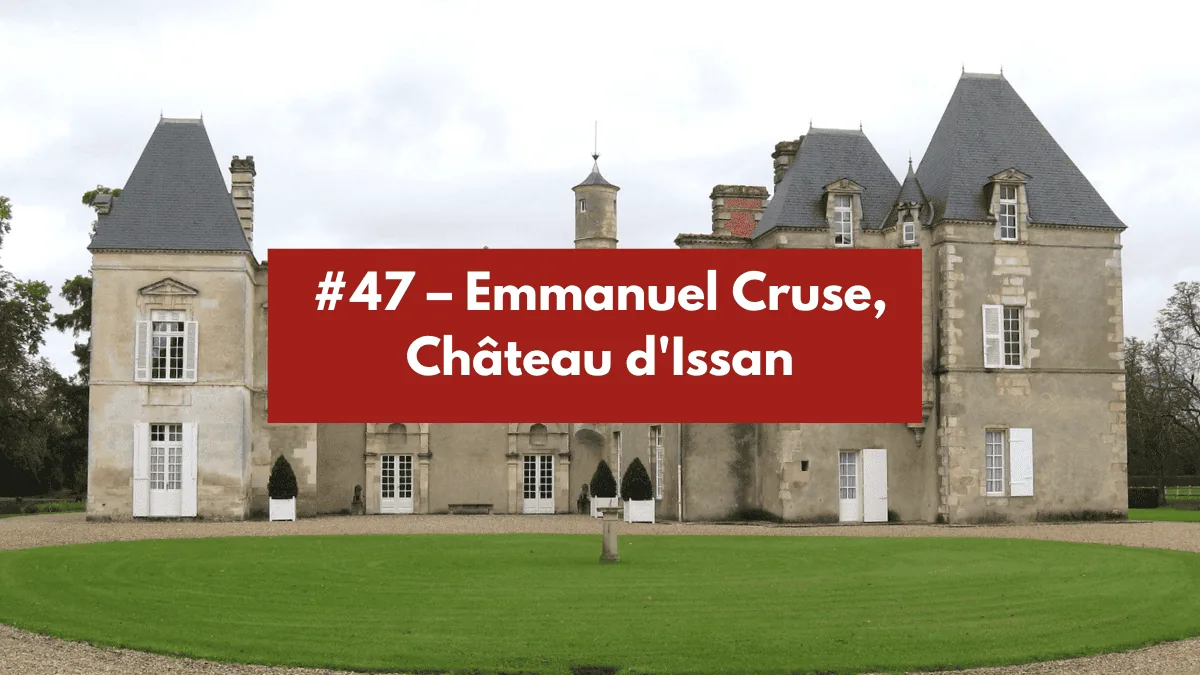
Emmanuel Cruse opens the doors of Château d’Issan, a 1855 grand cru classé based in Margaux. Over the course of this episode, we discover the history of the Cruse family, the role of Château d’Issan, and the role of the 1855 grands crus classés. We also touch on China opening up to the great wines of Bordeaux: a fascinating period in the region’s history. Château d’Issan is one of those iconic Bordeaux wines that will definitely find a beautiful place in your wine cellar.
Can you start by introducing yourself?
Emmanuel: My name is Emmanuel Cruse, I’m 52, so I’m already part of the old dinosaurs in Bordeaux, and I’ve been running Château d’Issan since 1998 when I was named manager. I started working in 1994 with my father. From 1998 onwards, I officially took the reins of the property.
Let’s dig into the period before 1998. Can you tell us a bit more about how this passion for wine came to you?
Emmanuel: I have no scientific or oenology training, unlike some other members of my family you may have interviewed, my cousin Anabelle at Saint-Émilion in particular. I have more of a bad lawyer’s training, since I studied law because my father wanted to see me embrace a career as a lawyer, ideally international, whereas in fact I’ve always been passionate about wine since my earliest childhood. Helped quite a bit by my grandmother, who let me taste, and I wouldn’t want to shock people who might be listening to this podcast, but I think my first drop of wine in a glass of water was at age 5. It was a very pale rose.
Bit by bit, the color of the liquid became a bit more intense. At age 11, I had the right, for the first time, to taste a glass of wine, well a few sips of pure wine. I always bathed in this atmosphere, in a family of négociants. I always spent my summer holidays in the family properties. Back then a bit at Pontet Canet until the end of the 70s, and then here at Issan. Although having done studies that had nothing directly to do with wine, I always had this idea of wanting to work in this world.
At first on the commercial side because I had the idea of working for a négoce house. I was about to do a final interview to be export manager for the English market for a négoce house. My father fell ill at that moment. I took advantage of the situation to replace him. Until his heart problems meant he had to retire. I was named manager after him in 1998.
So everything happened very fast?
Emmanuel: Let’s say my father’s age and health may have favored this installation a bit faster than expected. Very often in these cases and especially in family businesses, you’re told you have to go cut your teeth elsewhere and that you’ll come back one day.
Circumstances meant that, very cowardly, I took advantage to not go cut my teeth elsewhere and to stay on site.
How old were you at that point?
Emmanuel: It was in 1998, so I was 30 when I was named manager and I started working with my father 4 years earlier, so I was 26.
That’s young to take the reins of a house like Château d’Issan. It must have been a challenge for you?
Emmanuel: Yes, but I’d already been steeped in this atmosphere for a long time. In parallel my father had recruited Éric Pellon, the technical director of the property. He was about the same age as me.
If he was taking on and managing all the technical part, why wouldn’t I have been capable of taking the commercial management side of the property? So yes, I consider that it’s neither too early nor too late. At 30 you have a certain carefreeness and maturity, so it’s a fine age to start.
Antoine: Good, I still have a few years left.
What were the first projects?
Emmanuel: Overall, we took over, whether Éric Pellon from a technical standpoint or me from a commercial standpoint, a property that was a bit of a sleeping beauty in commercial terms and in the image it could give on markets.
Issan was for a very long time part of the Maison Cruse stable of properties when the négoce house existed.
So there was exclusive distribution through the family négoce house. This exclusivity ended in the early 80s, and so we had to rebuild a whole distribution scheme. Break down exclusivities in some countries, clear new ground in others, endure what I’d call at the time the Parker bashing.
So through a few négociants who agreed to help us anyway, we cleared the ground but the old way, so without having the “Open sesame” that was Parker’s good rating. It came, as far as we’re concerned, a bit later with the first vintage in 1999.
Why the delay?
Emmanuel: It’s perhaps because, for some time, the logic of Issan’s production was to make as much wine as possible to feed the négoce house.
We were perhaps a bit less attentive to selections at the time. The arrival of Éric Pellon helped us with putting the vineyard back in shape, with real complete re-drainage work on the property, much more precise work on the vineyard with also, as I said, slightly more drastic selections.
I imagined a good Parker rating from the 95 or 96 vintages, which are very good vintages for Issan. Apparently they hadn’t yet convinced Parker, who made the rain and the sunshine on the Bordeaux wine market at that time. We had to bite our lip a bit and wait.
I also believe that the style of Margaux wines, a bit finer and more elegant than those Parker was used to tasting, didn’t help us. I also think that, as he aged, his style and taste changed. We started entering the classic canons. From 1999 and 2000 onwards, we started getting good ratings. That obviously helped a lot in developing the American market. I’d already started in 96 to head a bit more to the other side, that is, the Asian market.
The wine market in Asia must have been young at that point?
Emmanuel: I feel a bit like an old man saying this, but I knew Beijing when wine wasn’t drunk except in a few international chain hotels, and rather with anglo-saxon connotations. There weren’t many cars in the streets of Beijing, apart from official cars and taxis. For sure today I no longer recognize the city I knew at that time.
How did you do it back then when you wanted to go sell wine?
Emmanuel: So, there’s something not to forget, which is that we don’t sell directly. We do tons of promotion because the sale happens essentially through the négociant. We’re a bit like luxury ambassadors. Sometimes we provide after-sales service, sometimes pre-sales service. We’ll go have samples tasted or present wines to people who haven’t yet bought or who don’t want to buy. You have to try to convince them.
It’s not us who’s going to sell it. We clear the ground a bit for the négociants because they have Château d’Issan to sell but they also have Giscours, Brane Cantenac, Prieuré-Lichine, Cantenac Brown…
Why favor one over another? It’s up to us to do the job on the ground so that the local distributor, after two or three visits, says he really wants us distributed in the country and in his shop and will buy wine.
There’s real ambassador work for our brands, more than preparing the work in front. It’s the négociant who really does that job and it’s not the easiest. We have the easy role because we don’t have the pressure of selling at the end of the day.
How did it go in Beijing?
Emmanuel: It’s our Hong Kong distributor who organized an evening at a hotel in Beijing. We got the papers through Hong Kong and made a 2-day round trip to China. There was a dinner where we found ourselves facing about forty Chinese clients. Nobody spoke English and we didn’t know if they were clients or officials.
A few make efforts, but globally they speak very little English. So you give a speech to people who understand you little or not at all. They didn’t have the knowledge of wine at that time, nor the feeling of how to taste it. At the time it was the big development of cognac in China, so they’re used to drinking cognac more. They drank wine like they drank water. After two or three glasses, they were often happy, to put it mildly. From there, communication became really complicated.
There was a whole education that happened gradually on how to drink wine, with what type of food and so on. In Hong Kong, they lived under English protectorate for years. They were much more trained in tasting and conserving wines.
There were négociants a bit older than me who certainly knew even more comical episodes. It was pretty sporty back then to go promote, and I repeat, we were only doing promotion. I can’t imagine for those who had to sell. Just for promotion it was special. I imagine some négociants could tell you extremely interesting things on the subject.
What’s the distribution of Château d’Issan today?
Emmanuel: It’s pretty interesting because we just received the latest results from the survey we ran with our distributors, négociants and partners.
We received statistics from about 44 négociants. We’ve been lucky for some time to have a fairly balanced split: a third Asia, a third United States and a third Europe. I’ll give you the precise figures. Surprisingly our top market remains the United States with 29%, despite our friend Trump’s tax problems.
The second market, which is a much more traditional market with 26% of distribution, is England. Then we have China and Hong Kong, which are at about twenty percent. After that comes France in 4th position, Switzerland in 5th, Japan in 6th, and after that I get a bit lost in the figures.
We have a distribution that’s relatively stable. If it’s not England that’s number 1, it’s the United States. They alternate a bit depending on the vintages. I think the Brexit effect will perhaps play a role in 2021’s figures. In 2020, the American market remains our top market. And that despite the troubled health situation and extremely complicated political situation, the change of presidency and tax issues.
It’s pretty interesting because it’s not automatically the most loyal market there is. On the other hand, when a brand is implanted you realize it works. We didn’t have the famous 14 degrees that allowed bypassing the taxes. So we expected to see some negative effects on sales, but not at all. In 2020, the United States was our top export market.
Are you seeing new markets emerge with the same education needs as China 20-25 years ago?
Emmanuel: There’s one where there will be exactly the same problems to solve, that’s India. We need to break down barriers that are complex. There’s also the tax issue. Each state has different taxes. There’s also a real logistics problem in India. Sometimes to deliver from point A to point B, there’s 120 km and it takes 4h30. Conditions aren’t quite the same as in other countries. Then, I’d say Indian food is fairly particular and spicy, doesn’t automatically pair with wines.
The market is potentially huge. Still, 10% of the Indian population has a European standard of living. We should be able to sell some wine there. But today it’s very complicated.
There’s a market that’s in full development, that’s currently hampered by taxes, the Brazilian market. There’s perhaps more education to provide and that’s linked to their proximity to the United States, Florida. I think it’s a market where Bordeaux wines in general will have great success in the years to come.
I hope one day or another I’ll see the Indian market develop because I go there every two or three years and I’m convinced that one day or another it will end up paying off. It’s true that it’s very complicated but China was very complicated too. Today we’re still in the early days. I think the Chinese market is underexploited for now. There’s a future for distributing Bordeaux wines provided you make the effort.
When you go to India, do you go with other property managers or owners?
Emmanuel: It depends, that one was rather organized by a distributor. In India there aren’t many. There are only two or three important ones around Bombay, Delhi, and a few tourist regions where there are big hotels. So there has to be wine.
But it happens fast. We organize that with a Bordeaux négociant and a local distributor. He’ll take you around in his region of origin and maybe organize something in Bombay if he’s from Delhi, or vice versa. Those are the two big centers.
There’s also Bangalore, where there’s a whole high-tech side, so big companies, purchasing power and foreign engineers, potentially a clientele. But it remains marginal phenomena.
I stopped you a bit in the history of Château d’Issan around 2000-2001, I propose we pick up at that moment. You were telling me you were going off to conquer new markets?
Emmanuel: From that date, the journalist of the time’s ratings started to improve. That allowed us to have greater diversity in our distribution. We gradually arrive at the figures I gave you.
Thanks to the advice of Eric Pellon, the technical director I have full confidence in, I traveled quite a bit and tried to polish up the property’s image. It wasn’t damaged, but it was unknown. It was distributed by only one négoce house exclusively with specific markets, like the Scandinavian market, the Belgian market, or other markets.
It’s true that we had to reconnect a bit with local distributors to re-establish a slightly more spread out, open and international distribution of our wines while continuing of course to work on quality. If the quality of Issan wines improved, that of all our neighbors, competitors and friends also improved.
Everyone worked on the excellence side of products, so what was true for Issan was true for our neighbors as well. Despite the friendly bonds we may have with some of them, competition exists.
You can’t have all the bottles on the same table, or at least not at the same time. Twenty years later it’s rather a success?
Emmanuel: Yes, but I’d say unfortunately, once you’ve put your finger in the gear you can’t stop. It takes a long time to build, and on the other hand it can stop pretty violently. All it takes is a bad rating from a journalist, bad distribution, or a price error and you fall through the cracks. It’s then more complicated to rebuild. It’s rather a success, but it’s not because it’s a success today that it’ll be a success tomorrow. We unfortunately or fortunately have to keep plowing the field.
The problem is that, as you know, for a year to the day, we’ve been stuck with this unprecedented health crisis that has reshuffled the cards a lot in the distribution of great Bordeaux wines. There was a small moment of anguish. We wondered last year if the primeurs campaign could happen. In the end it did, and even in fairly good conditions, at least for some grands crus.
Today we’re no longer in contact with our clients. We can send them samples and exchange via Zoom or Teams, but human contact is also important. Shaking your distributor’s hand, meeting clients, that’s important and is sorely missed today.
What are your main upcoming projects?
Emmanuel: They’re relatively important since last year we expanded a bit by buying a few hectares of neighboring land.
There’s the takeover of these few hectares, which will bring quite a bit of complexity. In all of these parcels, there are also grape varieties we didn’t have before. They’ll inevitably bring a plus to Issan’s blend, in any case a plus in terms of complexity.
We’ll have to rework this vineyard and take it back in hand. Manage to integrate it into the existing vineyard, and commercially speaking it’ll soon be a year since we did anything much in terms of field visits. We hope to see the end of the tunnel next autumn.
I think from then on, we’ll have to be ready to reinvest in markets in an excessively important and precise way both in Asia, in the United States and in Europe. We realized Europe had been a bit neglected in recent years but that it was important in the primeur market launch of the 2019 vintage.
We’ll also have to count on our historic markets like England obviously, but also Switzerland, Belgium and the Scandinavian countries. They’ve been a bit left behind in favor of Asia in recent years.
Antoine: OK, so those are the main challenges.
You mentioned new grape varieties in some parcels. At Château d’Issan, it’s essentially cabernet sauvignon and merlot.
Emmanuel: There’s a bit of cabernet franc, a bit of petit verdot, and half a hectare of malbec located on limestone parcels so perfectly suited for this type of grape variety. I have to say it was a discovery, and rather a good surprise. I’m willing to bet that in the years to come we’ll talk about it a bit more in the Bordeaux microcosm.
Antoine: We can’t wait to discover that and to have the first tastings in a few years.
Emmanuel: Careful, I do say it’ll be in homeopathic doses. It’ll be a small plus. The priority grape varieties in the Médoc remain cabernet sauvignon, merlot, cabernet franc, petit verdot. Maybe there’ll be a bit more grape varieties like malbec or others, given climate change.
Are you already perceiving climate change a lot here?
Emmanuel: Yes we perceive it. We notice it even if the harvest dates aren’t moving much. The vine’s maturity and flowering are regularly ahead compared to 10-15 years ago.
There’s a climate-related effect, that’s undeniable. Today we try to pick and harvest with diabolical precision, being much more precise than 10-15 years ago. But the harvest periods haven’t really evolved, roughly from September 19th to the first week of October. There aren’t big changes. On the other hand at flowering, we sometimes see 15 days ahead or more.
Antoine: We see it right now. We’re at the very beginning of March and buds are already appearing. It’s a bit worrying if it freezes after.
Emmanuel: It’s always worrying because of March showers and possible frosts. We’ve already had frosts up to April 28th. We’re not yet out of this period of tension.
By the way, how is 2020? We’re approaching the primeurs, you must already have a vision of the vintage.
Emmanuel: I think given what I just told you, 2020 is a vintage that will mark a bit of a milestone for us. Instead of the traditional cabernet sauvignon-merlot blend, we’ll for the first year likely include a bit of cabernet franc, petit verdot and maybe a hint of that famous malbec.
I think 2020 is qualitatively superior to 2019. For us it will be by default, since we’ll bring complexity to our traditional blend while trying to keep the cru’s DNA. It’s not about completely changing the wine style. The idea is to bring a hint of additional complexity on a base of cabernet sauvignon and merlot.
Antoine: We wish you lots of courage for this approaching primeurs campaign and we hope it can go properly given the health situation.
Emmanuel: We’ll see at the end of June.
Can we come back to the role distribution here at Château d’Issan and how it’s managed? Château d’Issan is a family property, if I’m not mistaken.
Emmanuel: Yes, since 1945. My grandfather bought the property just after the Second World War. My father took care of it from 1947 to 1997. As I told you, I took the reins in 1998. From 2013, following a change in family ownership, the Lorenzetti family joined us as partners within Issan. So it remains family, two family groups, but two families.
During our visit, we did a tour of the Château. We were told there was a tradition during the harvest, which is that a large group of harvesters were Danish, because your family has Danish origins.
Emmanuel: So that’s not related, it’s linked to a visit by a professor from a business school in Denmark, who’s an amateur and crazy about wine. At the end of the visit, he had asked me about the harvests. I had answered him, a bit laconically, that it was always a bit complicated. Between the staff and the students who had to start their classes again and didn’t finish the harvests, we always had a bit of trouble having complete teams.
He told me, “If it interests you, I can bring you about fifty Danish students.” I had answered that it interested me a lot but then I completely forgot about it. Two months later, he called me telling me that he had, if we were still willing to host them, about forty students available.
We hosted these Danish students who have been coming since 2001. They’re supervised by their professor and the idea is pretty good. They’re paid like normal harvesters. Half the money goes to the school and the other half is intended for a visit to Paris, the Louvre, Versailles and various museums on their return home. When there’s no more money in the common pot, they go back to Denmark.
It’s a pretty interesting way for them to discover France while working. We’ve trained quite a few ambassadors for our wine in Denmark. All the students who have cut grapes, when the bottles are at wine merchants in Denmark or on restaurant menus, they can say they participated in the harvest of this wine or they were there… Somewhere that makes good brand ambassadors.
Isn’t it too difficult to organize in the vineyard?
Emmanuel: No, because they’re supervised by their professors who now have the habit. We assign them parcels that are rather outside the Château more accessible by bus. It goes pretty well, they’re seasoned. They find their usual tractor drivers. Two years ago, they were invited to spend a week in summer in Denmark with the professor to discover the country. There’s a reciprocity that’s pretty cool. It’s not complicated to manage at all. You just need to manage the first year well, and then you make them regular allies.
It’s been almost 25 years now that you’ve been working here. Wasn’t there a moment you said to yourself you wanted to do something else?
Emmanuel: No, because I do a job that I’m passionate about. So no, not at all, it never crossed my mind for a second. There are always moments that are a bit more complicated than others, but I assure you that at 52 I consider myself roughly young and in the prime of life. For now, I have no intention of taking early retirement.
Antoine: OK, in any case I wish you to continue as fit as possible, with as much passion as possible in the years to come.
What does the future look like for Château d’Issan?
Emmanuel: It’s a bit the same problem as for all wine properties today, we can’t wait to get out of this fairly particular situation linked to this global pandemic. We can’t wait to start back on the markets as I was saying earlier to see our clients again. We want to participate again in the global promotion of Bordeaux wines, starting obviously with those of our properties.
The future after that is to maintain this level of excellence we seek every year. And it’s true that 2020 will really be one of the very great vintages. We had this morning the last blending tasting and our consultant oenologist Eric Boissenot compared it to 2016, so that’s a pretty good reference.
The future is to continue to always try to seek excellence and the maximum of the upcoming vintage. And of course make sure to maintain as spread out a distribution as possible. You shouldn’t be dependent on a single market.
We saw this year that what greatly facilitated our task was this relatively spread out market between the United States, Asia, Europe and especially England. So I’d say keep going forward, keep seeking excellence for the wines we produce.
We talked about the 2020 vintage earlier, but we didn’t talk about Château d’Issan’s range, can you come back to it a bit?
Emmanuel: Issan’s particularity is that on the 70 hectares of vines currently planted, we have 3 different appellations: margaux which is the main one, a small part of haut-médoc and about ten hectares of bordeaux supérieur.
That brings us to producing four wines. On the margaux appellation, we have Château d’Issan which is obviously the flagship, the 1855 cru classé and therefore the spearhead. A second wine called Blason d’Issan. It’s actually a wine made from the property’s young vines. That’s for the margaux appellation.
We have fairly limited production for haut-médoc. It’s distributed exclusively by a single négociant and is called Haut-Médoc d’Issan.
Finally, we have Moulin d’Issan, which is the bordeaux supérieur production. It’s distributed throughout the world by about ten Bordeaux négociants who have been the same now for, let’s say, 5-6 years.
That allows you to reach amateurs and consumers with a completely different profile.
Emmanuel: Yes and with different price ranges, since we’ll talk about a public price around 10-12€ for a Bordeaux and rather 50-60€, even more depending on the vintages, for the first wine of margaux. We have a whole intermediate range of haut-médoc around 15-20€. And to finish, a second margaux appellation wine between 20€ and 30€.
Indeed, we touch a whole range of different clients. It’s pretty amusing because we’ve seen clients start with bordeaux, after a few years, taste the second margaux appellation wine. Eventually they switch to first wine purchases. So that allows a certain range management.
Antoine: Yes, that’s interesting.
There’s a topic we haven’t talked about, which was very fashionable in the pre-covid period and which is a bit more delicate today, that’s wine tourism. Are you open to visits here and is it something that interests you?
Emmanuel: So, wine tourism, I think it obviously needs to be developed, because today we can’t say we can develop the brand image while staying closed in on ourselves.
You have to manage it intelligently. Especially in a family property, since the family may live on site. We need to be able to adapt our wine tourism offer to our property management specifics. We can’t today not integrate it into our distribution, commercialization and wine promotion system.
Can we already come see you today, the door is open?
Emmanuel: I think you just did the tour with Marion who’s responsible for wine tourism, so you know what you’re talking about.
Antoine: In any case I invite listeners to come tour during their discovery of Bordeaux. The architecture is very pretty and the wines are very good.
Emmanuel: From an architectural point of view, it’s one of the oldest Châteaux in the Médoc, so it’s true there’s a small historic side. According to history books, the wines produced around Issan were served at the wedding of Eleanor of Aquitaine and Henry Plantagenet, who became Henry II king of England. And that ties us by the way to the English market, to come back to our distribution.
The end of the construction of the château behind me dates from 1626. So we’ll soon celebrate the 400th anniversary of the château’s construction.
Antoine: Are you already planning something?
Emmanuel: I just gave you a hint…
An interesting element we saw in the corridors is the book you made on food and wine pairings between Château d’Issan and various dishes.
Emmanuel: So, she’s not here, so I take advantage of it all the more easily, but it’s to my wife’s credit that she worked on this subject. We’re lucky to have a head chef here at the property. We realized that to receive our clients it was much easier to do it at home. And we have a site that lends itself to it.
We worked with him on a kind of harmonization, or work, between certain vintages and certain recipes, focused by season hence the title: “Les Quatre Saisons du Château d’Issan.”
We tried to marry certain seasonal recipes with vintages. I think the idea is to do a follow-up to this book in a few years. Obviously with other vintages, perhaps more recent, younger and other recipes.
Wine is part of gastronomy and the French art of living.
It was a fun way to combine business with pleasure and to give a small gift to our best clients but also to allow, in the case of wine tourism visits, we don’t have umbrellas or souvenir keychains for example, but they can have a cookbook or a bottle of wine, even both is even better.
The book is available right here?
Emmanuel: Yes because unfortunately, it came out at a bad time. It should have gone out with our greeting cards but there was a printing delay. We had thought we’d give them to our clients on the occasion of the 2019 primeurs tastings. Of course there was the health crisis, the closing of borders and the lockdown. So, we couldn’t give it out.
It’s only available at the property for now because we’re not looking for distribution through bookstore networks. We rather want it to be an original and somewhat exclusive souvenir for visitors who came on site.
Antoine: It’s an additional excuse to come to Château d’Issan. I know you have an obligation so we’re going to wrap up with the three traditional questions of this podcast.
Do you have a recent tasting that stood out?
Emmanuel: Yes, no later than this morning. The final adjustments to the tasting concerning the 2020 vintage blend. It’s complicated to say, people will think it’s because it’s the next vintage to be sold. This 2020 vintage, for the first or second wine, is among the most beautiful successes of the Château.
There’s also this exceptional side of finally being able to add new grape varieties, and to make our blend more complex. I’d say that was the favorite of the day.
I also have an old memory I often cite, it’s the first bottle of Château Latour. It was actually a magnum of Latour 64. It was the first time in my life I was drinking Latour. It was during a tasting as an intern at a négociant in London. It was an exceptional moment because he grabbed this bottle as we’d grab a bottle, I won’t say of Abatilles, but not far off.
I had already drunk other wines from great names before, but that was the first time so it was a beautiful memory with Latour 64.
A book to recommend to me on wine?
Emmanuel: Jane Anson’s latest book, which is relatively well documented, very objective. I think it’s the future bible of Bordeaux wines.
Antoine: Yes it’s a very beautiful book.
Emmanuel: It’s an Anglo-Saxon author and it’s important to see that Bordeaux remains at the heart of Anglo-Saxon authors’ concerns. Jane Anson is an author and a very great taster who knows Bordeaux wines perfectly well.
Last question, who do you recommend I interview in upcoming episodes of this podcast?
Emmanuel: I think Jean-François Moueix would be the ideal person, if it had to be a négociant. I also recommend Philippe Castéja, who is currently the president of the Conseil des Crus Classés. He’s also at the head of several négoce houses.
If we had to turn to the property side, Jean-Michel Cazes but you may have already interviewed him.
Antoine: We’re seeing him Friday actually.
Emmanuel: He’s the memory of the Médoc right now. Like that off the top of my head, I haven’t thought about it too much. I’d say obviously perhaps Éric de Rothschild too because he’s a very great gentleman of wine. He took Lafitte to peaks and it remains a family property too.
Antoine: I won’t fail to contact them and I’ll say I’m coming on your behalf, so that’ll greatly facilitate things for me. Thanks so much Emmanuel, honestly it was a pleasure.
Emmanuel: Thank you, and I hope to see you very soon!
Antoine: Likewise, see you very soon.