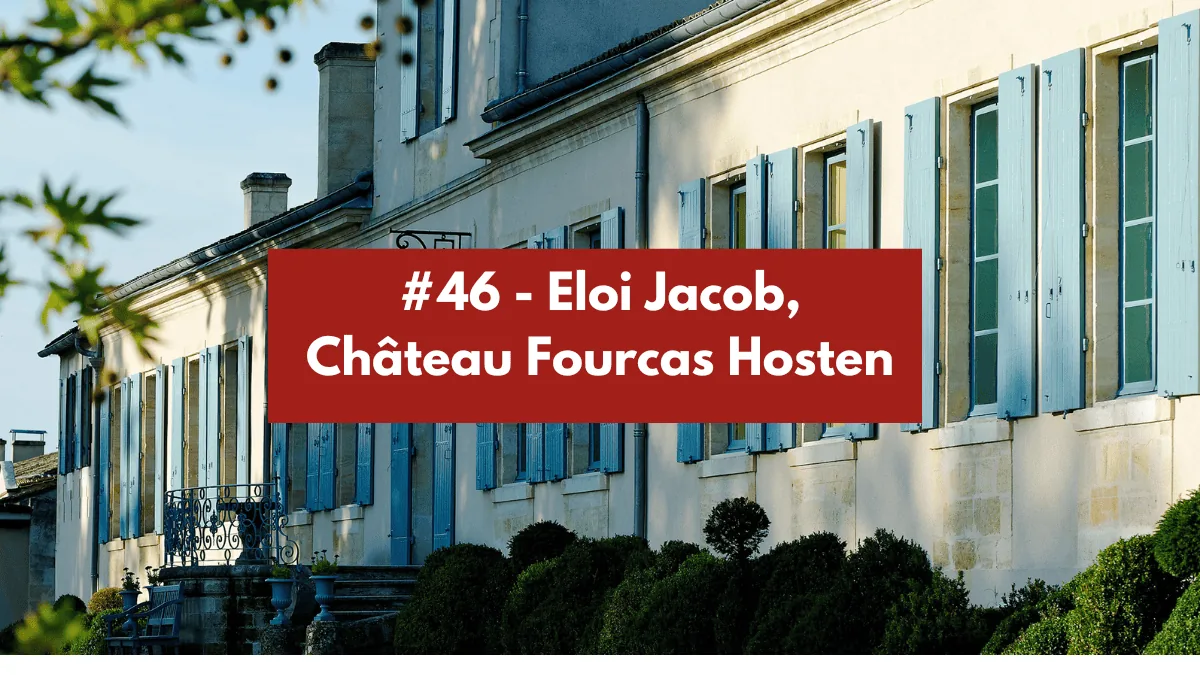
In this new episode of the Wine Makers Show, Eloi Jacob opens the doors of Château Fourcas Hosten. A chance to discover this terrific property, converted to organic farming, where every plot is known by heart by the team. Authentic, the welcome at Fourcas Hosten was truly superb, and I’m convinced some beautiful bottles from the château will find their place in your wine cellar.
Can you start by introducing yourself?
Éloi: My name is Éloi Jacob and I’m the general manager of Château Fourcas in Listrac-Médoc. I come from Brittany and my father was a farmer. That’s what brought me into wine. My goal was to take over the family vegetable farm. I didn’t take it over, because my parents advised me against it. They pushed me to continue my studies and I went to Rennes. I got into an agricultural engineering school in Bordeaux, ENITA Bordeaux, which is now “Bordeaux Sciences Agro.”
When I was in Rennes, my geography teacher in preparatory class would have us taste wines from all over France. He gave me this passion for wine. I took the viticulture and oenology option in Bordeaux. After that I did my studies from 2000 to 2003 and did an internship in California to open my eyes to the wine world. I made wine in the Côtes du Rhône, in the Côtes du Ventoux to be exact. I found a job in Côtes de Bordeaux.
Then I worked for a group of American investors. I technically managed their vineyards in Saint-Emilion, in Pomerol, and in Côtes de Bordeaux at Lalande-de-Pomerol. There were about a hundred hectares. I ended as general manager, setting up wine sales from 2013 to 2019.
In 2020, I arrived in Listrac after meeting Renaud and Laurent Momméja. They were looking for a general manager who had technical knowledge to manage their wine estate and who had the will to work in organic and biodynamic farming. The pairing, a bit like food and wine, happened quickly. We got along very well because we share the same way of seeing things. We have the same way of approaching the wine world. You have to practice and each year is a different experience.
How does it go when you’re from Brittany and you arrive in Bordeaux? Bordeaux is often said to be a relatively closed place compared to the rest of France or other regions. How did this integration in Bordeaux go?
Éloi: For me it went very well. In the class I joined at ENITA in 2000, out of 100 students, there were 15 from Brittany, a Breton clan. The wine world is a small world. It’s vast, and at the same time it stays small too. When you enter this world, you all rub shoulders fairly quickly. There’s an agricultural mutual aid spirit, you might say, even if you’re in Bordeaux. And in particular, the school’s alumni help younger people integrate into this world, and there’s wonderful mutual aid. So Bordeaux integrated through wine, very easily.
Can we come back to this experience in California? We’ve talked about it in some podcasts because it’s one of the world’s great wine regions. What did you discover in California?
Éloi: To be totally honest, I went there to brush up on my English. Brittany may be close to England, but we struggle to express ourselves in English. I went to California for that and my biggest surprise was speaking Spanish for 3 months. The whole workforce was Mexican. I didn’t necessarily progress in English, but I made huge progress in appreciating winemaking. Their biggest issue in California is winemaking. The climate is fairly simple, it’s very nice and very hot, so you have to irrigate to make up for the lack of water.
It’s not the same viticulture as in Bordeaux, or in France, where we depend a lot on climate hazards, but that’s also what makes the richness of Bordeaux and France. In California, there was a very technical handling of the way to make wine, with teams made up of Mexicans who operated by feel. There was a lot of very simple work, like managing winemaking, harvest, aging… It’s completely different from what I get to live in Bordeaux. Whereas in California it was 80% cellar, in Bordeaux it’s 80% vineyard. If you want to perform in Bordeaux or in France, you have to be in your vineyard.
What comes through from previous interviews, and about California in general, is this idea that anything is possible. Is that something that struck you?
Éloi: Yes, it’s a bit more industrial you might say, but it’s also very experimental. They’ll buy harvest, different grape varieties, and for example they’ll say: “This year we found some Zinfandel, we won’t put it in the vat because we don’t have enough, we’ll put it in small bins outside.” We receive the harvest but reception isn’t ready, everything is done a bit hastily, but everything is possible. It’s the American mentality of saying “Don’t worry, we’ll get there, we’re very strong.”
It’s surprising, compared to here. I often compare it with my current experience, which is more significant than in California, where we try to calculate everything, but we depend a lot on climate hazards. In the end, we planned a Plan A, B or C and it might be Plan D or even more. In California, anything is possible and there’s no limit, but not in the negative sense. They experiment to move forward, and they may have a good lead.
Antoine: That’s clear and it’s certainly a place with a less present historical heritage. It’s easier to say that this year we’ll do it this way and we’ll see. Here, it can be a bit more complicated to change everything suddenly. We’ll come back to certain aspects, on the organic side of course, but also on the biodynamic side at Fourcas Hosten. I sense that’s relatively new in the region. There are a few estates that take it on, but it’s pretty new. In other regions there’s perhaps a bit more lead on biodynamics as such.
You came out of ENITA in Bordeaux, and you started working in the vines for a major group. What were the first sensations of work, the first days on site?
Éloi: I didn’t take my oenology diploma because I wanted to quickly get back to fieldwork. My first sensations were a bit of living the same things I’d lived when I was at my parents’. It’s working the land, it’s hard, it’s like vegetable farming. You have to bend over constantly. I replaced missing vine plants for example, you have to bend in two to make holes in the earth. That’s what we call racoter.
For me, it wasn’t a difficulty, but rather rediscovering what I’d already lived before. It made me smile when I’d hear people say: “The vine is hard.” I wanted to say: “But you know, cauliflowers are even harder, because you have to be even closer to the ground.” I rediscovered what I’d lived earlier. For me, it was a common point with the vineyard activity, and after that an opening with exchanges between properties.
The difference between viticulture and agriculture in general is that we share our product. That was something that really opened my eyes about sharing with neighbors and with neighboring appellations. You present what you produce, you share it, you exchange, you’re not necessarily competing. You’re rather there to push each other up, whereas you’ll rarely share your cauliflowers or your tomatoes with the neighbor. So that’s a very positive point in viticulture in general, this sharing of wine.
What did your parents think about you going off to Bordeaux, far from Brittany, far from cauliflowers and into the vines instead?
Éloi: A look that said: “Maybe one day he’ll plant vines in Brittany.”
Antoine: Is that planned?
Éloi: No I’m joking of course. It’s started, but it’s not my goal. It’s a pride I think, because I did what they told me to do; that is, continue my studies and have a job that excites me. Which is the case. I wanted to continue in agriculture, but it’s true that wine is another dimension. There’s a product that you present, you travel, you go a bit in all directions you might say. We don’t just produce, we produce and we have to showcase this product. They live it as a pride. They share all the products I’ve been able to make during my small experience so far.
Antoine: Do you have them taste?
Éloi: Of course, and they order. They’re my best customers.
Antoine: That’s a good sign.
How did the meeting with the Momméjas, owners of Fourcas Hosten, go?
Éloi: They created a position when the technical director left. So it was to take over the technical part, but also commercial and administrative. They went through a recruitment firm and I met them after passing the selection stages. The first meeting struck me in the sense that they’re very human people, close to people, who aren’t simple owners. I felt they were very invested, that this is the property they’ve put enormous energy into and that they always have the will to make it progress.
The first meeting happened first with Renaud, then with Laurent, and then both. Each time it went very well. It’s hard to express because it’s as if I’d known them for several years. We have the same way of expressing ourselves and seeing things. They’re fairly discreet people, who don’t impose themselves and have a strong will for the property. It’s pretty common with what I’d done before, like organics, biodynamics and respect for the environment with the will not to leave a negative trace of their passage on earth, but also on the property.
Antoine: It’s very interesting.
What you were telling us earlier, was how knowledgeable they are about the property, how they regularly practice and how they know the detail of each plot.
Éloi: Yes, that’s what makes the difference with other properties. Renaud directed and still directs the property and he’s invested a lot in all the strategic choices to make it evolve. As I was saying, wine in Bordeaux is mainly made in the vineyard. To be able to make a great wine, you have to master your vineyard, know your plots and their names. It’s true that on my first day of work at Fourcas Hosten, which was during lockdown, I had the presentation of the vineyard. Renaud knew the start and end of each plot, its name, the planting years, the grape variety, but also its history, and that reassured me because they’re really invested 200% in this project.
It’s important and these are things that are nice to see when you direct the property or when you work there, having this connection.
Éloi: Yes completely, and they’ve also built a team that already existed around this project. The vineyard manager already worked on the property, all the employees and the winemakers have been on the property for many years and some are about to retire, unfortunately for us. The cellar master is the one who was there when they bought the property. They continued what existed, but they transcended it because they built a team around a new project.
We were talking in particular about the creation of the white wine. They got themselves coached by competent people, including Éric Boissenot, one of Bordeaux’s most prestigious consultants. By Athanase Fakorellis, also for advice on white wine. They identified the terroir where we needed to plant white. There were no other possibilities for that terroir. It’s very motivating for someone like me arriving on the property and taking direction, to see that the teams are even more motivated than the leader.
This motivation comes from the owners and from their way of behaving, of living, of integrating all the teams, of not denigrating their work but showcasing it, of congratulating them when things are well done, of helping them when things are difficult, and not putting them down, and that’s the difference at Fourcas Hosten.
The team makes the difference, and having the right people, the right talents in the right places and the desire to do something makes all the difference. So you’ve been here a bit over a year?
Éloi: A bit less than a year, I arrived early May.
How did this arrival go, what were the first actions?
Éloi: Well my arrival was very frustrating, because the thing I couldn’t do and that I wanted to do was shake the hand of the people I was going to work with.
In the Covid context, it was inevitably complicated. I never could exchange physically with the people I work with daily, and for me it’s something important that lets me see each person’s strength: a handshake, if it’s vigorous or weak, I already know how each person behaves.
It was very difficult but Renaud was there when I arrived and he introduced me to everyone. Before I arrived, he had shared my phone number. We exchanged a lot because it was during lockdown. I was able to direct the property a bit remotely from a technical point of view, even if I wasn’t yet on site, and so everything went very well despite the context.
I think it’s also thanks to them that it went well, because in a context like this, arriving in the middle of lockdown, without seeing people because they have a mask, without being able to exchange, get close, touch the same vine plants, it’s complicated if you don’t have a group atmosphere. On top of that, they did everything to integrate me well. From the first week we had lunches with each of the collaborators, the vineyard manager and the cellar master. Respecting the safety measures of course, but despite this health difficulty, they did everything to make it go as well as possible.
Can you introduce us to the wines of the property? We mentioned in a few words the presence of the white wine, but can you introduce us in a bit more complete way to what you do at Fourcas Hosten?
Éloi: Yes. I talk about the white wine because it’s a team project. But indeed, we produce very little white wine compared to red. You should know that historically, in Listrac, there was a lot of white wine because there’s a clay-limestone terroir. That allows for very tense white wines.
Before the Momméjas arrived, the wines on the property were exclusively red. Before going on to the vineyard restructuring project, they did what, in my opinion, was the best thing. They drew on the experience of the people who worked on site to do soil studies and analyses and an inventory of what had already been done to make a long-term project.
Hence the arrival of white wine on a white terroir. It’s a wine produced on clay-limestone soils. It’s very tense, mineral, fairly fleshy but so fresh with a low pH, which gives very tense wines. For the reds, they kept all the Merlot plantings on the clay and clay-limestone soils.
There’s a very gravelly terroir, Pyrenean gravels at the highest point of the Médoc, at 43 meters, so we dominate the Médoc. It’s a terroir suited to Cabernet Sauvignon.
They had to restructure the vineyard on the part where the Cabernet Francs were planted. They quickly pulled out the plots that very rarely produced great wines while the terroir there is exceptional. We produce 80% Château Fourcas Hosten, and about 20% Cèdres d’Hosten which is a wine made mostly with Merlot on softer extractions, so as to make a fruity wine, easier to approach. For a beginner, it’s a first step into the property. It allows us to make a wine for quicker consumption, with lots of fruit, lots of freshness. Château Fourcas Hosten itself is, simply put, made of 50% Merlot and 50% Cabernet Sauvignon, with a small touch of Petit Verdot and Cabernet Franc.
We’re on a more concentrated wine, but more complex. We don’t work in over-extraction but rather in elegance. It’s a wine we love to drink but you have to understand it by tasting it. It’s not opulent and it’s not on the quantity of tannins that you’ll appreciate it, but on the finesse of its tannins and the freshness of the wine.
The estate’s grape variety mix is also evolving for plenty of reasons, but indeed certain grape varieties are more suited to the soil. Climate change implies choosing other types of grape varieties, and also vines I suppose?
Éloi: Yes, absolutely. There’s a will to adapt the rootstock and the grape variety to the terroir at the present moment. I’m talking here about the soil but also the microclimate. If they’re warm soils, we’ll have to put rather late grape varieties that will be ripe but not over-ripe. On cold terroirs, where we have the Merlots, it’ll be ripe but not too ripe either.
The arrival of Petit Verdot and Cabernet Franc are evolutions in the property’s grape variety mix. They’re tested at 1% but we know very well that in the coming years with the restructuring plan, we’ll probably be led to plant a bit more of each, telling ourselves it’s not for the current year, but for the 15, 20, 30 years to come. The Fourcas Hosten project is a project of Renaud and Laurent, but it’s a long-term project. It’s a family property and they’re already thinking about the future of the property. Everything they do is for them but it’s especially for the children.
Can we talk a bit about organic and biodynamic farming? These are two important subjects for Fourcas Hosten and they’re two steps in this journey of the lightest possible impact on the environment. Can you tell us about the approach taken so far with organics and mention what’s coming on biodynamics?
Éloi: The project is simple, Laurent and Renaud have been in this mindset for a very long time, but always with the desire to try before going 100%. They’re patient and they had this will of respect for the environment, and organic is an important subject when we talk about it.
They first did trials on white, which is our laboratory as Renaud says. By planting the white, they immediately farmed it organic, as well as all the new plantings done at their arrival, so as to see if it worked or not according to their strategy. They were quickly convinced since, by 2017 everything was converted to organic on white, in large part on red, and in 2018 for the rest of the red. In 2020, we had the first organic vintage for the white wine, and 2021 will be our first officialized organic vintage on red, and that, for the entire vineyard. We’ve been farming organic for several years but it’ll be officialized in 2021 for the entire vineyard.
They also took the lead on another subject, biodynamics.
Beyond organic, which is the fight against fungal diseases, they want to integrate life on the property and biodynamics is a level above organic. We try to understand why so we can act before, not after.
It’s not easy to explain. Often I compare it to homeopathy to make it simpler to understand. The way I see it: “Why do we fight against diseases? Because we have them.” The question to ask isn’t how are we going to fight against diseases, but why do we have them? Maybe it’s too vigorous, or humid, there’s too much grass or we did a poor job of disbudding…
Instead of fighting against the disease after, it’s better to fight before, and inevitably we have less. It’s a way to grasp this subject. We do a lot of preventive work. We’re not going to do this systematically and apply products on every plot. There are very vigorous plots, where we’ll work biodynamically from the start to reduce this vigor, to limit diseases. The more vigorous the plot, the more phytosanitary risks we have on the vines. Conversely, when the plot has little vigor, we’ll accompany the vine and revitalize the soils, by pruning differently according to the moons…
All this fits into a biodynamic principle. I think it’s already a plus because we’ve been practicing it for 3 years on 16 hectares. The goal is to practice it on the whole property because everything we’ve tried works. We can’t prove all this scientifically. We’re not researchers, but we observe that the result is better.
The result is better in what sense, in the quality of the wine?
Éloi: Yes, in the quality of the wine and even in the behavior of the vine. The quality of the wine is the outcome, the behavior of the vine is what will let us reach this quality. There’s a lot of observation, and to manage to do organics and biodynamics in Bordeaux where there’s a very difficult climate, and to be effective, you have to observe a lot. We spend a lot of time in the vineyard trying to understand how it goes. We’re a lot in observing the behavior of the vine, the vigor, why it grows or why it doesn’t grow. Biodynamics is also a way to bring the team together because it’s convinced by this way of cultivating.
Can it be difficult to bring on board a team that was there before for an approach that’s completely new and sometimes considered esoteric or different from what’s practiced in historic Bordeaux?
Éloi: Yes, it’s true that it’s not the easiest way to approach vine cultivation. As we were saying before the podcast, the will comes from the top, so from the owners. For it to work, the team and especially the vineyard manager have to be 100% in the project, and that’s the case at Fourcas Hosten. Xavier, our vineyard manager, is more than 100% in the biodynamic project. He’s always asking for exchanges with other biodynamic producers and he wanted to follow trainings.
It’s the same in the cellar too, everyone wants it, and that’s royal for me. My goal is to convert the vineyard to biodynamic and I have the ease of having the whole team behind me. That’s not always the case when you arrive on a project in general and you want to convert to biodynamic, because you first have to convince the team. I have all the elements and so starting this year, the entire property will be farmed biodynamically.
How did you come to biodynamics personally? When you have the background you have, in general, it’s not natural to gravitate to biodynamics. How did it come to you?
Éloi: Yes it’s true that it’s not natural. I had trouble, because scientifically nothing is proven, and I have a very scientific mind. To do things, I have to understand. But I understood that biodynamics is like entering this charterhouse. You have many doors to open but you don’t yet have all the keys.
Right now, we’re in a sitting room. When you were having lunch in the dining room, you didn’t think there was this sitting room. You discovered it because you found the key to enter. It’s about finding the keys to open up globally the vision of vine cultivation. I got there by meeting people who practice it and tasting their wine and saying: “It’s good.” It’s doable, and there’s one thing I understood that lets me move forward in biodynamics.
It’s not how to fight against disease after, but how do we fight before.
Why is the vine vigorous and how can we limit the vigor? Why does the vine lack vigor and how can we improve it? Why do we prune according to the moon? We say: “It’s ridiculous, it won’t work,” but why are there tides? Billions of tons of water move during tides thanks to the moon. The sap that circulates in vine plants is the same.
These are influences we don’t understand at first. When we practice and follow a bit what the grandparents and great-grandparents did historically and we see that it works. We say: “Let’s not get hung up trying to understand everything.” I crossed a threshold by telling myself I don’t have to understand everything. I’m still always seeking understanding.
Antoine: Understanding is also in the glass. We realize it’s good, or even better sometimes because that’s not always the case. You can be biodynamic but make a wine that isn’t good if you don’t put the attention needed into it, or if you do things badly, but often it’s still very good. I’m not in the vines daily. I have trouble observing what can happen there or how important biodynamics is. I think it’s a mode of cultivation that implies spending a lot of time at the vine and giving it a lot of attention. Whether it’s based on the moon or sometimes I tell myself “If we took another calendar, would it work too?”, the answer might be yes, we don’t know.
By giving such attention to the vine, spending so much time there and trying to understand it, it can only be positive, the opposite of putting chemicals systematically on plots or whole vineyards. I think the time and energy you give the vine, it ends up giving back to you.
Éloi: Yes, and you can feel it in the wine. Passion is transmitted through the way you work. For me a wine that’s truly farmed biodynamically is a wine that vibrates. It won’t be the most powerful, it won’t be the most concentrated or the most tannic but it’ll be the one that makes you vibrate. When you taste with the owners or with the people in charge, you feel the passion they put into bringing the product to fruition. That’s also biodynamics. It can’t be explained just in a book.
Do people sometimes look at you like odd birds, because you do this here?
Éloi: I imagine, I don’t know because we don’t talk about it openly. You’d have to tell me what the neighbors think when you go interview them. What pleases me in Bordeaux is that it’s evolving. There’s an image of Bordeaux that’s not necessarily positive. But I can assure you that in 20 years, it’s evolved enormously.
When I arrived, I’d see vines fully herbicided, I don’t see them anymore. Many people are starting to work, no one asked them. They work under the rows, mechanically, that’s not what improves profitability. But I think there’s an awareness in the industry and that we have to move forward, not wait to get our knuckles rapped. And that, we don’t talk about enough. It’s not when everyone is biodynamic that we’ll have succeeded, but when everyone has become aware that we have a big impact on the environment and that we have to improve our practices. Then we’ll have made a great step, whether in organic, biodynamic, or conventional.
Antoine: I share this observation of a world evolving very fast, here in Bordeaux because we hear things about the region that aren’t true anymore, that have evolved a lot, and it’s impressive to see how quickly. We sometimes say it’s a closed world, that it’s a big machine and it’s slow, when in fact not at all, and it goes very fast and there are very passionate people. I don’t want to come across as a fierce defender of Bordeaux, even though I love this region. There are people doing things well and it’s good to say so too.
We talked a bit about the charterhouse and the estate is wonderful. Is there a possibility to visit it, do you welcome visitors?
Éloi: Yes, it was complicated for us last year. We asked ourselves, in the context, whether to open or not to the public. Before opening we trained internally with mask and gel protocol, how to share the wines, where to taste them… We ended up saying: “Let’s go, we’re ready.” So yes, we opened last year and we’re going to open this year.
We put in place all the protocol because we want people to come without apprehension of risk, that they feel protected and they can be assured of it. We protect them and we pay attention to the visit circuit. They’re private visits, by appointment, and that avoids having several groups at the same time. If couples come at the same time but don’t know each other, we do two separate visits. We stagger the times and they really have the property to themselves. We act as if they were alone on the property so they live a different experience.
This health context made us evolve very quickly in this direction, and we realized that even for us, it’s more pleasant because exchanges are much easier when you’re in a small group with people who know each other. They dare to ask more questions. They’re not wine professionals so we accept all questions.
To visit Château Fourcas Hosten, I assume you just go to the website, fourcas-hosten.com, and there’s a booking module?
Éloi: Yes, yes, well you just have to call us. Sometimes a phone call is the simplest, because we also like to know what people expect. We offer several formats and the idea is for them to live a good experience. Either they’re seasoned amateurs who know a lot about wine and we’ll orient them to a certain type of tasting. Or they’re people who are discovering and don’t know wine at all. Then we won’t drown them in technical information. We have several types of tasting and we adapt to the people in front of us so they learn things without flooding them. Or that they learn a bit more if they’re already very knowledgeable.
Antoine: If you’re planning your vacation, think of a getaway…
Éloi: You’re welcome!
How do you distribute Fourcas Hosten? Mainly through the place de Bordeaux, but what’s the typical consumer profile?
Éloi: Fourcas Hosten changed distribution with Renaud and Laurent. The wines have evolved and they’ve moved up market. One of the first important points was making Fourcas Hosten known in France. We often talk about the notoriety of a cru internationally but to work, you first have to be known at home, so in France and in Bordeaux of course.
Distribution was done so as to be close to the consumer, so we’re present in wine fairs because it’s an affordable wine. Any wine lover can afford a Château Fourcas Hosten or even a case. We want it to be an elegant wine but also a pleasure wine. You have to taste it and take pleasure in drinking it. We don’t want people to keep it in their cellar saying: “Maybe one day I’ll drink it,” and not drink it, or too late.
We have this philosophy of wanting to make a wine that pleases people, that’s a wine you can open on the weekend with family or friends and that you can reopen the following weekend because that’s the moment it drinks best. Nothing like local distribution and wine fairs. There’s also restaurants and wine merchants. Then there are foreign markets. Asia was a big market but it collapsed with the crisis. The United States too, we’d like to perform there even more but it’s been complicated these past few years. Our big distribution is France and we diversify with the rest of Europe and the United States and we hope Asia will start taking Fourcas Hosten again.
How come it’s hard in the United States? It’s generally a big market for many châteaux, some even before France.
Éloi: It hasn’t been necessarily hard but it hasn’t been the priority. It worked at the moment it was set up. But the acceleration hasn’t been as fast as expected because of taxes and the health context.
What’s the future of Fourcas Hosten?
Éloi: You’ll have to come back to see us and I’ll tell you! Our big project is to continue in organic but also biodynamic locally, with us. The future is to keep making very good wines and progress qualitatively. All the work that’s been done so far doesn’t pay off now. It’s in 5 or 10 years that we’ll start to see all the progress that’s been made at the vineyard and cellar level. We’ve already seen strong progress but I’m convinced it’s going to skyrocket. The future at the distribution level is to be recognized internationally to be able to buy it everywhere in the world, in New York, Los Angeles, Beijing, London… To be a wine recognized in the affordable, pleasure and elegant sense. That for me is the future of Fourcas Hosten.
Antoine: We hope it comes true.
Éloi: We’ll do everything to make it happen!
Antoine: We’ll do an episode 2 to verify all this.
I have three questions left, fairly traditional in this podcast. What’s your recent tasting that blew you away?
Éloi: In general, or on the property?
Antoine: It’s pretty open, but it’s nice to say a word about your friends of course.
Éloi: Of course. Well, it was last weekend, Terres Chaudes, 2016, Loire, Saumur. Biodynamic I believe, but that’s not why. It’s a very well-built wine, very fresh with lots of roundness, I took a lot of pleasure in consuming it. For me a wine is very good when there’s not a drop left in the bottle.
Antoine: Generally it’s a good sign, that’s true.
Éloi: Yes so for me it’s a love at first sight, I won’t go look for very recognized great wines because wine is a winemaker’s profession and it’s not just the crus classés that make wine. There are all those winemakers trying to emerge and sell their product. I’m talking about a winemaker who does big work. He’s rewarded by the quality of the wine. It’s Thierry Germain, I was looking for his name.
Antoine: Noted, I’ll try to find a bottle in the coming weeks or months.
Do you have a wine book to recommend?
Éloi: We talked a lot about biodynamics and I’m a technician at the base, so I’d say “La vigne, le vin et la biodynamie” by Nicolas Joly which is one of the references for grasping biodynamics. Maybe we’ll lose you, but it’s also to have another vision of the wine world. I think it’s good to approach it in a simple way and close to the earth to understand what the vine grower’s profession is.
Antoine: Super, the references will be in the podcast description and in the article that goes with it.
And for my last question, who should be the next guest on this podcast?
Éloi: I’m going to try Alain Moueix, of Château Fonroque.
Antoine: We’ve already been recommended Jean-François for a more négociant side, but Alain not yet.
Éloi: He’s one of the pioneers of biodynamics in Bordeaux. And he’s someone I really appreciate. He helped me evolve a lot in grasping biodynamics and he’s a wine enthusiast. He’s a person you should meet, especially since you’re often in Saint-Émilion.
Éloi: We’re in Miss Marple’s sitting room, and so listeners understand what Miss Marple’s sitting room is, we suggest they come visit the property and maybe they’ll have the chance to come settle in the sitting room.
Antoine: Noted! For those listening, if you liked this episode, share it with at least two people to grow the number of listeners of this podcast. Get your friends or family to discover these gems, also rate it 5 stars on Apple Podcast. It’s very important to me, it makes me happy when I see this rating. And it also lets other people discover it. That’s the most important thing, sharing this passion, getting wine and the people who make it known. Thanks again Éloi, see you very soon.
That’s already the end of this episode, I hope you enjoyed it. From my side, I hope to see you again very soon on Wine Makers Show and the other episodes of the podcast. See you very soon!