For the 43rd episode of the Wine Makers Show, your wine podcast, we sat down with Christine Vernay in Condrieu. She walks us through her story and how she took over the domaine: a family affair that’s clearly in good hands.
Antoine: Hi Christine. Thank you so much for meeting me. This came together a bit suddenly because we’d been meaning to meet for a long time, thanks to Laure Gasparotto, who kindly recommended you in her podcast episode. With everything going on health-wise, it’s been hard to cross paths, and by a stroke of luck I called you yesterday evening saying, “We can do a podcast whenever you want, I’m in Paris,” and you told me, “I’m in Paris tomorrow, so we can do it!”
Christine: Yes, you have to seize the moment when it comes, but it was a funny bit of improvisation.
Antoine: Exactly, so this should go well because we’re currently at the Caves du Louvre, which is hosting us in this gorgeous spot. We’re going to talk about lots of things. I’m really thrilled to have you here with me.
Can you start by introducing yourself?
Christine: Sure, this’ll be pretty simple. My name is Christine Vernay, I’m a winemaker in Condrieu in the northern Rhône valley. I’ve had several lives, but for my current life, it’s a takeover of the family domaine. It’s a historic family estate. I’m the third generation after my grandfather and my father, and I took over in 1996. My first vintage was 1997.
What happened before that?
Christine: What happened was that I had the freedom to be who I am, and I’m grateful to my parents and to a society that, at the time, was steering girls away from the agricultural world. It steered them away from action and decision-making. There were no projections placed on girls. And I think my father didn’t project anything onto me. So I was able to imagine something else besides staying at the family domaine.
I have brothers who worked successively with my parents and who had other passions and other dreams. They went on to other things. I was also able to have other interests besides wine or viticulture. I’m passionate about art and Italy. So I studied art history and Italian. I taught Italian and French, and I stayed 15 years in Paris.
I think it’s important to also build yourself outside of this family unit. It’s an inheritance and it’s not easy. From the outside it might seem magnificent, but it’s a responsibility. It’s pressure, and you need fairly broad shoulders to take it on.
Did you walk through the vines as a little girl?
Christine: Oh yes! I grew up at the foot of the Coteau de Vernon, which is a magical place, so beautiful, and I live there today. Of course I grew up there. It was my playground. I grew up with this viognier grape, with these scents, with this landscape. I’m rooted in this family domaine. But I never had any pressure. I enjoyed it and I worked with my parents too, because I was a late student, so all my summer jobs were simple. I’d come back to the domaine. But I was still confined a bit to the administrative side, customer reception, what my mother did.
The classic pattern was the man in production and the wife helping her husband, that’s often the classic setup. I loved wine, I loved this place, but I didn’t project myself into it. It was my parents’ domaine. It was their story, even if it was a bit mine too. The trigger was my parents’ retirement. I have a habit of saying that my roots grew.
So about that trigger, your parents retire and then how did it go? Did you say to yourself, “Alright, I’ll take it over”?
Christine: I said yes, that I’d take it over, even though I lived in Paris and had no skills in this field.
How did your parents take it?
Christine: My parents were very surprised because they didn’t expect it at all. My mother told me, “We weren’t waiting for you, I still can’t believe it.” It was really a huge surprise. What’s a bit funny is that my father turned to my husband and said, “Don’t worry, I’ll teach you.” I said, “But Dad, you don’t understand.” Coming back to Condrieu, what made me come alive was being in production, in the vines, in the cellar. Even though I had no skills, no experience, but it was that desire that guided me.
I’m not saying that desire alone guarantees success, but it does give you wings. My father at that moment respected it completely. He was someone with that respect for other people’s lives. But I sensed he was a bit worried. I don’t think it was a worry about my ability to learn or to do, but more a worry about the winemaking world for his daughter. He always protected me, I never worked with him in the vines. My brothers worked with him in the vines but I didn’t, because I was his only daughter. He had this desire to protect me. He knew this winemaking world. This rural world that, regarding women, wasn’t always kind. That’s changed today, but back then I think he had a bit of that fear. And it’s a physical job. But he completely respected it. He kept his worry quiet, he held onto it, and then he realized that we could actually do it.
Did he teach your husband to make wine?
Christine: Not at all. But I think my husband had no desire to. So there was no issue.
When you took over and announced it, didn’t you say to yourself, “What did I just say?”, “I shouldn’t have”?
Christine: No! At the same time it was something thought out, because I was bringing my whole family along. I didn’t want to run a domaine remotely. It was possible, I could have come for a week each month, stayed in Paris, and hired a commercial director, a technical director. It was totally feasible. But I never imagined that for a second. For me the adventure was one to take on as a couple, with my husband and my children too. It was the family unit I was committing. So I did think about it a bit and convinced my husband to follow me. I never said to myself, “What have I done?” Today I might say it, in retrospect I think I’d be afraid. But back then I didn’t know, so it’s good not to know. You just go for it. But today I’d be less serene because I didn’t realize my level of ignorance. But you learn and you move forward.
Antoine: When you made that decision, you obviously talked about it with your family, your husband and your children.
How did they take the news?
Christine: My brothers were in the discussion too, but they weren’t interested. Everyone was surprised. Because I had a Parisian life, so seen from the rural world… Today it’s different, Parisians want to leave. And even more so today with the health situation. But back then no, I had loads of friends telling me, “But what are you going to do? Where is Condrieu? What, 3,000 inhabitants?” Everyone was very surprised, my parents, my brothers too because they didn’t expect this decision at all. And my husband was thrilled to change his life. It was the right time, a good moment in our lives to start something else. And it’s quite exciting too. So there was surprise but also acceptance.
How did it go when you took over the domaine? What were your first days, your first actions?
Christine: I think it’s a bit of a fog today. Sometimes I look back and I tell myself it’s true, I just dove in. My father had a team of vine workers in place. So I leaned on them because I didn’t really work with my father. My father always said, “Two heads is a monster.” Dad was someone who wasn’t capable of working with someone else. So either he did it, or he stepped back.
I talked a lot with my father. But it was a silent transmission. I didn’t learn the gestures with him. I learned in another way, differently. After that, I don’t know, you just dive in. You have to be in action. You don’t really know. You do, and then the more you start to learn and understand. The more you advance, the more you measure your degree of ignorance. It’s this knowledge that never ends. It’s a little dizzying but I think you have to bring your stone. You have to move forward and then you ask yourself questions, you go look for answers.
When you’re self-taught, it takes more time to find all those answers. But being self-taught lets you have no preconceptions, you play the innocent. Why do we do it this way? My questioning could sometimes seem childish but it allowed me to question things. I didn’t sign up for an existing path. I tried to make my own. Being a woman too, I was allowed not to know. That gives you that freedom of action. I maybe had less pressure because perhaps less is expected of a woman. So I quite liked that.
Antoine: We’ll come back to Condrieu, to your wines just after of course, but it’s something that runs through your story, the fact of being a woman in wine.
Things have evolved a lot in recent years. What changes in the place of women in wine have you been able to observe over the years?
Christine: Women came in more through sommellerie. They’re very present, and in oenology too. We see that in the first graduating classes in the 1950s for the national oenology diploma, there were zero women. Today I think they’re almost the majority, so we have this evolution. Then, in the management of wine estates too. There’s been a strong increase. I don’t remember the percentages, but it’s moving a lot.
In this world I move in, in my appellations, girls now allow themselves to take over. Whereas before, 20 or 30 years ago, they didn’t feel concerned. There was a kind of self-censorship, telling themselves, “This doesn’t concern me, it’ll be my brothers.” And today no. We see it in the new generation. There are lots of young girls launching into taking over. And I find that superb. Women have another way of being, another way of approaching things, and diversity is always wealth.
Antoine: That’s for sure! I can’t say anything against that.
Christine: It’s not women for women’s sake, but giving the opportunity. In the past, if you only had a daughter the domaine would stop. Or she’d have to find a winemaker husband. So it’s an interesting evolution that I think is heading toward the good.
Antoine: Let’s move on to Condrieu and your wines. I have to confess my weakness, but the wine world is full of humility and I think that’s a lesson I draw from the encounters I have in these podcasts, just how important humility is. I know Condrieu extremely poorly.
Could you describe Condrieu to us, the type of wine, the soils, the vines?
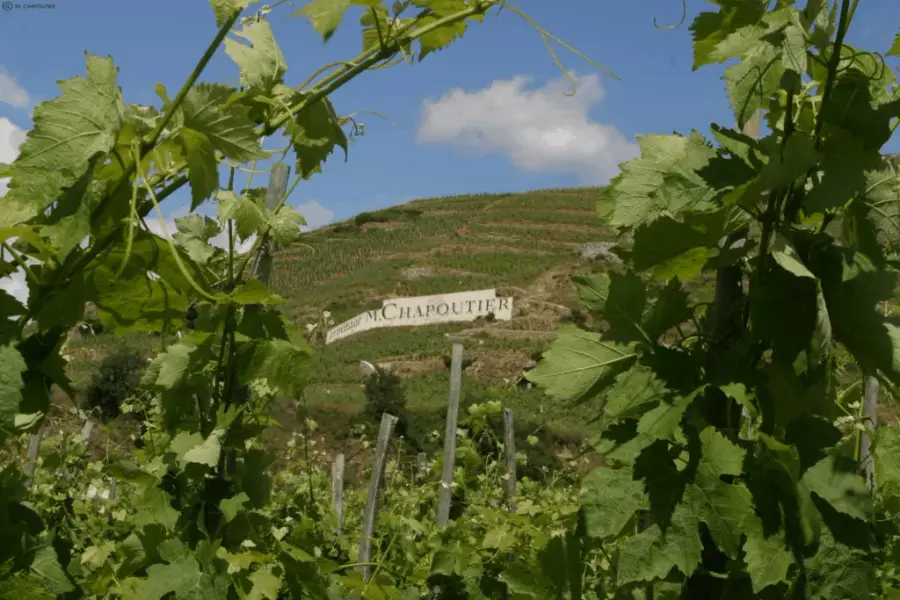
Christine: Yes, Condrieu and Côte-Rôtie have a similar history. It’s quite a rich history. Condrieu is hillside vineyards. So that’s the first particularity of this terraced vineyard. Non-mechanizable, only the human foot treads these terraces.
It’s a very old vineyard, said to have been created by the Romans 2,000 years ago. We have the Rhône, which also allows navigation, so going upstream. This vineyard has had its ups and downs, was flourishing, but like all vineyards, it’s the same story.
In the 18th century it was a very flourishing vineyard. Late 19th, we had phylloxera, so it’s the same for all vineyards, but the Condrieu Côte-Rôtie vineyard was replanted at the start of the 20th century. Everything was replanted. It was as we find it today. And then there were the wars. The first one took many men, so no more labor, so a first stop.
And then the Second World War which was the second stop. There was also the development of mechanization. Because in agriculture everything was manual. After the 1950s, tractors arrived. Mechanization arrived, which favored work on the plain. Market gardening developed strongly, and arboriculture, and then the upper hillsides that were mechanizable.
The hillsides on which we cultivated fruit trees were completely abandoned. The Rhône valley, Condrieu, had a very important wholesale fruit market. People came from all over France. And then there was the Paris-Lyon-Marseille train, which allowed all these fruits to be quickly delivered to different cities. It was a windfall, we had apricots, cherry trees… They were practically the first fruits of France, because they were on these hillsides. The appellation was created in 1940. At the creation of the appellation, only 5 to 6 hectares were planted. There’s nothing, it’s ridiculous. We had to wait until the 1980s for this revival.
My father set up in 1953, there were still only 5 or 6 hectares. In 1970 there were 10. In between there was an extension of the appellation. So no plantings until the 1980s. My father was the only one to believe in this, well, one of the few, to believe in these hillsides.
I grew up with this idea of terroir. My father said, because all his friends had abandoned cultivation and had gone to work in offices, in factories, more service-sector work. And he said, “But they don’t know what land they’re walking on.” I always found this phrase very beautiful, because he had this awareness of the terroir.
You have to recontextualize all these events because at that time, when people said a wine had the taste of terroir, I’m sorry, but it was pejorative. It wasn’t valued at all. Today this notion of terroir, which is still very recent, we struggle to translate it into other languages. We use it as is, because we have no translation. And my father already had this vision and this awareness of the uniqueness of this meeting between a place and a grape variety, which made something unique and not reproducible.
For him, that was the magic. I really grew up with this idea. That’s why when I came back, I quickly committed to organic farming. Because for me, it was really essential if we wanted to keep talking about terroir, to preserve these lands, these hillsides. If we want the longevity of these hillsides, we have to take care of them.
It’s something essential for me. I always say that the land doesn’t belong to me, I belong to the land. Saint-Exupéry says it another way too, but we’re just passing through. We borrow the land from our children. So we have to know how to take care of it. And I grew up on this land, it’s visceral, it’s an attachment. For all these reasons I quickly committed to organic farming.
You should know that Condrieu is a bit difficult. Because everything is manual and weed management is what’s most difficult. Apart from the hoe, we don’t have many solutions, so it’s very complicated but it’s possible.
I started fairly early. I’m not saying the first year, but yes I’ve been organic for more than 15 years. It took a long time. I started on the easier parts that were more mechanizable, to finish on the steepest hillsides.
Antoine: Thanks so much for this overview of Condrieu and I can’t wait to visit.
Can you tell us about your wines?
Christine: Oh yes! Today the domaine is very marked by Condrieu, by the white wines. My father was that essential figure of the Condrieu appellation, of this viognier grape that was born in Condrieu. I obviously continue to produce Condrieu. But I had a lot of fun developing the reds, on Côte-Rôtie and Saint-Joseph. As I told you, I was born at the foot of the Coteau de Vernon, the oldest hillside of Condrieu, of viognier. I grew up with all these scents, this grape variety. I felt like I knew it well.
And syrah, my father also produced Côtes-Rôtie, Saint-Joseph but it was something I wanted to make my own, that I knew less. My father was so marked by Condrieu that I wanted to stand out a bit, and have this stronger freedom of action. Today, I vinify almost as much syrah as viognier. I make 6 cuvées of syrah and 4 cuvées of viognier.
This viognier grape is still a very capricious grape, very particular, and I think it has its expression sublimated on our hillsides. This viognier that knew an enthusiasm in the 1980s and was planted and is now planted heavily whether in Australia, in the United States, you find this grape variety a lot everywhere. We find it in the south of France. But I think its best expression remains on these granites of Condrieu. Because we can have this freshness, this salinity, these floral notes. We’re on white flowers, on peach, on apricot. But we stay on something refined, on something that doesn’t go off into exuberance. That’s often what people criticize a bit about viognier.
Viognier is only allowed in 2 appellations, Condrieu and Château Grillé. It’s not by chance. It’s because it has a very particular expression, a class and nobility like nowhere else.
I get into this expression of viognier that needs to be controlled despite everything, to take it into this complexity that makes a great wine, wines that can age. I produce a parcel-blend cuvée, since we’re mono-varietal. It’s a cuvée you can drink while young. And then two other cuvées, one of which has a pretty name called “Chaillées de l’enfer”. The chaillées are the local term for the terraces and l’enfer means hell. The old folks called this vine hell. We can imagine why. Because it’s hot, it’s steep and hard to work. The great terroirs erase the grape variety. We talk about Condrieu because we have this magic, this kind of marriage between the place and the grape. It’s another dimension that is Condrieu, or viognier in Condrieu, that takes you really into pretty incredible spheres.
These are concepts that are quite spectacular. Some people call this geo-sensory tasting, this ability to feel the taste of the place.
Christine: I really believe in the taste of the place. All my vines are located in Condrieu, which is the original land of the appellation, on a biotite granite that’s quite particular. I make 3 cuvées and from the start, well on the 2020s I taste and I find my different parcels. And they’re sometimes 100 meters apart as the crow flies. The place imprints itself and it’s pretty magical.
I replanted on the Coteau de Vernon. I cleared a parcel that my father had never seen planted. It was abandoned at the start of the 20th century. It’s magical to see the birth of a terroir. These are vines that are 7-8 years old, very young, and already they have this depth. So it’s the place, the taste of the place, I remain convinced.
Antoine: It’s spectacular and it’s often the case among the people I’ve met, I’ve only met people who made good wine at the same time, so it’s hard to say otherwise, but the place really matters and you don’t drink a wine kind of in the air.
Christine: Wine tells a story. It has a vibration, something that calls out to you, emotion. The place is there to release all these emotions and that’s what a wine is, it has to move you. When people ask me what a great wine is, it’s a wine that moves you, that’s important. People often tell me, “Oh yes but I don’t know anything about it.” But who cares. We can let ourselves be carried, but it’s like in painting, like in literature. So effectively when you have knowledge, you have keys. But you can have emotion without intellectualizing things and that’s what emotion is, it’s the vector to enter.
Is wine an art form then?
Christine: In a way wine is an art, because we create something despite everything. I wouldn’t describe myself as an artist, but rather as an artisan. In the word artisan there’s the word art.
Antoine: I really agree. It’s something that always strikes me in my tastings. Often, I can say I like it, here I want to eat such-and-such a dish… We have no words to describe it. We don’t think about anything else, except what we’re drinking and the emotion it generates. It’s quite impressive, because at base it’s just grapes.
Where can we find your wines?
Christine: At my place! And all the wine merchants. In restaurants today, it’s a bit complicated. Because I’m fairly present on tables. But in many wine merchants, I won’t name one in particular, but yes.
Antoine: If you don’t find them, ask him and he’ll call Christine!
Christine: Right. It’s true that I don’t have huge production. Because I don’t do any négoce at all, I only vinify my own grapes. So there are moments when I have no more wine.
Antoine: Which is rather a good sign!
Christine: Yes, which is a good sign of course, but we manage to find some.
What advice would you give, having lived through this setup, to a young winemaker, male or female, setting up or taking over a family domaine they were absent from?
Christine: There’s a young woman who recently called me and is asking herself about taking over. She was asking herself loads of questions about climate change, about commercialization… I told her, “I think you’re not asking yourself the right question.” In all the decisions we can make, we have to start from ourselves. I told her, “Do you want to? From there, if you want to, you’ll be able to lay things down. But that’s the first question you need to ask yourself.” You have to feel it deep down, and you have to have the honesty to descend into yourself and go for it, but it’s very physical, this verticality of descending. In Condrieu Côte-Rôtie it’s very complicated and for me that’s what drove me, it’s that desire.
From there I believe everything is possible. It won’t be simple, but it wouldn’t be fun either if it was simple. The right advice is that desire that drives you and that’s going to carry you. I’m not saying it’s a 100% success but it will allow many things.
Sometimes we don’t measure, and that’s always what I told my children, “Start from yourselves, start from what drives you.” When it’s time to find directions, orientations, think about it, what drives you, what do you like to do? Do I like to be outside or inside, do I like to talk to people or not talk… Lots of little things that allow you to make a path and to try. What drives you? What appeals to you?
How is Condrieu sold abroad? Is there strong sensitivity in certain countries? Is it easy to sell? Do foreigners know the appellation well?
Christine: Countries with a wine culture, yes, know it well. For example, Japan has a very lovely culture of wine and white. Because it works very well with Japanese cuisine too, so that’s interesting. China is very difficult. It’s not difficult per se, it’s that today China is not yet a very mature market so it goes more for safe wines. So Bordeaux, it’s starting to be in Burgundy, we’re present in China but it’s a bit harder.
But otherwise no, it’s not very difficult, the quantities again aren’t huge. But we’re present a bit everywhere. South America is a bit less present but there it goes, Brazil is opening up. But my father was already present in export.
So Europe, and England is a very big market, the United States obviously. But the Eastern countries too, Italy and Spain a little less because they’re big wine producers, it’s a bit complicated. And Asia, it’s much open too. I tried to keep about 30% in export and to stay on the French market. It’s split between private buyers for a quarter, and then wine merchants and restaurants. We try to have a balance in markets, because we could sell everything to export but that bothers me a bit. The French market is important for me.
Speaking of which, do you welcome people at the domaine?
Christine: Yes, right now we welcome a lot. It’s not a joke, respecting the safety guidelines, lots of professionals actually. Since restaurateurs and sommeliers aren’t working, they take advantage to do a bit of touring. I find it very pleasant because they take the time to discover and put this time to use to go to the vineyards and to develop their culture of the French vineyard. There’s a temporality that’s completely different. They take this time and when they come they’re more inscribed in time and the exchanges are very interesting. I love it.
Particularly Parisians, who all year are wired when they come, they’re always in a hurry. They string together appointments and they’re always late. Especially because to come visit a domaine you need time. You need to go see the vines. It’s not just tasting, since you can taste anywhere. If you come on site it’s to see the place and discover the taste of the place. So yes we receive. Few people, but we receive. We do more tastings and vine visits to understand the place, the way we work. But yes, I receive.
Antoine: The amateurs listening to us can also come, by appointment of course. We’re not going to go knock at Christine’s door. I assume it’s visible on your site, yes there’s everything, you should find it without a problem.
This interview was recommended by Laure Gasparotto, who’s a journalist at Le Monde and whom I had interviewed in a previous episode. I’m innovating a bit with this episode, since I sent Laure a text saying I was recording with Christine. And I asked her if there was a question she’d like to ask you.
The question Laure would like to ask you is: “I believe her daughter is going to take over from her. What’s different for her daughter taking over today from when Christine took over from her father?”
Christine: I don’t know if many things are different. We were talking about desire, and when my daughter started thinking about this takeover, I told her, “I want to see your desire in your eyes.” That’s what I wanted. A takeover is always very difficult, it’s heavy. And Emma, my daughter, just joined me. It’s quite extraordinary, it’s been four months. It’s really brand new.
Is it still a trial period?
Christine: Yes, well I don’t know, the trial period, no. It’s different because she’s her and I’m me. It’s different because she has a different background. I think she thought about it longer than I could think about it before my takeover. She has a path that’s been inscribed in wine. Not in production, since she was a sales rep, a wine buyer. She did a viticulture-oenology BTS training. She worked elsewhere in production. And I think that’s different. She’s perhaps more equipped than I was at her start. She has more ease than I had. I think she’ll have fun faster than I could have fun. It took quite a few years.
What are the challenges to take on now for you and your daughter?
Christine: So challenges, I made this step into organic farming. I had started the beginnings of biodynamics, and I think Emma will put this additional step in place toward balance, by going toward biodynamics.
It’s quite a challenge for her and I’m thrilled. Even though the teams are already used to using the lunar calendar, that we work on pruning following the moon, in the cellar too, we do it for plantings. But going even further into the preparations. For me, it’s almost more a philosophy and it’s to be even closer to the plant and to be more in observation.
I don’t think we’ll work miracles but we’ll be even closer to the plant and that’s what I like. I think the wines too will have this balance that biodynamics can bring. The challenge is to go toward biodynamics.
Antoine: Good luck because it’s a lot of work.
Christine: And on our hillsides it’s very complicated. But you get so much from it. Because it’s difficult, when you succeed it’s even more…
Antoine: It’s true that the harder the fight, the more beautiful the victory. It’s pretty funny because there are quite a few stories of places that are a bit ungrateful but from which the wines are absolutely magnificent. There’s maybe justice in the end. Christine, thanks so much for all this, it was a pleasure.
Christine: It was a shared pleasure.
Antoine: I have three traditional questions left for this podcast.
The first is, would you have a wine book to recommend to me?
Christine: On wine…
Antoine: I think I forgot to warn you about these questions.
Christine: Yes, I wasn’t warned about these questions at all.
Antoine: I can give you a few seconds to think, no problem.
Christine: I’m going to mention Laure Gasparotto’s, which I’ve given as a gift fairly often, which I find well done for discovery.
Buy this book
Do you have a recent tasting that stood out?
Christine: My recent tasting that stood out, I’m going to mention Antoine Petitprez again, who’s half Savoie and half Burgundy. I have a crush on his mondeuse, which is a mountain grape variety, a grape that’s also a cousin of syrah, and his ascendance in mondeuse, yes I really liked it.
Finally, who should be the next person I interview in this podcast? I’ll send you a message too to ask them a question remotely.
Christine: There are plenty of people I love who are interesting, who have things to say, but I’m going to stay with the women.
Antoine: I haven’t had enough lately. At the beginning it was very balanced in the podcasts and after I went down a slippery slope where it’s been hard for quite a while. And there it’s starting to rebalance a bit, so that’s why I’m very happy to record now.
Christine: There are two girls I really like who are in the Rhône valley and who are the Saladin sisters who took over a family domaine too, who are organic and have a beautiful approach, a beautiful philosophy. So I’m thinking of them.
Antoine: Great, the names are noted. Stay tuned to this podcast, you’ll perhaps have the chance to listen to those journeys. It’ll be a potentially three-way episode. I won’t fail to send you a message to ask her a question remotely.
Christine, thanks so much. I really enjoyed doing this interview and I learned tons of things about Condrieu. It made me even more eager to come.
Christine: Wonderful! Thank you, it was a lovely moment.
Antoine: For the people listening, if you liked this episode don’t forget to share it around, send it forcibly to two people, make them listen to this podcast, two people who are amateurs, make them listen to this podcast and they’ll come out with even more desire to discover, I hope.
Don’t forget to give this podcast a five-star rating on Apple Podcast, it makes it climb in the rankings, it gets it discovered by even more people and it’s very important to get it discovered and to grow it, and I’ll see you in two weeks. Christine, see you soon!
Christine: See you very soon, thank you!