For this 26th episode of the Wine Makers Show, Wine Makers Show goes to meet the famous Michel Chapoutier. This interview with an iconic figure of wine and biodynamics is an incredible opportunity to better understand wine and to gather the testimony of this personality.
To celebrate the release of this interview, Michel Chapoutier’s teams agreed to set up a promotional sale. Here’s a chance to nicely fill up your wine cellar with great bottles at gentle prices. Enjoy 10% off many of the house’s wines:
Discover this exceptional sale!
Can you start by introducing yourself?
Yes, I’m Michel Chapoutier, farmer in Tain l’Hermitage. I have another way of introducing myself: it’s what’s written on my business card. Wine grower, wine maker, wine lover. When I say farmer, it’s because wine is above all about agriculture. Wine grower means viticulteur. Wine maker means vinificateur. And Wine lover means passionate about wines. What’s interesting is that you can have all the technological mastery you want, you first need a notion of passion. The greatest wines come from people of passion. In my life I’ve met great wine technicians but they lacked passion. The second thing is that this passion also helps put into perspective the divide between viticulture and vinification. In our world, many people talk about oenology but in reality there are at least 18 months of work in the vines. 18 months because the vine we harvest in 2020 began its gestation in 2019. The vine carries almost two harvests. The agricultural part creates the quality potential. The oenologist only transforms this potential but never creates quality.
If quality is a ladder, agriculture sets the height of that ladder and the oenologist will climb it but he’ll never go beyond. We’re really in an agronomy profession when everyone talks about wine making. It’s interesting because in the new world you see the difference between wine makers who have an agronomic sensibility and the others. You spot the worldly wine makers very quickly. Often they want to live in the city, so you recognize them very fast.
I spent every summer of my childhood in the Vercors. We almost never went on vacation with our parents but we lived next to a couple of old peasants. So I spent all my summers going to work at their place. Since their daughters had left for the city, he had never invested again. So I knew 19th-century agriculture (I’m not from the 19th century, mind you). I knew haymaking. We worked with cows, we collected hay loose. All this work taught me a passion for terroir, for the land and for agriculture.
Later I went to California. I spent my summers in the wine world of Mont Elena. It was the time when Craig Williams had just arrived at Phelps. I discovered the world of wine through the American gateway. At the time, the eldorado of wine was Napa Valley with guys arriving in the wine world with something very brilliant and a star system. I had been impressed by the mastery and technology of more advanced oenology than ours. The legislation was softer so they were ahead. On the other hand, they were convinced that everything was done in oenology. Today, I no longer think young wine makers think that.
It was interesting to see those guys who didn’t really care about the notion of terroir. Before going further, I’ll maybe define the notion of terroir. Terroir is the conjunction of soils, climates and humans. I say soils because that includes geology and pedology. Climates means microclimate (south-facing, close to the sea, etc.) and the vintage. If I claim my vintage on a bottle, it’s because I claim a climate of a year. The human part is composed of tradition, essential to historical gestures, and the talent of today’s operators. Tradition plays a big role in pedological compositions. For example, in the Middle Ages, families that worked one way and a neighboring family that used another technique both shaped a completely different pedology between the two places.
At the time, in the United States, people didn’t believe in the influence of soils on wine. It was a message that wasn’t heard in 1990s California but it stuck with me. I quickly realized that the expression of syrah in Hermitage, with the same techniques, is different depending on the geology and pedology. It can’t be the climate. If we want to see how soil influences the taste of wine. I have roots that go very deep. They absorb the richness of the soil through the biotope. The bacteria that live in this environment transmute mineral richness into organic richness. You have to see them like a mom giving the breast. For example, if a baby lacks proteins, I can’t make him steak juice and give it to him: he doesn’t know how to assimilate meat protein. So the mom has to eat meat protein. Her body will transmute meat protein into milk protein. Then she gives this assimilable protein to the baby. It’s the same thing for the bacteria of the vine: it will make minerals assimilable to the vine. The more bacteria you have, the more you will boost the capacity to absorb mineral richness. All this will have an impact on fermentation.
Now, what is fermentation? It’s the transformation of sugar into alcohol and carbon dioxide. In truth it’s not one fermentation but several fermentations. It’s an essential chaos in the process of life. Fermentation is the process of decomposition. When there is life, there are two obsessions: ensuring the next generation and colonizing the environment.
What is a grape? It’s a seed (that’s the next generation), surrounded by flesh (that’s colonizing the environment). We wait for a bird to eat the grape and poop the seed so it can germinate elsewhere. If I put the seed in the ground, it won’t germinate. Well, no bird wanted the grape, how is it going to germinate? Yeasts will transform sugar into alcohol, bacteria will transform alcohol into acid and there, the possibility for the grape to germinate arrives. When I have a fruit that rots, first I get an alcoholic taste then a vinegar one. The art of the winemaker is to stop this process at the right moment.
Humans have tamed this process. Yeasts are omnipresent in the process. Sometimes I hear people say they have no yeast. No yeast means no decomposition. Indigenous yeasts are best adapted to the environment. When I was in the United States, we thought we needed selected yeasts. If we’re on balanced products, we manage to follow along and make room for these yeasts. I find it very interesting to let indigenous yeasts work. I like to say that wine is an aromatic symphony. Each yeast will have its preferred mineral and each yeast transforms sugar into alcohol with its aromatic signature, exactly like each instrument in a symphony orchestra has its own sound. Through this yeast diversity, I’ll get aromatic diversity. If I take a selected yeast whose first job is to wipe out indigenous yeasts, I’ll get aromatic power but I lose diversity. That means instead of playing my symphony with an orchestra, I’ll only have trumpets and I’ll have 90 of them. If we let minerals play with yeasts, we’ll get marked taste differences. It’s in the symphony of alcoholic fermentation that the aromatic dimension is different. That’s what we develop at Chapoutier and we see it in our wines.
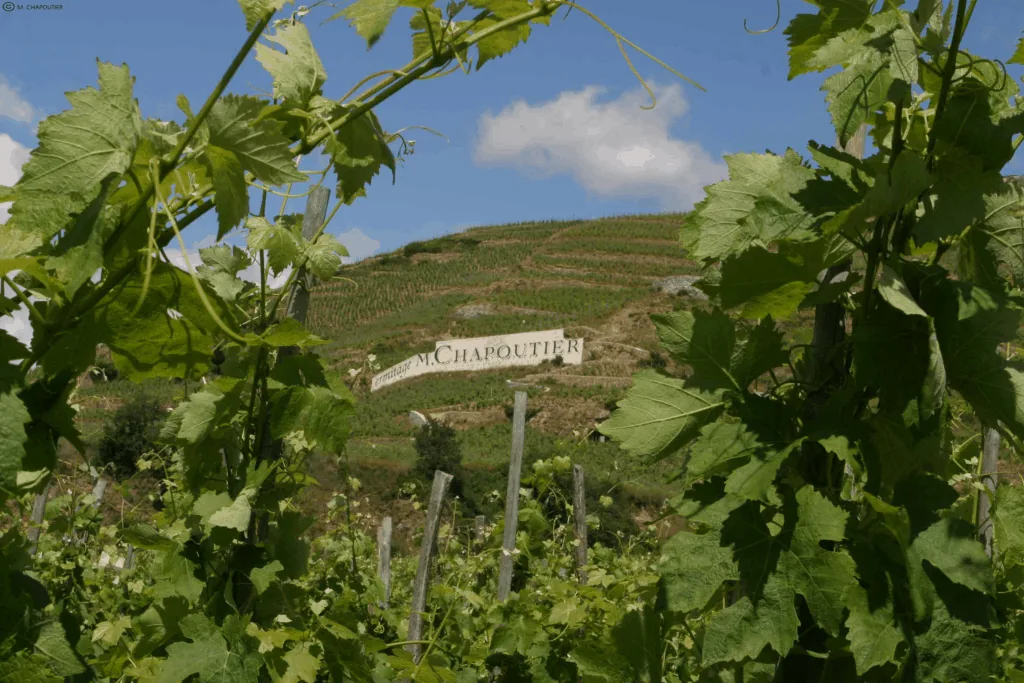 Hermitage by Chapoutier (c) Michel Chapoutier
In my youth, when we did mineral water tasting courses, people didn’t believe me. With wines made similarly but on two different terroirs, that’s where people can understand the impact. That’s the whole story of AOCs in France. If we created the AOCs, it’s because we had a history.
I come back to France after California and I tell myself we’re done for. We’re done for because they have a technical lead, administrative freedom and economic freedom. On top of that, they have a marketing dimension we didn’t have in France. On the other hand, we have one thing they’ll never have, which is 20 centuries of viticulture. The work of microbiology around the roots and viticultural soils have become more efficient century after century. That’s the magic of viticulture: we haven’t dried out the soils, we’ve refined them.
In the 1980s, that’s when Robert Parker arrives. People often put him on trial unfairly. He arrived at the end of the 30 glorious years. France didn’t have enough wine and had productive clones that ravaged the appellations. I had incredible dilutions. When Parker says that someone works well, it’s because he had more reasonable yields, he has roughly normal concentration. He wasn’t necessarily looking for the super concentrated as he’s been accused of, but we needed to come back to the appellations.
To return to the appellations, you need agriculture that respects life (bio) and not death (cide): fungicide, insecticide, etc. That’s how I came to organic. We lose some power but we get mouthfeel and yield concentrations that hold up. Of course, we need wines of all categories so we can sometimes bodybuild wine but there have to be limits. Sometimes appellations are seen as a social entitlement for the winegrower but we need to give them back credit for the consumer.
If I kill my soils with the use of powers of death, I’ll have a soil with 20 centuries of evolution but which will no longer be able to give the vine back its mineral richness. On that, Claude Bourguignon was very interesting. He did a lot of research and had to venture into new areas. He had the merit of doing micro bio counts. If the workers of soil expression are bacteria, you just have to count them. That bothered people. He demonstrated that in certain places in AOC, there were areas with fewer bacteria per cubic centimeter than in Sahara soils. Where’s the credibility of my AOC at that point? The only real weapon against the rise of new world countries is to guarantee that there’s life in the soils. That’s how I came to biodynamics.
Was that on your return to France?
I take over Maison Chapoutier in the 1990s. I was with my brother. The house was in great difficulty. We say we’re interested in taking over the domaine but we want to buy it. Because if we take it over and bring it back up and have to pay inheritance taxes on our work, that won’t fly. We were lucky to have banking partners who trusted us. When you’re young, if you don’t have the right support, it’s hard to take off. The older I get, the more I put my energy at the service of young winemakers because we’re going to face a vocation crisis if we keep going like this. These banks made a bet with real risk-taking. We take over in 1990 and in 1991 we switch to biodynamics.
What’s the first day of this takeover like?
It’s tense at that moment. I say “I’m out”. I didn’t like the style of the house’s wines at the time. My grandfather had made great non-vintage cuvées. When I did a tasting, I didn’t recognize the wines. I just said “that’s a Chapoutier”. You should recognize the appellation before the winemaker. If I recognize the style of the houses, it’s that I’m misusing the AOCs. At that moment I say I’m leaving. We argued several times but I felt I was selling consumers a lie. When you take a painting, the signature is in a corner of the canvas, not all over the canvas. So when we vinify we also have to respect the work. The oenologist has almost nothing to do. He’s there just in case, like a dad teaches his five-year-old kid to ride a bike without training wheels. He doesn’t hold him but he’s there just in case. The winemaker’s child is fermentation. He brings curative corrections.
My idea isn’t to make the best wine possible but to make the best photo of the terroir possible. When we work on granite, we find a signature. It’s called petrichor. I call it summer rain on hot stone. In truth it’s an ozone smell. Granite almost fixes this smell in the wine. You have this persistence on the palate. It’s really the signature of the terroir. The great terroirs are chaotic terroirs: they’re encounters. Hence the interest of grands crus and premiers crus in Burgundy. I defend the same logic in the Northern Rhône appellations. It would also help young winemakers settle in.
How does your settling in 1990 go?
It’s not necessarily easy. Many people look at us with a deluded air. Some colleagues look at the two young Chapoutiers. Everyone is nice with us because everyone thinks we’re going to fall flat on our face within two years. And if we have to sell vines, it’s better to be friends with us. We had taken over a house where Michel Ferraton, in difficulty, had been picked apart because every time he needed help, he had to sell a hectare. When I arrived, I said we were going to protect him, set up a 50/50 company. He kept his vines and sold his grapes. When we settled in, a lot of people were nice to us hoping we’d sell them a hectare of Hermitage.
I buy in 1990 but in truth I arrive in 1988. What I didn’t like much was that I wasn’t running the vinification entirely. 1989 is a vintage I made entirely. I bring out my first parcel selections and we get a 100/100 from Robert Parker, which surprised everyone. It was an era when not much was happening in the wine world. So we got all the press and that was confirmed in 1990 and 1991. 1992 was harder. We were in the era when we were managing our entry into biodynamics. Surprisingly our drop in yield gave us a lead over others with concentrations the others didn’t have. In 1993, there’s chaos but we still get extraordinary things out of it. That’s the quality of the slopes. But when you work at 400 hours per hectare on flat land, you’ll quickly go up to 1000 or 1200 hours per hectare on slopes.
You switched to biodynamics overnight?
Yes, I do about fifteen hectares in 1991 and the rest in 1992. We weren’t using too many chemical products so it wasn’t too difficult either. You don’t have the rainfall of the proximity to the sea, we have the mistral that dries everything. Conventional didn’t have too toxic effects but had an effect on the diversity and density of soil microbiology. In twenty years, we’ll have specific plants that will oxygenate the soil and occupy the environment. That should replace soil work.
Then it’s time for expansion?
We win the world Syrah championships. We win the title of best négociant by Revue des Vins de France even though at the time a large part of our grapes came from our vines.
In 1995, we make our first purchase. That one I’ll remember for a long time. It was in Banyuls. I had fallen in love with Banyuls. We buy 2.5 hectares of magnificent Grenaches and it cost 45000 francs. For me it was expensive at the time. I had a Renault 11. I was telling myself I needed to save. Since I’m a Brel fan, I was listening to JoJo in the car. And at one point, Brel says: “the world sleeps for lack of recklessness”. I stopped at the first highway exit, I called the notary and I told him “we’re buying”. It makes me laugh now but it was important for us.
My idea was to go look for terroirs. When you do the math on the price of wine, the amortization of land makes up the majority of the bottle’s price. There were a multitude of terroirs and soils with potential. Forgotten soils are the great wealth of Roussillon. There was also natural sweet wine that interested me. I meet two incredible people in Roussillon: Bernard Cazes and Jacques Paloc. Very quickly you get attached and you say “this, this costs that?”. It was thrilling. We had soils, interesting climates. We were discovering biodynamic viticulture much easier. We tell ourselves it’s hard to work like this and we tell ourselves it would be nice to look at the southern hemisphere.
We then look at Australia: it’s the second-largest Syrah vineyard. We realize that in the 1930s, they imported Syrah from Hermitage. In the 19th century, phylloxera hits France. For two decades, French viticulture is almost bankrupt. When they find the rootstock, two things happen: drop in quality, and they replant on a selection of productive clones. The post-phylloxera selection is necessarily economically oriented.
We had discovered that on L’Ermite, we have an important part of pre-phylloxera vines. On this selection, the quality level is of incredible finesse and extravagance. It was the excitement of going to Australia. We discover that the importation of clones helped save varieties. We make this discovery.
Your work on a personal level moves to another scale, that of manager, of grand architect. How do you experience this moment?
First you don’t realize when you have your feet in the soil that it’s financially difficult and that you need good people to manage the teams. We started working with young people and that was the right bet. The advantage of young people is that they’re malleable and play the game of adventure. When we wanted to take already trained people, it’s harder. We had to manage egos when we were a small house looking for adventure. Australia was exhausting. Those who go to the United States want to stay but not those who go to Australia. What I regret is that the children of winemakers become flying winemakers. The best salespeople we have are children of winemakers. They come to us, they know how to get up in the morning, know how to talk about wine and know the vine.
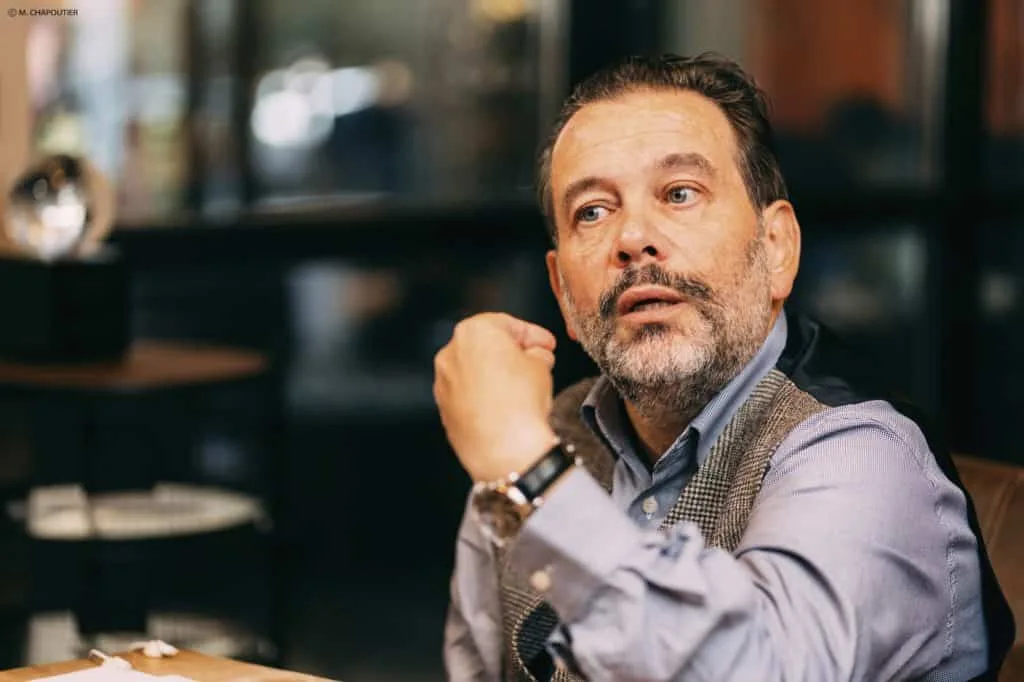 Portrait of Michel Chapoutier - (c) Michel Chapoutier
Did travel make a mark on you?
I haven’t traveled that much. I’ve tended to always go to the same place. Between my generation and your generation, we’ve seen the price of plane tickets drop dramatically. When I see the airline prices to go somewhere, it’s much easier today.
Maison Chapoutier is huge today. It’s the fifth most well-known wine brand in the world.
No, that’s not quite it. A magazine does a placement on favorite brands in the world. We often come in as the first or second French brand. It depends a lot on the panel selected.
The house remains very large, recognized, with hundreds of thousands of bottles. Do you realize it?
Often we tell ourselves we could have stayed with our vines and instead of making 11 or 12 million bottles, we would have made 800,000 and we would have lived with extravagant financial returns. My dream wasn’t there. In California I had seen French gastronomy collapse. The rise of Italian gastronomy with pasta when we had truffles, foie gras and lobster, we only made very expensive things. People then turned to Italian gastronomy. I found it dangerous and I thought it was going to happen again with wine. French wine ghettoized itself in suicidal snobbery. There are plenty of people you ask if they like wine. They answer “yes but I don’t know much about it”. You want to answer them “you don’t need to be a gynecologist to make love” so you don’t need to be an oenologist to taste wine. We wanted to make it something too cultural. Before, red wine was always drunk cut with water.
How did French gastronomy recover? They did gastronomy and bistronomy and brasserie. We realized we had to get into the competition by being good at a reasonable price. When I arrived, I was rich in debts so very poor. When I wanted to buy wine, I realized that the entry-level was very bad. In Bordeaux, what Philippe de Rothschild did with Mouton Cadet is incredible. The snobs criticize Mouton Cadet but it’s a good generic Bordeaux. He brought out an above-average wine with a generic Bordeaux label.
So I wanted to have, alongside our gastronomy, our bistronomy. Otherwise we’ll experience what happened in Japan where wine became so expensive and snobbish that young people lost interest and turned to beer and various liqueurs. Wine became an old people’s thing. Banyuls almost died like that. The new generation is starting to take an interest in cooking more. It’s really important, I cook every day. We should push cooking classes in oenology schools.
My dream is to present affordable wines with superb quality. That’s where négoce is important. The collaborations I have with cellars are incredible. Négoce is the solution to bring this to the market. When you go to Vuitton to buy a bag, do you ask that it be Vuitton employees or subcontractors? The answer is no, so it’s the same for wine. Sometimes, it would even be better if it were the subcontractor. Because the employee at our place does 35 hours with 100% social charges. Whereas the subcontractor on his tractor does as many hours as necessary. So the grape that arrives from the subcontractor has a head start. Then, vinification. I have a vinification tool, I’m at 80€ per hectoliter. The coop is at 30 euros per hectoliter. I have a vinification tool for my parcel selections. If I make my Côtes du Rhône with vinification at my place, I won’t necessarily do better than at the cellar at 30€ per hectoliter. Who’s going to benefit from this difference? You, the consumer.
Everyone tidied up their wine cellar during lockdown. I tasted a 12-year-old white Côtes du Rhône that was exceptional. We have grape varieties for aging and it’s not because there’s less acidity that we have less aging potential. It’s incredible to offer this quality at a competitive price. Sometimes I say we’re not négociants but that we work with subcontractors.
You also help your subcontractors progress with your specifications and your teams?
Yes. I see it well in those who have switched everything to our production model when they only sell us a quarter. We don’t have complicated specifications and we’re not in the dogmatic logic that you have to switch to organic. Most of the time, they come to see us saying “we’re ready to switch to organic”. Taste our Pays d’Oc Marius, you’ll see, it’s impressive.
What’s next for you?
When you count your cents, you risk becoming greedy and working with your head in a bag. One day my wife told me “by being obsessed with profitability you’re going to become an idiot”. I force myself to give time to the collective and to others. First it’s not a gift you’re giving because you’re paid by what you learn. Then, our children took over. So you have to know how to step back and work for your industry. My future is being able to keep working on collective files. The job of the elders is to make room for the young and to make the ground easier for other young people to settle.
If you had the chance to see yourself again at the time you took over Maison Chapoutier, what would you tell yourself?
I’d maybe say “be less of a fighter”. I’ve been cutting sometimes or hard with people on our teams. Whereas maybe it was us who had missed something in not getting them excited. So be passionate. It’s so refreshing to work with people like that. The saddest thing is to be jaded.
Do you have a wine book to recommend to me?
I recommend the emotional intelligence of plants. One day he’s messing around with his polygraph and hooks it up to his plant. He goes to get his lighter and he sees the polygraph already working. That means the plant didn’t react to suffering but to intention. We realize there’s a real exchange between humans and plants and that you need to have passionate people in the vines. We did research on bio-resonance. We saw that the plant rejected certain people and accepted others. With this book, we finally admit that there’s something between you and the plant.
Buy The Emotional Intelligence of Plants
For open-mindedness, I love recommending a book that is the dictionary of the impossible. The author went to catalogue experiences or events not explained by science but uncontested. With this book, he demonstrates that when science can’t explain, it closes the file. Academic science sometimes makes me think of the Vatican’s position toward Galileo. Today, the memory of water is in no doubt but some still say it’s a superstition. Watch this little report by Luc Montagnier on the memory of water.
I also recommend a report on Egyptology. There are six discoveries in Egyptology because they show that Egyptology has sunk into something improbable. We need to bring back doubt.
What’s your latest favorite tasting?
A 2014 Échezeaux DRC: extravagant. And I mention the Cathelain de Chave 1991. These are wines with common points on the mouthfeel. The real art is to seek a mouthfeel. The leaders in this are Burgundy and I love the viticultural organization of this region. It demonstrates that you can work with qualified people and on the single grape. I’ve often wondered if blending grape varieties is a historical necessity or the loss of a certain complexity.
Do you have a person to recommend for my next interviews?
I really like the challenge Gérard Bertrand has taken on. If we really want to help the planet, everyone has to do organic. The attacks on intentions according to which large companies can’t do organic are unbearable. His work is turned toward the future. And he’s a character so you’ll have a great time.
Amazon links on this page are affiliate links. They cost you nothing extra, and they help me keep this going.