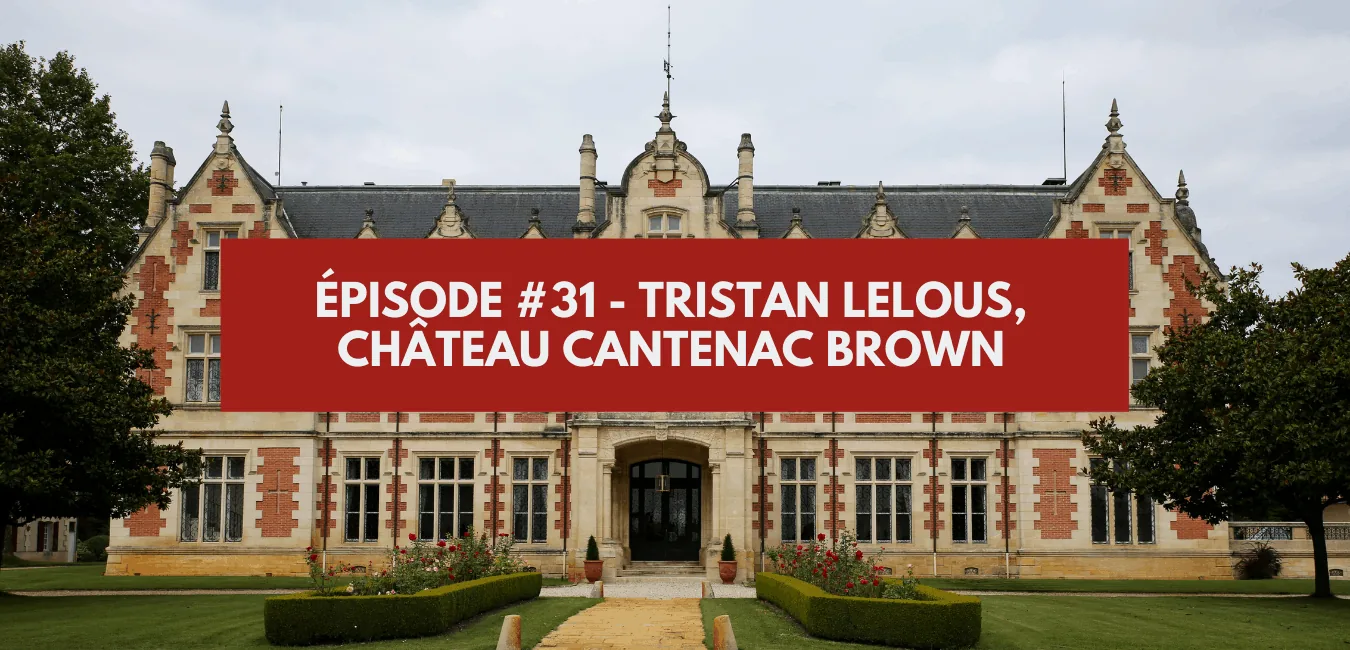
For the 31st episode of the Wine Makers Show, Wine Makers Show goes to meet Tristan Lelous: the new owner of Château Cantenac Brown. While acquiring such a château was a childhood dream, Tristan looks back at his passion for wine and at all the challenges presenting themselves in this new adventure. Château Cantenac Brown is a grand cru classé of 1855 that still has many surprises in store and that we invite you to discover. Enjoy the listen and happy tasting.
Can you start by introducing yourself?
I’m Tristan Lelous, I’m 40. I studied agronomy in my youth and I’ve always been passionate about wine. It’s mostly a family transmission through my grandfather and my father. I bought, with my family, a grand cru classé in Margaux called Cantenac Brown. Since then, I’ve been devoting a lot of time to it and investing a lot of myself in it.
Can you tell us a bit more about this passion for wine?
My family is originally settled in Burgundy. My grandfather settled there in the 1940s, originally Breton. At the time of demobilization, he found himself unemployed because he was a colonel pharmacist in the French army. Through one of my grandmother’s connections, he was offered to take over a struggling pharmacy in Dijon. He needed money and found some from local winemakers. We then ended up rubbing shoulders with many winemakers who financed my grandfather’s business and who remained shareholders in the company for a long time since they stayed until 2005. My grandfather had the opportunity to recover bottles and have a truly exceptional cellar.
Since you’ve been a child, are these things you saw?
At the start, I had a beautiful vision of the Burgundy vineyard. We drank from my grandfather’s cellar, even when fairly young. At 12, 13, 14, we drank wine at the time and, especially, we talked about it. We spent a lot of time at the table talking about the wine we were drinking.
Is it wine that gave you the desire to study agronomy?
No, I don’t think so. Traditionally, in the family, you had to do a science track and then a more business track. Which I did. I did Normale Sup in Lyon in molecular genetics and I wanted to dedicate myself to research. I realized, through an internship, that this wasn’t what I wanted to do. This profession didn’t match the image I had of it during my studies. So I sought to retrain and the agronomy school was perfect for that and I became an agronomic engineer. I realize that 15 years later these studies have served me well since I use them today almost daily. After Agro Paris, I took entrance exams and got admitted to ESCP.
How did the start of your professional career go?
It wasn’t related to wine. My father immediately offered me to come join him with my brother and I’m immediately integrated into our pharmacy company which is the heritage left to us by my grandfather. I’m responsible for finance in this group, called URGO. Until last year my professional career had nothing in common with the wine world.
How did your knowledge of Bordeaux come about?
It came fairly late since it was when I met my wife who was studying at the Bordeaux magistracy school. I would come see her on the weekend and that’s how I was able to discover this city, its wines and the region. When I would come visit her, we’d take a car and go wander in the vineyard. I immediately liked it and very strongly. Now, I don’t know if it’s due to meeting my wife or to the context. Anyway, since then, I no longer spend my vacations in Brittany but near Bordeaux on the Atlantic coast. I’ve forged a very strong attachment to this region and to its wines.
What’s funny is that when I met my wife, I mostly drank Burgundy wine and she mostly drank Pessac-Léognan. In the end, it’s a crossed discovery. Today, I largely prefer Bordeaux wine to all others, even though there are great wines everywhere, and she largely prefers Burgundy wines. There are subjects on which we never manage to come together.
How was the decision made to go look for a wine estate to buy?
It’s a very long-term project. Getting into an adventure like this took us 7 or 8 years. I made this proposition to my two brothers and my father. I proposed Bordeaux because of the affinity I had with this region. They let me run with it a bit. I started by visiting different estate managers in Bordeaux to try to understand how it works. I met José Sanfins at Cantenac Brown with whom I spent a few hours. I liked the property, I liked the contact with José. For several years, I continued to do some visits and some meetings and to keep an eye on the market in case a property went up for sale, so they would think to contact us.
It took time since there are quite few properties of this nature for sale. The opportunity presented itself when we were called to be told it was likely Cantenac Brown would go on sale. At that point, we immediately positioned ourselves. There were sale rumors and we were tipped off. We went and forced things by contacting the owner and we were very motivated.
We went in with my two brothers and my father. Since then, my father has retired and we set up a rotating presidency with my two brothers. Each is president of the holding for three years respecting primogeniture since my older brother started.
How does it go when you buy a wine estate? What do you have to look at?
What’s fundamental is the study of terroirs. We focused a lot on that and we contacted consultants specialized in this to do a parcel-by-parcel study. These are fairly in-depth analyses, absolutely fundamental. Independent of everything else, the terroir doesn’t change and it will always be anchored in the property. If you have to dedicate time and money, it’s in the study of parcels you have to do it.
Then, what was fundamental is contact with José. Without a very high-quality manager, the project will be difficult. You can always go look for an outside manager but in the end the team and the person who manages it is the second fundamental element.
The third element is market analysis. What’s interesting with Cantenac Brown is that it’s rated by many critics in France as in the United States and in China. Fairly consistently over the past fifteen years, the ratings have improved. This consecrates the work José has been able to do to make it progress. The wine, its quality and its perception by critics on the market are very important.
Finally, there’s brand analysis. Cantenac Brown is a strong brand because it’s a third grand cru of 1855 in Margaux. On the other hand, if there’s work to do, it’s still on the brand which hasn’t been put forward enough. With the continuation of the improvement of wine quality, we have to work on this. Cantenac Brown isn’t well-known enough relative to its rating and its positioning in the 1855 grand cru classification.
You already had a close relationship with José but what’s your first day at Cantenac Brown like?
I’ll remember it all my life. When you make an investment of this nature, it can’t be a hobby. As it’s something important, it generates a kind of emotion: it’s new, it’s exciting and, at the same time, it’s important to succeed. So I remember the first morning when I arrived at Cantenac Brown with these mixed emotions in my head. I arrive in Margaux by taxi and I see a sea of vines. I then see appearing in the background this remarkable château that emerges from the sea of vines. It’s a morning when there was the bridal veil: this little fog that appears when it’s a bit cold at night. It’s really a vision I’ll always remember.
I also thank my two brothers for letting me realize this project. I’ll remember that moment for a long time.
Is the château open for visits?
We have a person who handles visits and wine tourism full-time. We’re very well rated on Google Maps and Maeva does very high-quality work. We want to strengthen this aspect. Margaux is close to Bordeaux so it’s quite simple to bring people in for a visit. In addition to the château, we have a very large park just behind. You can discover the château by crossing the vines but there’s also this large park in which there’s a river and a collection of rare trees. It’s an extraordinary potential for introducing wine and we want to develop wine tourism and visits to the property.
How were you welcomed in Margaux?
I had been warned by being told Bordeaux is a fairly closed environment. There are many families that have been there for a long time. In fact I was remarkably well welcomed. I started by visiting our main customers. I did about thirty meetings in a week to introduce myself and give indications about our project. These people welcomed me very well because this project has many strengths.
First of all, the project is embodied by a person and the transaction is carried out by a family. It was important because the family spirit is crucial for the Bordeaux place. I knew absolutely no one when I arrived and I was very well welcomed.
I don’t yet know all my neighbors but I went to lunch at a few restaurants around the château to meet people. José had told me the habits of certain owners or managers. Each time, we’d take a bottle of Cantenac Brown with us to offer a bottle to the next table.
What are the first actions you took at Cantenac Brown?
We launched many projects in parallel. The first project is to initiate the construction of a new chai and a new cuvier. The idea is to go even further in the qualitative progression of the wine. To do this, we needed a new tool to have even more precision in blending. We also launched the construction of a new chai to have more space and refine our wines.
I wanted to inscribe this project in an eco-responsible approach. We’re going to build this new chai with raw earth and untreated wood construction sourced exclusively in Aquitaine. For this I chose Philippe Madec who is a globally known architect and pioneer of eco-responsibility. The first meeting with the Margaux town hall is November 18, 2020 with the goal of filing a permit in December. The objective is to use this new tool for the 2023 harvests. It’s important that everything be ready by then.
This raw earth chai, is it something you had in mind from the start or did it impose itself by the vision you carry?
I had it in mind from the start and I was visualizing a project like this one even before we were owners of the château. That’s why this project went fairly quickly. There are few architects capable of going so far in the project since this construction will be done without cement, without glue. Finally, there’s a whole series of small details that make it state-of-the-art in eco-responsibility. It’s also a story of encounters. Philippe Madec goes very far in eco-responsibility requirements.
Can you tell me more about your vision of Cantenac Brown in the years to come?
Our first objective is to progress further in wine quality and ensure this progression is recognized by all the critics that count on the place. So you have to maintain the demanding standard José puts in the execution of his wines for over 10 years and accelerate it. It also means developing our relationship with the opinion leaders who rate wines and talk about them in the United States, in France and in China.
The second objective is to welcome more people to the property so that Margaux and Cantenac Brown become a destination for these tourists. It’s also a way to show them what an eco-responsible raw-earth project is.
The third project I have would be to develop white wine in our range. It currently represents 1.8 hectares but is very recognized in terms of quality. There’s a commercial approach to develop on our brand with its three wines: Cantenac Brown, Brio (the second wine) and the white wine: Alto.
View this post on Instagram
A post shared by Château Cantenac Brown (@chateau_cantenac_brown)
What’s the distribution of Cantenac Brown?
It’s fairly broad. We’re sold for a third in the United States, a third in Europe and a third in Asia but mostly in China. Then, it’s fairly balanced with half on the wine merchant side and then restaurants and hotels. The wine is well distributed with négociants who do great work. So you have to improve wine quality and improve the brand by convincing opinion leaders since the wine market is a prescription market.
The Bordeaux place is extraordinarily efficient at penetrating new markets because it allows you to offer a coherent price range and efficient logistics almost everywhere in the world. That’s why Bordeaux has a leading place because the Place works extremely well. There will be new countries that will open up to great French wines. What I see on my side is Japan. We sell a lot of white wines there and it’s a fairly firm trend for Cantenac Brown.
Editor’s note: To learn more about how the Bordeaux place works, you can listen to this episode with Emmanuel Coiffe, négociant in Bordeaux.
What’s your relationship today with José and with the Cantenac Brown team?
We call each other once or twice a day with José. So it’s a daily relationship because we have many projects in parallel. I personally invest a lot with José with opinion leaders in the wine world. Furthermore, we have many decisions to make daily given the Covid situation right now. Today we really form a tandem with José.
The project is inscribed in time since we’ll see the result of our actions in 10 or 15 years. It’s very challenging and absolutely thrilling.
How does the rest of your family, and your brothers in particular, invest in the project?
My brothers have an emotional relationship since we spend weekends there as a family. On the other hand, in our organization, each manages their perimeter autonomously. They aren’t invested daily in the property. We work very well together for many years but it requires perfect discipline. There are certain decisions we make in common but each is responsible for certain perimeters.
Did your brothers or your father ever tell you “but are you sure you want to do this”?
Yes. What I promised them is to dedicate enough time to it, on top of the rest, for it to be a success. I keep this promise.
You said the results of today’s efforts will only be visible in 15 or 20 years. Isn’t it frustrating?
We’re used to that in pharmacy when we manage research. We make investments today for products authorized in 10 years, marketed in 12 years and market leader in 15 years. So we’re used to managing long times. For Cantenac Brown, there are long-time cycles but there are also series of small successes and small victories we can have.
Doesn’t Burgundy hold it against you for not having settled there?
Yes, a little. It’s quite funny to see that the fact that a Burgundian family settles in Bordeaux holds attention. I received quite a few emails from Burgundians and from some of our staff in Dijon who make this remark. I think it’s something accepted today but that aroused astonishment at the start.
Do you have a recent favorite tasting?
Yes. A wine I particularly enjoy is Sauternes. It’s not necessarily very fashionable but a few times a year I open a bottle of Sauternes with a fruit salad or foie gras. Recently, with a fruit salad, it’s a 2000 Climens. It was absolutely exceptional.
Do you have a wine book to recommend to me?
It’s not a book but a graphic novel: Château Bordeaux. It’s the story of an American whose father is from Bordeaux and runs a grand cru classé. Her father dies and she’s forced to come back. She then takes over the property. You find many characters who make up Bordeaux life. I really enjoyed it.
Do you have a guest to recommend for the next episodes of this podcast?
He’s a person I met with José and I found him extremely generous in his way of sharing wine. It’s Éric Beaumard, head sommelier of Le Cinq, the restaurant of the George V in Paris. He had the kindness to spend a very long time with us and let us discover some favorites. He’s a very endearing personality. The wine world is an environment of enthusiasts in which you can discover very beautiful things. What’s a shame is to consider with snobbery a moment of pure pleasure. Éric Beaumard doesn’t fit into that at all and shows sharing and a lot of generosity.
And there you have it, you now know everything about Château Cantenac Brown and I’m sure you now want to put a few bottles in your wine cellar.
Amazon links on this page are affiliate links. They cost you nothing extra, and they help me keep this going.