For the 27th episode, Wine Makers Show heads out to meet one of the most recognized figures in the wine world: Stéphane Derenoncourt. You may not know it but I’m also from Lille. So I’m thrilled to meet one of my fellow expats in a world of vines and juice. Over to you to go meet Stéphane Derenoncourt in this episode of the Wine Makers Show.
Can you introduce yourself?
I’m Stéphane Derenoncourt and I have a double cap: a very big cap which is having set up, about twenty years ago, a consulting company (Derenoncourt Consultants), which has grown a lot, and a second one which is having developed in parallel a wine company called Domaine de l’A.
I’d like to dive a bit into your story: we’re both originally from the North, and we both spend a lot of time in the Bordeaux region. How did that happen?
It happened a bit by chance. I grew up in the Dunkirk region, I did fairly unremarkable studies and found myself very early on the job market, in a field I didn’t really enjoy. Those were a few rough years. Being young, I had dreams of elsewhere. After a while, I made the decision to move, but I had no idea where I was going to go, or why. I was rather hands-on, I had skills in mechanics and woodwork. I told myself I’d do a classic move: I went to the unemployment office, and they told me “if you want, you can go cut grapes in Bordeaux”.
I found the idea nice and I landed in Bordeaux in September 1982. Which is a sign because it was a very great vintage. I loved the region, I loved the work that I had seen fairly superficially, because it was an abundant, very ripe harvest, the weather was nice, everyone was smiling, it was absolute happiness. And I told myself “this is where I want to stay”. I dropped my bags in the Fronsac region, where I had harvested. Winter came and I had to find odd jobs. I started doing all the small vineyard jobs. Actually, I hated it. I had become a bit disenchanted, because I’m a city person at heart, and being cold in winter and too hot in summer, I wasn’t familiar with that. In parallel to that, I had small activities.
It was the 1980s, I was a hippie. I made wooden toys, I went to work in the vines, I went to sell my toys in works councils, I went to a few markets and that paid me a rent in a super nice house. That was largely enough for me, and it lasted like that for two / three years, time enough to learn the ropes. At the moment of telling myself I was going to change projects, because this isn’t for me, I met someone who hired me and gave me a lot of trust. He was someone who undertook a lot, in a small estate, which already at the time was in biodynamics. It was very rare, there were very few.
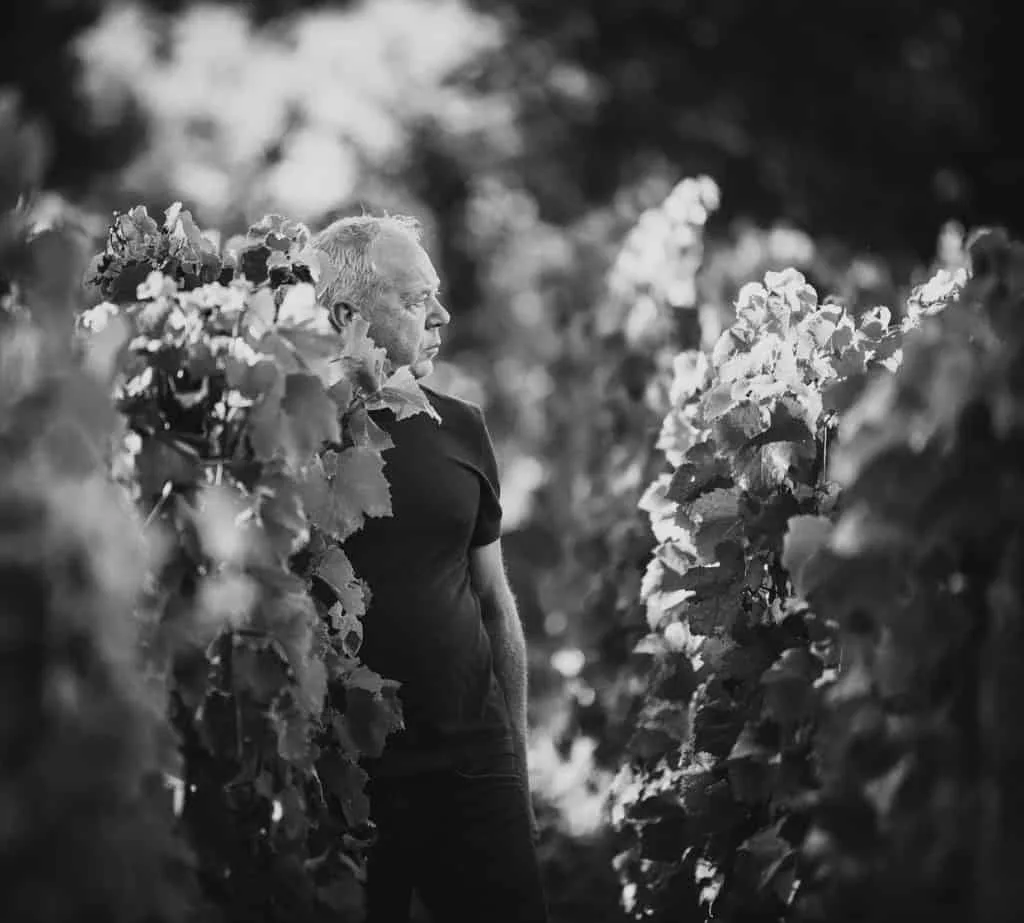 Stéphane Derenoncourt - Photo: One Wine Production
It was in Fronsac, at Paul Barre’s, Château La Grave, Château La Fleur Cailleau. I did my first vinification in 1985 and it’s a bit like I had seen the Virgin. I fell in love with this trade, for its sensual side and because I was starting to acquire a certain knowledge of the vine. I didn’t like it, because at the time we didn’t supervise young people much, we didn’t train them much, it was a slightly more closed world. The fact of vinifying allowed me to understand many things about vine work. It calmed me down a lot, and plunged me into a world both mysterious, complex and that I really wanted to explore further. From there a passion was born, to which I’ve dedicated almost all my life and all my time.
What was your work, when you joined La Fleur Cailleau?
At the start it was a helping hand, I was a jack-of-all-trades. My boss realized very quickly that we could have a level of exchange he hadn’t perhaps known until then, and that gave him the desire to give me some responsibilities. I’m pretty hands-on, I knew how to acquire fairly quickly the first methods of cellar work, racking, vinification. As he undertook a lot and had little time, he very quickly handed me the keys. I found myself responsible for three cellars, with a small company moped. For me, I had succeeded in life. And then I had gone through complicated phases at a personal level, because it’s not easy to uproot oneself, to find oneself alone, especially when you don’t have the means. I had a very solitary and very rural life. The fact of having someone give me their trust, I really wanted to give him something in return, and that gave me the desire for management afterwards: I always told myself “no matter what, as soon as I have responsibilities, I’ll remember all this frustration I lived through, so as to spare all the people who work with me from that and to give them maximum chances.”
After that, it took off. With all this positive energy, the wine which is a product of civilization felt it in its quality, we had success with the wines, which gave me a small local notoriety, in the village. I got noticed, which allowed me to find a small personal satisfaction and a small reputation. Unfortunately, four years later, he sold the estate he held in tenant farming. So he had to shrink the team. At the time, there was a couple housed on the estate with their son. It was a family of three, which he couldn’t touch without destroying everything. Then there was me. So I’m the one who left. But I left through the front door: at the time his mom managed an estate that was completely run down in Saint-Émilion, also in biodynamics, the only cru classé at the time, in Bordeaux, that was in biodynamics, Pavie Macquin. She offered to take me on for the reconstruction of this estate. It was very rock ‘n roll, there wasn’t a penny left, there was no equipment, but when I saw the place, I told myself “OK, let’s go”.
I worked alongside her. She was a fairly elderly lady, so she too aspired to delegate a bit. Very quickly I had complete technical responsibility, in the early 1990s. By chance, we had more than honorable results on the wines. Once again, there’s a notoriety subject that meant I was a bit better known in Saint-Émilion. I started with somewhat mysterious methods at the time, because we worked in biodynamics, we had set up vinification processes different from what was being done at the time, and the results on the wines were very positive. Little by little, people became interested in my work, came to see me. After a certain time, I had an interesting offer, from Comte de Neipperg, who at the time had Canon la Gaffelière, Clos de l’Oratoire, and who had a small estate, for which he hadn’t really attached himself to restructuring yet, but which had extraordinary potential, Château La Mondotte. He made a small Saint-Émilion, that sold for next to nothing. It was a terroir fairly close to that of Pavie Macquin, so one I knew well. He had wanted in 1996, during the new classification, to integrate this 4-hectare parcel into the classification for Canon la Gaffelière, which had been refused, claiming that the terroir wasn’t up to the level of the classification, which had deeply offended him. He had told me “I give you carte blanche and we try to do something a bit extraordinary”.
Which is what we tried to do, and what we succeeded in doing, because it was an incredible success. This bottle which sold at the time for 7/8 francs, was three months later at 3000 francs a bottle. More and more people then asked me to give them a hand. Which I did here and there. Then at the end of the 1990s, it had become a bit heavy, there was a choice to make: take the leap and set up a company? I’m rather of an unstable nature, so the idea of wandering around, seeing new subjects, appealed to me. I went to talk about it with my bosses, Nicolas Thienpont of Pavie Macquin, with whom I’ve collaborated for thirty years, and Stephan de Neipperg. They welcomed the news with a lot of sympathy and told me “go ahead, keep us as clients, because we need you, but we know we won’t keep you like this until your retirement”. So I set up a company that was very well welcomed, I immediately had many requests. I took at the time, in 1999, 7 clients. For me it was inconceivable to do consulting without producing. I found there was coherence: to have the pretension of making wine for others, first show that you can make wine. Plus I needed my own workshop: 20 years ago, the subjects around organic were in full ferment, I needed my experimentation center. In six months I had a draconian life change, I quit, I set up a company, I bought an estate and I got married.
How does it go when you restructure estates like Pavie Macquin, you arrive, everything is abandoned, you make all the technical choices, and off we go?
At the time I was young, I didn’t make all the technical choices, I also had someone with me who had a great demand on the production philosophy because we were in biodynamics. I was lucky to start like that, because I was a bit preserved from common conventional thinking. The first ten years of my professional life were done in places where there was a bit of marginality. Which suited me well. For example, I didn’t know there was anything other than biodynamics. I didn’t have an opinion on chemical or non-chemical, I didn’t know. I learned that way. It was very good learning, because it was learning based on observation. What really convinced me to do this trade is sensuality: the idea of knowing that a grape, depending on where it’s born, will be able to express different tastes. It’s a subject of observation, of creativity, that’s endless. There are so many parameters that it’s exciting. I hate routine.
In 1999 I took over Domaine de L’A. At the time I didn’t have a penny. We were also the creators of crowdfunding, it was a first in France. I arrived with my beautiful ideas, I was starting to have a bit of knowledge and recognition. When I saw these 2.5 hectares, at one million francs, I went to see the banker, it seemed to me to be an easily realizable initiative. The banks refused. It was a first lesson: you only lend to people who have money, not to those who don’t. Coming back, we were quite disappointed with my wife, because we wanted to launch into this project. We didn’t give up, I made a kind of motivation letter, that I sent to my small network of 250 addresses, to offer people to become partners, but not associates: they would bring me a bit of money, in exchange for which we’d commit to repaying their loan in bottles of wine, over 4 vintages. It was a bit complicated legally and for VAT questions to put that in place, but we managed it. People found it original, we got 200 positive responses, so we raised one million francs. We arrived at the bank with a cardboard shoebox, in which there was one million francs. We put that on the counter of the same banker, who told us “sit down, let’s talk”, to which we answered “we don’t have time, we have an appointment with your competitor”.
So we were off for Domaine de l’A. What was the state of the estate, at that moment?
It was terrible, we had a lot of solidarity from friends and from my ex-employers. We didn’t have a tractor, we didn’t have employees. We came to work every evening and every weekend to maintain the vines. I did the soil work, the treatments, with tractors I borrowed here and there. But the project worked, and the consulting company worked super well. So well that, the first year, in 1999, I had an intern I was able to hire from the second year. Then we hired almost every year for 5 years. We had to refuse about fifty applications a year, it was crazy. Today it’s less the case, because the company is no longer the same and we’re much more numerous. We have 150 clients, we’ve grown a lot, we’re 18 people. It’s been an extraordinary adventure.
It was an exhilarating life where projects fell one after the other, we worked like crazy. I was arriving with a relatively new project, because I didn’t have the pretension to bring a scientific, oenological or agronomic contribution, but my message was simple: bring back peasant common sense and say that with a good understanding of the vine, a balanced grape and an identity we have good wine. It’s a method that played a lot in favor of the company’s development, because it’s a method that can be written down. It starts from the identity of the wines. We were able to easily integrate new people, who today become my successors. We’ve entered a logic of transmission. Stéphane Derenoncourt Consultants, today is no longer just Stéphane Derenoncourt.
Can you cite a few successes of Derenoncourt Consultants in recent years?
For me, success comes from the moment we meet someone, that we try to explain to him the limits and advantages of his place, and that we accompany him on something that seems coherent to us and to him, and that we forge a strong, interesting and especially intelligent relationship. That we get out of the only-business side. Wine, for people who have vines, is something very intimate.
Wine is a cultural product, a reflection of society. Today I find that in wine you feel all the anxiety-inducing sides of society. Before, wine was reserved for amateurs. It was about pleasure. Today it’s different, there’s almost a notion of commitment. People have incredible successes not because the wine is good, but because they have ideas, that they defend things, whether it’s natural wines, respect for the environment, organic, non-organic, biodynamics… Today, these are arguments that are practically as important as the quality of the wine. Me, I didn’t know that.
I read there were quite a few quarrels, notably claims to ban you from calling yourself “oenologist”. Was it hard to live through that?
It wasn’t hard because I had a slightly marginal side, so somewhere it pleased me. For example, with the budding successes, I started getting media coverage, and often journalists wrote “the rising oenologist”. I had a real press file that was kept by the union of oenologists. I never defined myself as an oenologist, and I never will. I’m not one. I would receive copies of articles with kinds of threats, of being taken to court for having usurped the title of oenologist. Until the day I made a business card. I sent the first copy to the union of oenologists, and on which was inscribed “Stéphane Derenoncourt, definitely not an oenologist”.
The less funny side is more difficult humanly, it’s that we’re in a region, in Bordeaux, fairly traditional, where there’s a faculty that’s very good and very strong, that has been and still is a showcase of world quality. There were many great men, Emile Peynaud, Michel Rolland. Arriving there, I had a usurper side, a bit illegitimate, and they often made me feel it. At a personal level, that could hurt me a bit, because it’s a form of rejection, it’s somewhere a form of racism, and I didn’t like it. On the other hand, having this kind of sword of Damocles over the head, was also an encouragement to rigor. More than the others, I needed to succeed. Finally, all these people who hated me, helped me a lot. And I thank them, while hating them.
You talk about wine as a cultural product, but what’s the definition of wine for you?
For me, wine is a consumer product above all. But it’s also an invitation to inspiration, to dream, to travel, because wine must be the expression of a singular place.
For me, accompanying a property is giving them a wine that resembles what they can do, the place it comes from, everything that breathes around. It must be singular, it must not resemble the neighbor’s.
How does it go when Derenoncourt Consultants arrives in a place? In the interview with Gérard Margeon, he cites the anecdote of your arrival at an estate in Tinos, in Greece, where you were offered to see the tanks, to which you had answered “I don’t care about the tanks, I want to see your vines”. Does it always go like that?
It always goes like that. The identity of a wine is defined by the soil on which the vine grows. We have a geo-sensory approach to tasting, that is, through tasting a wine, we go back to the origin of the soil. In thirty years of work, we have a coherent database, and we know what type of wine we can make in a place, both with knowledge of the grape variety on its aromatic families, as well as on the form of the wine, depending on the nature of the soils, the quantity of clay, the qualities of the clays or the bedrock, etc. So the first thing is that, going to identify.
Then, the second thing is to see if it all works well. Is the vine well established on it? Viticulture is a difficult agriculture, because it’s a nonsense. The basis of agriculture is autarchy, but not monoculture. Monoculture is a nonsense. If we have great terroirs today, it’s because we’ve massacred them for centuries by forcing them to grow a single plant, which isn’t very good. As soon as we talk about agriculture, we talk about crop rotation. For example, the main subject of viticulture is soil compaction, because we go through it with machines, always in the same place, which blocks the arrival of oxygen. Without oxygen there’s no life. So we sometimes make wines on magnificent soils, but we make hors-sol wines.
Vinification isn’t something difficult, on the other hand, how to make a good grape is more difficult. There’s a spiritual dimension, between man and the land, that makes its interpretation singular. Wine is a profession of expression, each will have an interpretation of the vintage, of the place, that’s their own and that’s what makes this trade fabulous.
You were sometimes reproached that the disadvantage of advising so many estates is making the same wine, but in fact it’s the opposite?
I’m the one who often said that. At the time the oenologist was more focused in the cellars than in the vines. The oenologist was often reproached for having a dominant signature that levels the qualities of wine, with wines that look alike. In thirty years of career, I never had that problem. People recognize there’s a style. I really like the notion of sensuality in wine, simply because sensuality is beautiful and we drink to give ourselves pleasure. Everything that’s angular, bitter, dry, I don’t like much. We always have rather gentle vinifications to make balanced and pleasant products from the point of view of tactile sensation. From the moment we have a method that’s explainable, pragmatic, on the understanding of soils, we have an itinerary to follow, a path that sets aside the ego. We’re at the service of a cause. That’s what allowed us to diversify enormously. Culture also helped us a lot. We started making foreign wines in 2003. When you find yourself in central Spain, you’ll enter into a global approach: you’ll know the place, you’ll know the vines, the people, you’ll be interested in gastronomy, in history, because wine must have meaning that integrates into all that. We’re not going to make Bordeaux in Spain, that has no interest. All this means we have lives that are very enriching.
How many countries today is Derenoncourt Consultants?
We work in 17 countries, mainly in the Old World. I was never seduced by offers that came from the New World. We’ve gone back a bit through wine history, we went toward the Middle East, toward the origin of wine. History, culture, will become central again; the discovery of indigenous grape varieties too, which we’ve helped a lot to revive and modernize to put them back in a more current context. There’s only California, where I was contacted by Francis Ford Coppola, out of curiosity I went, and out of love I stayed.
The projects you do are always in biodynamics?
No, not at all. On the other hand, we became aware fairly early of this demand. Before, within estates, we asked ourselves: organic, not organic? There were those who went, those who didn’t. Today, the situation is different. The demand comes from the street, from the consumer. It’s been ten years that I’ve been telling myself that all estates a bit in search of a strong identity and strong notoriety will have to produce wines with total respect for the environment. Five years ago we thought about that, and we said “how could we get into the world of phyto consulting?”. We saw what was being done, we especially understood that in 90% of cases, they were completely biased cases, because people deal with technical-sales people, who surely have good technical training, but who won’t earn their living with the advice they’ll give, but with the products they sell. On that ground, in terms of competition, we couldn’t do anything.
We told ourselves together that we were still going to create a position we’d judge as an investment, on which we couldn’t bill much, but that would at least move us forward quite a bit, externally and internally. We recruited a young agronomic engineer, very sensitive to organic. The idea was to analyze our clients’ fears, and to bring expertise on the distance separating them from a switch to organic. It was a magnificent idea, because it allowed many people to be reassured, to set up trials. We had more and more conversions, so much so that we’re launching a new pole, that we’ll call “environment pole” and that goes even further: we’re entering into the logic of ecosystem. Always in the idea of monoculture, what can we do to make the world more protected, more solid, with better defenses? It goes through knowledge of animals, the construction of hedges, everything that’s external to monoculture, but that has coherence.
Let’s go back to Domaine de l’A. I read that it was one of the best quality-price ratios in the whole region.
Yes and no. In fact, we live a drama in Bordeaux. Bordeaux is a brand appellation. We can symbolize two world-renowned regions: Bordeaux and Burgundy. As much as Burgundy, with their history, with all this period of Cistercian monks, who are going to define the climats, we’re completely in the spirit of the times, because we’re in something historical, beautiful, empirical, and that is absolutely indisputable. In Bordeaux, we’re more in a valorization of brands. You see it in the 1855 classification which is immutable. Some crus were classified in 1855 for 10 hectares, and have 150 today. This notion of brand is no longer really in the spirit of the times, notably for environmental reasons, but remains embedded in the Bordeaux system. I would have dreamed of buying a premier grand cru classé of Saint-Émilion, but when I arrived at the bank and they told me they wouldn’t give me money, I abandoned the idea. So I told myself we were going to find a place, and with Domaine de l’A we found a place. I attached myself to soils, to expositions, that could in my opinion be subject to the expression of great wines. What I call a great wine, is a wine that expresses a place and that has an aging capacity of more or less 20 years. We told ourselves “we’re going to make a grand cru here”. Indeed, if we have to compare that to the neighboring production of Saint-Émilion which has crus classés, we have soils that have an equal potential, even superior to certain Saint-Émilion. We make wines that have a quality that approaches, in terms of identity, this style of wines from the crus classés of Saint-Émilion. For these people who love these wines, necessarily we have a quality-price ratio that’s extremely good. In Bordeaux, there’s no longer a middle class, there are speculative, magnificent, classified, recognized wines that work very well, all the better and as long as it lasts.
But facing that, there are all the small appellations that live big suffering. We can consider today that the wine price of small appellation winemakers, except for rare exceptions, hasn’t increased in 20 years, which is still a bit dramatic. In this Castillon Côtes de Bordeaux context, we’re expensive. That’s why I tell you yes and no. For the wine amateur, we’re in a niche market, we don’t market in mass retail. In the world of wine amateurs, Domaine de l’A is an excellent deal, because we have production costs that are equal to any grand cru, we make yields that are also in that order, and we can’t valorize that. But it’s not very serious, because my idea isn’t to finish the richest in the cemetery. There’s also a bit of this defect in Bordeaux, sometimes there are commercialization philosophies that don’t fly high: the desired price is one euro more expensive than the neighbor to show it’s more beautiful. Me I don’t care, if I can pay my guys, invest and make sure it runs, that’s fine with me.
Domaine de l’A was 2.5 hectares?
Yes, it was 2.5 hectares, today it’s 12. By chance we managed to create an estate practically all in one piece, thanks to one of our neighbors, a local winemaker, who saw us arrive with a lot of happiness, because we arrived, we did organic, we worked the soils. Now here, in these appellations, it’s complicated, there are many weeded vines. That reminded him a bit of the viticulture he did as a kid with his father, a peasant viticulture a bit winemaker-like. He loved that and as he had no descendants, he told us “little by little I’m going to ease my pace, and if I have parcels to sell, I’ll offer them to you”. Over fifteen years, little by little, we took over his estate. He’s super happy, us too because he had super places. Especially, what’s hard to find in these appellations, are places that are beautiful, with strong potential, and that don’t have heavy baggage. We bought back many old vines, often well-loved. We were able to increase the surface, while increasing the quality of the wines.
Today, where can we find Domaine de l’A?
You can already find it here, in Sainte Colombe. We do a lot of what’s called CHR (Cafés, Hotels, Restaurants), so cellars and restaurants. Restaurants are very important to us. In the world of wine criticism, the one I venerate, that I respect and that I love above all, is the world of sommeliers. I attach a lot of importance to the criticism of a sommelier, whose job is to give pleasure to people. I prefer the sommelier, because the action of tasting isn’t at all the same action as drinking. I make wines so they’re drunk, not so they’re tasted. (Editor’s note: here’s a very nice bottle to put in your wine cellar, we recommend it).
What would you like to say to young Stéphane Derenoncourt, who arrives here, with his earrings, his long hair and his torn pants, a few years ago now, if you had the chance to pass behind him, at the moment he’s doing his manual work outside in the cold?
I don’t know if I’d be good advice, because I find that the era coming now is very different from mine. Maybe it would be more difficult for him, because there’s less room for madness, less room for dreams, for creativity, simply because freedoms are tightening, people are anxious. So I’d tell him “watch out, but go ahead, live your life”. I can’t transfer that, I knew an era without nostalgia, that was an era of great discoveries. Today I find we’re in slightly more political strategies. It’s a profession of passion, so you have to go for it. Success is a lot of work and it’s hard to manage. I’d say “go where you have to go, but don’t forget where you come from”.
We talk a lot about climate change. Will we still make wine here? Is it worth thinking about going to make it elsewhere?
Going to make it elsewhere is something completely current. Today we make wine everywhere. We, who are from the North, there are vineyards in the North today.
That’s my underlying question: is it worth going to buy some land in the North?
Yes, there are more and more, necessarily that can help. That said, we follow projects in England, weather-wise it’s getting better, but if it can warm up a bit faster, that wouldn’t be bad either for them. It’s still complicated, climatically, to make grapes in Nord-Pas-de-Calais, in England. Wine is also the need to appropriate something strong and rooted. The improvement of knowledge, technologies, push back the possibilities a bit, which means today we make wine everywhere.
Will we still make some here, in Bordeaux? There too it’s complicated, we live it every day, I’m not at all a climate-skeptic. Indeed, we’re living through climate change, which for now means we have the chance to make wines that are better than before, because made from riper grapes. Now, will it last a bit? How long? I don’t know. I’m a bit against quite a few people who are white coats, technicians, who try to catalog that on software, and who tell you that in 20 years there won’t be any vines here anymore. I can’t stand the idea of neglecting the living side. That is, the vine, necessarily it will have a need for adaptation, but it has every possibility of doing so, because, whether it’s the vine or something else, any living element, there’s a natural instinct of survival, of adaptation, that means it will take time. Even more stupid than people who say in 20 years we won’t be able to make wine here, are those who say we’ll make wine here, but with Tempranillo or with resistant grape varieties: it’s completely neglecting, in my opinion, the living and spiritual side of nature, and its balance, that we’re not going to change from a test tube, it’s not possible.
I have 3 traditional questions left to ask you. The first is, do you have a wine book to recommend to me?
Yes, of course, ours. We made a book 6 years ago now, called Wine on Tour. “Wine on Tour”, because there’s something that has importance in my life, it’s music. We made a book that isn’t a biography, but that traces the story of this adventure in a broad sense, where the chapters are punctuated by song titles, that belong rather to the rock universe, and by a series of photos that were made by a photographer who also worked a lot in the rock world. He was the photographer of Noir Désir among others, and became a buddy. It’s a very nice book, that isn’t necessarily only about wine, it’s a bit broader than that. It’s a bit the story of the evolution of what we did for 20 years, and a few somewhat philosophical subjects on the way we see wine. It’s not very technical, but rather the philosophy that motivates us in our work.
Do you have a recent favorite tasting to recommend to me?
I’m going to cite a wine I fell completely in love with. Often the loving state is ephemeral, but here it lasts, so it’s serious. It’s the wines of Tinos. It’s a fairly disturbing, fairly violent, fairly shocking encounter, with a place. I had sensations like I hadn’t had in a long time. Together, with the team, we managed to lock these sensations in the bottle, and the wine is completely vibrant. I’d cite that one for the whites.
In red, I’d cite something much more classic. I celebrated my birthday not very long ago, and my children chipped in to give me a bottle, a Château Figeac that I love, in 1998. That was my last great emotion in red. I cite it with all the more pleasure that I’m not at all involved, it’s really a wine I love for its authenticity.
I have one last question: who do you recommend I interview in the next episodes?
There are plenty of people you should interview, the list is long. If I had to choose two, for parity, I’d take two neighbors with two different styles.
For Mister, I’d take Yves Gangloff, because I love his wines, I love the character, we have fairly common things, on the love of music for example, on collecting guitars. He’s a guy I find a bit outside the codes and that’s becoming rare, because there’s a common thinking, people are a bit smoother than they were. I really like his sensitivity and his form of roughness at the same time. He’s in my opinion someone with whom you’ll have original exchanges.
And then his neighbor, that I love, Christine Vernay, Domaine Vernay, who is discretion itself and who I find has a formidable talent, who succeeded a formidable transmission. Her father, Georges Vernay, was actually THE reference of this region, and to take over after such a strong personality, isn’t necessarily easy, but she did that with a lot of elegance and a lot of success. I’m always very touched by their wine. Paul, her husband, is a brilliant guy, jovial, who allows his wife to stay in discretion, in his pattern of people I love. We have a few great ladies of wine in this country. Not enough yet, but Christine is one of them.
Amazon links on this page are affiliate links. They cost you nothing extra, and they help me keep this going.