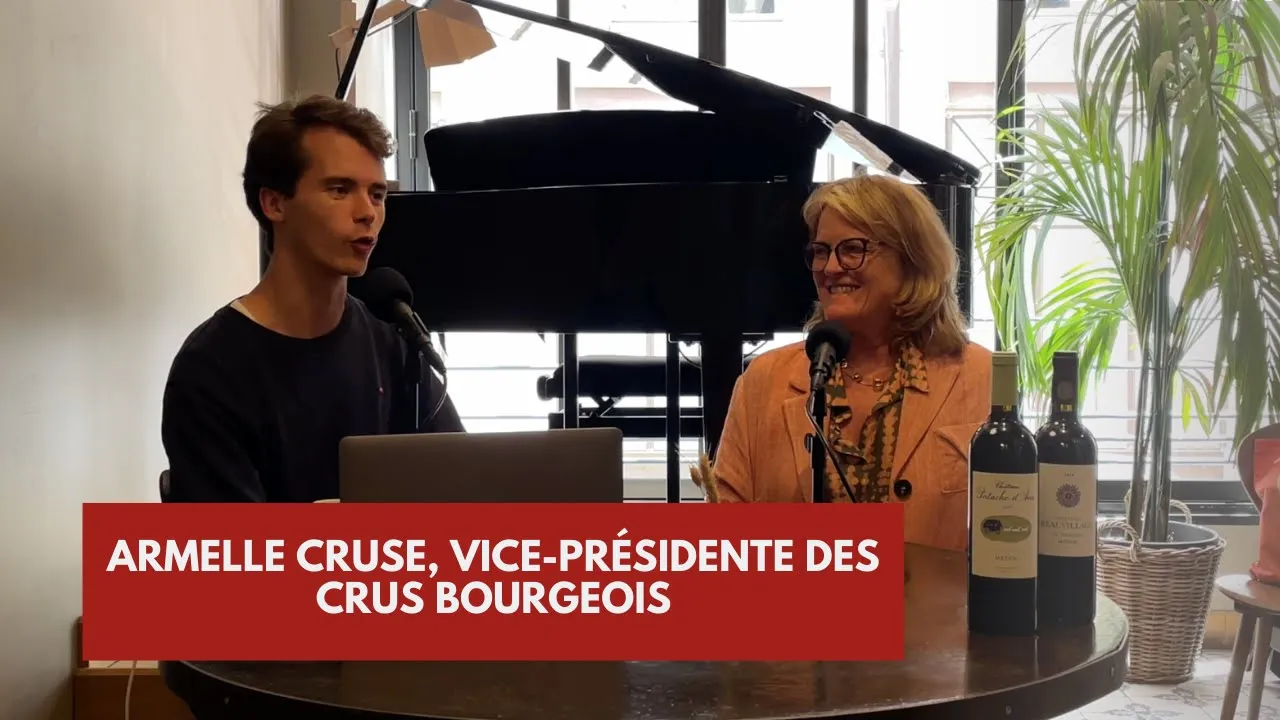
Today, we’re with Armelle Cruse who is the vice-president of the Crus Bourgeois classification in Bordeaux, in the Médoc. Together we look back on her career, on wine and of course on the Crus Bourgeois classification. She reveals all the secrets and smallest details to us, so you’ll know what this mention means on a label.
Antoine: you’re the third Cruse I’m interviewing, since I was able to meet Annabelle at Château Corbin and Emmanuel at Château d’Issan not so long ago. You were telling me you complete this triplet in a way with the Crus Bourgeois, this time.
Armelle: Exactly. Annabelle and Emmanuel are my young cousins. Me, I take care of a property called Château du Taillan which is an exceptional Cru Bourgeois, of Haut Médoc appellation.
It’s true that I often have the opportunity to meet Emmanuel, and I love Annabelle who is very dynamic too. It’s amusing because we’re descendants of an old Bordeaux family that has always been in wines, well since 1919.
So we continue to perpetuate this family tradition, each in their branch, because we’re not from the same branch, actually. With successions, inheritances.
We’re each from a different branch, we’re cousins, and each makes their branch perpetuate.
To be precise there’s still a fourth, who is Annabelle’s sister, called Vanessa and who also takes care of a Médoc Cru Bourgeois called Château Laujac, which is there by the way, that you may have been able to taste, which is in the north of the Médoc. So no, there is still a fourth.
Armelle, we already started quite a bit, but can you still introduce yourself?
Armelle: Yes, so I’m Armelle Cruse. I’m managing owner of Château du Taillan. I’m an oenologist by training. I worked for a long time in wine merchant business. That’s why I know Bordeaux wine distribution well and I focused on the family property which I share with four of my sisters. That’s why I say I’m the co-owner manager.
We are five girls owners of Château du Taillan which is a magnificent property, Haut Médoc. I’ve developed there, for many years now, several activities.
First, big work at the vineyard level to bring the quality of this property as high as possible and make it, at the last classification that took place in 2020 an exceptional Cru Bourgeois, which is my greatest joy, technically speaking.
And then, I also developed a second activity which is very important now, which is a hosting and wine tourism activity where I am the property relatively leader in this domain since, due to its geographical situation. I have a whole organization and we receive up to 10,000 visitors per year.
Yes, we have a big activity. For me, it’s an activity that we long considered, in viticulture, as the “poor” parent of our profession, but for me it’s a mode of communication that’s essential. It’s an after-sales service that we owe to the consumer.
We always go to the four corners of the world to sell our bottles but when our consumers come to see us in Bordeaux, it’s the least we can do to receive them and have this activity, this property tasting service, discoveries of our installations and especially contact with the winemaker. It’s something that’s dear to me and that once again is really a very important mode of communication.
Can we come back a bit on your youth, or in any case your beginnings in wine? How did it come to you to be interested in wine? You surely soaked in it quite a bit when you were young, but was it always something prevalent for you, was it something you always wanted to do? How did this path of telling yourself that wine had to be your profession go?
Armelle: Let’s say it happened a bit by chance, because we were of a generation where, well for my father’s generation, it was complicated for him to have five girls.
In his time it was important to have a boy. And so he had drawn a line a bit on his succession concerning the property. None of us was trained on the job, on the property. On the other hand, it’s true that we always soaked a bit in the wines.
I was scientific by nature and so I wanted to do scientific studies and I found myself in oenology a bit by chance. And in oenology, you’re asked at the start to do an internship and the first internship I did was at Château Giscours with a head of culture called Lucien Guillemet who really had me discover wine and tasting.
That’s how I started and how I acquired this passion for tasting and this profession.
What discussion did you have at that moment with your father, when you really got interested in wine? Because from what you tell me, he didn’t envision it necessarily that way or in any case maybe he didn’t even cherish the hope of it. What discussion did you have when it started to be really interesting for you?
Armelle: Listen, we had little because he had the misfortune of leaving early. I was 28, so I didn’t have time to discuss it too much with him. Especially, I didn’t have time to work at all. I have the memory of a tasting, but it was the last. So I found myself very early, since at the age of 29, with the property.
We found ourselves five on the property. So we were two who took over. One of them, who is one of my sisters stayed a few years and then decided to leave and me I took the leadership very quickly to try to develop this property and go as far as possible. But we couldn’t work with our father, you know. It’s destiny that wanted that.
Your four sisters precisely today, do they work in wine or not at all?
Armelle: So, there’s one who works in wine, who is a wine broker, that’s amusing. She’s rather in commercialization. Another works with me, she rather takes care of logistics, order preparation. Her name is Marie-Caroline. And finally, the other two, no.
On the other hand, it’s a family property, that is, the château is inhabited. The grandmother is still alive and she receives her grandchildren. It’s more a house, really a residential house.
Do you receive people, today, too? In wine tourism? You were telling me you welcome 10,000 people per year, but can people sleep on site?
Armelle: So, no. For now it’s only visits, themed workshops. So we have lots of kinds of workshops, winemaker walks. We do a bit of hosting, like organizing receptions, dinners, tastings, and so on.
I haven’t started a hosting activity precisely because it’s a profession and you have to have the passion for that profession. Me I have the passion for wine, so what interests me is wine, tasting, transmission, talking about the product more than hospitality where you really have to have a profession. But I think that for the next generation it will be possible because there’s a beautiful building that deserves to be shared too.
I interrupt your reading for a few seconds. Stay informed of the publication of the next episodes and access my list of 10 wine books to read by leaving me your email:
You arrive on the property at 29. How did you see this property evolve in recent years, between the moment you arrived and today? What happened?
Armelle: So first I stayed straddling in quotes, between the property and the merchant business since I was a buyer in several merchant houses up to the level of purchasing director. That interested me a lot, because my role was to go see viticulturists in all Bordeaux appellations and buy their wines at the best price.
But to converse with them about the quality of their wines, about their problems, that’s really what interested me. That’s why today I don’t only have the vision of my property, I have the vision of viticulture in general. I know what the viticulturist knows a bit from different appellations and that’s what interested me.
After I returned 100 percent to the property in 2010 and at that moment, in the meantime, of course, there was a technical team in place, and me the first thing I did was study my terroir, adapt as much as possible my grape variety mix or the grape variety mix of the property to the terroir.
And that’s how this property, which is a Médoc property with a tradition of cabernet sauvignon switched to a dominance of merlot. I planted enormously of merlot at the time because the argillo-calcareous soils, which are cold soils suit the merlot grape variety better. Which is different today since with global warming, I’m bringing down a bit the percentage of merlot, but so I made it evolve.
I especially made the quality of wines evolve by surrounding myself with advisors to favor as much as possible the fruity side, the roundness side, the balance side of my wines. I always paid attention not to transmit an austere side that you can sometimes find in Médoc wines, which are relatively tannic wines, that take time to open and that present themselves sometimes in a slightly austere way.
My “stamp”, was especially to cultivate the maturity of grapes, make wines as fruity as possible, not give them too much wood not to dress them too much, keep authentic, round, balanced, charming wines, in quotes.
While keeping of course the power of Médoc, since in Médoc we still make powerful wines but accessible wines. That’s exactly, in my opinion, the philosophy that I have of a Cru Bourgeois.
A Cru Bourgeois is a wine that isn’t a cru classé by definition and that is a wine that must be accessible to the consumer, that you can open easily without being afraid to open a bottle. It remains a Bordeaux wine but it’s a quality Bordeaux wine but not complex, no complexity.
There you go, the demystification of this myth, or the cultivation of the myth that you can have on the crus classés when you think you’re going to drink a mythical, rare wine, and so on. In the Crus Bourgeois, I think it’s exactly the opposite that should be done. We make quality wines, beautiful quality, at an accessible price and it’s a “pleasure” price. It’s a pleasure price wine. It’s not a basic wine but it’s a quality wine at a pleasure price.
There you go, that’s a bit my definition. My wine reflects a bit what I imagine, the philosophy I have of wine commercialization.
Yes, I understand very well. So you mention the Crus Bourgeois. We’re here at an event that’s organized precisely by the Crus Bourgeois. Can you tell me what it is the way it works? What is the vocation of the crus bourgeois?
Armelle: The Crus Bourgeois is a mention that’s part of the Médoc heritage since the Cru Bourgeois mention has existed since 1932. There have been several classifications. There was one in 1932, there was a second in 2003 and a third in 2020. And now, there will be one every five years.
Cru Bourgeois was a way, for certain Médoc properties, to try to differentiate themselves from others by their quality knowing they couldn’t integrate the 1855 cru classé classification which is frozen and will never be revised.
How to exist alongside the crus classés and how to extract themselves a bit from basic Médoc crus? This mention was created in 1932. It’s historic.
After, what we try to do in the Crus Bourgeois, in our family, is to stay dynamic. That is, our classification isn’t frozen. The best proof is that every year, we question ourselves. Until 2020 every year we had to take the exam, a blind tasting to know if we had the right to the Cru Bourgeois mention or not.
And then in 2020 we reintroduced the notion of hierarchization which is three levels inside our family. Why? Because we’re still 249, that’s very many.
Among the 249, certain brands have more notoriety than others. It was to manage to differentiate vis-à-vis the consumer because actually, inside the Crus Bourgeois family, there’s a price differential that’s very important.
By the way we saw it today. Here, there are wines that sell for less than 10 euros, including consumer tax, and then there are other wines that are in the same family that are themselves closer to 25 euros than 20 euros.
There’s an important amplitude in the family. For more clarification at the consumer level, we wanted to do this hierarchization. Hence the three levels. It happened at the start through a blind tasting of five vintages.
Five vintages, that was important in the classification. Why? Because you can have a surprise, or an accident, on a vintage in a given property. It’s very rare to have it on five vintages in the same property.
What I mean is that there are certain vintages where such property will make a fabulous wine, and so this vintage will be able to claim to be above others. Or the inverse case, there can be an accident and this property isn’t at the level of others.
When we judge five vintages, we judge the personality of the property. That is, the global culture over five years. Over five vintages, we see the philosophy, we see the style of the property, the style of the wine, that’s what’s important.
And it’s this style of wine that’s judged at the classification tasting. Did the wine maintain itself at a very high level qualitatively over five years and at that moment, it has the right to claim a Crus Bourgeois Supérieur mention, even Cru Bourgeois Exceptionnel, or did the wine precisely have a very pretty year and then four other years that are below a minimum level of Cru Bourgeois Exceptionnel and at that moment it stays at the basic level.
This qualification is very serious. It’s done by people who aren’t from Bordeaux or Médoc, and it’s interesting through this multi-year approach.
After, we’re classified for five years only. So that means that when we want to progress at the quality level we can’t relax the pressure, we have to progress. That’s one of the elements. What’s the most important element? The tasting.
And then after we have to expose, through a file, and that’s what some properties had trouble doing, the global philosophy of property management. Where do I want to go, what do I want for my wine, what’s my engagement for the Crus Bourgeois family, why do I want to be supérieur or exceptionnel, what do I do for, in terms of price policy where do I want to go, in terms of notoriety, where do I present my wine?
You can well imagine that to be Cru Bourgeois Exceptionnel, or Supérieur, you must have a certain distribution ambition, a certain notoriety ambition too of having your wine tasted in such a way as to participate in the radiance of the Cru Bourgeois mention, how do I do to make this mention live and to make my brand live.
And all that is compiled at the level of a file that’s presented and that’s then judged by people who aren’t tasters and who judge the investment and ambition the manager or owner has in their property.
We’re judged on notoriety, on our environmental engagement. We must all be HVE certified, Haute Valeur Environnementale, which doesn’t mean organic because today organic isn’t part of the Crus Bourgeois. Not everyone can afford to be organic.
A certain number of crus are in organic or biodynamic, but we can’t impose on everyone to be so because that includes important sacrifices.
What’s my ambition? So I told you, at the distribution level, what are my sales prices? If I sell at very small price I don’t need to claim to be among the greats, let’s say. What’s my press point? Do I have notes from journalists, I present my wine, I have references, am I distributed in certain good restaurants or am I 100 percent with the same client?
There are lots of data. There’s my investment too in wine tourism, but it’s not pure wine tourism, it’s is the property open to welcoming? Am I capable of welcoming people in a correct manner?
And so all that is argued in this file, it’s judged. That’s what’s going to make that at the classification level, the tasting note plus the file note will mean that some properties will be able to be Cru Bourgeois, others Cru Bourgeois Supérieur and finally others Cru Bourgeois Exceptionnel.
Today we are 14 to have received the Cru Bourgeois Exceptionnel mention. It’s true that it’s a mention that’s important and that’s a reward, let’s say, but we only are for five years.
That means that all the Crus Bourgeois Supérieurs who want to be exceptionnels will try their luck in 2025.
You can also watch this interview on YouTube.
Are you limited in number of Crus Bourgeois? There, you are 249 but it could be 310?
Armelle: Exactly. That doesn’t mean there were 249 candidates. We don’t know how many candidates there were because for legislative reasons. You know well that in this kind of classification, and we know it in other appellations, the unhappy find anything they can to go to court to try to break the classification.
That happened at the Crus Bourgeois level in 2003. In 2003, there was a Crus Bourgeois classification. Château Taillan by the way was Cru Bourgeois Supérieur, so I was delighted since it was 10 years ago. It was broken because some went to court and the judgment annulled the classification. In 2007, so four years after, we all came back down to Cru Bourgeois.
We had to start over, get along among ourselves, do general assemblies, go see the authorities, the governments, and so on, so they would accept that we redo a new classification, which could be done, in 2020. But between 2007 and 2020 it was 13 years still, where we had to row to continue making this mention live and to reintroduce this classification.
Once it was promulgated, so in February 2020, there were a few unhappy people but thank God, there weren’t big flaws that could justify the annulment of this classification. Today it’s valid until 2025.
But the Crus Bourgeois, in itself, what is it? So is it an association of winemakers? How was it structured and could in fact, tomorrow any collective in quotes decide to produce a classification, open it, grade it, and so on? You see what I mean? How was this done?
Armelle: The Crus Bourgeois is an association of Médoc winemakers who decided to associate but a very long time ago. Actually, it’s the ancestor of the médocs-haut-médocs syndicate formerly but this syndicate also encompasses communal appellations. It’s a syndicate that was created alongside the médocs-haut-médocs syndicate which still exists.
So it’s a kind of syndicate of crus that wished to differentiate themselves from basic Médoc crus and 1855 crus classés. So at one time they created a Crus Bourgeois cup, but there they created a classification to try to make this family live and also have a challenge between us.
For the consumer it’s not so easy to understand. What’s certain is that if we didn’t protect this Cru Bourgeois mention, many other appellation syndicates, whether Bordeaux or others, would take this mention back. That means it means something.
It means something, it’s historic. It’s a historic mention that’s part of the heritage, so we don’t have the right to drop it. Now, in collective of winemakers, you have “Les Vignerons Indépendants”, for example, which is another association, by the way of which I’m also part and that has a philosophy of distribution, of organizing fairs to the final consumer, and so on.
Each has a bit their history. I think viticulture is part of French heritage. It’s normal that there be all these associations. Actually, it’s diversity. It’s a bit the opposite of what you can find for example in the United States with Gallo Wine, where there one could represent enormous viticulture, an enormous quantity of wines.
Us, we’re a bit a multitude of viticulturists. We keep a bit this peasant side, in quotes, in the good sense of the term that means we have our history and we keep it. But we know that union makes strength and so we have this notion of solidarity.
By the way, at the Crus Bourgeois level we’re creating a forum precisely for discussion so that we can exchange equipment. Today there’s a big problem of recruiting winemakers, tractor drivers, and so on.
If you’re listening to this podcast or watching this video and you’re a winemaker or tractor driver, you can contact Armelle.
Armelle: But there are few. You earn very well today when you’re a winemaker, tractor driver, because as there are few they are sought after and they’re cannibalized let’s say, by the big brands and we need this kind of people too so we’re creating this exchange platform.
We have to evolve on lots of subjects, at the marketing level, in our labels, in our promotion, in our distribution, well we have lots of things to do.
We have lots of things to do because in addition at the commercialization level, it’s not as simple as that, because we’re a bit between the two. When we’re between the two, that means we’re not in the Bordeaux elite who themselves carry the image. And we’re not in basic Bordeaux where we can afford to do volume to sell very cheap.
Us, we’re between the two and so we have to diversify and manage a bit by ourselves. And that’s what we’re doing today by traveling together, by organizing events like today.
What does it mean to be vice-president of the Crus Bourgeois? What are your responsibilities?
Armelle: So my first responsibility is to be president of the promotion association. I take care of promotion essentially, of the Crus Bourgeois family. So that means I propose to the board of directors everything that’s events like today, trips, market support, travels, presence at wine fairs, you know.
It’s important because people, the members need us to make the brand live. My role is to make this collective brand live, so the Crus Bourgeois signature and quality with closed eyes.
That, that’s something for example that we tried to put in place: being a Cru Bourgeois is quality with closed eyes. When you have a Cru Bourgeois you know you can go for it, that’s my role.
It’s a role I’ve had for quite a long time. I aspire to have young winemakers come in, because this promotion evolves all the time. We need to renew ourselves. It interests me a lot and especially I’m very proud to be Médocaine. Plus, due to my past in merchant business precisely, I know my own problems, but I know that union makes strength and that we have to manage to move.
What’s precisely the evolution that you’ve been able to notice among these Crus Bourgeois and the vision you can have? What’s the vision you can share?
Armelle: So, evolution, already. We’ve had highs and lows within the family since with this mishap, this 2003 classification that was annulled it was complicated. Many people were discouraged to see that we made so many efforts with specifications, and so on. It’s very long to put a classification in place from a legal point of view, so it’s a lot of work, then suddenly it disappears. We had to remotivate the troops. It’s a family that has had highs and lows.
Today, we’re in a new dynamic with the arrival of digital in our communication, the arrival of summer universities where we have more solidarity between us. Our vision is to support this brand and as far as possible and to gather around this brand.
We’re now trying to bring in a pleasure side with our wines. For example, we’re organizing the first festival called “Good Wine Only,” which is based on a gathering. We’re 80 Crus Bourgeois and we’re going to present our wines with musical animation, with a festive side.
Where will it be?
Armelle: So the first one takes place during the Bordeaux Wine Week, so the wine festival. It takes place on the evening of the music festival, so it can’t be simpler. It’s on June 21 in Bordeaux. There will be musical animation with a musician but I don’t remember the name anymore because he’s modern and I no longer know him, but I know it’s someone who’s interesting.
That’s going to show a bit some slightly relaxed wines, a bit cool. The relaxed side of the Cru Bourgeois. I think that’s our coming philosophy. We no longer want to be the Bordeaux person with the slightly cru classé image, with the white tie, the white gloves. And we want to be a bit cool and music will help us with it.
We’re 80. It will be in several French cities with a beautiful finale that will surely take place in Paris with a big music festival and tasting.
The Crus Bourgeois you’re together obviously to progress, diffuse this image. Do you also commercialize together with the same circuits or does each commercialize on their side, in quotes?
Armelle: So, today each has their own commercialization. It’s not the role of the Crus Bourgeois alliance to take care of commercialization. On the other hand, we’re thinking or rather reflecting, because a certain number of crus are not, let’s say, equipped yet to manage to commercialize their wines differently. They’re not ready to diversify. However, they need it. Why not eventually have, I don’t know, a digital platform where any person who would want a Cru Bourgeois could go and buy their wines, or something like that. So we’re thinking about it, but it’s not in place yet.
Today the Crus Bourgeois are present almost everywhere in the world, in terms of distribution?
Armelle: Yes, more or less in large numbers. One of the first markets still of the Cru Bourgeois is France, you have to know it. It’s in France that you can find the maximum of Cru Bourgeois, notably in wine fairs because it’s a typical wine that you can buy in wine fairs because it’s its quality-price ratio.
Then, one of the important markets of the Crus Bourgeois is the United States. That’s why every year we organize a delegation that I generally lead to the United States, to New York where we are followed by a certain number of sommeliers and we organize tastings on occasion in different New York clubs. That, that works well, the United States.
Then there’s Canada. They’re monopolies but a certain number of crus are distributed at the SAQ notably, you know.
Then, in Belgium, which is the traditional market of Bordeaux wines.
You’ll have some who are more or less strong in England or Germany, after each goes with their distribution. Since 249 crus represents in 2020, 25 million bottles. That’s perhaps more telling that way, it’s a very important number of bottles.
Yes, I don’t remember anymore who was talking about it earlier during the tasting but in terms of commercial strength, of representation, it’s what, 80 percent of Médoc crus, I’m maybe saying nonsense? Of the volume produced?
Armelle: It’s, no, it’s not 80 percent but it’s 50 percent.
Yes, it’s enormous. That’s why each has their commercialization mode. There are some who sell directly at the property. Others go through the merchant. There are some who do both, there are some who have agents, there are some who sell directly to export, and so on.
Everyone goes a bit with their resourcefulness, compared to before. The system from before, so from the time of my parents and grandparents, to have a Cru Classé, it was mandatory to buy the Cru Bourgeois that goes with it and even the red Bordeaux that goes with it.
And then the crus classés having changed hands a lot, some of them belong to big groups that have very developed marketing approaches with a brand policy that means there’s no longer this locomotive with the train.
The locomotive left the wagons a bit. We are the wagons and each wagon has to move in their way, you know, that’s how it is.
I didn’t know at all that you had to buy the Cru Classé, the Cru Bourgeois, the Bordeaux Supérieur.
Armelle: When you wanted to have 100 cases of Pontet-Canet, you had to buy 20 cases of Château Taillan, 20 cases of La Dame Rouge Bordeaux Supérieur, and so on, it was mandatory.
It was a locomotive. Little by little, there was this notion of investors who arrived in Bordeaux and luxury development, the LVMH group, and that mean that the Cheval Blancs, all the firsts, the Moutons, the Lafittes and so on have their own distribution circuit, they have their own brand policy that has nothing to do with the rest of Bordeaux.
It’s not a criticism, it’s the normal evolution of things. They’re people who invest so much money to buy these properties because you have to know that the price per hectare is very important, that automatically they want to have a return on investment, which means they play their cards.
But the others who were used, the rest, the wagons, who finally were winemakers, weren’t interested at all in commercialization but they found themselves little by little like winemakers without a locomotive. A certain number of them became what I am, that is, technical-commercials.
Today, a winemaker in Bordeaux must also worry about their commercialization, which wasn’t the case before. Today, you can have a property, that’s very good, be passionate about the vine, produce wine it’s fascinating but you also have to have a commercialization aspect. How am I going to distribute my wine, it’s no longer enough to just be a producer.
It’s a new deal, because for us it forces us to be polyvalent in our heads, to think of everything because it serves no purpose to produce if you don’t know how to distribute it.
That’s why a certain number of properties, unfortunately are going to be brought to be ceded. They produce but they don’t manage to commercialize. They didn’t learn to commercialize and not everyone is commercial in the soul.
In the same way as a commercial, without passion for the vine, will have trouble being a producer. It’s so complex especially now with global warming, with all the new deals, and so on. You have to be passionate about the vine, you have to understand the terroir and the grape variety to have the will to continue producing despite the difficulties.
So you really have to have both. That’s why I say you have to be technical-commercial to lead a property today.
If there are some that sell for not too expensive and that are very good, you call me. I’ll leave you my number.
Armelle: Not too expensive, that’s rare in Bordeaux.
Precisely, do you think we can still settle there?
Armelle: Yes, I think we can still settle there. It depends in which sector, because there are sectors that are totally inaccessible. On the other hand Bordeaux still makes people dream. That’s what’s incredible is that Bordeaux continues to make people dream.
Anyone who’s succeeded in another field, often, has a desire to concretize their success by investing in a terroir, in a château, in something. I find that it has a certain charm. When you just want to invest to become profitable in stride, that doesn’t work.
If you’re an industrialist and one euro invested equals one euro in your pocket after two years, that’s not possible. But when you want to come back to the sources and really, put your success in the vine, in the stone, I find that it’s a beautiful story still.
There are, in Bordeaux some beautiful stories like that. And often people are caught by passion, plus. That is, passion catches up with them. There are many families in Bordeaux, Smith Haut Lafitte for example. They arrived and finally they developed enormously and they’re attached.
Transmissions are also a real subject in Bordeaux
Armelle: Yes, we have trouble making cash. The only thing we can do to realize an estate is to realize it, to sell it precisely, and that’s what’s complicated. The one who’s in finance tells me it’s a lot of work to value the estate.
Then, I have a second one who also set up her company but who’s in jewelry, nothing to do. She creates jewelry and it works well. It’s called Argelouse.
We’ll put it in the description, we don’t have a promo code but we’ll put it in the description.
Armelle: And finally, the last one, who with Covid landed on the property because she had of course other plans like most young people of that age who were supposed to leave for the United States or Asia. She was supposed to leave for the United States in cosmetics because she had landed something fabulous.
But she could never leave and ended up telling herself after a year and a half, you can’t stay waiting eternally for something that doesn’t come. And so she did an experience on the property since I needed precisely, to attack, or add a digital aspect to the property’s communication. As those are her skills, she started, and finally she got passionate about wines.
It’s exactly the same thing, passion is catching her, it’s incredible. By dint of tasting, by dint of discovering, of seeing the vine, it’s so rich and it’s so different. There are so many things. She’s only 25 and she’s getting passionate. And I find that very good because I wasn’t expecting it.
Now, they’re still 14 on this property. I have sisters, who have children, who have boys and so on. They’ll still be 14 cousins. She won’t make her life like I was able to do. But I think it’s a beautiful experience in any case.
What projects are you carrying out in this preservation of the environment and also in the transformation of the vineyard?
Armelle: So actually, for the 2020 classification to be Cru Bourgeois, we had to justify a commitment in a certification. We didn’t have to be certified, because it was too complicated to ask that of people. There are a certain number of farms that are a bit old. We let people have time to adapt. But they had to be committed, and justify a commitment. For the upcoming 2025 classification there we’ll all have to be Haute Valeur Environnementale certified.
As you say, it’s in the spirit of the times and it’s important. Bordeaux is quite a leader with notably the CIVB which has done many training sessions with viticulture to encourage viticulture to commit in this direction.
We try to encourage everyone. There are organisms to accompany. Notably an organism called the Environmental Management System, EMS. They’re small groups managed by the Chamber of Agriculture.
It’s that it’s a training that viticulturists, so the Médocains, can do. It’s very interesting because it allows, not only to see how to manage your vineyard with zero pesticide, how to thus bring the vine to continue producing grapes without contaminating the land.
But how also to introduce well-living together, how to have a CSR policy. It doesn’t only encompass the viticultural part, and that’s very important.
I was, at the level of Château du Taillan, the property in the metropolis, and in Bordeaux metropolis. That is, we are one of the properties closest to Bordeaux. I was very quickly sensitized to it since with the different slightly criminal reports there were on televisions, it’s certain that the population is vigilant on this subject and that we, viticulturists, must respond to their concerns.
We have a communication at the neighbors’ level that’s established. And then, we no longer need to make them adhere. All new generations are very sensitive to it. And in addition, the law also obliges us to.
There are a certain number of products we can no longer use. It’s what’s called CMR products. They’re products that could have consequences on health, so those are prohibited little by little by the government, so they come to it mandatorily. And now all of Bordeaux is coming to it.
As much as five years ago it was still a relative novelty for the Médocains, now, it’s in the spirit of the times. We have symposiums permanently on this subject, we’re in sustainable development. Even wine tourism is in sustainable development. I mean all activities are. It’s no longer just a reasoned agriculture activity. It’s an activity on all of Bordeaux activities.
What should we wish you for the Crus Bourgeois by say 2035 in about 10 years? What is it?
Armelle: Well already to have a certain climatic clemency, to try to have fewer climatic uncertainties than the last five years because it’s complicated. As we were talking about with President Franck, today it’s complicated from a production point of view, it’s complicated from an environmental point of view. It’s complicated from a commercialization point of view. We do a profession that’s complicated today.
But well, I tend to say, and what my daughter who’s in finance tells me, it’s the same in all professions. In the restaurant business, it’s the same, and so on.
We need to be wished clemency at the climatic level, a pretty solidarity between us and the quality of wines, we work on it so much that it’s not worth wishing it for us, we’re there, a beautiful enthusiasm, a new enthusiasm for our Médoc wines and for a recognition of what we do.
And the desire, for the young generation especially, to taste our wines not like their parents’ wines but like current wines because we have a bit this problem too of being a bit, we need to be in fashion, a bit, you know.
Thanks so much, Armelle, for this interview. I have three questions left, which are traditional in this podcast. The first is do you have a recent favorite tasting?
There’s a wine that I find extraordinary, that I’ve always tasted, wine is linked to an emotion too, so it’s some Cheval Blanc. It’s a wine that represents something, that I tasted with my father and it’s something that will remain. It’s not recent but it will always be the favorite.
Each time I’ll taste, and I have the opportunity to taste some from time to time, you know, me it’s my favorite.
My second traditional question, do you have a wine book to recommend to me?
Armelle: Hugh Johnson’s World Atlas. Yes. It’s the wine bible the World Atlas. It’s the wine bible. There’s everything in it. It’s simple and complete. For me, it’s the bible that I recommended to, that I gave by the way to one of my daughters, you know.
And my last question that’s just as traditional, who is the next person I should interview?
Armelle: So, it’s a person I don’t know but that I heard recently in a conference. No, by the way I don’t remember his name but he is technical director of Cheval Blanc, precisely.
I won’t tell you his name but you’ll find it, Jean-Luc something, but that’s normal, I don’t remember names. Why? Because he’s a man who has an approach precisely of viticulture, of environment, who intervened during a conference on engaged vineyards, which is an association precisely managed by the CIVB in Bordeaux that organized a conference recently on engaged vineyards.
He gave the testimony of Cheval Blanc which has of course the means to put in place but he’s someone who’s convinced of agroforestry, return to nature, reintroduction of nature in the vineyard, and so on. I found that he brought back, and God knows if Cheval Blanc is a wine that’s precisely mythical and that’s out of time because it’s inaccessible, we don’t have the opportunity to taste it, he has a way of talking about his profession that brings him back to peasantry. So to the peasant side, to the natural side and I found that it was fascinating. I urge you to meet this person.
So, I know many of course owners but he, will have an authentic discourse and really interesting and in the spirit of the times for future generations. He’s inhabited by the future of the earth. And that, that’s our future.
I interrupt your reading for a few seconds. Stay informed of the publication of the next episodes and access my list of 10 wine books to read by leaving me your email: