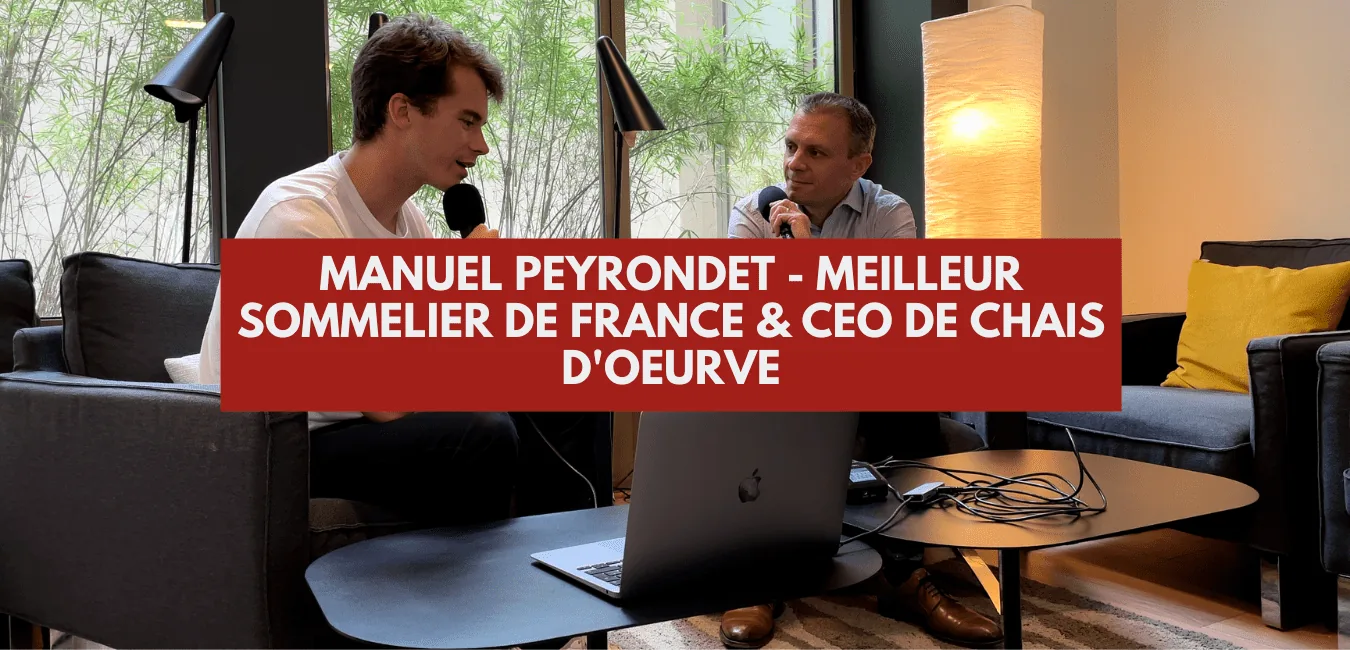
Antoine: Hello, and welcome to this new episode of the Wine Makers Show. I’m really thrilled to be back with you today. We took a little break to recharge our batteries, and today I’m with Manuel Peyrondet.
Manuel Peyrondet is, among other things, Best Sommelier of France, Meilleur Ouvrier de France, but not only. His career path is absolutely incredible. Today, he’s the founder and CEO of a company called “Chais d’Œuvre,” which does an enormous amount of things in the wine world and is absolutely incredible. We had a great exchange together, I really enjoyed it. With Manuel, we had a wonderful time, so I really thank him for the time he gave me.
I hope you’ll enjoy this interview as much as I enjoyed doing it. Don’t forget to follow me on Instagram, join the newsletter on the site, and check out what we’re doing on YouTube. We created a YouTube channel called “Wine Makers Show by Antoine Desferet”. It’s been available for a few weeks now. I publish tasting videos and explanation videos about wine, so go check it all out. I’ll leave you with my conversation with Manuel. Thanks so much for being here, see you soon, bye.
Hello Manuel.
Manuel: Hello.
Thanks so much for welcoming me here. We’re at your place, at “Chais d’Œuvre” today.
Manuel: That’s right.
Antoine: So Alexandre Nazaref recommended I interview you in a previous interview I did with him quite a while ago. If you haven’t listened to it yet, I invite you to do so.
We’re obviously going to talk about a lot of things because you have an incredibly deep wine background. You’ve done so many things in this field, but I’ll let you start by introducing yourself.
Manuel: With pleasure. I’ve been a sommelier for about 22 years now since I started my career at the George V in the early 2000s. I’m from Bourgogne. I was born in Bourgogne and I had the chance to grow up in a family that loved wine, my father in particular, who’s a doctor. I was also lucky to grow up in an environment where we cooked well.
A little anecdote, I’m a cook first, and then a sommelier. The wine world caught me on the fly while I was doing my hospitality BTS in Poligny in the Jura.
I was a sommelier for about 15 years in great establishments in Paris. So the George V, where I started my career. Then, I worked at Taillevent for 8 years where I became head sommelier at 25 and I was Best Young Sommelier of France in 2005.
After that, I took on other sommellerie competitions. I became Best Sommelier of France in 2008. I then moved from Taillevent to the Bristol because one of my friends, Marco Pelletier, was working there and told me: “Take a tour at the Bristol” because I’d already been working at Taillevent for 8 years. It had been a few years and it was time for me to see something else. So I went through the Bristol with Éric Frechon. It was wonderful.
Then, I was headhunted by the Royal Monceau teams who were doing the reopening of the Royal Monceau, a mythical palace that had been completely redecorated by Stark. A wonderful opportunity to create from scratch, a wine offering for different restaurants, the bar, and so on. And to immerse oneself in the universe of palaces. I spent 6 years there.
In the meantime, I became Meilleur Ouvrier de France in sommellerie and then, a little anecdote, I became an entrepreneur at the same time since Chais d’Œuvre started from a group order for a few friends. Chais d’Œuvre is my company today. It’s about 15 people working there.
It all started from an order for friends at the beginning, since one of my Chais d’Œuvre partners was actually at the time my coach for sommellerie competitions, who invited me to make a few proposals at his consulting firm. He had 40 people, saying: “Couldn’t we buy with you the wines you buy for yourself?”, that’s it.
The pitch was already a bit there, which I did. We described two domaines I love. At the time it was the 2008 Loire wines, which is a great Chenin vintage, that’s truffling today, telling them: “It’s a bit like the 2002s and the 1996s in the Loire, it’s going to be wonderful.”
I wrote why I love and why I buy for myself. This group order went out to friends and when it came back there were 950 bottles on the order. It was a huge order for 40 people that was impossible for me to deliver. When the order was actually delivered, we threw a big party. I discovered that day that I didn’t simply want to do service but that I wanted to shift the notion of service to that of sharing. That’s how we created Chais d’Œuvre.
At the end of that evening, people told me that if they had tasted these wines before and if they had heard about them like I’d just done, they would have bought more. Why not create a club that would allow that?
Today, Chais d’Œuvre is a fairly successful little company. We have 8,500 members who buy nearly 200,000 bottles a year. We do a lot of events, a lot of experiences, a lot of evenings, a lot of things that stimulate passion around wine. All connected of course with the Internet, digital, the capabilities we have to obviously go very fast with information. And especially bring information home.
It’s a bit hybrid. It’s something very experiential. People come for the wine, not just for the food at the start, which is the case in a restaurant. It’s rather selfish as a project but globally people come looking for experiences, networking, life moments, encounters with taste artisans, sometimes great winemakers.
Chais d’Œuvre is several different activities that cross and intercross. We stimulate the passion of a circle of individuals through flash sales, tasting boxes that people receive at home, vineyard outings, oenology classes, online masterclasses, you know, lots of things that stimulate.
We build cellars that can be passed on to children. That’s the promise of Chais d’Œuvre Heritage. We create an account for the child. We give them bottles, leaving them messages in a cellar book. When the child comes of age, they receive their cellar with all the traces of the people who gave the bottles. We obviously give oenological support to this child. That’s to pass on the taste of great mature wines.
Otherwise, we also support a few major luxury world groups in the art of living around wine.
We also sign the wine list for the Barrière group restaurants.
We also do a more B2B activity. There our clients are sometimes entrepreneurs, doctors, or big company bosses. They call on us to stimulate their networks around wine with tasting journeys.
Since 2016, it’s been full-time for me. Chais d’Œuvre is celebrating its 10th anniversary this year, on July 19 to be precise.
Bravo. I hope there will be a big party.
Manuel: There will be a big party, that’s certain.
I have no doubt about it. You know I have a second podcast on productivity which is a topic that fascinates me and I think I should also interview you because you all seem to do tons of things here. There seems to be a lot going on.
We’re going to go back a bit before talking about Chais d’Œuvre. How did you discover this passion for wine and for sommellerie in particular? You said you’re from Bourgogne.
Manuel: I’m from Bourgogne.
You were a bit immersed in the vines.
Manuel: Yes.
But how, at what moment did you tell yourself: “I want my life to be this”.
Manuel: My parents were quite curious in their approach to gastronomy. It’s true that my mother is an artist and my father was a doctor. Even though they separated afterwards they always kept the taste for beautiful things and the art of living around food.
I have childhood memories where my mother cooked for almost two days with my father in the kitchen, with Paul Bocuse’s books, Bernard Loiseau’s, and so on, and I saw them overexcited at the idea of organizing an event, an evening.
My mother was an artist. She also embroidered aprons or evening dishcloths with the great wines they were going to drink. They had created a club with friends where everyone put money in a little piggy bank, and at the end they bought themselves beautiful bottles.
The bottles back then were much more affordable than now but I saw legendary bottles parade through the house. When I see those aprons today and the names that were written on them, it brings back good memories. I was a bit immersed in all that and I was quite amazed.
At home, there were lots of magazines, like Saveurs, at the time. A fairly high-end magazine, with very beautiful photos, it really made me want to.
I was in scientific track. I was deeply bored at school because I wanted to be a doctor, like my father, but I quickly understood that anyway it wasn’t for me. In first year, I told my father I wanted to do cooking.
He told me it was a beautiful profession, but if you want to know if it stings you, you really have to live it. I did a 3-month internship over the summer in a 2-Michelin-star restaurant in La Napoule, at L’Oasis. A 2-Michelin-star that belonged to the Rimbaud brothers at the time. I spent 3 months from 7 in the morning to midnight in a kitchen with a half-hour break.
I really discovered the restaurant business, its advantages and disadvantages. But I also understood that it’s a profession of passion. I met incredible people. I learned tons of things. At the start, I was peeling vegetables and at the end I was plating dishes. It was also an interesting social elevator. I quickly understood that the restaurant business was going to grab me like that.
And wine, actually when I was doing my hospitality BTS my father had told me it would be good to do hospitality training. It’s clear that it’s a profession you can learn on the job, but you can also quickly branch off. I did first year science track, last year literary track to learn German. Because to do hospitality schools, people don’t know it, but you have to speak at least 2 languages, so English/German.
After that I had interviews to take a hospitality BTS. I was rather oriented toward table arts and culinary art. That was really the branch I wanted. I did a 3-year BTS with a leveling year. What’s called a leveling year is a year where you actually learn all the basics of what you can learn in a professional baccalaureate.
And there, I discovered the wine universe thanks to a restaurant teacher who was wonderful. He explained to us Sauternes, the morning humidity, the afternoon sun, the concentration of this little fungus in the berries, and so on. There, I totally went off the deep end. I leave the class and I remember there was a winemaker called Bernard Badoz on the street in Poligny in the Jura where I did my studies. I went to see him and told him: “Listen Sir, I’m just out of an oenology class with a restaurant teacher. I think this is going to sting me and I’d like you to tell me a bit about your domaine, the Jura, the specificity.”
I quickly understood that wine was something that was going to go much further actually than cooking in my interest in any case. I started devouring books, finding something that really fascinates me.
There, I became very good at school because, that’s a bit how it is I think, many young people when they find their way distinguish themselves. My restaurant teacher at the time told me: “Manuel, if I may, I think you have a sommelier’s soul, you should look at the path of one of my former students, called Aurélien Blanc, who was Best Young Sommelier of France and who afterwards had positions of responsibility, who is today in Switzerland, one of the unmissable people in wine. He did his school in Dijon. I invite you to look at the additional sommellerie qualification”.
I said: “Yes, why not”. At the start I wasn’t quite sure I really wanted to do that but I told myself an additional qualification lasts a year, it’s not too long and not too painful in terms of prices for studies for my dad. I self-financed a lot of my studies, but I didn’t want to go to a big, very expensive, very well-known school either.
I think it’s a profession you really learn through passion and contact with the greats.
So I did the additional sommellerie qualification in Dijon. There I put my finger in the gears and I never came out.
That’s how it happened. It all started in Bourgogne. It expanded a bit through gastronomy. I came back to Bourgogne for my first vinification internship in Gevrey Chambertin, learning to make wine. Then I devoured all possible and imaginable books.
I think we all need in the world we work in, a model and inspiration. When I was in Poligny in the Jura, in my little student room, I saw one day “Des racines et des Ailes” where there was Éric Beaumard who is the director of the George V, who was taking the Best Sommelier of the World competition and in which actually for an hour and a half he explained how he was preparing for this competition and especially his secrets to win.
I’ll remember this sentence all my life. The journalist asked him a question before he went on stage for the world finals which were taking place in Vienna: “But what are you going to do today to win?”. And he answered: “I’m going to make people want to be served by me”, that’s it.
When I heard that I told myself: “I want to work with this person”. I only sent one CV to Paris, that’s how I arrived at the George V.
Very strong. Éric Beaumard is one of the people I want to interview on this podcast.
Manuel: You absolutely must interview Éric Beaumard.
He sounds incredible. He was recommended to me by the way. Actually, I contacted him a long time ago. He was recommended to me in the meantime and I, I admit I haven’t reconnected. I need to do it. Did you believe in it, when you sent that CV?
Manuel: Well, I’d polished the cover letter a bit. My father had reread and corrected it and so on, but I’d really put my whole heart on the table, and especially I’d put a photo of me in a tuxedo and bow tie. The photo was in black and white. It’s the only CV I sent to Paris.
Job interviews in palaces like that are quite long. There are 5 or 6 people you cross paths with. The first question they asked me was: “But why us?”. I told them clearly that it was them and nothing else. I think it’s rare in the restaurant business to find someone, by the way you see it today with recruitment problems, who really knows it’s their profession, that it’s their fiber, that it’s what they want to do but who says it’s only there they want to work.
Because I know why I want to work there. Whereas often, you grope, you test, you send tons of CVs, whether here or there, it’s not serious. Me, I had a vision. I wanted to work with Zinedine Zidane, I wanted to work with Éric Beaumard, he was my idol, my childhood dream.
And I told them: “Listen, I would do anything to work here.”. I accepted all the conditions, including the starting salary. And to arrive in a big capital like Paris, with rents that were almost as high as my salary.
We’ve all been through that.
Manuel: Classic. Lots of sacrifices, but I don’t regret anything, not one second.
That’s the recruitment to enter the George V. The first day, what happens?
Manuel: Already, I discover a universe that is the opulence of Parisian palaces in which someone who comes from the provinces and who doesn’t necessarily have the same reference points can be initially a bit shocked. But then, you’re very quickly amazed. You discover what a no-limit client is, you discover what a hyper-passionate client is with an unfathomable wine culture. And you also discover the level of demand of a 3-Michelin-star because clearly when you arrive there you tell yourself: “It’s the essence of a great…”, but the degree of demand of a 3-Michelin-star you have a hard time imagining like that, but it’s the smallest detail pushed to the extreme.
There’s no place for approximation, there’s not half a millimeter of gap between cutlery on the place setting. There’s not a possible imaginable lint on a glass, there’s nothing whatsoever. There’s not a bottle that’s on the list that can be missing, and there’s not the slightest acceptable defect of under or over cooking, seasoning, or other on a dish. Especially in a palace that made this meteoric rise of one, two, then three stars, in three years.
You discover that and you discover the pressure that goes with it. You have to have solid kidneys and nerves. The hours are very tiring, obviously, but at the George V let’s say we were also at the beginning of the slight improvement of working conditions with shifts in one go.
We no longer necessarily did the break like was the case for 8 years at Taillevent. I also discovered a form of rotation. I discovered all that obviously with amazement but also telling myself that for me it wasn’t going fast enough. Learning while doing only one shift at the George V didn’t allow me to cross paths with a maximum of people, open a maximum of bottles, test a maximum of things.
I found the experience absolutely wonderful but I needed something a bit more intense still. That’s why I left the George V after a year and a half to go to Taillevent. Taillevent was a slightly old-fashioned house with a crazy cellar.
By the way, it’s the former maître d’hôtel of the George V who came from Taillevent who told me: “I think this house is for you”. It was 350,000 bottles, 6,000 wine references, an amazing cellar. It was wonderful this experience in 3-stars, especially the George V. I went back to eat there a few weeks ago, and frankly nothing has changed.
Listen, it’s part of my plan.
Manuel: It’s a box to tick, clearly, especially with Christian Le Squer who’s currently in the kitchen.
OK. Got it. You arrive at Taillevent then, right after. You needed a more intense experience. I get the impression you needed to be a bit roughed up?
Manuel: Yes. It’s funny because even though the profession is very hard I think it’s a profession for which when you set your mind to having a rapid professional ascension, you naturally set yourself goals, wanting to surpass and reach them. Me clearly, I’d given myself a target. I told myself: “One day, I’ll be Best Sommelier of France” and maybe one day, I’ll represent France at the Best Sommelier of the World competition. I always hope one day to be able to do it but the bar is very high.
So I always set professional goals for myself and the first one was to prove to Jean-Claude Vrinat, who was the boss of Taillevent, who didn’t believe sommeliers could be that important. It was a very well-known house. They managed the cellar very well, there were lots of great wines. But he hadn’t measured the impact a sommelier can have in his restaurant from the point of view one, financial; two relations and three cellar management, which is very important. When you have 350,000 bottles and you only sell 35,000 of them, you have to be quite agile on wine rotation otherwise you can very quickly have losses.
Jean-Claude Vrinat told me: “Listen, I’m willing to recruit you but as a cellar man”. I say: “Listen, that’s not really what I set as my goal. I’m willing to organize the cellar, but if you let me on the floor, I’ll prove to you A plus B that an additional sommelier can do something very significant in revenue.”
There was no sommelier at all at the time?
Manuel: There was a head sommelier but it wasn’t enough since there were 120 covers for lunch and dinner. It was mostly the maîtres d’hôtel, and a bit Jean-Claude Vrinat who advised the clients, but without really having added value both in selection and of course in advice.
We cracked the thing. After 3 months, he was quite convinced it was important to have a sommellerie team that we expanded a bit afterwards. We went up to two or three sommeliers. Gradually the house oriented itself toward another way of selling wine and organizing its purchases.
And especially, we went a lot into the vineyard. We did almost one outing per week in the vineyard, on our own dime in addition. We were an invested and profitable team. When we left in the morning and came back for the evening service, we came back with lots of bottles and lots of domaines.
That’s how we also allowed this house to register in totally different and nuanced purchases compared to what existed, big allocations in Bourgogne, legendary domaines, and so on but in which there’s no renewal.
In a great 3-star restaurant like that at the time, for nearly 40 years, you also have to start the next phase. The CAC40 boss who came to eat, OK for the great burgundies and the great bordeaux, but if you take the synthesis of what today stimulates the passion of people who are 25, 30 or 35 years old today and who are going to eat in these establishments for business or for passion for wine, it’s not necessarily at the same degree of demand. I’m happy to have also participated in the evolution of Taillevent’s cellar.
Yes, I think it’s super important what you’re saying. It shows that this type of restaurant, and even establishments in general, also has a role of impulse or discovery in any case, you see what I mean?
Manuel: The hardest for these domaines and for these restaurants, I knew it when Taillevent lost its 3rd star, in 2007. It’s that obviously, there’s the push from palace restaurants which have considerable means because well, globally a 3-star palace restaurant is the marketing budget of the hotel, clearly, it loses money, it has no profitability point.
People need to know that gastronomic restaurants, in general, aren’t necessarily very profitable. At Taillevent, I remember, the profit on 100 euros spent was 2 euros. That doesn’t make many entrepreneurs dream.
Clearly.
Manuel: But that’s also how we have the best in the dining room, the most beautiful tableware, that’s how we have a beautiful cellar.
You’d have to talk to the owners, but I think it depends on what you want to do with your establishment too.
Manuel: Exactly. Jean-Claude Vrinat had also been clever. He’d developed an empire around wine. The Taillevent caves, that’s 600,000 bottles a year, it’s not just a doll’s tea party. There was a wine cellar network that was very deployed. There was “114 faubourgs” at the time. So there was a restaurant that had been created exclusively around wine with lots of experiences. Now it’s called the “110 de Taillevent” but at the time it was called the “114”.
He’d created something very balanced. It was a group that did between 15 and 20 million in revenue. That starts being solid in restaurant entrepreneurship, and he was very respected for it.
We saw the great palace restaurants arrive, which had considerable budgets and also creativity in the dish with the Yannick Allénos, with the Éric Frechons, with the Christian Le Squers at the time, people like that, Jean-François Piège and others who had totally disrupted the expectations of Michelin Guide inspectors.
Jean-Claude Vrinat was quite visionary on the transmission of the art of living around wine, from his clients to their children since he did, that was very funny, I remember, he did father-son lunches.
He invited all the people who came to eat regularly at midday. It was a bit the canteen of big company bosses. In 5 minutes during lunch you knew everything that was happening in the Parisian CAC40 scene at Taillevent. That was really it at midday. In the evening, it was a very particular American clientele, 80 percent Americans with whom Jean-Claude Vrinat maintained a special relationship.
He did these father-son lunches. He obviously initiated the children to these pleasures. It was very interesting, but it didn’t necessarily allow the restaurant to take the contemporary turn of contemporary 3-Michelin-star cuisine today.
When we went to Pierre Gagnaire and Taillevent at the time, they were two totally nuanced and different universes. Today, I think a house like that didn’t know how to pivot to go up to 3 stars. I think it’s doable, it’s not inaccessible. Taillevent is roots, it’s codes, it’s a bit like Paul Bocuse and so on.
You can’t sweep everything aside with a wave of the hand. History weighs in nonetheless. And there’s a clientele that comes looking for this kind of thing too. The Americans by the way, until the 2008 crisis, had a very strong relationship with Taillevent.
I remember Taillevent sent 7,000 handwritten greeting cards. Jean-Claude Vrinat sent 7,000 handwritten greeting cards to his clients for New Year’s Day.
He was already starting on January 1st.
Manuel: It took him 2 months to write them but globally, and each American responded. When people who receive letters every year, handwritten by the boss of a 3-star, come back to Paris, they come to eat at Taillevent. So that was completely unique.
I learned a lot of things with Jean-Claude Vrinat. I remember a little detail by the way that will certainly amuse the people listening. Jean-Claude Vrinat sometimes left for Japan for a week to Taillevent-Robuchon, since they had a restaurant in Tokyo with Joël Robuchon at the time, a slightly faithful copy because Taillevent’s history fascinated the Japanese, Bourgogne and so on. When a client came to the restaurant, he sent a fax with a handwritten letter that we put in a little envelope and gave to the client.
He apologized with a personalized note for not being present to welcome them this midday but that they were in the good hands of Jean-Marie, the maître d’hôtel, or Manuel the sommelier, and so on, and that he wished them a very good lunch.
That tells you how much the sense of detail was pushed very far. He had all the reservations of the people who came. As he also read newspapers a lot, he also allowed himself to congratulate this or that person on the acquisition of their new company, on the baccalaureate or the exam of their daughter, and so on.
It was really a very strong sense of welcome. And that’s why Taillevent was very recognized in the world of service and table arts, but especially in the sense of welcome. That, that was a real experience.
I think it’s something that seems to inhabit you too, personally. When you say: “I absolutely wanted to enter the George V, so I wrote an ultra-precise letter with a tuxedo photo”, you went the extra mile. Same for Taillevent, you went the extra mile saying: “No, I’ll show you it’s going to work. I’m willing to earn less money to start but I want to show you.”. You meet this boss who does the same. I suppose today you do the same too. You have attentions for the people you work with, who are your clients or your partners.
Manuel: Even though today we’re entrepreneurs, we’re digital and digital allows us to do lots of things, there are lots of things that are extremely personalized at Chais d’Œuvre.
We write a lot above all. I like writing actually. All the comments you’ll find on Chais d’Œuvre, that’s 40 lines for each wine. Which is still quite long, but that means 2 or 3 hours of daily writing, on lived experience. I like taking messages and transcribing them. I like telling what I’ve experienced.
In my cover letter to the George V, I’d told my evening watching “Des racines et des ailes”. There’s the emotion that creates for me.
I think the strength today of our model, in any case at Chais d’Œuvre, is being extremely contemporary in the way of stimulating an audience, but very engaged and very embodied. When I say embodied, it’s me who writes. It’s not from Michel Bettan or the Revue des Vins de France for a wine, however good that may be. We really carry the messages and we embody.
When we do masterclasses here I host the evenings. When we do “members” evenings, for 10 years, I’m there all the time. It’s very embodied. You can embody something and be very contemporary in the way of stimulating an audience. That’s what makes the equation quite strong and especially loyalty. I think people are part of a community, a tribe, that gathers behind. It’s not just a website with SEO or making products rise according to what people search in Google, clearly not.
People who come to Chais d’Œuvre, they come looking for something else, an experience, a lived moment, a form also of general culture, a 360 view on world viticulture and on the domaines that make us vibrate but you know, that’s a bit what we come looking for, I think.
Yes, that’s clear and people generally prefer to buy from people than from companies or websites. The fact of embodying is super important.
Manuel: Exactly.
After Taillevent, or during, you start preparing for Best Sommelier of France?
Manuel: Better than that actually. As soon as I left the George V, I’d given myself the goal of taking sommellerie competitions without really knowing if I had the capacity. I told myself: “Nothing ventured, nothing gained”. By the way it’s the only motto I have at Chais d’Œuvre. It’s written: “Nothing ventured, nothing gained”.
I have one like that, but I think it’s the motto of special forces or something like that. It’s: “Who dares, wins”. Basically, it’s the same spirit.
Manuel: Exactly.
The number of opportunities that unfold to you when you try something, when you contact someone, when you launch an offer or otherwise, when you try to do something, actually it’s insane.
Manuel: You have to try.
The threshold of people who don’t try is actually gigantic. On podcasting I think there’s a stat that says 80% of podcasts don’t publish more than one episode and of the remaining 20%, 80% don’t publish more than 10. Actually as soon as you’ve done 11 episodes you’re in the top 5% of podcasts that can exist. I find that quite incredible.
Manuel: You have to dare, you have to go for it.
Anyway. I’ll let you continue on the competition.
Manuel: I took the Best Young Sommelier of France competition, Best Young Sommelier of Île-de-France at the time even. I remember, it was quite funny. We rub up against this fairly deep general culture. By the way, you can’t imagine the questionnaires.
Can you tell us how it’s structured?
Manuel: The competitions are all a bit different but the Best Young Sommelier of France or Best Sommelier of France competitions, it’s first fairly deep questionnaires on French vineyard culture that require spending a few hundred hours cramming. You don’t pull out the wards of Swartland in South Africa or Georgian grape varieties without revising. It’s learned.
It wasn’t yet at the international level, but in Best Young Sommelier of France, there’s a big culture to have on the French vineyard with a legislation part, appellations culture, domaines culture, legendary wines culture, great vintages culture, the style, the vinifications, all the processes, and so on. It’s culture that in writing first sorts the candidates.
After there’s lots of sensory analyses, blind tastings, either written or oral. Then, there are eaux-de-vie, there are teas, coffees, cigars. We’re even today at olive oil and chocolate.
Sky is the limit. You need general gastronomy culture, in-depth food and wine culture. There are role-plays where you have to take the order at a table of 10 who ask for something particular and bring a bottle that you have to place in the menu and then propose a dish with, lots of things.
I invite the people who want to discover, today there are lots of videos on YouTube of the best sommeliers of France, best sommeliers of the world, where you see the trials. You really have to take a tour to understand the level, it’s demanding.
I was Best Young Sommelier of France, at 25, I was the 25th candidate and it was the 25th Best Young Sommelier of France competition, I remember. The 25 brought me luck right to the end. It was in Bordeaux and it was on June 25. It was crazy as a number anyway.
I took the Best Young Sommelier of France competition in Bordeaux, in 2005, which I won. And at the time, I remember we’d had a Cheval Blanc 1990 in the glass. I’d said it was an immense bottle, I’d said it was a Haut-Brion 1990. I’d been wrong, sorry.
We can forgive you.
Manuel: At 25, yes. The other two candidates had said it was a wine without strong pedigree. I think that’s why I won.
After, I continued. In 2006 I took the Premier Sommelier de France finals where I came in second. I stumbled, but I wasn’t ready, clearly.
I took the Meilleur Ouvrier de France finals at 27. I was a young candidate. The MOF is another level, it’s another culture, it’s another knowledge, it’s another attitude too. At 27, I wasn’t ready, but I still made it to the finals.
That’s where I met my partner who coached me for the sommellerie competitions. It was an incredible meeting for me. His name is Jean-Philippe Couturier. He was a Taillevent client. He was eating at table 12 with his wife one evening. It was the day after the Sommelier de France competition.
He was talking with the maître d’hôtel and tells him: “He’s nice your sommelier”. The maître d’hôtel tells him: “Yes, Manuel, he just finished Best Sommelier of France, second. We’re happy to have him”, and so on, you know. When I come back up with the bottle for the client he tells me: “But why didn’t you win your competition?”.
Brutal.
Manuel: I told him: “Listen, I don’t know. Maybe I wasn’t prepared enough. I prepared alone, I studied alone”, and that’s it. He gave me his card and the next day asked me if I wanted us to have a coffee together. He told me: “If you want, I’ll coach you, for the next competition”, which was taking place 2 years later.
There I inquire and realize he’s someone who coaches big company bosses and I tell him: “Listen, I’m sorry but I work in restaurants, I can’t afford your services clearly”. He told me: “But I’m not asking anything from you”. He tells me: “Whatever you bring me on wine in culture will be largely enough for me compared to the time I’ll spend with you, no problem.”.
I told him: “Bring it on”. He told me: “Well then come”. He had an office, I remember, place Madeleine and he told me: “Here’s a room, 20 square meters, with a professional photocopier, you’re at home, you have the key. We set the rules of the game”. He told me: “What do you need to win?”. I say: “You have to be diligent”. “If you have to be diligent, well it’s simple, you have to come every day. Otherwise it’s not worth coming back”.
Then, he paid for theater classes for me. He paid for humorous improvisation classes for me. He had me go on stage with an audience, with a glass of water. I had to do the tasting of this wine which was just water in front of 70 people who were behavior professionals. I did completely mind-blowing things.
I worked much more on form than substance because for substance, he told me: “For substance, I can’t do anything for you, you’re the one who has to learn the rankings, the châteaux, the domaines, the vintages” and so on. “However on form I think there’s a lot to gain”.
I took the Best Sommelier of France competition in 2008 after being prepared but really at another level. I’d done the trials so much with the teacher, with the people who coached me and so on that it was a formality. And then at blind tasting I always did well. I found quite a few wines and that allowed me to win the Best Sommelier of France competition in 2008.
Incredible. That’s where you also see the importance of having a coach.
Manuel: Completely.
A person on the outside who helps you.
Manuel: I think the most important thing, I’ll remember it all my life, the first thing we did, the first 15 minutes that we started working with Jean-Philippe, he had me read a book called: “Who Moved My Cheese?”.
It’s a book that’s one of the bestsellers on self-confidence. It’s two mice in a maze. There’s one that’s next to the cheese stash and is enjoying it telling itself that having found the cheese stash is incredible. And the other says: “Yes but here the cheese stash little by little every day moves, it goes down. It’s worrying because we may have to go into the maze to see if there isn’t another one because the day we’re done with this one we’re going to die of hunger”.
There’s one of the mice that says: “No, I’m not moving from here. We have this, if we get lost in the maze…”. And the other says: “Yes but if we both stay here, in the end there’ll be no more cheese and if we have nothing else…”. And so globally, in the end there’s one of the mice that survives, it’s the one that decides to leave.
This book, it’s 70 pages, I invite all people who lack self-confidence to read this book. Globally, you have to jump in the pool. You learn to swim by falling in the pool and throwing challenges at yourself, going much further, daring, and really believing in it, not letting go.
These are values that for me were very strong. I really discovered something else in these competitions than the fact of winning, the adrenaline of victory or just the fact of putting on my business card that I was Meilleur Ouvrier de France.
I discovered the taste of entrepreneurship, the taste of trying things, raising oneself to a level of culture and knowledge that few people can have except those who have also rubbed up against these long revisions. It was really formative for my career and my life, clearly.
And it was one of the most beautiful encounter periods I think. By the way, he’s a partner of Chais d’Œuvre today, and we see each other very regularly. He’s someone who has these values of transmission of knowledge, mutual aid of others, self-confidence and helping others that we try today, in the MOF, that’s exactly it. In other words the MOF is the transmission of knowledge.
And especially, trying to be in excellence really on a daily basis because it’s also important to stay. Reaching a certain level is one thing but the most important is staying there, or being even better. That’s really the wonderful side of sommellerie competitions, it’s entering a self-improvement silo.
I invite all young sommeliers who will perhaps listen to this podcast to obviously plug into this very strong social and personal elevator, with the taste of competition, in sommellerie particularly but everywhere else in the restaurant world or elsewhere. It’s true everywhere I think.
We were talking about it a bit earlier. Trying doesn’t cost much.
Manuel: Clearly. You shouldn’t go in with your hands in your pockets, but you have to give yourself the means. And especially you shouldn’t count your hours. The time spent studying very early in the morning, the afternoon break, and so on. I would have preferred to go to the gym or be with my friends or with my family.
Did you make sacrifices precisely, at that time?
Manuel: Yes, because the restaurant business is a demanding profession. Already 70 hours a week was the Taillevent rhythm. When we started Monday, we knew when we started but rarely when we finished, generally on Friday evening when we’d finished, not much happened on Saturday because we were so out of sync from the rhythm of this 3-star restaurant which still did a lot of covers, you know. But yes, I sacrificed a part. I have an extraordinary wife. I met her at 18. We’ve been together for over 25 years now.
Did she also live in Paris when you were doing all this?
Manuel: No. She came afterwards. She came to join me afterwards because she did studies. She did a prep year in Paris and so we didn’t see each other, globally.
Her in prep year, you in sommellerie…
Manuel: Between 22 and 27 years old we didn’t see each other much. We crossed paths from time to time. She was a swimming champion. These are strong values, sport, I love. My wife was a swimming champion but with a steel mentality completely crazy. Anecdotally, she also swam as fast, when she was a junior, as Laure Manaudou who became an international swimming icon.
It’s a sport that’s very hard, swimming. You have to swim almost 4 or 5 hours a day, in two sessions, with weight training sessions, to swim a tenth of a second faster than the record, it’s months and months of preparation. It’s an archi-thankless sport.
We met on the edges of pools, and it’s also her who pushed me to the maximum in work. She told me: “Don’t count your hours, work, work hard, you can do it, you’re going to win”. She said: “We only go to win”.
Between Jean-Philippe who helped me and my wife who pushed me saying: “It’s a formality for you, you’re going to make it”. I’d like to underline one thing on self-confidence: once you’ve acquired this baggage and this work, that you know you’ve really worked, once you arrive on stage at the moment of the trial, you have nothing to regret. That’s where you tell yourself: “I gave everything, you mustn’t regret anything”.
A little anecdote, the day it was the Best Sommelier of France finals in Perpignan, Jean-Philippe sent me a text: “I’m in the audience, it’s your turn to play, it’s your day”. Actually, he wasn’t there. He was at the hospital because his wife had just had a little problem, and so he sent me this message to tell me: “I’m here”.
He was there, and my wife, and my family and everything. He told me: “I’m here”. At that moment, the confidence I had, I told myself: “That’s it, everything is aligned. I’m ready, it’s the big day and all those I love and all those I want to show that I’ve worked a lot and that it’s my day, well they’re here”. It was a fairly strong moment.
Incredible. That also shows how crucial those around you are at all moments.
Manuel: Clearly. These are very demanding professions that require having a very solid family cocoon. Today, I’m happy with Chais d’Œuvre to be able to spend a bit more time with my family.
It can’t have been easy at the start.
Manuel: I worked in restaurants until 2016. Restaurants during the day then Chais d’Œuvre at night, if I keep it short. But at the same time today we’re happy to have created it.
I think Jean-Claude Vrinat had told me two very strong things that really left a mark on me. The first luxury is knowing how to choose your clients and being able to choose your clients, knowing how to create a universe in which you want to navigate. I’m proud to say that all the people who cross the threshold of this place come for the wine, come for us, for the proposed experience and for everything the team proposes and for nothing else. That’s already a first luxury.
The second is also being able to manage your schedule as you wish, and I’m happy today to say “Next week I’m not working. I’ll be with my children, on vacation, far from everything, with a solid team that works with me.”, being able to choose, that’s the ultimate luxury.
And working for yourself especially. I think all entrepreneurs who will listen to this podcast will surely join us, it’s the most beautiful adrenaline, creating something, creating value, creating something that has meaning for the people you work with but also the clients who experience it daily. It’s something today that’s really wonderful. Obviously, it’s investment.
You can’t create a company that runs well and has meaning, that brings enough value to its clients, without working.
Manuel: You have to set the example. The first thing when you recruit people, it’s the first thing they observe. Is the person who created the thing invested? I think I can say we embody quite well and we’re present, for that.
Is there a before and after Best Sommelier of France or in the end it didn’t change much afterwards?
Manuel: Professionally not really, because I was always there. In restaurants or palaces or others, whether you’re Meilleur Ouvrier de France or not, it’s not very serious. It’s an aura. It’s an additional aura. Media-wise, when I became Meilleur Ouvrier de France in 2011, the Royal Monceau used it as a very good communication support.
But people don’t come because you’re potentially Best Sommelier or Ouvrier de France. People come to your place because they find something there. I have lots of friends who have restaurants with crazy wine lists, who are neither Best Sommelier nor Meilleur Ouvrier de France, their restaurants are packed. They have incredible success because people come for them. And because they’ve created something strong.
It changes people’s view for those who know what the competition represents in terms of work, abnegation and level of excellence to reach. For all those who say it’s just a title on a business card, they didn’t present themselves or didn’t imagine daring to take the step. It’s a lot of work.
Meilleur Ouvrier de France is three or four people in sommellerie, every four years. Since the competition has existed there are about twenty of us in France. The public has a form of admiration. The blue, white, red collar has more power than the Best Sommelier of France competition. Because Best Sommelier of France, you’re good one day, on D-day, and you can’t represent yourself. Once you’ve won, you’ve won. That’s how it goes in France. It doesn’t go the same way in competitions of other countries.
In the end, it’s a bit like Miss France. You don’t remember who won in 2020, but you know that you’re someone who at one time or another in your life, you aligned the planets and you ticked the boxes.
However, the blue, white, red collar, for the public it’s very important. Especially today, because chefs and cooking have been very mediatized. We’ve never been so aware of what’s happening in gastronomy as now.
We have star chefs, flag-bearers, the Philippe Etchebests, the Thierry Marxs, people who embody many things beyond what they do in their restaurant. So yes, the public’s view changes a bit. It imposes a certain respect, even if that’s not what makes everything, you have to be good.
When we do a masterclass here, there are people who come to challenge me, who ask me very deep questions. I have lots of clients who have a very rich general wine culture and who beyond coming to look for experiences and great wines and a good time, also come to challenge me. There are some who have fun with that. They bring me unfindable bottles. They like to challenge me with that. And by dint of it we completely surpass the client relationship. Sometimes, it becomes friends for some. It’s nice. But it doesn’t necessarily change the career. It’s not what makes you better paid. It’s nicer obviously when you’re Meilleur Ouvrier de France when a company calls on you and so on. But if you’re a good orator, that you have a very solid wine selection, that you live the program you sell, that you propose something people remember, whether you’re Best Sommelier of France or not, it’s not serious. People will remember the lived moment. It’s very important, I’d like to say that today also to people who are listening to us.
Yes, that’s clear. I haven’t done a huge number of starred restaurants in my life but I remember each one of them very well, and even potentially each of the wines that were served to me or the moments I was able to spend with beautiful bottles. I think I remember in a very precise way. I agree with you 100%. It doesn’t change anything for your employer or for your employability, but you described it very well earlier you went through a process of improvement, of complete transformation.
Manuel: I went from palace sommelier employee, to entrepreneur. It’s gratifying to work in an establishment like the George V, the Ritz or the Bristol. You work in a magnificent setting. You’re in cotton, let’s say. You work with the greatest bottles, all the great winemakers want to work with you because you’re a showcase, you know.
But one day a client, who was a wine merchant at La Madeleine, came to eat at Taillevent, I’ll remember it all my life told me: “How many people in restaurants come for the wine?”. Good question. People come to eat in restaurants. And in a palace they come to sleep, and sometimes to eat. I’d tried to see. I think 30% maximum come for the wine experience, in addition to the gastronomic experience. Sometimes it transpires less passion than something else.
They don’t come specially for that.
Manuel: I told myself: “What could we create so that people only come for the wine, regardless of the bites that will be served alongside, even if they have to be super. What are we going to do?” It was actually a slightly selfish project. I’m going to go from palace sommelier to entrepreneur to create the environment in which I want to evolve. That is, no longer necessarily to serve but just to really be in a shared community.
I’m not at the service of people at Chais d’Œuvre. I stimulate their passion. It’s really something else. I think it’s a form of quintessence of this quest to make wine live beyond the slightly more closed codes than restaurants.
You created what you dreamed of living back then actually, in terms of experience.
Manuel: Yes, I’m also happy to say that it’s something that doesn’t exist. Actually Chais d’Œuvre, there’s not really anything similar, that does the same activities as us, that stimulates the same audience, that works with the same domaines and that makes wine live this way.
There are great tasting clubs, there are lots of things but, or there are great wine merchants, great restaurants. Chais d’Œuvre is a bit hybrid. I think we created something a bit new, perhaps in the way of talking about wines too.
I say that with modesty all the same, because obviously we don’t necessarily please everyone. That’s what makes us vibrate, having created something a bit new in the wine world offering.
You said it, Chais d’Œuvre is at the same time a tasting club, the opportunity to buy wine that you’ve selected, a heritage cellar for your children, B2B events.
Manuel: That’s right, it’s lots of different things.
Is it, if I don’t know anything, do I need to come here?
Manuel: There are lots of people who come here who don’t know anything. I’m going to tell you a bit about the genesis of Chais d’Œuvre and the services of Chais d’Œuvre because it’s important that the people listening understand that it’s by listening to clients that you create services.
When we created Chais d’Œuvre, we said it earlier, people told me that if they had tasted these wines before and if they had heard about them like that, they would have bought more. Why not create a club of wine-buying amateurs that would allow doing that every month? It was a request from one of the people who had bought these wines during this group order for friends.
We did it and after these people, when they had spent a few good events and evenings with us told us: “But Manuel, that evening we could reproduce it for my clients because I have a network of clients, and so on”.
We organized the first live evenings, Chais d’Œuvre live, a slightly B2B branch of evening hosting for these clients who are bosses or in certain networks. We make wine live differently but especially we allow people to network.
Then, we grew the circle, the community, the “tribe”. I call it a tribe, Chais d’Œuvre, because the people who had the experience that evening join Chais d’Œuvre, are often sponsored by the person who invited them. And then the person finds in themselves proposals, things that make them vibrate for the wines tasted, other experiences.
Sometimes I welcome here in the Chais d’Œuvre courtyard for members evenings an intern from the Royal Monceau who’s just 18 and who comes here to spend a good evening and the CEO of Deloitte. These people have absolutely nothing in common socially or culturally or anything whatsoever. They come for the wine. After for example this same person will say: “Me Manuel I love these wines and I’d really like to build a little cellar for my children”. We tell ourselves: “But wait, if someone wants to pass on the taste of mature wines to their children, maybe we should create a service that allows passing on this taste of mature wines.” That’s how Chais d’Œuvre Heritage was born.
In another universe, we’re preparing for 2022 Chais d’Œuvre School because we’ll have done Chais d’Œuvre Club, Chais d’Œuvre Live, Chais d’Œuvre Kids. We didn’t call it Kids because otherwise the lawyers would have…
That’s a bit brutal.
Manuel: That’s it, it’s a bit brutal. But Chais d’Œuvre School will allow people to start, in a learning silo, of experiences and understanding of one’s own oenological DNA. What makes me vibrate, why I love, why I don’t love, and acquire the culture.
We’re preparing that. It’s our big project for the year for 2023. We hope to come out with something that will be in perfect conjunction with the other proposed services that allow either people who come to live a good moment, or just learn, or live an experience or taste or discover new wines, to enter through a new door at Chais d’Œuvre.
Super. I wish you the greatest success for Chais d’Œuvre School.
Manuel: Thanks.
It’s really super interesting. I think there’s clearly material to do something in education. I have no doubt that it works well from that point of view and it’s cool to see how precisely you’ve added service bricks but each time we asked you for it.
Manuel: The hardest in these new services each time is staying focused. You have to do something very well, stay focused and maintain the level of excellence at each step.
Today, I think on the events part it’s very solid. On the experiential part of Chais d’Œuvre clients in person, yes. But there are lots of things that are each time to improve, in digital and in lots of things. All that is in perpetual evolution. When you create new services, you also have to stay focused and not dilute yourself, otherwise you do everything badly. That’s a little advice I give to people who launch into product creation.
That’s clear. I take it for myself too because, sometimes, I need it. There’s a point you mentioned just before that’s interesting and I’d like to underline, it’s when you say there’s the CEO of Deloitte who’s there and an intern from the Royal Monceau, actually it’s the characteristic of wine I find how much…
Manuel: It breaks down social barriers.
Exactly.
Manuel: That’s really what I’ve always found wonderful in wine. You’re on the plane, you open a wine magazine and the person tells you: “Ah I tasted this domaine.” the conversation, you can talk for 3 hours with the same person without knowing them.
What I find wonderful in wine is that it completely breaks down social barriers. Behind a glass of wine, whether you have an incredible position or you’re just someone who’s discovering, you have the same sensations. You may not necessarily have the same product culture, but everyone has their reference points. No one has the right to say to the other that they’re right and the other is wrong. It’s a pleasure product. Tastes and colors aren’t debated. There’s no competition. There are always people who try to get noticed, who spread the jam a bit thick, but it’s a product that makes you so humble, wine, that generally we don’t go up too much in the towers. Or you really have to be someone extremely well-versed but at a certain moment, they too find their limits.
I think even sommeliers or the most brilliant or incredible people in the wine world like the best sommeliers of the world or the Olivier Poussiers, or Éric Beaumards also find their limits at a certain moment because we can’t know everything. I think it’s a product we should bring back to what it is, that is, a product of the earth, an extraordinary message carrier, a culture, history carrier.
It’s no accident that wine has been called the most civilized of beverages. If the greatest of this world for centuries, even millennia have underlined it, it’s because it’s something that has very deep foundations and strong values.
We only extend what this product has most wonderful to offer us, that is, life moments, memories, anecdotes, gustatory and sensory pleasures. I think when you love wine, and someone else loves wine, the first thing you like to tell is the emotion you had with this and that bottle in this and that context. And to say: “Ah yes, this bottle, I drank it with friends.”. That’s what’s wonderful in wine.
It’s the product of those who love culture, history, who are also aesthetes of taste, who like to eat well. People who are often demanding of the choices they make for wine, are demanding on the product, they develop little by little their culinary culture, the desire to cook. We eat and drink regularly, so we might as well do it very well and enjoy as much as possible what life offers us, especially in France. We have a heritage that’s really unique.
That’s very true. That makes a magnificent concluding message. I have three questions left that are quite traditional in this podcast. The first is: do you have a recent favorite tasting that you could recommend?
Manuel: Yes. We always say you have to be an actor of your time, and especially underline the evolution of wines in their time. I’m coming back from Alsace, I went there for 3 days, last week. It’s the largest biodynamic movement in France. That’s still a very important message. I think the turning point has started. The new generation arriving is going to be very, very strong.
But I’d also simply like to invite people to think differently about what history has bequeathed us. You know, in the history of France we say that the great pinot noirs are Bourgogne, the Côte de Nuits and so on but the pinot noirs in Alsace right now are so incredible, so rising in the hierarchy, in the mindset of amateurs, when you go see what Jacky Barthelmé is doing at Domaine Albert Mann, the Muré family at Rouffach, when you see even what some young authors are doing in a region where actually we didn’t have the culture of intense, savory and deep reds. And when you also see the hierarchy of their terroirs with these grands crus, geological bedrocks that match perfectly this grape variety, then yes, I invite all the people listening to us to take a tour in Alsace and take the temperature of this region which has never been as dynamic as today, which has an extraordinary mosaic of terroir and which is in the process of aligning the planets considerably with engaged viticulture, great terroirs, an improvement of the climate that allows pushing the cursor of pleasures even further. And so go see these domaines Albert Mann, Zusslin and so on to understand a bit where pinot noir can push the boundaries of imagination.
It’s super funny that you mention that. I did a pinot noir tasting outside Bourgogne not long ago. We still slipped a Bourgogne inside.
Manuel: It’s one of the masterclass themes this month, it’s Bourgogne facing its challengers. We’re going to do it all blind.
You’re going to put Bourgogne all the same?
Manuel: Yes, yes.
It was super interesting, we did New Zealand, then Alsace, Australia, South Africa and Languedoc too. We didn’t put American because it was starting to be a lot, we weren’t very numerous. We still had to restrict the choice because otherwise it would have been too much. It was super interesting, super cool. And you see, it’s true that we have the reference of Bourgogne pinot noir which is, I think, what we’re used to tasting. It’s delicious, without any doubt, but actually we’re not used to going looking for pinot noirs elsewhere. I found that incredible all the same.
Manuel: The thread of wine is staying amazed. It’s being amazed by everything and being curious. I think it’s the passion that sparkles like that in the heart there. You always have to be curious.
Me people always have me taste things. Even if I know neither the appellation nor the owner, I taste. I want to understand, I want to see what’s behind. Sometimes you discover incredible things that you would never have bet on.
I can well believe it. The second question which is quite traditional is: do you have a wine book to recommend to me?
Manuel: There are lots of them because I’ve read so many. What touched me recently as a book?
You already recommended us the book with the little mice and the maze.
Manuel: That one isn’t really about wine.
It’s more about cheese, actually.
Manuel: I’m not going to tell you about an encyclopedic book because there’s perhaps what’s needed there, the Jancis Robinson encyclopedia and these kinds of things are unmissable.
”Le Goût du Vin” too, it was recommended to me 150 times.
Manuel: I loved the latest book of a master of wine called Jérémy Cukierman and I recommend it to everyone. It’s called: “Quel vin pour demain?”
It deals with the topic of climate change. The first hundred pages are a bit technical. It’s a big information work with scientific specialists who talk of course about climate change and its effects. The second part isn’t just a concentrate of: “oh dear, it’s terrible, everything is going to change, blah blah blah.”
There’s also a lot of pragmatism. There are lots of solutions. There’s a very positive and engaged view on the small levers we can act on that allow changing things considerably. It’s a very strong message of optimism saying “No, it’s not over. We can still make champagne in 100 years here. No, Sauvignon, it’s not too late in Sancerre and so on.”
I really liked this book and I recommend it. It reads very quickly. The second part especially. It’s very rich in culture. It’s very topical. It’s called: Quel vin pour demain? It’s Jérémy Cukierman who wrote it. It’s one of my latest bedside books and frankly I found it really brilliant to read.
OK count on me to read it. Plus, it’s a topic that really fascinates me. The choice of grape varieties and the evolution of grape varieties. Ampelography is a topic that I find incredible. When you take an interest in the topic, you see that it’s a topic that’s alive. The choice of grape varieties, ampelography, you were talking about Sauvignon in Sancerre or other, it’s part of this evolution that we’ll surely experience. I can’t wait to read what he has to tell us about it.
And last question, which allowed me to arrive here thanks to Alexandre Nazaref, who is the next person you recommend I interview?
Manuel: I don’t know all the people you’ve interviewed. Among the people who in the world of wine or sommellerie touch me, there are several but I think that if we want to have a slightly more international view on the wine world with a Frenchwoman whom I find fabulous, who is Pascaline Lepeltier, who is going to represent France at the world competition next year. She’s a sommelier in New York in a restaurant called “Racines”, former philosopher.
She’s someone who studied philosophy before diving into sommellerie and restaurants. She’s an absolutely incredible girl, who has an unfathomable general wine culture but who has an even more philosophical view on wine and viticulture and other.
She’s extremely cultivated and very aware of the wine world outside of what we live in France. In France, we may have a fairly narrow vision of the wine market. What’s important is also listening to what’s happening in the beating heart of a city like New York or the United States, or a more international wine offering platform, because in New York wines are sold from everywhere.
You have to see a bit how all that evolves, what are the major movements, the major trends, the totally mind-blowing things we can hear, and what also allows things to evolve.
I’m thinking for example of the natural wines movement. You love it or you don’t love it, things like that. But globally, it’s often in cities like that that you see the major trends. It’s also this kind of movement that allows this and that domaine to think differently, about sulfur management, things like that.
I think Pascaline has a real vision. She takes the pulse through a very international audience in a city like that of the wine market and the major trends, while being an actor of course in the revolution that’s happening in the Loire. She’s from Angers, that’s it.
She’s perhaps the person I would advise interviewing because she has, for lots of reasons like that, a lot of things to say. Plus she’s a wonderful woman who’s breaking through in the wine world. They’re not very numerous to be recognized at this level today. I think it will necessarily interest the listeners.
OK. Listen, thanks for this recommendation, and count on me to contact Pascaline right after this episode.
Manuel: It will be done remotely because she’s in New York.
Remotely or if there are people from Air France listening to us and want to do something, I’m willing to spend a bit of time on it, no problem. Perfect, thanks so much Manuel for the time you gave me this afternoon.
Manuel: It was a real pleasure.
Antoine: It was a real treat to record this podcast together.
It’s the first time we’re doing a video test, I hope it comes out well, we’ll see later.
If you’re still here, it’s been a tiny bit more than an hour that we’ve been recording, that’s because this podcast pleased you.
Don’t forget to share it around you. Send it to at least 2 people and come discover what Chais d’Œuvre does and obviously, since there’s a good chance you’ll like it. Manuel, thanks again.
Manuel: It was a pleasure. Thanks to you.