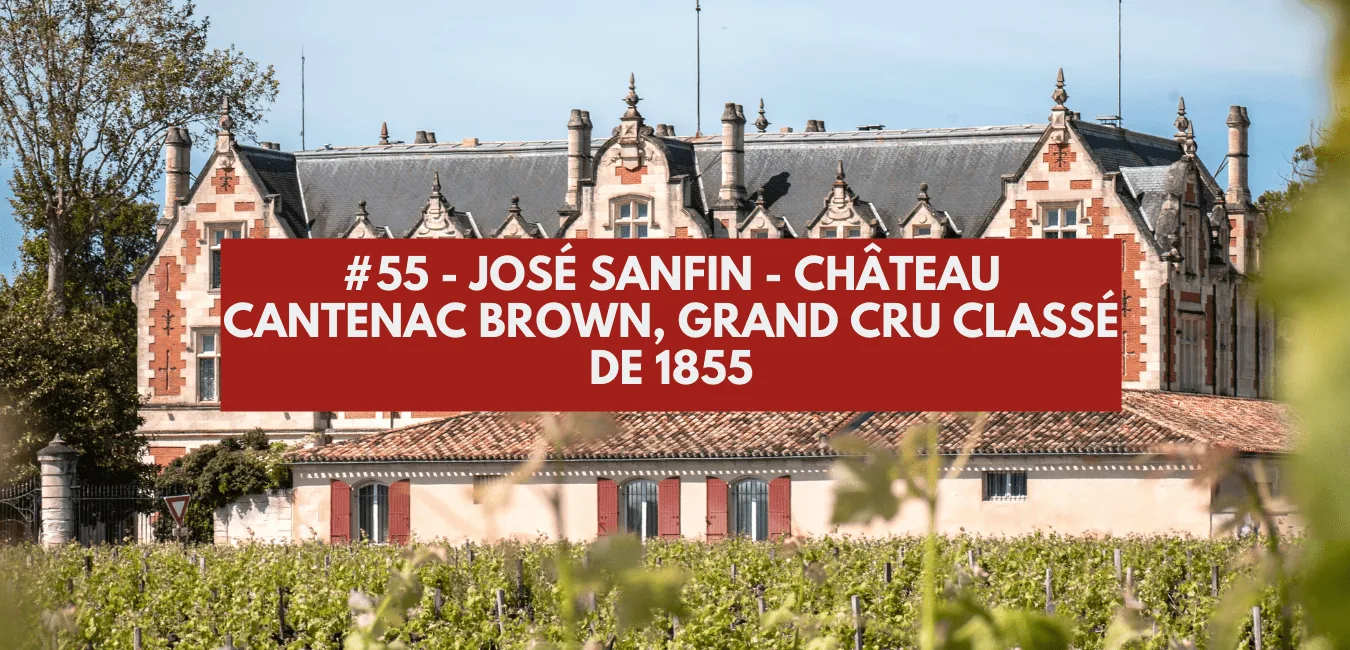
For the 55th episode of the Wine Makers Show, I meet José Sanfins, director of Château Cantenac Brown, grand cru classé of 1855 in Margaux. In his interview, Tristan Le Lous had told me about him: this is an incredible person with a spectacular knowledge of wine. So I hope you enjoy this exchange with José as much as I did. All that’s left is to wish you an excellent listen.
Antoine: Thanks so much for being with me this early afternoon. So it’s an afternoon that’s pretty unusual since we just had lunch together and we’re on a terrace right after that lunch. It’s very hot, we’re in Paris right now. You traveled to Paris, not for the occasion but you’re doing a marathon day in Paris. We’re going to talk about a lot of things together.
You have a ton of things to tell us about based on your experience in Bordeaux, but before that, can you start by introducing yourself?
José: José Sanfins. I’m not necessarily of French origin to start with. I was born in Portugal and I arrived in France in 1965 with my parents where I lived on an island opposite Pauillac, in the Médoc appellations, between Médoc and Blaye, the Île de Patiras where I lived several years with my brothers and sisters. Subsequently, I lived in Pauillac. I did my studies in Bordeaux, in Marmande, Aire-sur-l’Adour and then Bordeaux, ending up working in viticulture.
My parents were winemakers. When I worked with them in the vines, I would never have thought I could end up in the vines myself, 40 years later.
Your parents were winemakers and you’ve always known the vine, you grew up there, you were really inside?
José: In fact, we’re part of those families where parents worked in the vines and the children followed. Today me, like my brothers and sisters, I can’t say when I learned to drive a tractor or when I learned to roll a barrel. It was part of daily life. I don’t remember those dates but I know how to do it, I’ve always known how to do it.
I see what you mean. You’ve always been interested in wine in fact, it’s always been something interesting for you?
José: Curiously, no, because at first I had headed toward mechanical construction and a few years later I came back to the wine side and I realized it was very interesting. And I stayed there. It’s been more than 35 years that I’ve been working in the wine world.
How did this moment go for you? Was there a particular trigger? Did you say to yourself: “Finally I want to be in wine”? Because you weren’t headed there. How did it happen?
José: In fact the trigger is when you’re young and they essentially ask you to lend a hand on the technical side without explaining the theoretical side, like all young people, all teenagers, you don’t necessarily want to stay there. After when you discover things with a different eye, when you get closer and you understand why you have this work to do in the vineyards, it’s much more interesting and you realize you can change things. I think I took pleasure when I understood why I was doing this work.
Is it something you discussed with your parents since they saw you go far from the vineyard, in some way?
José: No, because today the vineyard, the winemaker is a noble idea today, but several years ago it wasn’t necessarily the best profession for the children of winemakers.
Today, it’s a very noble profession, it’s an artisan’s profession, that everyone loves or would love to do. But it’s a very difficult and very hard profession, if only because of the weather.
Antoine: We were talking about this earlier, the hazards that can happen in the vine.
José: When you go pruning in winter and it’s five degrees outside or it’s raining, the work still has to advance. Personally that doesn’t bother me. I even find that it’s one of the happiest and most pleasant periods to prune in winter alone in your parcel. But I understand it can be difficult for lots of people.
Tell me a bit about what comes next for you. You return to the world of viticulture. How does your career start at that moment?
José: In fact, no, I went back, I did viti-oeno. The big turning point is in the years ‘85 first, I vinified, I was a harvester and I had the chance to vinify at Château Lynch-Bages, lending a hand with the vinifications.
In ‘86 at Château de Belgrave, I lent a hand to a friend, for vinifications too. I didn’t realize but I had it in me. I knew what a pump-over was, a maturity, so it seemed natural to me to work in wine. That’s where I realized it was very interesting. After my military service I did studies again in viti-oeno to come to the source.
I entered as an intern at Lynch-Bages thanks to Jean-Michel Cazes and Daniel Llose. I worked with them since they hired me as technical manager at Château Cantenac Brown, and I’m still loyal there.
Antoine: We obviously take advantage of this episode to send a hello to Jean-Michel Cazes who came to this very microphone now a few episodes ago. By the time this comes out, since I think it’s episode 48 or 49, the people who listen to this podcast and now if you haven’t yet listened to that episode I invite you to do so because it was a really incredible conversation.
You started at Lynch-Bages then right after Château Cantenac Brown?
José: Exactly. It was the same person who managed the properties, and I entered as an intern too at Cantenac Brown.
I became technical director starting in ‘90. Today I’m general director but I always keep the technical side and the vinification side which is always the most exciting part.
When you entered Cantenac Brown did you say to yourself this is going to last a long time?
José: Oh no, no idea, no. When you enter Cantenac Brown, you’re very proud first to work for Axa Millésimes and for the whole team that was making this company move. And no, you don’t think, you know there’s a lot of work because it’s a cru classé that has to be brought back up to par, both at the level and in the chais.
We have people around us who trust young people, I was 26 or 27. I still thank them for trusting me.
Exactly you talk about a Château that you find in a certain state at the time. Maybe you said to yourself bring it up to date?
José: At that time many crus classés were still in quotation marks under reconstruction. Many châteaux were redone in the years ‘86, the Pichon Barons, other very great crus and great terroirs were in disuse, a bit abandoned.
Cantenac was part of those. To redo a vineyard, to redo a property takes a long time. It was quite classic in the 80s to see Médoc vineyards going through a difficult moment. I had the chance to contribute to Cantenac Brown in those years.
Cantenac Brown is a property that has an incredible history, obviously dating from well before you were there, since it’s a grand cru classé 1855. How did you see it evolve over the past 30 years roughly since you arrived? You went through different owners but also a wine world that’s completely different: distribution is surely not the same, the precision of vinifications is also no longer at all the same, in fact you’re a true witness to the evolution of Bordeaux wine over these past thirty years.
José: The difficulty was to put the vineyard back in shape. Putting a vineyard back in shape takes a lot of time. We dedicated a lot of time to that. From the first years we drained the entire vineyard, we replanted the parcels and grape varieties in the right place.
We’re reaping the benefits today because to have a beautiful, beautiful grapes and beautiful parcels of vine you need 10 or 15, 20 years, even more. Today we’re reaping the benefits. We have to thank the entire team since the beginning who was able to work too, each time, the cultivation managers, the cellar masters and the managers being able to invest in the right place, at the right time, and to put good grape varieties and good terroirs there.
It’s the conjunction of all that that makes that today, we manage to make very great wines every year because people before me and with me were able to plant and take care of the vineyard correctly.
The wines have evolved a lot. Before the 80s many crus produced rather mediocre wines. We were among those. Late 80s, the 90s, we put a lot of energy into bringing the Château back up to par, and I realize that in fact it takes a generation for people to realize that the Château is part of the tops of the appellation.
But it seems quite logical to me. The time to plant the vines, to elaborate the wines, to taste them, to drink them 10, 15 years later, it indeed takes a generation.
We were also talking about it at lunch, but in fact even all the work you’ve started today, we’ll come back to that in a few minutes, but all this work, all these evolutions will bring their benefits in 10 years for the first.
José: We’ll see the benefits in 10 years but indeed today we’ve done great work in the vineyard, and we have the chance with the arrival of the Le Lous family in 2019 first to have expanded the vineyard. And then to have the project of building a new building, a new cuvier, a new chai worthy of the terroir we have.
That’s a very nice adventure. I think it’ll be the conclusion of 30 years of work, to be able, to have a tool worthy of our terroirs. I think there’s a beautiful adventure and a beautiful qualitative progression still to come that can be there starting in 2023 since the worksite is going to start this year to finish in 2023.
Even if indeed the conclusion of this, the wines will be drinkable 10 or 15 years later, starting in 2023 or 2024, I think there will be a small bit compared to the wines we make today.
Antoine: So we have, in this podcast I’ve already interviewed Tristan Le Lous a tiny bit more than a year ago, by the time this episode comes out. I had a bit of his version of the facts.
Can you tell us your side of how it happened, exactly, how Tristan arrived, how you two got to know each other, how it happened?
José: Tristan had already passed by Cantenac Brown, we’d crossed paths. We had discussed to understand, he needed to understand the place de Bordeaux, how Bordeaux worked in general, the marketing, the products, how to elaborate the products, how we could improve them.
We spent several hours together and we really clicked together. When the property went up for sale in 2019, he made an offer with his family. Right away he understood that an additional tool was needed at Cantenac Brown. So we launched into project research and Tristan immediately wanted to build one of the unique chais in the world by its eco-responsible construction. And we quickly oriented toward raw earth and raw wood I’d say, which are the pillars of the future building.
We have many ambitions for Cantenac and I found an owner who has as many ambitions if not more than me. It’s really very exciting for the future, for my future and that of Cantenac Brown.
How were the first days of your collaboration? First, how did you learn that he was making an offer?
José: In fact, a Château like that doesn’t get signed overnight. There’s a lot of study on both sides for it to go well. Tristan and his family worked a lot on the quality of the terroir, on the vineyard, on the teams. We necessarily exchanged. That always went well in complete frankness.
When he signed in December 2019 we immediately kicked into second gear, I was going to say, the second. We had taken stock. Technically, it worked. There was a need to develop the image of Cantenac Brown and the marketing.
We tackled it right away, that’s why we’re going at full speed. The worksite to be more precise, today we’ve finished all the studies. It’s supposed to start in September.
We’ll start in September to be delivered in 2023. Beyond that, you can well imagine that in 30 years of profession at Cantenac Brown and with the technical team and the team on site which has the technical manager or the cellar master who’s been with us for over 20 years, we all had in our heads a technical project, perhaps not architectural but at least technical.
We knew we needed small vats to vinify by parcel, and even the volumes, we had already established all the tables. It was between Tristan’s architectural will to make an eco-responsible building and our will to have a technical and performant tool, it was very quick to put in place.
The raw earth chai you’re talking about, I have the chance to follow from a distance still what it looks like, it looks absolutely spectacular.
José: It’s spectacular and crazy at the same time. It’s a completely new and unprecedented project, and it’s quite fabulous to be able, to have owners, people who commit so much to a new construction model. And it’s a beautiful adventure to be able to build a chai that will be unique in the world and with different materials, knowing that today we’ll have walls one meter thick in raw earth that will have enough inertia to not use air conditioning.
It’s quite ideal for the aging of wine. And it’s an additional criterion for the quality of the product we’ll be able to make in the years to come.
It will be absolutely magnificent. Will it be possible to visit?
José: Yes, especially, you’ll have to come visit. The idea is, like all good communicators, we’re going to try to serialize the communication but today we have the broad outlines. We’ve avoided showing too many photos because we want exactly to serialize and explain to people little by little what we want to do and what we’re going to do. But the idea is that, indeed, we’re going to make it visitable.
There are already lots of people interested in our project. I even have a friend who makes wine who’s going to make wine in Tanzania and who came to visit because he’s also building an earth chai at his place.
It’s incredible. I had lost sight of him and he reminded me of him twenty years later. He came to discuss it indeed. I hope I’ll have the chance to visit his chai too.
Antoine: That would be nice.
José: But in our project there’s not just a technical project. There’s also a wine tourism project. It will be visitable and there will be a magnificent place to see because we’ll have a direct relationship between the chai and the cuvier with our park which is quite exceptional, and I think we’ll really have a beautiful visit to do.
It’s September 2023, is that it?
José: I hope in August because in September we’ll be harvesting. So the idea is for the 2023 harvests.
Antoine: Fingers crossed it goes well. There’s no reason it shouldn’t.
José: I’m sure and certain it’ll go well.
Is the arrival of Tristan and the fact of being able to reach this speed you were talking about earlier something you were waiting for? I have the impression everything was ready exactly but you had
José: We worked a lot technically because first, it’s the product. We worked a lot on the product. The advantage of having an owner like Tristan is to be able to have someone who believes as much as we do in the building and the property and who’s there for thirty years. So he knows we need a new chai, he knows he’s there for a long time, and so he gives the means to have a beautiful tool and to produce as quickly as possible the best possible. Obviously, it takes money, and someone who believes as much as we do in the property is extraordinary.
Antoine: It’s clear it’s a great chance to develop Cantenac Brown and to move precisely to the next level.
José: In fact we already produce very great wines today but we need to, to produce great wines, it’s in the vineyard but it’s also a continuity, a serenity and that goes through a performant and very qualitative tool. That requires investments. And investments in a property of practically seventy hectares require heavy investments that some families can do over several years and we chose to do it in two years so it’s quite exceptional.
Antoine: At Château Cantenac Brown you have different wines. There’s Brio, the great wine, and Alto, which is the white of Cantenac Brown.
José: Exactly.
Can you go back a bit to this different range and to these different wines?
José: In fact we have, Cantenac Brown of course, it’s a grand cru 1855. It’s really the heart of our vineyard, the perfect Margaux. To have a perfect Margaux you also need a second wine to be able to put young plants there, parcels that don’t have a first wine. We created Brio in 2001.
Previously, there was already a second wine but that wasn’t in direct connection with Cantenac Brown. And so Cantenac Brown Brio was created in 2001 with the idea of making a pleasure wine.
I think that’s what we managed to do. The proof is with the 2009 we tasted at noon, wines that know how to age with also great quality.
Antoine: That’s incredible.
José: And the advantage of Brio is that in fact, with experience helping, we were able to choose the parcels before fermentations. Which means that, year after year, we still have a bit the same character in Brio. It’s not just a selection at blending, that is to say vats that make the first wine but vats that make the second wine.
The wines are chosen, the parcels are chosen before the vinifications, and we vinify them to make this wine. That’s what gives it a slightly particular character. A character that year after year is well marked.
Then, to complete the range, we had a piece of land that was where we could produce wines but that was a bit colder. We always asked ourselves the question of planting red wines but we knew the wines wouldn’t be great. On the other hand it was an ideal place to make white wines. We decided to make a great white wine too. We planted 1.8 hectare, which seems little, but we make between 7,000 and 8,000 bottles per year, of the white of Cantenac Brown, Alto. So in the future we may increase the surfaces, but today with 1.8 hectare we manage to make wines of very nice quality too.
That’s a bit what we were also saying earlier, we had the chance to lunch together and we tasted Brio, Alto and the great wine. We were able to do a small panorama since we didn’t taste the different vintages either, but we already tasted the three wines that all three have their personality and it’s true that Alto is perhaps the least known.
José: Yes because in fact there’s little volume and when we do tastings, when we do tours with red wines it’s always delicate to present white wines because people who do comparative tastings taste all the red wines first and so promise to come after to taste the white wines and ultimately they don’t come.
It’s less known but it’s essentially due to volume too today because today we have very nice quality. People recognize it, so we sell it very well. But eventually, I think we’ll likely increase the volume when we have the new installations.
Exactly, where do we find these different wines? I think Alto is essentially in restaurants?
José: So the idea is essentially in restaurants since we won’t find it in supermarkets, if only because of the quantity, but otherwise all the importers, all the good wine merchants sell the three wines. Alto a bit less, because once again we have problems of quantity. Otherwise all the great wine merchants, even internet sites. We find our wines easily.
I have a bit the impression that Cantenac Brown is really kind of a gem that’s revealing itself little by little, a bit like a wine that was forgotten.
José: I wouldn’t say that because it’s still been ten years where the wines are well recognized. We have, you know, we have a period where the wines are tasted in primeur, the wines are distributed, Bordeaux wines are often drunk five, six or ten years later, that’s when we appreciate them best. It takes time. Tasting a wine, a Bordeaux or a Cantenac Brown in primeur, even if it’s pleasant, it’s still better to wait a few years.
All this takes time, so it takes a few years for the wines to be diffused and for the bottles to be opened, drunk and appreciated. That’s what makes the notoriety too. It doesn’t happen overnight. People have to go to their cellar, drink it, and recognize the product.
Antoine: The wine world is a world where patience is required.
José: You need patience.
Antoine: If we expect change overnight, we’d better change profession because it’s going to be difficult.
José: You need patience.
In these almost thirty years that you’ve been at Cantenac Brown you’ve also seen an evolution in wine consumption, in a general way, whether perhaps a change of nationality, a greater international diffusion, consumption habits also that change among regulars? Can you try to describe this a bit, how you’ve seen the consumption landscape evolve?
José: I realize that in fact wines today are, you can drink a red wine anytime whereas at a certain time we had a whole ritual to drink wines, it was addressed to a population of initiates.
Today we diffuse our wines around the world, we drink our wines in, not just in restaurants, you can drink them as an aperitif, anytime without it shocking anyone. I find that rather nice. And not just the second wine. We always say the second wine is wine to wait for the first, that we can drink it in other conditions. Even the first wine we drink as an aperitif, or in the morning.
Today I’m not shocked, even on dishes. We sell wines around the world. Our wines pair well with Japanese cuisine, with Chinese cuisine. From experience, we realize that everything that’s well cooked generally always goes with good wines, it doesn’t pose any problems.
Antoine: We agree on that and we saw it this noon.
José: That’s what’s fabulous. We had a fish with a slightly spicy sauce that pairs very well with red wine, that’s what’s fabulous, it was even surprising, I advise you to drink it with all dishes.
Antoine: At least try.
José: Try it.
How do you stay thirty years in the same Château? Wasn’t there a moment where you said: “I want to go elsewhere, I’m fed up”?
José: We’re more or less hunted, sometimes. If the question is: “Why haven’t we been fired in thirty years,” it’s very simple, you have to do your job, it’s no more complicated than that, to assume, to be attached to the property, to bring solutions permanently, to pull all the efforts we make, each one, upward.
I didn’t have the impression of doing extraordinary things. I just have the impression of doing my job, every day, the best possible. Thirty years later we’re still here. I don’t have the impression of having spent thirty years, that’s how fast it went.
And you, you never wanted to..?
José: I do lots of things on the side. I had the chance to work in Portugal, I do different things on the side in my life. Wine is something, you can’t say it’s a real job. It’s more of a passion. At the same time it’s also a grandiose world, but it’s especially agriculture above all. Like any farmer we’re passionate, we’re forced to be permanently in it.
Can you tell us a bit more about what your daily life looks like? What is it to manage a grand cru classé? For people listening to us we’re in a period just after the Covid epidemic, so you must travel I think a little less today. I suppose you must go to the vine very often, to the chai, manage the finances. It seems super vast.
José: That’s what’s fabulous about our profession, it’s that it’s a profession where there are several professions. I started as a technician, it’s something that’s anchored in my body. I do my twelve hours per day for thirty years. We don’t count the hours in this profession, you always get up early to be there with the technical team, greet the team in the vine, the team in the chai. We always have an eye on it.
And then surround yourself with competent people to always be able to have the information and also transmit the little we know about the property.
After indeed there’s the finances, the commerce, the marketing, the travel, the representation. It’s a complex job, not complicated but complex, where we intervene on several levels.
It’s quite fabulous but despite everything it’s agriculture that prevails and nature. We’re anxious when it’s going to freeze, by the mildew, by the rain. We try to get the best out of each parcel before the harvests, the stress of choosing the right harvest date, the right parcel, of heating the right temperature or extracting just what’s needed to have the right fruit, the right texture in the wine.
These are questions we ask ourselves every year, every vintage, and even though I’ve been working with Cantenac Brown for a few years, in our profession we don’t often do the same thing: thirty times the same thing, thirty times vinifications, that’s not enormous. There are people who do the same thing a thousand times in the year in their work.
Curiously we do work one year, we try to draw lessons from the vinification work we did or in the vines, or the chais, and we start again trying to improve the year after. It’s not very repetitive. Each time we start again the year after, but somewhere it’s not often, we don’t have the right to make too many mistakes. That’s what’s exciting. It remains essentially still agricultural and we adapt to climatic hazards.
Antoine: That’s what’s pretty exceptional about wine, I think you said it well: you have the opportunity only once a year to do things.
José: Exactly. In the morning, we’re with boots in the middle of the vines choosing parcels or seeing the pruning, and in the evening, we’re in suit and tie at the end of the world or in starred restaurants to offer our wines. It’s quite extraordinary, we have several professions somewhere.
I understand you can hardly get tired and hardly want to do something else because it’s diverse and complex, as you said, with lots of different stakes. For thirty years, there has also been a lot of evolution in a general way, in the world of wine. Whether an increasingly important arrival of digital, in terms of communication, but also in the vine, in the programming of different events within the vine. Is that something you’ve felt in the evolution of the profession?
José: Yes. We can clearly see communication on social media, we, we’re very active. I find it quite fabulous to see and explain the work we do in the vines and to popularize through social media. We’re very present on Instagram. We have someone who handles it very well and everyone plays the game. I think winemakers are very happy to show their know-how and to know it’s seen through social media around the world. With one click, it’s quite fabulous.
And then recently, closer to us, we couldn’t travel. So we had to find other means to keep in touch and communicate about our wine and our work. So, indeed, we’re today, we’re the world champions of video conferences and other tools to diffuse the image of the property.
How did it go exactly? The primeurs with the lockdown? The primeurs is a moment of marketing the wine in Bordeaux to merchants who buy the stock while it’s not yet bottled and will receive it a little after once bottled. Then they’ll handle marketing it to the final customer. How did it go, these primeurs with the lockdown or in any case with Covid? How did you do to adapt?
José: In 2020 we learned a lot, even though we did a lot of things. I think we were more performant in 2021. In fact, we set up a small studio on the property with the image of the Château in the back and so we diffused the wines around the world and we, by video conference, did remote presentation. It’s true that wine has a convivial side, we need to be close to people to talk about it. But there, we had no other choice but to stay on site and do that through a camera. But curiously, with the people we knew thanks to that, we kept a link. We were really able to continue to discuss and share through these video conferences.
In 2021, we are brown belt in image diffusion. And there, we organized video conferences with importers, with their clients. We did a video conference with 100,000 people in China who were following us, so it was really quite performant. And there, we were more pointed. We even installed ourselves outside to be able to diffuse and bring a bit of the property to life from outside because I found that we were too inside. And we diffused so many confined images that we needed to get some air.
So the primeurs, it went rather well. People were confident in what we did, to the extent that they were able to taste the wines, the commerce was able to be done very correctly. We were also helped by two great vintages. The 2019 and the 2020 reassured everyone. It went very well.
Antoine: Two very great vintages and that follow a series of very great vintages.
José: For fifteen, we’ve had the chance to have very nice vintages from 15, 16, 17, 18, 19, 20, the latest. It’s true the weather helped us a lot. We were lucky.
Antoine: May it last.
José: Yes. I also think of the climatology that helped us. But I also think we have techniques that mean wines are more and more regular, more and more qualitative.
Château Cantenac Brown, it’s a wine, a history of the people who have made it for decades, but also today. It’s also an architecture that’s quite particular. It’s a magnificent place that really stands out well from the vines.
José: In fact, the Château was built by John Lewis Brown, a Scottish businessman. His grandson was a naturalist painter. It has an English Tudor style, well marked in its construction. And today, it’s a unique style in the Médoc. Everyone recognizes it, and in the appellation, it’s part of the very particular monuments to visit in the Margaux appellation.
Is it open for visits exactly?
José: Oh yes, it’s open. You just have to phone, make an appointment, and we welcome people with great pleasure. And even though during the Covid period we were closed for health reasons, today, we’re open and it’s going very well. We receive a lot of clients.
Antoine: Don’t hesitate if you’re passing through Bordeaux, in the Médoc. Make a phone call to Château Cantenac Brown, obviously, and they’ll receive you with great joy. It’s really a magnificent architecture. The Château is incredible, the park around is spectacular, and the wines are very good in addition!
José: We’ll welcome you with pleasure.
Antoine: There aren’t many reasons not to drop by.
What should we wish for the future of Cantenac Brown? Once the chai is done?
José: What we should wish is that the chai be finished on time.
Antoine: And that the vault doesn’t collapse.
José: There you go, that people get used to taking delays in constructions. May we have a tool and may we work. I think it’s going to be in two years, so it’s very short term. And then after diffusing our wine around the world, I think that’s important. We have the chance in Bordeaux to do important volumes with wines of great quality. The chance also to diffuse around the world. That’s a strength, to be in all markets. And I think Cantenac, commercially, has a beautiful future ahead.
But it’s also an asset exactly in these somewhat difficult times of Covid, to have different countries, different continents. It also secures things commercially. And to you, José, what should we wish?
José: We’re in September when I’m interviewed, you have to wish me a good vintage. We’re preparing the harvests, we’re starting the whites tomorrow. Alto will be harvested tomorrow and the day after. Since we have two mornings, we harvest very early in the morning in the cool to keep the aromas of the whites. The whites are harvested in good conditions and the reds from here rather end of September for 2021. The merlots look very, very good and we need a few days, a little bit of rain, perhaps in not long, and then two more weeks of nice weather to have very nice cabernets.
Antoine: You’ll tell me all that in November, by the time it’s published. We wish you a magnificent vintage and we hope so anyway as wine lovers.
In this evolution of Cantenac Brown, you also have a recognition of the wine that’s more and more important, exactly through different continents and over the vintages. Is it something that touches you personally?
José: Oh yes, it’s always satisfying, and we’re very happy to be recognized. We have wines that are necessarily international, that are produced in Bordeaux, but we need this recognition to be diffused around the world. We make more than 150,000 bottles of first wine, plus 300,000 bottles in total. We need to have all the markets for the commerce to function. We need to be recognized around the world. Which is the case besides today. Commerce is going very well. I think improving qualitatively, doing commercial steps and working always with more affinity with the place de Bordeaux is very useful to us in diffusing wine around the world.
Antoine: It’s a real strength of this négoce, this place. I interviewed a merchant some time ago, his name is Emmanuel Coiffe. It was really a nice interview. He explained to us exactly how the place de Bordeaux works, the brokers, etc. And it’s a pretty particular universe, pretty unique in the world of wine, that especially makes the strength of Bordeaux.
If you had the opportunity to cross paths with him, the José who arrives as an intern at Cantenac Brown and slip a little word in his ear before he passes the door before he starts. What would you tell him?
José: That’s a very good question. I haven’t really thought about it to be very sincere. I’ve personally always been attached to being sincere in all the work, in the human relations I can have. And in the same way, in the work we were able to produce at Cantenac. We did fundamental work and I think it’s the first thing I did when I arrived as an intern.
The first thing I asked for as a budget was to drain the vineyard. There are others who bought a car or bought new tractors. Me, I asked to drain the vineyard, and I think that was indeed what had to be done to one day be able to produce great wines. I think you need sincerity, honesty, rigor and work.
Antoine: It’s an element that’s quite impressive in your journey, exactly, to what extent you embody this sincerity in the idea of really being at the service of a property and a wine to make it grow.
José: But we don’t have a choice. We’re permanently adapting. You have to adapt to the weather, to the parcel, to the vine plants. We try to get along with the staff, with the outside teams of harvesters, the merchants. You always have to adapt and put yourself completely at the service of a property, of a brand, like Cantenac Brown. That said, it’s still easier to put yourself at the level of a grand cru classé than to produce beets. But that doesn’t prevent us from working just as much with a lot of investment, of sincerity.
When I talk about myself, I’m talking about the whole team. We have a team that’s really very efficient, very loyal. I think of Fatima, who’s been with us for over 40 years, 42 years. Her sister too. Gaëlle, who’s been there for over 20 years. The cellar master who entered after his studies in 2008, who’s still there. The cultivation manager who arrived in ‘86 as an apprentice, who’s still there. There’s still a relational aspect that means we really have something sincere between us.
I think that’s felt in the work and in the vineyard. There’s the peasant side that we are. We need to be sincere, we can’t play and we can’t live by cheating and just pulling little stunts here and there. And the serene side and to stay so many years together shows there’s sincerity and serious work and trust between each other.
Antoine: It’s one of the best indicators in all companies. To what extent we manage to keep our team and build loyalty.
José: We refresh it regularly. We just recruited a quality manager to relieve the technical team and improve all that. We regularly have young people and interns, and we’ve trained many young people. At one time we took people for a year, who all found work afterwards. Managers, directors, merchants. Today, we have quite fabulous feedback from all those people we were able to meet and train. But the core is indeed quite loyal and there for a long time, but questions itself each year clearly, and that’s what’s quite interesting.
You said earlier in the introduction that you had done viti-oeno. What advice would you give to a young person who’s exactly right now in viti-oeno and who’s about to finish their studies? What advice would you give them?
José: To go discover the vineyards of the world. There are beautiful things everywhere. Before settling, traveling, understanding the world a bit to be better where they’re going to be. It’s very important because once you’ve started, once you’re committed to a property, it’s always difficult to leave again to vinify or work in another, in another country or in another appellation. Since after there’s family that gets involved, there are installations, the house you buy, etc. It’s always more complicated. So if you can travel, discover things before, you have to do it.
Is that something you managed to do?
José: Yes. First, my origins meant I had the chance to work in Portugal in my job during the AXA Millésimes period. I worked in Portugal for several years going regularly, making another wine. We made Ports so we made another wine than Bordeaux, so that’s very, very exciting. I have that chance. And then after, in the profession, in the diffusion of our wines and the distribution and marketing, we travel the world regularly. We see lots of things. It’s rather nice. I think if you don’t have the opportunity to be in this world and to do commerce and travel, that you’re in pure technical viti-oeno, I think you have to take advantage before. Or after, since it’s always more delicate.
How is your relationship with Tristan today?
José: Good! Tristan is someone who’s very present. We exchange a lot, perhaps not every day, but almost every day. Sometimes even several times a day, during slightly more critical periods, during harvests, during primeurs. Tristan closely follows the property. We did the rounds of all the merchants, all the négociants in Bordeaux, he’s very involved and so interested in everything we do today.
It’s really very interesting to share. It’s very important for us because when we need a new tractor, I can ask him the question and he knows why I need it. Or when we decide to change cultural methods, he knows them well and he knows what we did before. It’s very easy to explain to him and to have his ear to be able to make things evolve and move forward fast. And that, that’s quite fabulous to have someone who responds very fast and who can decide quite fast for our decisions. In cultivation, there are flaws, sometimes decisions that have to be made quickly. I share quite a bit with him on that subject.
Antoine: These are decisions that can play out very quickly and have an impact in addition over the long term.
José: Technical decisions we make every day on site. But everything strategic, indeed, we exchange a lot, and it’s very reassuring for us.
And I have the impression also that you teach him a lot?
José: Teach, I don’t know.
Antoine: There’s a real exchange between you.
José: I think he’s a seeker. Tristan loves to discover. And in our profession, our first quality is to share. Everything Tristan can ask, we’re very happy to share. And sometimes, even when he doesn’t ask, we give him the information.
It’s very nice. We have a duo, really good. Me, I feel good in the functioning of this duo. I also think people who meet us feel it. We’re very complementary and we can count on each other. It’s very important.
Antoine: We had lunch together this noon, we had the demonstration of it and it’s super pleasant.
José: He drinks a bit less wine than me.
Antoine: It’s true, but it’s understandable. It’s hard to compete.
José: I taste every day.
Antoine: We’re calmly arriving at the end of this interview. It’s been a bit more than 50 minutes that we’ve been exchanging together. I don’t want to make you late.
I have three questions left that are quite traditional in this podcast. The first is, do you have a recent tasting favorite?
José: Yes, because I went to Portugal not long ago, and I had the chance to open a Quinta do Noval Nacional 94 that we drank with very close people. And it was really extraordinary. I had a memory of the Nacional 63. At a time, in ‘95, we had inaugurated the property Quinta do Noval in Portugal. And with Daniel Llose, we had prepared the wines and we had opened too many bottles. And during the whole week, we drank ‘63 morning, noon and night. It was quite nice. And there, I had ’94s in my cellar and we opened them. It’s really a very, very great moment.
Antoine: I can well believe it and it’s noted. I was in Portugal not long ago. I went there in early June, I think. But I didn’t have the chance to taste all that. In fact, I was in Lisbon, but I took the opportunity to taste a bit. There’s a superb wine bar in Lisbon. I forgot the name but there are bottles on the ceiling, wine obviously. It was quite spectacular. We asked them for a small tasting of everything they had at the bar in tasting doses. It was super cool. We tasted lots of things. Notably a sparkling wine that was very nice.
Do you have a wine book to recommend?
José: On wine, no. Not particularly.
Antoine: I forbid recommending Le Goût du Vin to me. But everyone recommends “Le Goût du Vin” to me.
José: No, I don’t have one. On the other hand, I’m reading a book at the moment, by Carlos Ruiz Zafón, “The Labyrinth of the Spirits”. I recommend it because it’s really something magnificent to read. Someone who writes very well and who writes a beautiful intrigue in the story and especially a magnificent writing, and I think I’m on his third novel and I recommend the reading.
Antoine: Magnificent. I don’t know it at all.
José: It’s in French. You have to read it. It takes place in Spain during the war. But the story is magnificent.
Antoine: But I don’t know it at all. I’ll get it and read it.
José: That’s what I’m reading at the moment.
Antoine: I can’t promise to read it right away, but maybe early next year.
José: You’ll tell me.
And finally, I have one last question, which is who is the next person I should interview in this podcast?
José: Very good question.
Antoine: You can choose two or three. It’s not a problem. You can select several if you hesitate.
José: I would have cited Jean-Michel Cazes, but you told me you’ve already interviewed him. I haven’t thought about this question at all. I have no idea instantly.
Antoine: You’ll tell me by message. Jean-Michel Cazes is already done. I should do his son, who took over Lynch-Bages.
José: Maybe occasionally, you should also interview his technical master, Daniel Llose. He’s someone I love a lot. If you have the opportunity to interview him, you have to take it. He’s someone who has a story on the vineyard and on technique that’s quite incredible in Bordeaux.
Antoine: That’s a super idea. Tristan recommended your consultant Éric Boissenot.
José: I think they’re two technicians that make a good pair. Eric is someone fabulous, indeed, and who is a consultant with us. I think indeed he’s someone who has quite a bit of experience and who has a lot of knowledge in wine.
Antoine: Indeed, that works, count on me to try to interview him.
José: I can be the intermediary if you want.
Antoine: That works for me. José, thank you so much for this time you gave me this afternoon.
José: Thank you Antoine. I didn’t think I’d be interviewed at the microphone, I thought it would be in writing, but it’s going very well.
Antoine: Thank you so much. It’s rather relaxed, ultimately, as an exercise. Thanks for this time, get back to Bordeaux safely, and I’ll see you very soon!
José: Thank you so much, with pleasure.