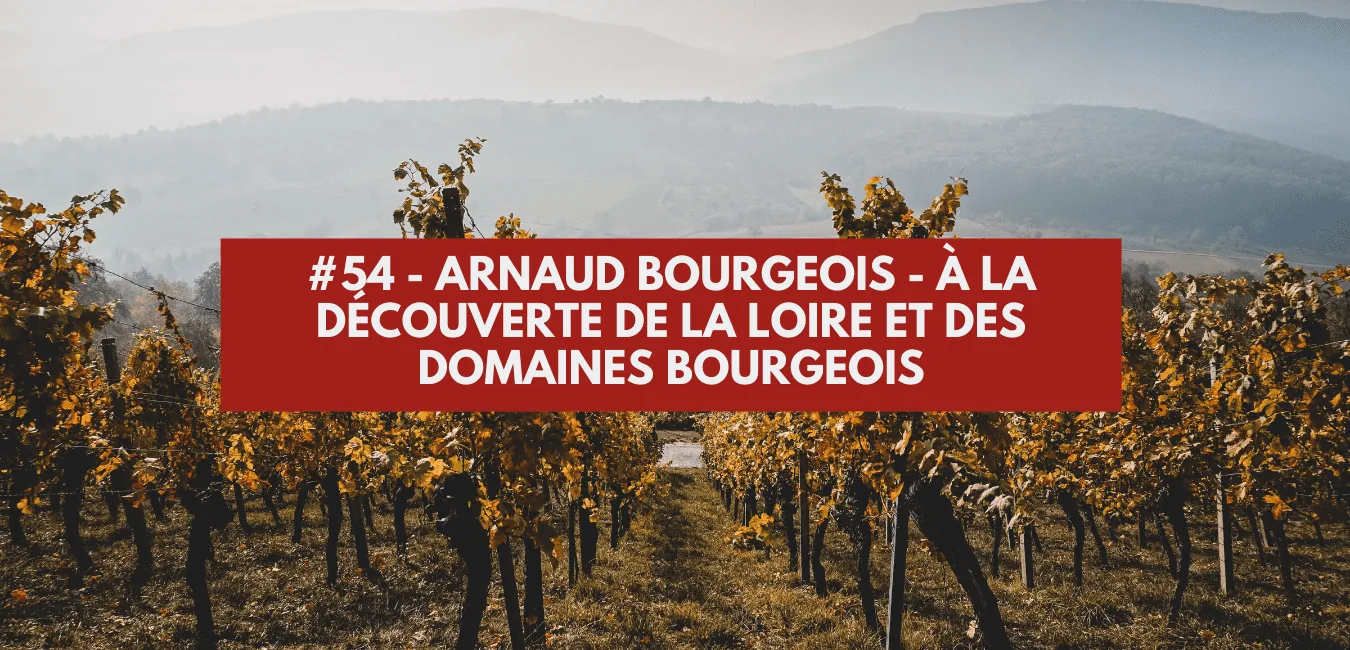
For the 54th episode of the Wine Makers Show, I was delighted to interview Arnaud Bourgeois during one of his stays in Paris. It was an opportunity for me to discover the Loire and its wines more deeply. I’ll of course be happy to go meet him when the opportunity arises. In the meantime, I wish you a great listen. Antoine: Thank you so much for being with me this morning. We’re at our friends’ place at Pain, Vin et Company who generously give us a meeting room. They always welcome us very well. You’re spending the day in Paris. I haven’t yet had the joy of going to see you in the vineyards. It could have happened but it’s always quite difficult depending on everyone’s schedules. We’ll do that another time. Arnaud: Yes, absolutely. There’s a particular Sancerrois welcome that we reserve for our visitors. I’d love to introduce you to our region on site. We’ll no doubt make that happen very soon. Antoine: Sounds good. I don’t know if it scares me or delights me… Arnaud: There’s nothing to be afraid of, it’s only pleasure. Antoine: We’re obviously going to talk about lots of things since lots of things are happening at the domaine. I have next to me a New Zealand wine, a wine from Chavignol just next to it. You have lots of other projects around.
Could you start by introducing yourself?
Arnaud: Yes, so Arnaud Bourgeois. I’m the third boy of Jean-Marie and Simone, my parents. I work at the domaine with my brother Lionel, who is the one in the middle. My eldest brother is a restaurateur, a trained chef. He worked in fine establishments in Paris. I’m thinking for example of Taillevent, the Côte Saint-Jacques, that’s in Joigny, but also alongside chef Jean-Pierre Vigato, who was previously at place du Maréchal Juin. He worked with very great chefs. Cooking has always been something very important in our family. I work with my brother Lionel and my cousin Jean-Christophe who is the son of Rémy, my uncle. It’s historically a family domaine. My grandfather, Henri Bourgeois, who actually gave the domaine its name, had taken over the family farm alone. He had taken over this farm young since unfortunately his father passed away during the war. That was a turning-point event knowing that our farm was originally a polyculture farm, like all the family farms of Sancerrois historically. At least until the 50s, 60s and a little beyond sometimes but the vine has always been very close. Even though until the 50s, you couldn’t count too much on viticultural activity to earn your bread and live from it. It was the cultivation of cereals, a little livestock, goats, a few cows. There was a bit of all that polyculture. I always roamed in the hills of Sancerrois with my brothers, my cousin. My parents being very busy with their activity, we grew up in contact with the activities that were theirs, including cereal farming. When I was young I myself did the harvests. I delivered the grain to the cooperative, the seeds, with all the festivity and events surrounding all these big stages. Whether at the level of agriculture, in any case cereal cultivation, but also at the level of vine cultivation. I did my middle school in Sancerre. The high school I did in Nevers, the lycée Saint-Cyr. It happens that during my time at middle school I spent more time in the sheds imagining myself piloting a tractor or alongside the bottling line, the bottling unit lending a hand, than in front of my notebooks. That didn’t make me a super attentive student. Nevertheless, my parents felt that I had some abilities so they asked me, well rather sent me directly to Nevers at lycée Saint-Cyr. They wanted me to have my baccalaureate. I got it and after that, with nature returning at full gallop, I had this appetite for being in contact with the viti-vini world. I went to Mâcon to study viticulture, oenology. My father traveled all around the planet. He brought us back some beautiful images, told us a bit about his experience. I understood quite quickly that commerce in our profession was an indispensable complement to production. So I did a complementary degree, let’s call it that. It was provided by the Paris Chamber of Commerce, at Jouy-en-Josas on the HEC campus. Then, I visited a number of countries while staying a bit at the domaine but I was quickly caught up by military service. I tried to find ways not to do it finding it wasn’t really very useful. But deep down I told myself that it was an experience and that you have to take all experiences. I did my training in Reims. I ended up being baptized aviator “Sancerre” and not aviator “Bourgeois”. I was rather known for my region of origin than for my name. I had befriended the lieutenant colonel to whom I brought wine. I tried to make something useful of it. Then I handled the Famas, also did a few exercises like all my army comrades at that time. I additionally tried to convey already a few notions of what Sancerrois is to our supervisors. With the army done, I went to travel. We had, and we still have, an importer in Belgium who each year organized a trip to a wine country. It was Argentina, Chile, South Africa, New Zealand… I was thirsty to discover the wine world elsewhere but in a slightly more complete way than what my father could bring me on his various trips. He had also visited the wine regions. That’s how I was led to travel in most of these countries. I necessarily learned a number of things. I think it helped a lot for open-mindedness in a general way, considering that we were lucky to have a wonderful terroir in France. But there’s a way of approaching viticulture technically and the vinifications, the oenology and the way of doing things which is different and no doubt interesting to consider for the future decisions to be made in our cellar. I had to feel ready to come back to the domaine, which is no small matter. It’s a family domaine. You have to try to integrate, with on top of that a complete activity. From vine cultivation to commercialization. The range of activities is vast. Which specific activity would best match my aspirations, my feeling? How were we going to be able to share all that together? My brother had already returned three years before. It wasn’t necessarily a fatality for me to return to Chavignol. Little by little things fell into place. The luck I had is really being able to continue doing all the activities. What I would no doubt have regretted is being stuck to one activity like for example being in the vineyard or in the cellar. It’s a domaine of a certain size. When I came back, we could have divided the roles. We decided we were going to touch on everything and learn all the facets and make all the mistakes or on the contrary start to shape an experience. It was absolutely wonderful. Our respective parents, my cousin’s and mine, were very open to any new experience we wanted to do. It’s sometimes a bit difficult since there’s the famous “father-ceiling” in family farms which is hard to break through and there it wasn’t the case. We were really able to put into application what we had in mind. I’m one of those who think that wine is the translation of a set of feelings of a winemaker. It must have its soul. Thanks to this possibility of moving forward in the direction we wanted to go, I think we’ve been able to translate that gradually into the wines. It’s a real satisfaction.
When you tell it like that I have the impression you always knew you really wanted to make wine?
Arnaud: I think the world, agricultural in any case, has always attracted me. To be honest, as a little boy I wanted to be in public works. I was completely passionate about the idea of building something. After, the atmosphere of machines on a construction site, that always interested me. Little by little living in this exceptional environment that is ours in Sancerrois, I discovered the beauty and I understood above all the meaning of nature myself. Notably through the time I had the chance to spend with my grandfather who taught me little by little other things very complementary to what I learned at school. I don’t know if it was obvious that I would come back to make wine in Chavignol and if I really wanted to do that deep down. I wasn’t aware of that but the fact remains that I was interested in all the facets of the profession. It was very willingly that I gave a hand every Wednesday rather than going to play soccer with my classmates, to bottle or to be in the tractor cab. As soon as I could touch the pedals I drove the tractors and no one forced me, on the contrary. They had to hold me back since it was often at the expense of learning lessons. Antoine: I think there’s something in family domaines precisely which is, I don’t remember who we were discussing this with, but which is the prevalence of wine.
You were never forced to drive a tractor or go in the vineyards but the fact that it’s there, that it’s normally rather joyful or in any case nice, impressive too for a little boy, it creates something gradually in you? There are many people who get a bit away from it at the start of their career and in fact they come back because they miss it.
Arnaud: It’s buried in them no doubt and so there’s a revelation a bit later. Yes I think that’s true. I didn’t have this feeling of having to leave. I wanted to leave, to visit the world, to understand the mentality, the approach, the state of mind of other winegrowers in other countries. Quite simply because I quickly understood, thanks to my father, and especially the visit of importers from around the world who already came to the domaine, the need not to stay stuck on our own knowledge which would no doubt have formed like a rampart around our open-mindedness. I think it was in me and I didn’t want to lose too much time to do that but without knowing exactly why. It was only after that it was obvious.
How did your parents react when you told them: “I want to come back to the domaine”?
Arnaud: Rather well, but without really saying it. I think they were waiting to see because you remain after all rather young when you come back and so do you want to do it in a sustainable way. I think they were waiting to see if this desire was lasting, if this sector was going to please us in the long run. So good, satisfied, but again without saying it too much and without making too many plans for the future. It really happened naturally, gradually. With hindsight, I think they didn’t want there to be any pressure, that I feel a possible need because time passes, because there had to be a succession, because there was also the possibility of expanding. We had just taken back another domaine from a winegrowing family whose brothers had decided to separate and whose father had wished that it be our family that take back this small domaine. And so there was work. But they didn’t want that because there was this new domaine, we had to feel forced to come back, we really had to come back through passion.
That’s the most important. If you want to do things well, considering all the hazards there can be, we were talking about it a tiny bit before, all that can sometimes happen in the vine, you’d better have passion.
Arnaud: Absolutely, it’s indispensable. We know well, like many other very demanding professions and especially when nature is involved, you have to be very modest, you have to be able to take a step back so as not to take all events at face value. I think you have to have a deep love of nature, a deep love of the profession, of the transformation of a fruit to make a product that will be shared, that will be savored, that will offer joy and to make abnegation of self, sometimes by the way sacrificing a bit of your personal life, to be very honest.
What did you take away from your trips abroad? Were there any lessons, things that are great and that you wanted to replicate, things on the contrary that you want to get as far away from as possible. What inspirations did that bring you?
Arnaud: I had the possibility, in wine regions of larger format than Sancerrois, which is only 3000 hectares, to go to farms that were of very large size with an approach to management more like a business model. Where things are planned, where things are organized, where we’re a bit Anglo-Saxon in the way of managing. The positive side made me realize that a wine farm, beyond the happiness of cultivating the vine, of making wine, is also a business with the need to organize. Of course, all that will be human resources. The way we’re going to choose these people to accompany, the investments so that they’re well planned. That’s the positive side, but in these structures, precisely with already a fairly important size, the place of wine was no doubt a little less, that is to say more industrialized production. We were going to seek to optimize, to have more productivity. That’s the side I didn’t know. It also allowed me to understand that it wasn’t necessarily what I wanted to do and the destiny I wanted for the Bourgeois family. It’s something that’s shared by my brothers and cousin too. It’s really a viti-vinicultural approach, this time technically, which was quite good too because quite complementary. We don’t have the same constraints in Sancerrois as we’re going to have in such or such valley in Chile or Mendoza in Argentina or in South Africa. However, we will cultivate Sauvignon blanc there. It allowed me to have a flexible approach with respect to what they were experiencing on their side.
There are big differences between all the viticultures in any case and you have an approach, in fact there are a multitude of approaches, but there are always two extremes from very small craftsmanship, almost personal in fact of one person who does everything. And conversely a very processed approach which is almost logistical optimization, supply chain and not at all making wine, managing flows but not creating a real product with real emotion.
Arnaud: Absolutely. There are domaines, businesses that, I would say jokingly, made wine on an Excel sheet. That is to say they’re investors who want to go into the wine world. Sometimes it’s because it’s a hobby and they want to produce their wine. Nevertheless the approach starts mainly from the customer and goes back up to the product. Whereas we’re more trying to optimize a terroir, that is to say make it speak the best possible, give it meaning, try to bring all the complexity, all the magic of this terroir. And it’s by trying to find a clientele that will appreciate this terroir. Whereas what I encountered, not only but in some cases, is: “I want to produce this wine because I know there’s a target which is this clientele that’s waiting for such or such style of wine.” It’s another approach. I’m not making a value judgment because we also need these producers, this industry to initiate a certain clientele to wine. They’re the ones who managed to move consumers from beer to wine, with wines no doubt a bit simpler, with less soul. Nevertheless that allows to educate, to bring into our world, consumers who would then no doubt have gotten a little tired of drinking these wines a bit too crafted to go to more authentic wines and with stronger personalities.
You’ve known the Loire forever, for several generations your family has known it very well. I’ve been there very little. It’s neither good nor bad, but in any case I have to go more. I hope to discover the wines of the region much more. I was talking about it yesterday, but I think that if I one day had to make wine, it wouldn’t clearly be tomorrow, I think it would be in the Loire.
Arnaud: It’s a good choice, very good Antoine. Antoine: I’m making friends, but I’m changing region. Arnaud: Oh yes, every time there’s an interview, ok. Antoine: Actually there’s even someone who noticed that in the podcast comments. People can rate the podcast and write a few comments. And someone, the first name I think is Margaux, the username starting with Marg who says: “Thank you very much for all your podcasts, they’re very good”, there I’m flexing a bit at this microphone, I take advantage of this comment, it’s: “When a little podcast on Loire wines?” Arnaud: Well there you go. Antoine: I’m happy that we’re here.
Could you tell us a bit, I have the impression that the Loire is going through a renewal at the moment, but above all that it has been in perpetual evolution for several generations? But that it has remained at the same time very family-oriented in any case in some places. Could you tell us a bit about the evolution of Loire wines?
Arnaud: That’s right. You say something I think very accurate. It’s that the Loire region, already, is not so easy to understand, we were talking about it earlier the two of us. It extends from the Côtes du Forez, so upstream of the Loire, to the Muscadet. All that, the Loire is 1000 km long. Necessarily we cross different regions with different micro climates, with different soils, with a history, different local traditions. It’s a country in itself. The Loire will offer all this variety, all this absolutely extraordinary mosaic. To say you know the Loire well, you have to have been there a number of times anyway and you can’t stop saying: “I went to the Muscadet, or I went to Anjou or Touraine and I saw the Loire”, no. In these regions, it’s still different from what you can see in the Sancerrois or in the central Loire in general or even a bit lower close to the Massif Central. What makes the great particularity of the Loire is its diversity. It’s also a vineyard that’s rather northerly of course. So northerly vineyards are vineyards that are mainly recognized for white wines, but not only. There are excellent red wines, Chinon, Bourgueil, Anjou red, and many others, Touraine red. The whites have the particularity nevertheless of having freshness because at the time of the grape’s maturation, the grapes, a few weeks before harvest, will not suffer a fall in acidity. There will be a slow evolution of maturation because the nights will start to be cool and so the acidity will not be degraded. Which means that when we’re going to harvest the grape, there will be a balance on the acidity that will be quite unique and that will give all the style to our white wines. Not necessarily only Sancerre, Pouilly Fumé, Quincy, it’s also going to be the whites on Touraine or on Vouvray with whites even in Anjou, from Chenin, where acidity will always be a strong element. This acidity will also bring an extremely important element, it will reveal the terroir. Along this Loire, there’s a whole set of terroirs, I was saying it just now, so this duo of acidity and minerality is indispensable and makes the Loire different. It’s still this complex, that we call a “terroir”, this complex of the nature of soils, of climate and then of traditions, of the practice of men in each of these regions of the Loire, that makes this region absolutely unique and wonderful. In the Sancerrois we also have lots of micro climates since there’s the Quincy region, the Menetou-Salon region, of Pouilly fumé. But even within Sancerre, we have several micro climates thanks to the rolling landscape of this Sancerre region with very different altitudes. The Monts-Damnés, we were talking about it earlier, that we have right in front of us in the glass, at the bottom of slopes and at the top of slopes, we’ll have a difference of 100 to 120 meters of altitude. Make no mistake, the maturities will not be the same so we have to adapt and that’s what makes us have a quite particular singularity. That’s what makes the magic in my opinion of Loire wines and the Sancerre region in particular.
Could you talk to us a bit, or even a lot, about the wines you have and that you make? We have two glasses in front of us. We have one of the two that comes from New Zealand, you’ll surely tell us a bit more about this whole adventure just after. And the other that comes from Chavignol which is the cradle of the family and on which you have lots of explanations to give us. I’m sure you also have lots of wines, of different ranges, so I’ll let you tell us a bit more.
Arnaud: Absolutely. What’s wonderful in this Sancerre and Pouilly Fumé region, since our vineyard which is 72 hectares, 66 hectares in Sancerre and 6 hectares in Pouilly Fumé, offers as I said just now a great variety of styles depending on whether the vines are planted in the east of the Sancerre vineyard where there we’ll have flint, in the center of the vineyard where there it’s rather limestones that we call locally calliotes, or whether we’re in the west of the vineyard, where there’s the village of Chavignol by the way, where there we’ll find Kimmeridgian marls. These are submarine sediments, since the sea, 160 million years ago, we’re in the Jurassic, covered all this zone and we were under a tropical climate. The three main terroirs will already mark the style of each of the Sancerres. We also have, I was saying, slopes that will have different exposures. Necessarily, if you’re exposed to the rising sun, the setting sun or even due south, we won’t have at all the same style of wine. We’re going to try to capture a bit of all that. Rather than doing what was long practiced in Sancerrois a blend, telling ourselves that it’s wonderful to take a part on flint, a part on limestones, a part on white earth, so the calcareous clays, well we’re going to have a bit of all that in our bottle and we’re going to have a Sancerre that’s interesting and complex, no doubt. Although I think there’s a bit of neutralization of the terroir effects when you blend, in a certain way and especially certain vintages. We rather went into the idea of being able to have in a bottle, to enclose authenticity, provenance and style. We have about ten different Sancerres. Some come from one parcel, some from slopes where we’ll blend one or two parcels, and others it’s the blend but the parcels of this same terroir can be on several villages. We have a vineyard that’s quite fragmented. There are about 130 parcels distributed across the whole appellation, 14 villages in the Sancerrois. What we especially don’t do is a blend by crossing terroirs. We have in front of us the Côte des Monts-Damnés. It’s for us obviously a fairly iconic wine. It’s exposed due south, it’s very rugged. For those who know a bit of Sancerrois, it’s no doubt the steepest of the slopes. It’s covered in Kimmeridgian marl. We have this calcareous clay with pieces of fossils embedded. There are small fragments of mussels and oysters that have been crushed and embedded in the soil. It’s the living proof, the witness of the presence of the sea 160 million years ago. The Monts-Damnés, that’s that terroir. It has the advantage of offering both great finesse, very elegant. And at the same time, power thanks to its due south exposure. The maturation of the grapes is always very good, very high concentration in sugar for the grapes from this parcel. Despite this power and richness, there’s always great finesse. I call it the tightrope walker in a tutu. I find that we’re on a tightrope with a cuvée like this one. It needs mastery and I find that this wine doesn’t lack any, even on solar vintages or slightly weaker vintages. Why in a tutu? Because I find there’s a grace of a dancer in a tutu that we find in this wine.
We’re obviously going to taste it. In any case it smells extremely good. For a while now I’ve had aromas reaching me and so, I extremely want to taste it.
Arnaud: It’s a wine that can be appreciated in its youth but not too young either. Honestly, we leave the wine on its lees for several months after fermentation with the objective of having complexity since the potential is there. There’s no urgency for it to be bottled. We prefer to give it the time it needs. It’s the successive tastings during the aging of the wine on fine lees that will allow us to determine the date when we’ll do the racking and the date when we’ll bottle. In general, it’s rather a year after the harvest that we’ll bottle this wine. And then, we give it another year of bottle before it’s commercialized.
It’s absolutely magnificent. You mentioned the acidity earlier but it’s perfect. It’s very tense and at the same time very aromatic. I really enjoyed it. I reassure you we have something to spit into next to us to be able to continue this podcast because otherwise, it’s still a bit early. It’s ten o’clock, it would be a bit difficult, but it’s magnificent.
Arnaud: Absolutely. We can always move to consumption later around a good dish, always with moderation of course. In any case I think that whoever loves wine, is whoever respects it. And to respect it you have to be moderate in your consumption obviously.
And when you love it, me I love it, tasting many different ones and without being moderate or spitting, I tried but it’s impossible.
Arnaud: Absolutely, we agree. There we have the wine that stays a long time in the mouth, even if we continue. So this persistence is really the signature. I even have a bit of a side almost of limestone dust on the tongue. It reminds me a bit of when I wrote in chalk when I was a kid in primary school on the blackboard, and I had some on my fingers. Obviously, we never really pay attention, we put our fingers in our mouth and I find a bit this calcareous texture like that. Or when we eat an oyster and with the tongue we scrape the bottom of the shell, there’s a bit of that side which is absolutely extraordinary. By the way with seafood it’s a wine that goes wonderfully. But we went much further with my brother who is a chef. We made absolutely sumptuous pairings with the wine of Monts-Damnés. We can go on white meats, sweet and salty. When the wine is a bit older, we can have a very aged cheese, like crottin de Chavignol of course. It’s a bit all that which is wonderful with this wine. I’m not saying it’s a Swiss army knife but it always remains in an extremely unique class despite the different accompaniments with which we can pair it. Antoine: From hearing you say that and also tasting the wine I really want oysters with this wine and seafood. I might just go do that right after. Arnaud: After the interview.
You also opened a second bottle that comes from New Zealand, this one. So already, could you tell us a bit about this adventure, before we taste it?
Arnaud: Yes, absolutely.
A Sancerrois, it’s not so strange to export to New Zealand, but it’s still not next door. It’s not the most practical either, to go there.
Arnaud: The distance obviously is a constraint and the constraints are numerous, in all objectivity for this project, for this favorite. It’s not a crazy move, it’s really a favorite. Among the various trips I mentioned a bit earlier, we were led to visit New Zealand. And the country, as a country, the warmth of the women and men there, their proactive spirit, their love of their land, their peasant side in the noble sense, they’re very attached to the land. They’re islanders. They had to build themselves up. They don’t wait for there to be aid from left and right to make things happen. Maybe also the Anglo-Saxon approach that we had already savored here and there. For the little story, during one of my trips to South Africa I met my wife, who is South African. This slightly Anglo-Saxon culture since despite everything it’s a country that’s marked by the Anglo-Saxon world, even though it’s the Dutch who notably were among the first to cultivate the vine through French people on site. They had sent them when the Edict of Nantes had been published and that had therefore driven out the Protestants. Which Protestants had taken refuge a bit everywhere and so had embarked on expeditions with the Dutch. The English were present and so there’s this strong influence of course Anglo-Saxon. This Anglo-Saxon state of mind all that already had pleased us well. But beyond that, it’s the beauty of the country. Nature in its pure state, as we love it. There’s no artifice. It’s rugged sometimes, but it’s absolutely dazzling. South Africa will offer absolutely sumptuous landscapes with enormous variety on New Zealand. It’s much greener of course, although in South Africa there’s a place we call “Little Switzerland”. It’s a small place that’s next to Lesotho which is an enclave inside South Africa, where there too we have greenery. But globally New Zealand is very green, there’s no really desert zone. We felt that there was, especially in the north of the South Island, in the Marlborough region, the possibility to try to create a Sauvignon that wouldn’t have at all the pretension or the audacity to be a Loire Sauvignon, that wasn’t the objective. The objective was to see how we could still make the terroir speak more. We felt there was potential and through our tastings, compared to their approach to Sauvignon blanc, well our approach was a bit different. They, for example, were looking for what we call a bit of vegetal taste, by harvesting a bit earlier than expected. Whereas we, this vegetal taste we rather make it appear as a defect. It’s that the grape isn’t ripe and so you have to be patient a bit, you have to taste the grape in the vine until it’s well ripe. That’s just one example. And then above all, what we quickly felt, was that we were able to execute what’s important to us, it’s clean farming, being in biodynamics, being certified organic. We quickly felt that this land was going to offer us this possibility. Mildew doesn’t exist there, so there are no natural copper treatments, certainly natural. But still, the natural treatment, just a bit of powdery mildew and grey rot when humidity is present at harvest time but nothing serious and it’s not a challenge so we can cultivate the vine in an extremely clean way in an absolutely extraordinary environment. This valley is vast. It’s today at 24,000 hectares. We chose a place at the base that wasn’t necessarily planted with vines, but that interested us for its micro climate. We did research before buying this place which was a hill where only sheep were there grazing. It was a place where we had a crossing of two ancient glaciers, which offered us three very specific terroirs. These three terroirs are separated by a line, the faultline. When there’s an earthquake it’s a line that demarcates the place where the lands could separate. The property we bought is divided. One of the faults at least of Marlborough crosses our vineyard, with very strong markers of the different terroirs, and that pleased us a lot. By the way, I brought some with me since one of the terroirs, fresh from New Zealand, one of the terroirs is composed of rolled pebbles, I took the smallest but normally they’re bigger than that. They’re pebbles that were in the old river that we call the Wairau River, which river, like by the way the Rhône at Châteauneuf-du-Pape over time has shifted, and the bed no longer runs where it ran. We planted the vine where the riverbed ran at the time, extremely rich in rolled pebbles which will offer us by the way quite exceptional minerality. I wouldn’t compare it to the minerality we’ll have in Sancerrois or in Pouilly Fumé or Quincy or other. It’s another minerality but it’s much more mineral than the rest of the other terroirs we can have in the Marlborough valley. It’s by the way the wine “Clos Henri”, which is in our second glass, which comes from this type of terroir that we call Wairau Gravels. Not easy to cultivate. When you work in organic you work the soils. When you have a soil that’s strewn with stones, you just have to ask the producer of Châteauneuf-du-Pape the difficulty of working the soils at Châteauneuf-du-Pape. We encounter this difficulty, but it’s worth it. On the nose, there’s a lot of aromatic power. The intensity is good, although it’s not the most intense, it must be acknowledged. On this type of terroir we’ll look more for finesse, elegance than intensity but thanks to maturities that occur in excellent conditions in this part of the Marlborough valley, we have despite everything Sauvignon blanc grapes that are particularly expressive. I’m smelling for the moment so I’ll let Antoine perhaps give his impressions.
It’s really very nice, I don’t know New Zealand wines at all. I have only partial knowledge of the wines of the world but it’s really very good, it’s fine, aromatic. There’s always a nice acidity anyway, it’s really pleasant. It’s a pleasure to drink this.
Arnaud: Absolutely. We don’t have a mouthfeel that will be a bit heavy or a bit sweet as we can sometimes have in some New World Sauvignons. For those, we try to convince, or to please an audience that’s not necessarily an enthusiast. That’s why we leave some residual sugars by stopping the fermentations before all the natural sugars are fermented. Our case, it’s not that. We’re really going to go to the end of the fermentations. It’s because we want all the elements, especially the sugar that could mask the authenticity of the terroir, to no longer appear. We’re going to lay ourselves bare by bottling a wine that’s well dry. We’re going to enjoy just its natural generosity. There’s a very pretty concentration in sugars at the moment when we’ll bottle it. But all the sugars will be fermented. And then indeed, the acidity. We’re lucky in the part of Marlborough we chose to plant our vineyard. It’s a new planting, we didn’t take over vines since we decided to be in high density, lots of vines per hectare to have small yields. There’s a natural acidity that’s exceptional. We’ll have very cool nights for 4 to 6 weeks that will precede the harvest. These cool nights will allow us, like in Sancerre, to prevent the acidity in the grape from degrading and that then the wine lacks zip if I may say so, lacks freshness, lacks tonicity. Natural acidity will always be there.
How does it work when you have a French family and you want to buy a domaine in New Zealand? Isn’t it a headache?
Arnaud: No, it’s not a headache. It’s not great simplicity. Already you said it earlier, Antoine, the trip, we know it, it takes 24 hours more or less to go exactly door to door, by plane. There’s a dozen hours to go to Hong Kong. Then from Hong Kong, you can go through Hong Kong but you can also go through Australia if you wish, but from Hong Kong you go to Auckland. And from Auckland you take another flight to go to Marlborough which is in the north of the South Island whereas Auckland is in the north of the North Island. It requires special organization knowing that there’s between 10 and 12 hours of time difference with us, France. It’s a lot of sacrifices, I’d say. At the start in any case, we were led to do two days in one, the time of the construction, but it’s especially this opening that it brought us, this wealth, the meeting with the natives who welcomed us with open arms. Obviously, if we had arrived there saying: “You’re going to see what you’re going to see, you’ve planted vines, but we’ve been making vines since Antiquity…” No. We rather went into the idea of exchange, and that’s how we conceive our profession by the way. I think no one is right, or everyone is right but no one holds the truth. There are several truths and they had a part of it too, knowing their region, the constraints, the wind, the rain. All that we can experience there, the soils that are very draining, all that we don’t really know in Sancerre. We shared a lot, we explained to them what our project was, why we practiced like that. At the start, when they saw us plant in high density, they didn’t understand. They said: “But they’re crazy, they’re doing three or four times more work whereas we do at a different density.” And then they understood the style of wine we wanted to create as well. And well that inspired a number to rather follow the style we decided to do there. There’s a real exchange. Clos Henri, our team there and our family is perfectly integrated. We’re part of this New Zealand winemaker family, I think.
Who had the idea to settle there?
Arnaud: It’s a collegial idea. The one obviously who was a bit better positioned to make the decision was no doubt my father at the time, with my uncle. Beyond the studies and the experience we can have, I think you become better, you’re more and more able to make the right decisions with experience, with time. We had completely the backing of those who had the experience, my uncle and my father, but maybe the grain of folly of youth, since it’s been 20 years now. 20 years ago, I was 30, 31, 32, my cousin and brother slightly older than me, we still had this grain of folly to say distance is not a constraint, you mustn’t put up that barrier. We want to have a new experience. And then we have to say it’s no longer like the domaine in Sancerre where we were taking back the existing operation. Certainly that we developed in our own way. We reoriented at the level of vinifications or we created cuvées in our own way. But we weren’t starting from a blank page in Sancerre whereas in New Zealand it was an experience like starting a startup. It’s also a nice adventure for that reason since it led us to think about problems we hadn’t necessarily had to think about before. We felt mature for that but also supported by the previous generation.
Doesn’t the success it can have and having overcome all these difficulties make you want to repeat the experience elsewhere?
Arnaud: I tend to think that it’s hard to fall in love several times. Nevertheless, the question is pertinent because New Zealand was in competition at the time with other wine regions like Austria, in particular, or northern Italy. We had possibly considered going to plant Sauvignon there. You understood, the style of the wines we look for are wines that will have both aromatic generosity but also tension, minerality and elegance. These two regions, northern Italy and Tyrol in Austria, were going to be able to offer us those possibilities. I also tend to think that it’s hard to do things well when you have too many things to do. I’m also in this idea of being detail-conscious, which is the case in our family. We’re called the eternally dissatisfied because it’s never sufficiently finished. For each task, from cultivating the vine through to vinifications. We go as far as possible, as precise as possible, as detailed as possible. It’s hard to be in several places. I consider that a chef who has a three-Michelin-star restaurant, if he’s capable of cooking well for 25 or 30 people, he’s capable of cooking very well for 400 people too. But that’s a bit the limit. There’s a rising generation that exists. Let’s see a bit what it brings us, what land it’s going to fall in love with and we’ll see. If the future generation makes a decision like that, we’ll be there to support them and help them. As for ours, I think there are no projects for now that go in that direction.
Precisely let’s talk about this new generation. How has it gone with the children so far, what age are they, what are they doing, are they on their way to the domaine or is it still a bit early?
Arnaud: The oldest are still a bit young.
Do they appreciate wine already?
Arnaud: Yes, they appreciate wine. My cousin has a daughter and a son. The son particularly is doing oenology, viticulture studies, so he has an apprenticeship to do. He wishes, he’s right I think, to travel a bit around the world, have his own experience, his own life experience. On my brother’s side, it’s a bit more in reflection. He has three children. As for me, I have two boys. One who is doing agriculture studies in general, engineering then. After there will be an orientation, a specialty to choose. We’ll see in what orientation he wishes to do his specialty. There’s potential. I have a second son who is a bit young to be able to decide. He’s in fifth grade. We have a whole generation that I think grew up alongside us as we grew up alongside our parents. No one is forced to come back to the domaine but there’s still despite everything an impregnation that’s there. Let’s not make plans for the future, let’s let each one express themselves little by little and make the decision, which will be the right one for them.
Where can you find all these wines, at all the good wine merchants, I suppose?
Arnaud: At many wine merchants, indeed, perhaps not at all wine merchants, but at many wine merchants. By the way I salute them well because they’re absolutely wonderful people, who make a selection, who have a lot of seriousness in the way they do it, it’s really nice. For us viticulturists and winemakers, they’re still important relays since we need people who are able to bring back to the consumer what’s happening behind each bottle. It’s not for nothing that there’s a year of work plus the experience of each new year. That’s good. Otherwise a lot in restaurants too. Throughout France of course but we export about 65 percent of the production to a little over 70 countries.
I have the impression, from the discussions I’ve had so far that Loire wines, in particular, are rather well received in Nordic countries. Is that the case for you too? How is that distribution split?
Arnaud: Yes. So Sancerre wines, classically, are sold mainly, until 3 or 4 years ago it was the United Kingdom which was the first customer, then the United States. That’s reversed a bit, it’s the United States that has become first. But indeed Germany, Belgium, Scandinavia are very good customers. Often big consumers of fish. I think the fact that they consume a lot of fish leads them to consume quite a lot of white wine and they discovered Sancerre, Pouilly Fumé, central Loire wines in general, or Loire in general and I think that’s what makes us have very good popularity and a very loyal clientele on central Loire wines in whites and rosés actually for a short time. For us it’s a bit like all our colleagues, this distribution of countries with the United States in first place. Then the United Kingdom too. We sell a lot to restaurants there even though in general there’s a distribution in supermarkets. We don’t really have that distribution network, but rather restaurants in all European countries with a large share in Scandinavia, indeed, and in Canada too actually.
I invite you all, to discover your wines which are very nice and to come see you too. There’s a restaurant, there’s everything you need. There’s also a hotel, I believe, a guesthouse.
Arnaud: Absolutely, my brother’s hotel and restaurant. We’re really in partnership since we’ve always done wine tourism. Now there’s a word for it, it makes me very happy. Welcome at the domaine is something we’ve given a lot of importance to for years. We’ve always been open, seven days a week practically. Apart from Saint Vincent’s Day, which is still a very important festival where the cellar doors are closed. New Year’s Day of course, and Christmas Day, but all other days we’re open historically. There’s a bit of the parents’, grandparents’ sacrifices, since it’s a bit historical. Wine tourism we’ve always done a bit. For about twenty years we’ve rather even developed a specific activity. We considered it was extremely important to talk about our terroirs, to decode why all these bottles the customer had in front of him were different, what made these differences. So we trained people to be able to communicate well daily with all those who visit us in Chavignol. So yes, come, with great pleasure, we’ll be there to give you a great adventure and let you discover, I think, things that are interesting and also at the gastronomy level. Antoine: Perfect, dates are taken. For people listening to us I think you’ll find all that on your website, on social networks, it shouldn’t be very complicated to find. Arnaud: No, it’s not complicated. You go to: famillebourgeois-sancerre.com and all that will come naturally. Antoine: That seems pretty easy. Arnaud, thank you very much for this time, for these exchanges.
I have three questions left that are pretty traditional in this podcast. The first is do you have a wine book to recommend to me?
Arnaud: There are many. Antoine: I forbid “Le goût du vin” by Émile Peynaud because really everyone has given it to me. Arnaud: That’s part of it. There’s a famous one, well I say famous in my heart, after I don’t know what its renown is by the way, it’s called: “Monsieur Bourguignon en Bourgogne”. He wrote a book on the life of soils, on how a soil is important and its relationship with the vine that I would recommend. I don’t have the name because I saw it a few years ago, I don’t have the name in mind like that, but it was revealing for me. Antoine: Got it.
Do you have a recent favorite tasting?
Arnaud: I’m going to get into things a bit personal. For my son’s baptism, I had bought a Sauternes, the Lafaurie-Peyraguey 1991. I had bought a bit more than what we really needed for the baptism. So I uncorked a bottle again recently. We weren’t many, we didn’t completely finish the bottle and I left this bottle open like that. I tasted it again a bit every day and the wine was absolutely magnificent. I was saying that I love dry wines with a lot of finesse. Lafaurie-Peyraguey from Sauternes, is obviously not a dry wine by definition. It made me understand even more, even though I already knew it, the potential a wine could have and what it was capable of telling us even once uncorked. And the way it’s capable of evolving. It’s still a wine that has some years now.
All Sauternes wines are wines that are a bit underrated at the moment. Or in any case less tasted, less appreciated, perhaps less known or in any case less and less known by new consumers. There are magnificent things to do with these wines even next to or not very far in any case from Jurançon. Things that are incredible and that are not very well known, but so much the better for us actually.
Arnaud: Absolutely. Jurançon is by the way part of one of the recent tastings. But given that it’s rare that I uncork only one bottle in a single day, memorable tastings honestly there are a lot. I had to give one and I found that the wine, the way it had evolved extremely well from its opening to the last drop, really astonished me. I was very surprised.
Who is the next person I should interview on this podcast?
Arnaud: Oh my God, there I’m going to attract lightning. Who to interview as a winemaker?
Not only, I’ve received people from really varied horizons. There was a banker, there were startup leaders, Angélique de Lencquesaing who is part of the first episodes, journalists. I try to meet all the wine professions to not stay precisely only on winemakers. Obviously it’s ultra important because that’s where the product is, but it’s really open.
Arnaud: It’s a question that’s very difficult and to be very honest I wasn’t really expecting that question. Giving a name like that spontaneously, obviously this person would be important in my eyes, but they wouldn’t be alone in being important. Do I have a few seconds to think? Antoine: Of course, no problem. Arnaud: Very well.
If you have several, you’ll give me the others off the record and I’ll contact them.
Arnaud: Okay, very well. I’m not necessarily going to name a person. I think it would no doubt be very interesting to interview a winemaker who represents a bit the memory of a terroir, of a vineyard. It’s always with enormous passion that I listen to all those who will be more or less between 75 and 90 years old. They’ve experienced incredible things from working with horses with all the difficulty that involves. And they’ve experienced all the modernity of viticulture and oenology. They have calloused hands from having worked in a very hard way since it’s a very difficult profession. I won’t have a specific name to give but it would rather be that category. What makes me say that is the contact I had with my grandfather. He taught me so many things alongside what I learned at school. For him, it was much more practical learning. A winemaker, whatever the region. But that they can talk about their terroir and all that history. It’s fascinating. It’s so important for listeners to be able to have this chance to listen to someone like that.
I quite agree on the style. Quite recently, I released the interview with Jean-Michel Cazes, in Bordeaux.
Arnaud: Oh well there you go, wonderful. It’s quite spectacular. We spent an hour and a half together. He has an incredible story. I even believe we could have spent three hours together. It’s true that these are quite incredible profiles. I understand that you leave me with this recommendation. I’m a bit sad that you don’t leave me with the name of a person you would like to hear. Arnaud: There are people who obviously marked me. It’s just because I don’t necessarily want to do, because I carry them in my heart in the same way. To pull out a name, there would suddenly be a bit of hierarchy, which is not the case. I’ll give it to you off the air. Antoine: Got it, noted. For the people who are still here after one hour four of recording, it means you appreciated this podcast, in which case share it around you, send it to two of your wine-passionate friends or not yet wine-passionate precisely so they can get into it. Rate the podcast, give it 5 stars on Apple podcast, it’s super important, it allows it to climb in the rankings, to have it discovered by even more people and to open even more people to tasting these magnificent products. Arnaud, thank you very much for the time you gave me this morning. Arnaud: Thank you Antoine, thanks to the listeners, thanks to all those who will give a rating, and especially if possible a nice rating. We of course wish for it. In any case we had a nice moment, an exchange that’s very convivial. I hope to be able to renew this exchange very quickly in the vineyard. You showed me Paris, now it’s my turn to show you Sancerrois. Antoine: That works for me, it’s perfect. The date is set. Thanks Arnaud and see you soon. Arnaud: See you soon, thanks Antoine, goodbye!