We continue our Bourgogne trip and for that, I went to meet Albéric Bichot. Albéric leads the Maison Albert Bichot, without a doubt one of the greatest Bourgogne wine houses. Through our discussions, we cover his story and his family’s history along with all of the major issues facing Bourgogne.
Can you start by introducing yourself?
Albéric: Hard to introduce yourself. I have a name and a first name. Or rather a first name and then a name. My name is Albéric Bichot. In these somewhat historical, traditional family businesses, people always say you have to make a first name for yourself. That’s what I was told a bit at the start. Some people told me that. But in fact, it’s not important to make a first name for yourself when you’re in continuity, in a handover. When we’re only the trustees of a story that has a past, that has a present and that above all has a future.
Let’s dive in. The Maison Albert Bichot is a house that’s been around for 200 years, right?
Alberic: Almost 200 years. We’ll celebrate our 200 years in 2031, fairly soon. The story started, his name was Bernard, the founder of the house. That was in 1831. Bernard had a son named Hippolyte. Hippolyte had a son named Albert. The grandfather, who actually started late in the wine trade, gave his company the first name of his first grandson named Albert. There was a Bernard, an Hippolyte, an Albert, then there was another Albert, an Albert, an Albert, an Albéric. Antoine: And after that were there any more Alberts? Albéric: No, but there was another Hippolyte. I would have liked to call him Albert, but my Breton wife would have threatened me with divorce if we’d called him Albert.
You grew up in this wine world. Can you tell us about it, what was your initiation to this wine world like? I assume that since you were small, or at least young, you went into the vineyards, you discovered all that. How did it go for you? What memories do you keep?
Albéric: Well, memories from before 5 or 6 years old, I don’t have many, let’s be frank. But I remember mostly clients who came for lunch, dinner, or to spend the weekend at the house, at my father’s. It’s more those memories I have rather than memories of vineyards or cellars. My father and his three brothers worked during the week, we were at school. We didn’t see all that, but we saw the reality of things at the lunches, the dinners or the weekends. That was the first initiation, it was seeing, with my brothers and sisters, seeing our father, and our mother for that matter, “doing business,” trying to convey messages of welcome, conviviality, sharing, of what wine is, what’s beyond wine. There are lots of things to tell about that. I’m ready to lie down on the couch, it’s not the first time, we’ll see.
How old were you when you tasted wine for the first time?
Albéric: I don’t know exactly but in any case with my brother and my cousins, particularly when there were communion meals or family meals, we honestly weren’t served wine, no. Everyone says that, from childhood, our parents would mix wine with a little water for us. Not us, nothing at all, but I remember well that on the other hand, since we liked to do it, and we didn’t really have a choice, we did the wine service. We had to help. As soon as we went back to the pantry or kitchen, the first thing we did was either finish the glasses of those who hadn’t finished theirs or downright finish the bottoms of bottles. That’s how we initiated ourselves with results that weren’t always very positive or flamboyant. When you’re 10, 11 years old and you’ve had a bit too much and the croquembouche of the communion arrives. There was still champagne back then for communion meals, it wasn’t crémant. It was very empirical and on our own initiative in any case.
Was there a click, a moment when you said to yourself, “Actually this is a product that interests me or I want to learn more about it.” Was there a kind of permeation, something so omnipresent around you that automatically, without you noticing, it got into your subconscious?
Albéric: Yes I think it happened more in an unconscious way. I imagine, I’d have to ask my father one day, I’m lucky to still have my father. I’m a father in turn, I have a son too. How much is there a predestination, how much is there impregnation, how much is there destiny or do you have to force destiny or on the contrary leave it free? I think my father left me very free on this. It was maybe double-edged. It’s pretty complicated, I have no answer there. In any case what I know is that at 25 or 26 I’d done some studies, I’d done some very personal trips around the world, from the North Pole to the South Pole, well, lots of things. I’d started working in business turnaround consulting at 25. Your mission is to explain to a man twice your age how we’re going to turn his business around because he’s no good but you’ve done studies so you know everything. It didn’t last very long, it didn’t fascinate me and at that point my father Bernard told me, “Listen, if you don’t want to, go sell financial products, car wheels or yogurts, but if you want you can come see what’s going on with us.” And there you go, for 31 years now I’ve been seeing what’s going on with us, happily. Antoine: Before that you did studies, from what you say more in business or finance. Albéric: That’s it, I went to learn what I couldn’t learn at the domaine or the house.
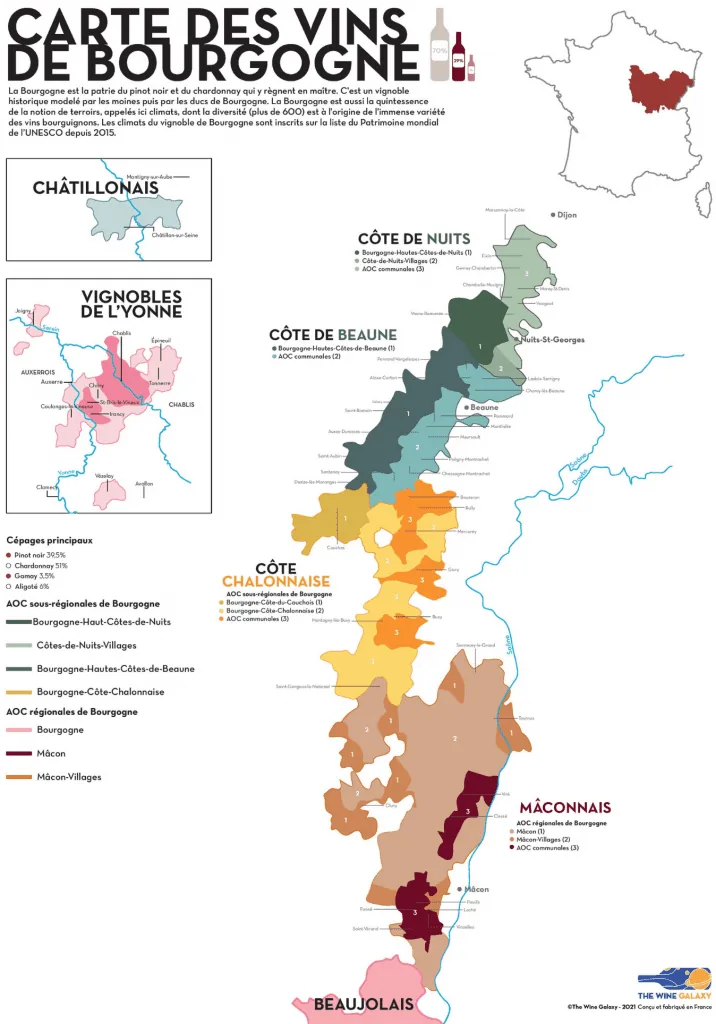
Before continuing, we suggest you discover this superb Bourgogne wine map in collaboration with The Wine Galaxy.
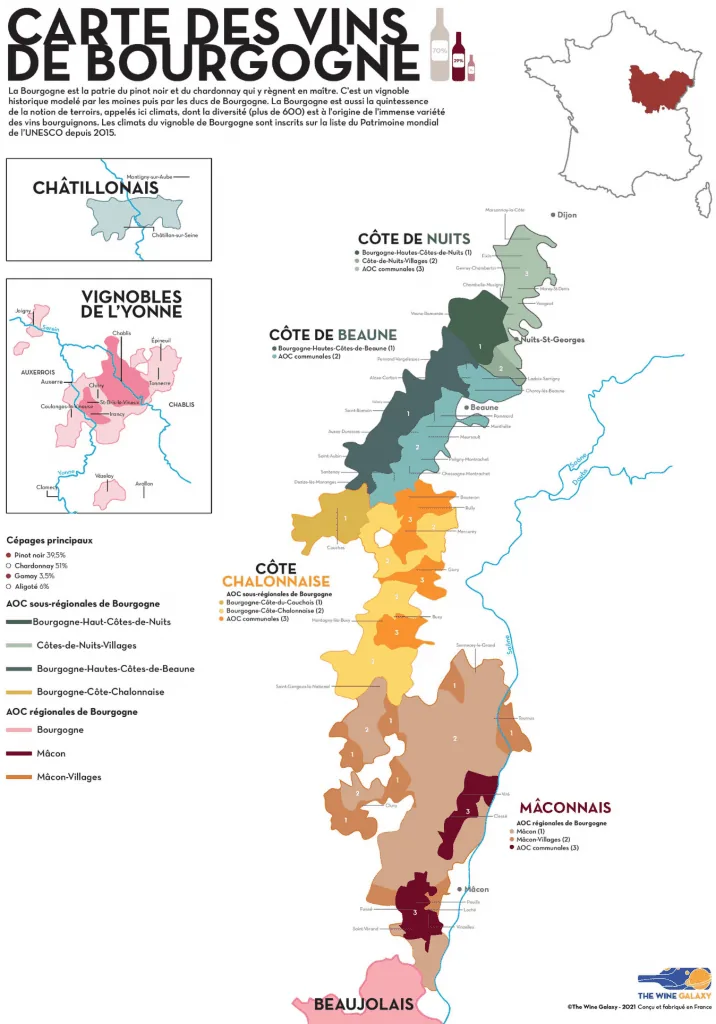
Buy the Bourgogne Wine Map
Did you keep coming back, I don’t know for the harvest or not, or did you happen to be spending the summer and it was the harvest? What attachment did you keep during that time here?
Albéric: Honestly not much, because the harvest at the time was rather from September 15th or 20th to mid-October. That wasn’t the holidays at all. On the other hand, there were the weekends. There we could come back from school, from boarding school and we could indeed go to the vat house at the time, go see what was going on. But I can’t say I was really immersed in it. They didn’t put my head, not in the bucket, but in the vat. And maybe if they had, even forcefully, maybe I wouldn’t have warmed to it. Antoine: Yes, very possible. Honestly, lots of people I interview, who are in family businesses or who have domaines from generation to generation, mostly have a speech like that, “I wasn’t forced, I was there, I was immersed in it and actually I did something completely different but when the opportunity came up, I was offered to come back. I thought I’d stay, I don’t know, 3 years, and I stayed 30 or 40 years.” Albéric: Yes because once you put your hand in it, or your nose, or your whole body and mind, it’s such a fascinating, absorbing, involving trade that to leave it you really need to have very good or very bad reasons. Something must have happened, or there must really be a real malaise. Which wasn’t my case, the proof. Antoine: That’s clear, a few years later.
Tell us how it goes, those first steps in the Maison Albert Bichot. You’re 25, you’ve come out of an experience as a guide or consultant. What do you start by doing?
Albéric: The first thing I was advised was, “You keep quiet.” Good thing because I’m rather the quiet type, “You observe, you open your big eyes and your big ears.” The first 3 years I went into the vineyard, to the cellar, on the bottling lines, a bit traveling, on commerce, in accounting. I opened the mail, here in this room where we are today, with uncles, with even a great-uncle. You had to grasp everything you couldn’t learn in school. At the end of school, you don’t remember much. But these moments, I remember very precisely. When you’re in a house, or a family domaine, you have to bring legitimacy other than that of your filiation, or that of your patronymic, of your name. That’s a challenge I tried to take to heart from the start. And still today. I think you’re always more watched at the turn than someone else. To prove a legitimacy other than that of being born where you were born.
Is that something you felt or that you still feel today?
Albéric: Yes, still today, all the time. It’s maybe a misplaced obsession. But in any case it’s the one that pushes me and that still guides me a lot today.
How does that translate, into working more?
Albéric: Yes, working more, being more attentive, never giving in to a form of ease, always questioning yourself. Antoine: It mustn’t be easy to say, “After all these years, what can I still do better today, what can I still try to improve, to carry, to push?” Albéric: It’s not easy. But what’s funny and fascinating in our trade is that with each new harvest we always say it’s a blank page we’re rewriting. The phrase is pretty, but it turns out it really is the reality. Both in production, in commercialization, in cultural practices. What we do today, we didn’t do 20 years ago or 50 years ago. We may not have invented much because it’s always an eternal restart. But there are still very engaging stances, that’s certain.
For about 2 years you go from service to service, from mission to mission, you discover this whole universe. After 2 years you start understanding all the gears of how the Maison Albert Bichot works. What happens just after?
Albéric: Just after I really become a sales rep. Antoine: On a particular zone? Albéric: Essentially in Asia. In the early 1990s Asia, particularly the Japanese market, was really one of the major stakes for us. I spent a lot of time in Japan. I went there for a little over 20 years, two to three times a year. I even spent two full months one summer to understand. It was our importer who’d told my boss, well, my father, “Listen it would be good if your son came to explore the market a bit.” He’d written to my father saying, “It would be good if he arrived on February 1st of one year and left on January 31st of the next year.” The notion of time in Japan is completely different from ours. He told my father, “A year, that would be good.” That wasn’t the goal at all, so I spent “only” a little over two months in two different Japanese families. That taught me to understand Japan from the inside. Between what we see from the outside, especially when on a business trip, and the very intimacy of an island spirit like the Japanese know how to live or do, there’s really a very different step. That let me learn a few very important words in their culture. When I bring up these two or three words, they look at me as if I’d violated their intimacy or the 4000-year history of this island. These two words are “renai” and “tatemae.” It’s the face and really the inside of the person. We could talk about Japan for hours. Antoine: I dream of doing that. Taking two or three weeks somewhere, that’s already a lot. But I don’t know if I really enjoy “doing nothing.” But to tell myself I’m living for 3 months in, I don’t know, in Tokyo, I keep doing the same job, but I live there. I live as a normal person there, I go to the local restaurants, do my shopping, take the metro, I don’t know. I think you discover a place in a totally different way. Aldéric: Between putting your bottom on the deck chair of a hotel, it’s another trip. It reminds me of a show called, “I’ll Sleep at Your Place.” It’s fascinating. It’s the real meeting of one person with another, with a family, with a country, with a culture. Even if it lasts only one night or slightly more. I have a certain inclination toward this kind of experience. Ultimately, wine is that too. It’s the encounter, it’s a moment of sharing. It goes well beyond the simple beverage.
You said you’d traveled a lot during your studies too, was that a trigger for you, those moments?
Albéric: Yes, very much a trigger. I left Beaune at the end of ninth grade. I went to a boarding school north of Paris, for three years. After that I came back to Lyon. Basically I cut the cord. The cord was cut, at least superficially, relatively early, at age 15. Even if I only came back 10 or 15 years later. That let me do things from a human point of view that were truly profoundly structuring. One day, for example, at boarding school, with two other friends, we liked watching a show called, “Adventure Notebooks,” it was on Antenne 2 at the time. We saw a guy who was telling his epic in Quebec. He’d left from southern Quebec to reach the confines of Ungava Bay, in northern Quebec Labrador, and we said, “This guy is fascinating.” We met him a few weeks after seeing his report.
How did you manage to meet him?
Albéric: It was simple. We’d called Antenne 2, it was the programming unit, a certain Mr. Guy Maxence, he was the head of programs. We told him, “We’d like to meet this man who did a report.” He put us in touch with another person and we went to see him at his place in Paris. We talked, we were fascinated. He’d come out with a book at the time called Ashuanipi. It’s a man named Alain Rastoin, who was actually an adventurer, a filmmaker. His trip ended badly because his photographer friend who was on the expedition had died in some rapids. A pretty intense thing. It made its way into our heads and a few months later we said, “Look, we’d like to do just the last part of that route.”
Further north?
Albéric: That’s it, further north, which was the “easiest” part. There were four of us. There was a certain Benoît, a Nicolas and Cyril. And the famous Nicolas, well, the famous, who became famous in any case in a media way, is named Nicolas Vanier who has made adventure his trade and is a filmmaker today. So, Nicolas’s first expedition, in 1983. That was my first expedition too. It went badly, we ended very badly in some rapids. But it was the start for me of the taste for wide-open spaces, of a form of adventure both with a capital A but also human adventure, isolation. I put together another expedition four years later, and then a bit later. My wildest dream was to arrive in Adélie Land starting from Montreal. But I realized that yes, the Atlantic wasn’t very far, but for Adélie Land it was better to go through Australia and Tasmania. By the way that’s also why I named my eldest daughter Adélie and our domaine in the Côte Chalonnaise, in Mercurey, the Domaine Adélie.
But so you never went?
Albéric: I never went. Antoine: Wasn’t there an expedition with your daughter that was supposed to come together? I think you’d told me. Albéric: Absolutely. I promised on my daughter’s cradle at her birth that for her 18th birthday I’d take her to Adélie Land. And she’s 17 and a half. Antoine: OK, 6 months left to plan it. Albéric: 6 months, and it’ll be very complicated. Antoine: A bit short, yes. Then it’s during the year of her 18th birthday, a year and a half actually. Albéric: We’ll go I think, maybe to Antarctica. But maybe not Adélie Land, it’s so preserved and complicated to go.
You do these 2 months in Japan, you go back to Beaune just after. In what state of mind do you come back, you must come back saying it’s incredible, you have to go for it?
Albéric: I’m completely going for it. Over there I met passionate, fascinating people, eager to learn, some who already knew ten times more about wine than I did, even about Bourgogne wine. You could already feel at the time that there was an extremely fertile ground for this European, French and Bourgogne wine culture. I really say culture more than viticulture. Because even today, I think a Japanese person who takes the trouble, who’s educated, who educates himself and wants to learn, isn’t just a label drinker. He really wants to know who’s behind that label, who made the wine, who cultivated it, who bottled it. If I drink this when I close my eyes, what does it inspire in me? That had really struck me. So much so that today, when I try to talk about our wines, it’s not just scientific things or more or less poetic qualifiers about wine, about the glass of wine we taste. There’s a painting behind you of one of my ancestors, it’s Hippolyte. It’s marked, “The Soul of Wine,” on the painting, well, on the book he’s holding. So already there, we’re in the middle of the nineteenth century and that painting that I know really well, has always intrigued me, the soul of wine. Are we overdoing it by talking about the soul? The soul is rather the soul of a human, of a being, but not the soul of a drink. Well, in fact yes. Behind the drink, there are men, and behind the men there’s everything else.
After you came back?
Albéric: I come back full of fire, lots of things to build and I did sales. But not only. Necessarily it’s a medium-sized structure, but you also have to be interested in all the other parts of the company, of the domaine, whether viticultural, whether in vinification, whether in management quite simply. You have to understand the numbers, you have to know them, you have to appreciate them and then there’s also all the human management of the company. How to attract good people, new energies, new generations more aligned with me than those I was with when I arrived. With each new generation there are new demands, new mentalities. It’s also been my role for all these years to adapt the domaine and the company to its time.
The expression isn’t so bad because without the people who make up your company you can’t take it anywhere or shoulder the ambitions that are yours.
Albéric: Culturally it’s something I think my grandfather and my father a fortiori, always told us. It’s that above all, it’s a matter of men, a matter of humans, of men and women in any case. It might be stating the obvious to say it but I’m experiencing it even more with the whole period we’ve just lived through, with Covid. The human adventure is more important, or more engaging in any case, than the adventure of the vineyard. Antoine: The vineyard makes the man, but the man surely also makes the vineyard. The two, it’s a soil, a vineyard and men who make the climats of Bourgogne and who make the wine in general. It’s quite complementary in any case, and crucial. Albéric: That’s it. I’ll bounce off the fact that you mention the climats of Bourgogne. What UNESCO classified as exceptional universal heritage is, when we talk about the climats of Bourgogne, it’s not just the terroir itself, it’s the interaction of man and his territories or terroirs for 2000 years. How to recognize the work of man who shaped all these terraces, these earth lifts, the creation of clos, over 20 centuries. If you haven’t yet come to Bourgogne, come. I myself haven’t been enough. I go a bit more now, but I have to come more. It’s true that what’s happened for centuries and centuries here is fascinating. Albéric: Yes and then this work of man on the vine. We always say, and it’s just the reality, the vine is, from a natural point of view, the vine is the family of the liana. And the liana, if you don’t control it, will run on the ground, it’ll go dozens of meters. We’re there to control it, for its own happiness, its happiness, I don’t know if the vine is happy or unhappy. It’s a happy constraint that we must bring to the vine. Antoine: The history of the vine, we talked about it a bit with Olivier Yobrégat on this podcast, in a previous episode. If you haven’t listened yet I recommend it, who is an ampelographer. And what’s incredible is that he said the vine is basically a vine individual, of grape, that has just been controlled differently depending on the place, that has mutated or not, and actually you could trace back the genetic history of all the grape varieties we have, all the clones, the individuals, all the vine stocks we have to a few individuals on a family tree.
It’s quite incredible to think that the vine has evolved, has been controlled by man for 2, 3, 5000 years, twisted, put on trellises to give what we have today. And we are passing this on to future generations.
Albéric: It also gives us a time scale that isn’t at all that of the day or the week or the year. When you plant a vine you always say you plant it for the, not even the next generation, the generation after that. I like the phrase we adapt here in Bourgogne, and that everyone can adapt: “We don’t inherit the vine from our parents, we borrow it from our children.” There’s a whole approach there imbued with generosity, at the same time humility, passion, things that transcend us, that are beyond us. Beyond the liquid in the glass, that’s what makes people dream too I think. The consumer, the client, all the imaginary, but it’s not just imaginary, it’s true. Antoine: It’s a link between the vine, the terroir, the men once again, the emotion that can come out of all that, it’s incredible.
What role do you take on in the company? You understand the whole company in general, but do you continue with sales functions? Does your father say, “Come a bit more with me,” a bit in the shadow of all he does to actually teach you to manage the company? How does it go?
Albéric: It’s roughly that, we do everything. My father did everything. Maybe a bit less technical and a lot of sales, administrative. What did I bring different? A bit like I told you earlier, we don’t invent anything and we just repeat the great principles. We knew we had to change our labels a bit. That’s one of the great classics, when a new generation arrives or when a new marketing director arrives the first thing they do is change the labels. We made them evolve. We made the vinification evolve. Because we were looking for wines a bit more like this, a bit more like that… At the vat house we pump during the harvest, over 30 meters we send it into the vats. While the neighbor has a kind of forklift with a rotating head, I’ll spare you all the technical details. But you can’t change everything overnight. First because you mustn’t change everything overnight because what others did before, it wasn’t to do badly. That you bring your touch yes, that the taste of consumers, of amateurs evolves yes, but there are still some great fundamentals that don’t change. Let’s say the big changes were late 1990s, early 2000s. There for our trade, no longer of wine producers as much as winegrowers but more as négociants with a capital N, it was at that time about buying wines that are already made. We bought them two or three months after the harvest. So to buy them we select them. Look, commercially I need 50 barrels, 50 pieces of Gevrey Chambertin. I’ll call my brokers, I’ll give them my needs and they’ll bring us samples, we’ll taste them. And then we select them, if possible the best or those that match our wine style. What we wanted to do, since we already had structures, vinification vat houses, was rather than buying the made wine, to try, and that was rather innovative at the time, to buy the grapes instead. To become a vinifying négociant, or I’d call it, I’m not the only one to say it, we’re vinegrowers. And it was a great revolution, step by step in any case, but cultural, fundamental on the trade of selector-négociant, blender and bottler. We continued to try to extend our domaines a bit while we could still buy a few parcels or secure a few supplies. Antoine: I’d like us to go on a topic that’s interesting and that we haven’t covered much in addition in the conversation. It’s the operation of the Hospices de Beaune sale since it’s an object of fascination in the wine world in general. We’re deviating a bit from your personal story, we’ll come back to it just after. While I’m thinking about it I’d like to dive in.
Each year, there’s a sale at the Hospices de Beaune. Can you tell us how it goes, what it looks like, what is it? You have a predominant place in this sale since I believe you’ve been the largest buyer for years. Can you tell us exactly how it goes, and what’s at stake there?
Albéric: So, the Hospices de Beaune wine sale, we’ll try to make it short. What’s often made me smile, being very understanding, there are quite a few friends, not necessarily in the trade, but in any case friends who each time, the week after the Hospices de Beaune wine sale, ask me, “So did it go well, did you sell well?” I tell them, “Well no, at the Hospices de Beaune we don’t sell, we buy.” “What do you mean we buy?” So that’s where we can explain a bit what it is. It’s a vinegrowing hospital that dates from the middle of the fifteenth century, from 1443. Over the centuries, generous benefactors, donors offered forests, livestock, meadows to help the hospital with its subsistence, sometimes also to thank for healings, many things. Today, the Hospices de Beaune, beyond their forests, fields, the domaine they have, are at the head of a domaine of more than 60 hectares of vines in Bourgogne. Essentially very nice villages, premiers crus, even grands crus, both in Côte de Beaune, in Côte de Nuits or in Pinot Noir or in Chardonnay. So the goal of the hospital isn’t to make wines, to keep them, to bottle them, to have a sales team to do it, to sell them but to sell them, it’ll be nearly 160 years that this is how it’s been, by auction, in barrels. Well in pieces since the Bourgogne barrel is called the Bourgogne piece here. The third Sunday of November the hospital auctions off all its harvest. So depending on good year, bad year, it ranges from 500 pieces up to 850 or 900 pieces each year. These are very nice parcels, great wines that we’ll then be able to age for 16, 17, 18, 20 months. We’ll bring a bit of our touch by choosing the barrels, the aging durations, the filtrations, no filtration, well, lots of things. And we try to reveal even more than the manager of the domaine, what the terroirs of each parcel, or the identity of each parcel wants to tell us. It turns out that already in my grandfather’s time, in the years just post-phylloxera, in 1895, 1887, we were already buying a few pieces at auction. The domaine has expanded a lot because at the time it was, I don’t have the exact figure in mind but it was three times smaller than today. Then it became, personally, something that really enthused me to see that wine, health, the hospital, the public good or the Res Publica, you who studied at Sciences Po. There you have it that we could mix all that for the happiness of all. And then it can also help to win your paradise and if we all tell ourselves that we’ll end up at the hospice one day… It’s been a little over 20 years that we’re the major buyer of the sale but it’s not an end in itself. It’s a reality because we take the trouble and we find it wonderful. We don’t do politics on public health but in any case, that Beaune and its district can have a hospital, that you have an accident tomorrow three kilometers from Beaune or that your wife is going to give birth and she can be taken in hand right away rather than going to emergency 60 or 100 kilometers away. All this is maybe an outdated battle but in any case thanks among others to this Hospices de Beaune sale, the Beaune hospital continues to exist, the Hôtel Dieu Museum of the Hospices exists, that there’s a nursing school, that they subsidize many local associations. We rarely talk about it, but whether it’s the Restos du Cœur, Secours Catholique, Secours Populaire, well, lots of things happen through this sale. It’s part of the history of Bourgogne. When Nicolas Rolin and Guigone de Salins in the fifteenth century founded this hospital it was in a spirit that continues today. There were surely ups and downs. But in any case today the director of the hospital, the mayor of Beaune who handles all this with our active complicity, tries to keep alive this message of sharing and generosity because we’re lucky to be on lands blessed by the Gods. We can still see despite the crisis, all the world crises, despite everything, Bourgogne continues to have a beautiful image of quality, of rarity, let’s take big words even of exemplarity in terms of culture, of terroir, well. We’ve received so much, all collectively, that if we can give back a bit it’s no bad thing.
You buy different pieces during this sale and they’re then sold here under the name Albert Bichot?
Albéric: So we all have a label, called Hospices de Beaune, which is the same for all the buyers of Hospices wines, all the agers, all the bottlers. The only small difference is that at the bottom of the label it’s marked, “Aged and bottled by…” That’s where we put our name, small, large, each does as they want. But it’s first and foremost the wine of the Hospices de Beaune that we’re promoting. And of Bourgogne, necessarily, with it. Antoine: This event, you said it’s been 160 years and we hope it will continue for at least 160 years, if not more. Albéric: For me, beyond this sale, it’s a colossal spotlight. I don’t want to say it’s the only one, in any case it’s the most important, the most impactful in any case of the year of Bourgogne life. Sure there’s the sale on the third Sunday of November, it’s not another date, it’s always like that, but there’s all that goes around. It’s three pretty festive days. It’s the trois glorieuses, not just for wine insiders or major national marketers or importers, no, it’s also a magnificent popular celebration. There’s a half-marathon, the city is completely transformed. Things that are really deep, welcoming, friendly happen and there I exhort all your listeners. Antoine: Come do the half-marathon, make a team for the Beaune half-marathon. Albéric: I’ll wait for you at the finish. Antoine: In any case if there are some who want to do it, contact me, no problem trying to organize it. Thanks a lot for these clarifications following this story.
You do your first years in different services. You’re a bit of your father’s right hand who puts you on particular projects or things you handle yourself. How does it go when you take over the management? Was it agreed between you before and then announced? Was it a bit more brutal and public? What did he tell you?
Albéric: No, it didn’t happen at all in a brutal way, nor planned, nor written. It happened in a totally natural way over time. Antoine: He delegated more and more things to you. Albéric: Look, it happened like that and after all it’s very personal. As I told you at the start of the interview, I’m lucky that my father is still alive and that he’s totally sharp of mind. And for me, it’s, how to say, it’s when he’s no longer there that I’ll take the function. Antoine: Even today you feel it like that? Albéric: Yes, it’s not that he wishes it like that but that’s how I see it. At least intellectually or deeply anchored in the soul. After in the facts indeed, on a daily basis things get done. I think after that it’s a form of sensitivity, of education.
Your father continues to come a bit here?
Albéric: Oh yes. His father, who was of the century, as we said at the time, he was born in 1900, and he died in 1996, so at 96 years old. He came up to age 95 and a half to the office and he climbed the stairs four at a time. And he had his office that he shared with one of his other sons, because he had four sons, he had no daughters. But the four sons all worked together for nearly 40 years and it was funny. When he came, almost daily, what he wanted to look at was orders. What interested him a lot was when he saw an order or when he saw I’d had a meeting with someone, I don’t know, Mr. Müller, whatever, or John Smith, that amused him. And me too for that matter, telling me, “Well you see, Albéric, your John Smith, I knew his father well, or his grandfather and when in 1923 I’d taken the steamship Le Normandie to go to the United States to do my tours for three months in a row, well your John Smith of today I can tell you the story.” And what was pretty funny, and I still re-read quite a bit of mail from time to time that he had written to his own father when he was traveling, is that what he wrote in the 20s, the 30s, on the apprehension of the market, how his trip went, what his commercial objectives were, well, nothing has changed. Antoine: It’s interesting to have this written record. Albéric: Yes because no internet, no really efficient phone at the time, so the only way was to converse by mail. He had a small typewriter that his father had given him and every day he wrote to the domaine, to the office, to keep his father and the commercial team of the time informed that orders were going to arrive, this, that. Antoine: It’s maybe something to do today, actually. We communicate a lot synchronously, we have tools, CRMs, of course emails to update all sales data, all deals in progress pretty fast. But we don’t necessarily take the time to say, I don’t know, how it went today, here’s what I thought I’d find… Albéric: Yes, we don’t take the time at all. While there it’s interesting to read that already the trip went well. Today, we say, “Yes the trip went well.” But we don’t even listen to the answer. While at the time, it’s sure, when you left on a transatlantic, whether passenger or even cargo ship, it could indeed go badly. Once on the territory, in this case American, you arrive in New York. He went to see his cousin Paul Masson all the way to California, that took time. And then, in his letters he describes things we don’t describe anymore today. He describes landscapes, encounters, atmospheres, smells, all that we no longer do today. You shouldn’t look back but it’s interesting to see that there are many things we forget to say. I’m maybe a bit more pessimistic to say we forget to feel, because we’re absorbed by too many things at the same time. There, he took the time to formalize it and that I found striking. Antoine: From a personal point of view, I try to do it a bit each day. It’s tiny in my little notebook. Every day, I have a “highlight” I want to do, a “let-go,” something that bugged me the day before and that I want to put on paper to get rid of, it can be a small thing, a car didn’t let me pass. Something a bit annoying happened at work or personally, and something for which I’m grateful. Every morning I do that. Then, I do my “to-do.” On the side I take notes on what’s happening in my day, my meetings. I realized that if I didn’t do that I was doing something else at the same time. I don’t have the level of attention I should have. I decided to take notes and that way I’m not doing anything else. I have this little box where I write, “Today, good day,” “super productive,” or “I accomplished good things” or on the contrary “Today not at all.” I think I’ll try to write a bit more. These are difficult habits today, but in 30 years, you can re-read a notebook of yourself when you were 25 that says, “Today was good.” Albéric: Even closer than 30 years. The number of times I’m asked, “Where were you last week or what did you do last month?” We don’t even know what we did anymore. Not that we have more hectic lives than others, but we don’t pay attention anymore.
Is there something your father told you that struck you about managing a house like the Maison Albert Bichot?
Albéric: Like that off the cuff, no. He often told me, and he still tells me whenever he thinks it’s necessary, whether wine-related or not, when it’s your business, that of your family, every morning you put on the line both your salary and your patrimony. This term is a bit strong but it’s really committing to say that. It’s both a weight and a form of responsibility. It can be a ball and chain but the fact of saying others did it before you can be reassuring. With us it’s been 6 generations. They often say there’s the first generation that creates, the second and it’s the third that eats the frog. With us the third has been long passed. We reassure ourselves that way. Antoine: The sixth, going pretty well. Albéric: Well, we’ll see, thanks. Antoine: The ninth remains then, but in a bit more time. Albéric: Yes, because there we’re smiling about it but it means that deep down, for most of us, we want the story to continue with the next generation. It’s not always easy but it’s that it fills us in some way with real happiness. Otherwise we wouldn’t want this for our successors or for our children. If we want it to continue, if it’s just for an ego story, or a name or a principle, it’s not worth it.
Can we come back to the different wines produced by the Maison Albert Bichot. We haven’t talked about it yet in all this. You have a super broad range, almost the whole of Bourgogne, I think.
Albéric: Yes. It’s broad and not very broad. We only do about 10 percent of the Bourgogne appellations. Antoine: Oh yes? OK, I thought you did a lot. Then you play a bit on the edges because there are quite a lot of Bourgogne appellations. Albéric: I’m a bit tricky indeed. No I come back to the climats of Bourgogne. There are 1247 that have been registered as UNESCO heritage, I’m repeating myself sorry. We do a bit more than a hundred appellations. That can seem like a lot but it’s at the same time in the image, the size and the identity of Bourgogne. Today an average operation or domaine in Bourgogne does about 7 to 8 hectares with 10 to 11 different appellations. That really means what it means. It’s that this mosaic of terroirs, this multiplicity of parcels means that, well, we never have big cuvées. We have both our own domaines, whether in Chablis, in Côte de Nuits, in Côte de Beaune, in Côte Chalonnaise. Our smallest parcel is 0.06 hectares, 600 square meters. Antoine: I think you’d shown us when we came during the harvest a tiny vat. Albéric: Well, that was that one. It was our Richebourg cuvée. It’s a grand cru. In all there’s a little over 6 hectares. Well, we have 1 percent, the happiness and the privilege, and we make one barrel. We’ll make one piece, we make a bit more than 300 bottles a year. And on the other hand, our biggest parcel is in Pommard. Where I live, at the Clos des Ursulines, at the Domaine du Pavillon. There it’s almost 4 hectares. So when you say that to an Australian or a Californian he laughs. Your biggest parcel is 4 hectares, what are you telling me? I’m exaggerating a bit but that’s still it. And that’s why it’s always surprising when people discover, “Ah, you make 50 wines, 60 different wines.” Whether a Pommard, a Gevrey, a Puligny or a Meursault, we just harvest the grapes from these parcels and identify them in the cellar and indeed age them, raise them all differently with their personality. It’s no more complicated. At the limit I’d say I’d find it harder to make a single wine of a hundred hectares, mix everything, blend everything. Even on large stretches, the age of vines is different, the grape variety mix. It’s another trade. I don’t think one is harder than the other. Antoine: It’s also the identity of Bourgogne to have this match between grape variety and terroir, this identity of the terroirs and to make place wines and not grape variety wines. We don’t make a Pinot Noir, we make a Côte de Nuits, something even much more precise, a Gevrey Chambertin, a Puligny or a Pommard. Albéric: That’s what’s fascinating and surprising every time, you don’t get tired of it. Honestly, most of us are worried before the harvest. As long as the wine isn’t bottled, or at least a few months before, it’s never won. Even once in the bottle. When you open it two years after, four years after, ten years after, there’s always a little stress. How has it evolved? I don’t know, this Pommard Premier Cru Les Rugiens, it’s been at least 4 years since I last tasted it. There’s a little flip, but salutary at the same time and that lets you also keep the surprise. Wine will always surprise us, well or less well for that matter. That makes a beautiful school, we won’t say a school of humility, because it’s not to say we’re humble, but you sometimes take some good slaps. The more you know, well, it’s the old adage. What did Jean Gabin say? The more you learn, the more you know that you never know, something like that. I think wine is a school of humility as a general rule. All the people I talk with tell me and I say it too because I taste a bit. And actually I think one time out of two blind I’m off, or I have no idea or I discover something completely new, that I’d never tasted. And even something I know, another year, I no longer know it. I think taste is something you educate little in your life, unless you’re interested in wine, but until you’re interested it’s a sense you educate little. We educate hearing, sight, etc., much more, taste much less. And after I think it’s just an infinite world actually. One day or another, it’s not the same, before or after eating, at this hour or that, it’s not the same, actually. Albéric: If you’re in shape, not in shape. Who you’re with, and then if we go into, are we in lunar phase, ascending, increasing, decreasing, well, atmospheric pressure and I say that laughing but it’s not completely false. There really are days when you taste well and days when you taste less well. And it’s not the wine that’s different in its bottle. It’s us humans who don’t taste the same way on a given day. We talk about flower days, root days, well, those aren’t jokes.
I also learned not long ago something about our taste buds. I had no idea, but they renew every 100 days and so actually once every 100 days we have almost no taste. You have to know it and it’s bad luck if it happens on a day when we have to taste wine. And it can happen not to feel the wine well just because our taste buds are in full renewal and actually we feel almost nothing. There you go, I learned that not long ago.
Albéric: I didn’t know. Antoine: Incredible. It’s Denis at the Couvent des Jacobins Saint-Emilion who taught me that not long ago. I didn’t know either. Then I don’t taste wine every day either. For now, I’ve never landed on the hundredth day, I think, I’m lucky. Albéric: Yes, I hope the taste buds don’t all renew at the same time. Antoine: Apparently yes precisely, it’s a thing like that. If there are people who do medicine listening to this podcast, sorry if I’m making a whole stew of it, sorry, please excuse my lack of knowledge.
What will the Maison Albert Bichot look like in a few years, in 10, 20 or 50 years, what should we wish you? That it continues obviously.
Albéric: That it continues, and that we always have as much pleasure doing this trade. It’s not even a trade anymore. When you’re an entrepreneur, when you’re in a family business, whatever the thing, our personal life and work life are intimately linked, even if you do indeed have to separate things. You have to try not to be eaten up by one or the other or in any case to find your own balance. But what to wish? In our trade which is wine, and maybe even more in Bourgogne, things really happen over time. There’s no revolution. There are always evolutions to bring but revolutions I don’t think so. The big stake today is, I don’t want to take terms that are too media-oriented that bug us a bit when we talk about climate transition, ecological transition, climate warming or, pardon the term, climate mess. What we see in any case is that in 20 years, we harvest on average 11 or 12 days earlier than the previous 20 years. We notice that the last 10 vintages, there were only two where, at least in volume, the harvests were normal. We hail more than before, or in any case stronger, we dry up during the summer because it’s very hot. There are also problems of vine longevity, that is there are more foot diseases. There are things that probably existed in the past but not in this frequency in any case of climatic accidents and not in this intensity. Our big challenge today is first to produce, and to preserve, or to renew and energize our production capacity. That is really the right vine stocks, the right rootstocks. What will make it so that, Bourgogne, in 50 or in 100 years can continue to produce Clos de Vougeot grand cru with pinot noir and then Corton-Charlemagne or Puligny-Montrachet with chardonnay. Is that the future of Bourgogne? For us that’s what we want because that’s our identity but let’s hope, cross our fingers and make it so that, well how I don’t know, but that this is the model that endures. If, I’d say bad omens told us, “Listen, your future tomorrow La Romanée-Conti, it’s syrah,” it would be a terrible shock. Before getting there, there are new culture methods, new defoliation methods or no defoliation, planting heights. Who knows, tomorrow maybe we’ll have the right, or we’ll ask to be able to irrigate. Why lose a harvest, or lose half your harvest in 2032 because we had a super hot summer, all for the sacrosanct rule of saying such AOC has not been irrigated. Then between irrigation and irrigation, there’s misting. There are intelligent rules to find. That’s real stakes, the production capacity, qualitative, historical, all while keeping the identity of our terroir and its history linked to its own grape varieties. It’s now we have to talk about it, not in 30 years. Antoine: Yes, that’s what you said, you plant the vine for the next generations so you have to take care of it.
If you had the opportunity to cross paths with yourself today and slip a word in the ear of the Albéric who’s stopping business turnaround consulting and slip him a sentence, a few words, what would you tell him?
Albéric: I’d tell him just go and don’t be afraid. It’s a bit complicated what I’m saying. The fear of not making it, because all this grows at the same time.
Is that something you still have?
Albéric: Yes, always. But it’s positive fear, it’s maybe more demand and creative worry. It’s better to have the jitters and not do too many stupid things than be a fool without barriers who crashes into the wall. To choose, I prefer not to crash into the wall. Am I a worrier by nature, I don’t know. I come back again to the vine and to nature, you’re always worried because you always have your eyes on the sky to see if when you lower your eyes the earth is doing well. There’s a phrase from Bernard Pivot, I come back again to the climate of UNESCO, “What’s a climat in Bourgogne?” it’s anything but raising your eyes to the sky. No, the climat is also under our feet. In this case I was talking about climatology indeed which is always worrying and stressful. We’re in 2021, late July. France as a whole froze enormously for at least three nights at the beginning of April. There are three regions that really suffered from this frost, including Bourgogne. We’re in, I won’t say a global trauma, but still. Probably Bourgogne will lose, or will lose about 40 percent of all its harvest, of which maybe 60, 70 percent of all its whites, or 60 percent. Chardonnay is always a bit earlier than Pinot Noir and there we say, “What did we do to the good Lord?” as the saying goes. If I compare with this year, that it freezes early April, that’s normal. On the other hand what wasn’t normal is that on March 15th, we were in shorts in the vat houses, in the vines. The vegetation took off fully, the buds were there and it took an enormous hit. That’s what isn’t normal and that didn’t happen apparently. The old-timers say that to have seen a frost of this geographic scope, of this intensity of such low temperatures, you have to go back to 1951, even before. That doesn’t mean it’s once every 50 years, we’d really like that to be the reality, but if for example such a catastrophe were to re-occur next year, or the year after that, it can really put many operations in danger. And then the vine is resilient and man must be creative. We have to find anti-frost, anti-hail, anti-drought means, as I said earlier, more adapted, more resistant rootstocks while keeping the genetic patrimony. There are many things we have to think about collectively. Each in his corner we’ll perhaps find recipes but all this requires a collective awareness. Then to take real measures, short, medium, long term, with research, adaptations, observation and especially passion.
Is there a question you would have liked me to ask you and that I didn’t ask?
Albéric: You could have asked me, “Why do we drink water and not…” Antoine: Very good question. It’s true, why do we drink water in the end? Albéric: Because we drank too much at lunch. Antoine: We’ve been relatively reasonable. Albéric: Very reasonable. Antoine: Albéric, we’re getting to the end of this interview. We’ll do an episode two in a few years to round all that out, I’m sure you still have lots of stories to tell us.
We didn’t go much into the details I think of your travels. I’m sure you must have lived through extraordinary things going to sell wine all over the world.
Albéric: Yes, travels, encounters… I could have talked to you about our evolution in terms of organic culture, well on organic viticulture, on organic wines. Today we have more than 42, I think we are the most, well I don’t like that term, it’s the largest offer under one same signature of organic wines. It’s us today. Antoine: In France? Albéric: In Bourgogne. We have 43 organic wines. What also interests me in this approach is where it comes from, how it happened. Antoine: Let’s spend a few minutes on it, if you want. Albéric: No but I link this a bit to the travels, my little past between the bachelor who comes back 10 years later in his Bourgogne after being to the North Pole, the South Pole, in Labrador, a few days in contact with Paul-Émile Victor, in Polynesia because I’d spent 2 years in the navy to do my military service, a long service. All this even more convinced me and even more pushed me into the love of wide-open spaces, of nature, of ecology with a capital E. So an ecology that’s anything but political, I mean by that politicking politics. It was late 1990s, apart from changing our methods by buying grapes rather than wines, it was also an enormous change in any case in the cultural approach to the vine. Antoine: You started early too. Albéric: We started at the early 2000s because to convert all these parcels. And before converting the land you have to convert the men. It’s not worth it if they’re not convinced. So it’s the oenologists, the culture managers of a certain generation that had to be convinced. Some in an extremely easy way, others who were more resistant for often very legitimate reasons. All this brought us to it in 2014, our domaines being certified in organic viticulture. That means we really started the conversion in 2009. That changed many things too in the approach to preservation, durability, inputs, even effluence management. If you’re organic, it’s not just to put on a back label that you’re organic with a big green label. If there’s no other conviction than that we know it doesn’t last and it doesn’t work. There’s a whole approach, the current great term of corporate social responsibility, the famous CSR. I think organic is part of it as well as the well-being of employees, as effluent management, what we consume in energy. Maybe I’ll decide to stop exporting such a wine, but the only way to drink it will be nationally, why not? It’s a bit of an extreme case I’m saying there. Look, I’ll stop there, season 2. Antoine: Season 2, that works for me.
I have 3 questions left to ask you anyway before season 2. The first is do you have a recent favorite tasting?
Albéric: I have way too many but if there’s one that crosses my mind it was not so long ago, it was a Meursault Premier Cru Perrières young, of 2018, from the Domaine Michel Bouzereau and I’ll tell you why after.
Do you have a wine book to recommend? Or not on wine, as you wish.
Albéric: So on wine, you see, the cobbler’s children are the worst shod. I should also read much more on wine. We think we know everything but actually we don’t know much. I can tell you about a book I just finished that fascinated me, captivated me. So it might be a bit linked to great travels and wide-open spaces. It didn’t come out last year, it’s a book about Magellan, by Stephan Zweig. Fascinating. To read. Antoine: Count on me, I love reading either good novels or business books. There I’m on “Crime and Punishment” for the moment, I’m already at 20 percent, I’ve largely passed the hardest part. It’s a delight to read but I’ll add this book on Magellan to my reading list.
Who is the next person I should interview on this podcast?
Albéric: Precisely, the one who made this wine, this Meursault Perrière 2018 so it’s the Domaine Michel Bouzereau. Michel is the father, but now it’s the son who handles it, named Jean-Baptiste. So you’re going to see Jean-Baptiste Bouzereau, on my behalf or not on my behalf. And there you’re going to meet a real fellow. Antoine: Got it, count on me to go meet him. It’ll be the chance for me to start really coming back to Bourgogne and multiplying the interviews here and really discovering all these terroirs and all the corners of this magnificent region. So with great pleasure. Albéric, thanks for all this time together. I hope I haven’t put you too far behind. We went over quite a bit but really, it was a pleasure. Go discover Albéric’s wines. There are 117 different ones everywhere. I think you can really find them everywhere you go, in any case at all the nice tables and I’ll talk to you very soon. Albéric, until next time. Albéric: Goodbye Antoine.