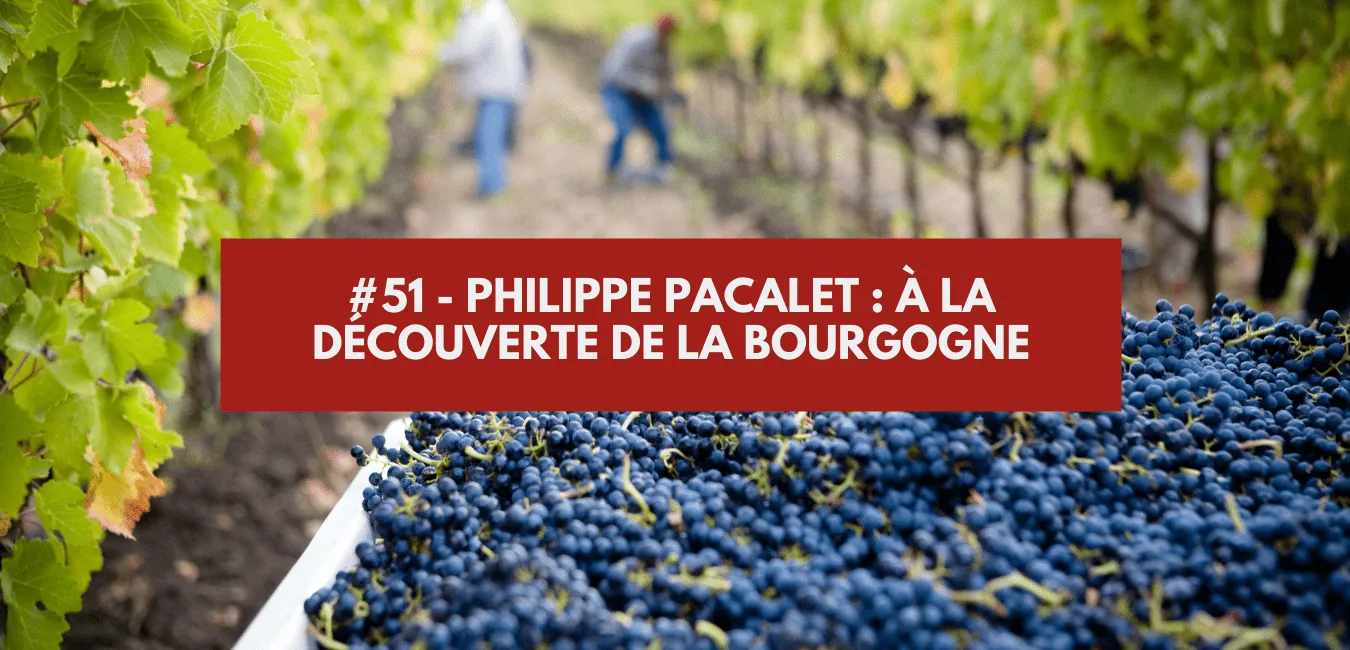
Burgundy, we’ve barely been there but count on us to change that. For the occasion, we had the chance to meet Philippe Pacalet. With incredible wines, Philippe and I discussed many things for an hour. His career of course, but also his journey, his vision of wine and of course his wines.
Can you start by introducing yourself?
Philippe: My name is Philippe Pacalet, I’m 57 years old. I’m a wine producer in Beaune and have been on my own for 20 years now. I come from the wine world, I fell into wine when I was little. I grew up with my grandparents at Lapierre. My mother’s name is Lapierre, she’s Marcel Lapierre’s sister. In the 60s, 70s it was still the farm, still polyculture. I was steeped in all those values that make a bit of who I am today. I make wines of terroir, in Burgundy. We try to express character rather than something systematic for the wines.
Let’s come back to this discovery of wine and your youth. You were in the vines from a very young age. How did this initiation go?
Philippe: I grew up there. From a young age I was steeped in it. I’d say it’s like we do ourselves with children. They don’t realize, there’s a permeation that happens rather than intellectual learning, and at some point it comes back. From age 14, I worked a lot in the vines, during school periods. I still went to school. And at 21, I decided to make it my trade.
How did this click happen?
Philippe: I was interested in nature, I was studying chemistry, biochemistry. The relationship with nature has always interested me but also the relationship to freedom. Freedom is expensive. You have to give yourself the means. My uncle Marcel Lapierre initiated me, from 1978, I was 14. We started making cuvées without sulfur, to develop natural wine which today has been popularized. At 21 I decided to make it my trade. I had no land of my own. So my uncle told me: “Listen, in this country if you want to do a trade you need a diploma. It’s like a doctor who treats but isn’t a doctor, he gets thrown in jail.” So I pursued studies, I did 2 years of DEUG in biochemistry, after I did two years to become an oenologist. I did research. I met Jules Chauvet, research on indigenous yeasts. All this determined who I am today. Antoine: It’s at 21 then? Philippe: In 1985, yes.
After you did two years of DEUG and two years of oenology?
Philippe: That’s it. In 1989, I come out. I was a little late for military service. I have nothing against military service. So I did civil service. I was a conscientious objector at Nature et Progrès. Antoine: What’s that? Philippe: Nature et Progrès, they’re the ones who, with Demeter at the time, developed the AB label. They got it through in the early 1980s, 1981 I believe. I worked for them for 21 months. I was based in Oullins. I wasn’t really doing journalism, I was doing a bit of consulting, I’d visit winemakers. I worked, you could say, between Valence and Lyon. There’s a whole sector, the Mont Pilat, apples, winemakers. I met Hervé Souhaut, Thierry Allemand, a whole bunch of people who contributed further to my development, my apprenticeship, it was very good. Antoine: About almost two years? Philippe: 21 months, yes. During that period too we’d set up a Beaujolais, a lab with Lapierre and his four colleagues Jean Foillard, Jean-Paul Thévenet, Guy Breton and Jean-Claude Chanudet to do wine analyses. Antoine: That is to say, set up a Beaujolais? Philippe: We’d set up a small lab. Philippe: We did analyses, volatiles, things like that. And I did microscopic analyses too, that was my specialty. Since we were working without sulfur we had to see where we were going. I was continuing my training. Antoine: Yes, it was a form of apprenticeship. Philippe: That’s it. And then, through the network, a friend named Jean-Christophe Piquet-Boisson told me: “You should go see in Vosne-Romanée, there’s a guy looking for someone.” That guy was Monsieur Roch.
I showed up there in July 1991 with my CV and a bottle of Morgon 1989. I did my interview, served the wine, showed my CVs and the deal was done. I knew how to make wine, you could say. And I knew well the processes, well, all the important technical processes to make red wines without sulfur, that wasn’t bad.
I stayed 10 years. I was operations manager. We developed at the time organic farming you could say, organic. We did a bit of biodynamics. And then in vinification, and whole bunches which at the time was very rare, without sulfur. There you go. Monsieur Roch trusted me. They didn’t have the technique or the way of doing things, the habit, but it was their will. I didn’t change him on that point. It was already mature with him. Antoine: There was a kind of complete trust. Philippe: In everything I do in my life, there’s always synchronicity. I must have a good star. You know, you take the train, you go on the platform but after you can’t complain. Sometimes you don’t know what you’ll find, but you have to go for it. It’s the adventure of life, that’s what’s good. It’s a quest, you don’t really know what you’re chasing. Well, you have a small idea.
I was born in a particular environment, in a golden period. At the time, with my uncle Marcel Lapierre, there was Jacques Néauport, they were two acolytes. Then we met Jules Chauvet, and Alain Chapelle, there was a whole movement that was created. With the four winemakers I cited, after with others a bit elsewhere, Pierre Overnoy, the Puzelats, Domaine Gramenon, Château Sainte-Anne, etc.
After it grew, it took, but it took years nonetheless. It wasn’t an ideological or political movement, contrary to what we see a lot today. People talk about things they don’t know. They have good intentions but that’s not enough with nature. It was already a desire for freedom, to free ourselves from the 1970s, 1980s. It was high chemistry. Then there were yields, we had a different climate. It was really a way to do what we wanted to do, to come back a bit to what our parents, our grandparents did, but with modernity nonetheless. We didn’t go back to the stone age. Making good wines, without added yeast, in vines coming back to more natural processes, more organic. But all this takes time. There are mistakes, but we were well accompanied, Monsieur Chauvet was a top expert. Antoine: That’s the least we can say. Philippe: I did an internship with him for two years and I worked with him for three or four years. Antoine: That was before or after? Philippe: It was from 1985 to 1989, since he died in 1989. I did my oenology thesis on the ecology of Beaujolais yeasts. There were studies from the 1960s, including his study with Paul Bréchot. We redid a study with the IFV (Institut Français de la Vigne et du Vin), with Jean-Luc Berger in 1986, 87, 88 and 89.
To pick up the thread, you were operations manager for ten years?
Philippe: Yes, where I learned my trade, because I had done stuff like that. Plus, my father, he’s Burgundian. As he says, here is the holy land of wine. We worked in Beaujolais but for us, we always looked here. Here there’s a capacity to make fine and elegant wines. There’s still a noble side. I didn’t say “aristo” but “noble”. There’s a nobility. Sometimes there have been somewhat altered terroirs but it remains. There’s been work over the centuries, since the high middle ages. All this imprint remains, this message, this information. For me that was the goal. It’s like a rugby player, he wants to play in the national team, then in international tournaments, there you go. But it wasn’t simple. Antoine: Ah yes? Philippe: I stayed ten years and after I wanted to wear my pants alone. I was well there but I wanted to make my wine, even if it meant not making crus. But it’s true that the proximity to Domaine de la Romanée-Conti, since Monsieur Roch was co-manager, so the exchanges and all that lead to another dimension.
In life it’s like in physics, chemistry, everything is a problem of dimensions. I tried to find a way to make wine independently and freely.
Here the financial phenomenon has become very important these last twenty years. Buying a vine, an interesting vine, village or premier cru appellations Gevrey, in Pommard, Chambord, all that, it’s quite complicated. We could no longer find tenancy, that is to say a rental for 18 years. Marrying with finance people to buy vines, I wasn’t cut out for it. I didn’t do studies. I know how to make wine but I’d get rolled in flour. I found another system, I made deals with owners. I’d buy them the harvest and for some of them we’d do the work in the vines. We refacture the work to them. Others we manage for them what happens. With others, we’re partners. They do the cultivation and we buy them all the harvest. There are several things. It’s multiplex. Antoine: In different dimensions then.
How did you start? What was the first negotiation or first cuvée? How did it negotiate, how did you find?
Philippe: I had started looking. Here in Burgundy we had brokers, cultivation brokers, wine brokers. There’s one I get along with very well. I had briefed him. I told him: “Here, I’m looking for this, or rather that.” He helped me, great experience. We rather went towards what I told you, rather than buying grapes every year, and after there are none, it wasn’t viable. And then the way we work, you had to have a winemaker mentality. You had to be in the cultivations. We weren’t going one year to buy grapes, one year not because that’s how it is. We’re artisans, we’re not industrialists. There had to be continuity, all this took a bit of time to set up. The first years I started with Pommard, Meursault, Gevrey, well many appellations I have today and I’d say 90 percent of the people we work with, they’re the same. That proves that everyone finds their account.
You go see the broker telling them: “Here I’m looking for grapes, this appellation”?
Philippe: The broker or sometimes it’s people who chat. When you start working with people, after it goes well, they talk to their cousins. Then we’re small animals, we eat the grass at the feet of mammoths, we don’t need much room. The people I work with are small structures. We have our place.
Very practically, how does it go? You go on site, you look at the vines, the grapes, the cuvée pressures…
Philippe: I have my son who manages the team and I have three employees in the vines. We invoice our work, and on the other side we buy the grape. For others, I intervene as a works manager. We organize, we find people, we manage treatment problems, etc. It’s organized like that, they’re new trades.
When did you start? In the 1980s?
Philippe: In 2001. Antoine: That makes about twenty years already. Philippe: It was a fairly unprecedented economic model because tradition before was different. People criticize or they don’t know, etc. You have to have the courage to do it and intuition because after there’s competition, there are many people.
Was it difficult at the beginning?
Philippe: It’s never easy. It was hard in terms of supply but also in terms of image sometimes. I’d say: “But you’ll see in 20 years, we’ll be like before the French Revolution. We can no longer buy vines. We’ll have to adapt. We’ll find another way because being an owner is one thing but having know-how is another.” You have to adapt, that’s the watchword today. After we can want to do like before but we’re no longer before, we’re in 2021. We do podcasts, 15 years ago that didn’t exist. It goes very fast, you mustn’t miss the train. Antoine: I agree.
What does your range represent precisely, what type of wine do you have?
Philippe: We’re mostly in Côtes de Nuit, a bit in Côtes de Beaune. So we do 80 percent red, 20 percent white. We’re well present in Gevrey, in Pommard, and we did Nuits, Chambolle, a bit of Vosne. And then we have premiers crus and grands crus. We do a bit of white wine Côtes de Nuits, Nuits Saint-Georges, white, pinot blanc, that’s very little. After we do Meursault, a bit of Puligny, Chassagne, some premier cru appellations. We do Corton-Charlemagne, a bit of Corton Bressandes, Côtes de Beaune, Ladoix blanc. And also a bit of Chablis premier cru Beauroy since 2004. Alongside that, being from Beaujolais, I bought a hectare of Moulin à Vent. Well, I don’t want to do more but it makes my mother happy, as we say. But it makes me happy too, because I’m still a peasant winemaker, we’re a bit frustrated nonetheless. And then since 2001 I make Cornas. That’s because I went through there. When I was over there one day I called my grandmother and told her: “Granny I fell in love.” She told me: “That’s good Philippe, what’s her name?” I answered: “Syrah, it’s a grape variety.” Now we make a bit of Condrieu, Côte Rôtie, because I like Condrieu. The Cornas we didn’t sell at the start. We drank it ourselves. It shocked people a bit, but I told them: “I make Cornas, but you do consulting, you make wine from California or Chile, what are you talking about?” For me it’s a project, it’s two hours from here, I have my vat, friends, we get along well. It’s a partnership too. I bring them a bit of technical knowledge, they lend me their place. It’s a synergy.
It’s a super wide range, but I have the impression it’s very small volume?
Philippe: Yes, the last two vintages we made 70,000 bottles. Antoine: In total? Philippe: That’s eighteen hectares, it’s not a lot.
You sell all over the world, on top of that?
Philippe: Yes, 80 percent for export, 20 percent in France nonetheless. When I started I sold one percent in France. We’re developing. I’d like to climb to thirty percent. Antoine: Mainly in the network of wine shops, restaurants? Philippe: Yes, half is private. Antoine: Direct? Philippe: Yes. We have a club, the Club des Amis de Philippe Pacalet.
How do we become your friend then?
Philippe: You have to be nice. We do events. With Covid we didn’t do many. We do an event in May here, something simple. Each one brings bottles, we do a big banquet, tastings and there, people can bring friends. You have to buy a bit of wine every year. We have an event in Paris too. That one we were able to do last year. We have quite a few young people too. I know there are some who even save to buy wine. Wine consumption has changed. It’s not continuous, it’s more occasional today. It’s better, people target better, they prefer to go up a bit in range. Even me, when I buy wine, I’m not fixed on wines at 50 or 100 euros, I can buy much cheaper. We drink less but better, and that’s good. Antoine: Yes, that’s true. We see wines that are extremely cheap and made in potentially horrible conditions, that are industrial wines and other wines that will become more and more expensive, more and more appreciated and hopefully even better. Philippe: It’s true that prices are expensive today. I went to California on a business trip. To find good carrots it costs a fortune compared to here. We’re forced to produce in mass to feed people. This mass production, which is generally low quality, creates a huge gradient with consumption and artisanal, organic production, whatever, which are produced in small volumes. And so it makes higher prices. In France before, you could find chickens, eggs for nothing. Today, this gradient grows, so in wine too. And not just in Burgundy. There are small winemakers who no longer have wine because they have big demand. It’s a new phenomenon. I’m not talking about speculation. That’s something else. There the wine isn’t consumed, it serves to create margins. That doesn’t interest me.
Is that a phenomenon that touches you a bit nonetheless?
Philippe: No, very little, I hope. We try to be reasonable and careful. It’s a phenomenon that escapes everyone a bit but that’s also linked to the massive arrival of money in lands, vines, etc. Everyone benefits a bit. We won’t complain, but wine is made to be drunk. It’s not a work of art that you put on the wall, after you put it in the attic. Antoine: I agree on that. It’s not for that that I open all my bottles the same year but it’s clearly made to be drunk. I can’t even wait to drink some that are in the cellar. Philippe: Of course. Wine if it’s well aged, it’s like kids. Good education comes back. After it depends, if you have many friends you have trouble keeping them. If you have fewer friends it’s easier. After you have to develop strategies. You have to put the wine a bit further, or I don’t know. Antoine: You have to put it under lock and hide the key. Philippe: There you go, give it to your wife. A long time ago, a lady in Hong Kong told me: “Monsieur Pacalet, do your wines keep well?” I never know how to answer these questions. I told her: “It depends, do you have many friends?” Here in Burgundy we can have a fairly wide range, but quantities are small. What we make most is Gevrey. We make 8000 bottles. All the rest is 5000, 4000. Then the majority is 1000, sometimes less. After 10 years, there’s nothing left. Antoine: Yes, it’s a few bottles, it’s impossible to keep. Philippe: Private clients buy a bit every year. But they shouldn’t have too many friends, open too many, it’s always the same. But they’re not very serious problems. As we say: “Opportunity makes the thief.” When we’re with someone we want to drink a good bottle with, even if the wine is a bit too young, it’s the right time.
How did this commercialization start? What happens when you produce the first bottle of Philippe Pacalet?
Philippe: I already had a name, with my uncle Lapierre. Then at Roch I also took care a bit of sales. When I started, importers, people in France, I was helped by Lavinia. The founder was a friend, he had lent me the money to start my company. When I started, I didn’t have a kopek, I had nothing. The banker told me: “Get out, you have no money.” I went to find money. I had to make a business plan. I got help for that from an old friend who taught me the trade of business owner. It was a beautiful adventure. I started with 20,000 bottles. I had no problem, I had a Japanese importer. I had no problem but I had no stock. After, after a few years, we started making a bit more. And then there were still crises. There was 2008, there was 2001 too. I started in full 2001. There was 2003, I no longer remember what there was after. And then, there was Covid. I believe that in the same way that to live long and serenely it’s better to diversify in sourcing. It’s the same in sales, you have to be diversified, in many countries, in different client segments. My wife takes care of the commercial service, and there’s work. We do a noble but laborious trade. It takes time, you have to travel a lot. Not just to sell, but for people to meet us. Do tastings, do seminars… It’s time-consuming but it’s part of the trade. Commercialization, it’s like in a sailboat, if there are no sails, it doesn’t move. And it can be interesting to stock a bit. It limits the air pockets as we say. You need a commercial policy not aggressive, but you have to be dynamic. Antoine: Having an enthusiasts’ club, or friends’, that’s already not bad because that makes a first layer that’s relatively assured each year and then nice contacts etc. Philippe: We also worked with Monsieur Lazareff. That’s part of all this ant work. We did a bit of press relations and communication, that’s important. People read, and today with all the media we easily access many things. Sometimes a bit too much, but we can select. There are many tools. I believe today we can go very fast, in both directions. For the young generation what’s needed is to try to have, set yourself a line and not change it every year. Put energy where it works and where you want to go. Today the danger is that, we scatter everywhere, we do tons of stuff. We do plenty of other trades that aren’t ours and that’s dangerous. We live in an era when many people know many things about everything, but to succeed you have to be a specialist. You have to be very good at what you do. And it’s complicated, you have to surround yourself. I started alone, now we’re eleven full-time employees. You have to get help, you have to train teams, you need faithful people. You can’t do it alone. You have to surround yourself with people to be advised, externalized, it’s interesting. All these people contribute to the success of the project, it’s a big boat, but it’s also exciting. Today, there are disruptions not only climatic. There are geopolitical, economic regulations. There are tons of problems so we have to try to arbitrate this and keep the course. Me for example, I never look at the weather. I find it serves me nothing. If I want to do something, I do it. If we get a tornado, we get a tornado. What can I change? For treatments, we look, but sometimes they’re wrong, so we do as we want and that’s all. It’s less stress. Antoine: Yes, that’s not wrong. There’s also a lesson in what you say, it’s patience, the reign of time. Philippe: That’s it. And being able to absorb stress. Today, we talk about young generations, it’s difficult. Maybe they weren’t educated like that or maybe they refuse it but it’s part of it and then after you have to evacuate it. You have to be passionate, you have to believe because when you start even like me, everyone told me: “You won’t make it, this, that.” You have to do what you want to do. After you have to take advice, you have to try to surround yourself with people you trust, who can sometimes bring you enlightened advice, because alone we do nothing. It’s so complex, it changes so fast. In 2018, 2019 and 2020 we had for these three vintages, one hundred hours of sunshine more than the average of the last twenty years. That’s strong, and that’s only the climate. I’m not talking about the rest. When I see all the means of communication, it goes faster. We see it, we work better. There’s also a change of mentality. Thanks to the new generations there’s a change of mentality and it’s going better.
Did you feel this change of mentality?
Philippe: We sell our wines better, not only because we make better wine, because the vintages are better, it’s also because there’s a dynamic. Despite everything we want to make us believe. We’re not pedaling in semolina. There’s a real global dynamic, not just French of course, but there’s a dynamic. Antoine: So let’s talk a bit about abroad because when we arrived we talked a bit about a Japanese vintage. Your wine is sold then 80 percent in the entire world, outside France.
How does it go for you? Do you travel a lot? Do you meet precisely the different people on site? So, it’s true there’s a before and after Covid.
Philippe: Before December 31, 2019 yes. I traveled almost two months a year. It’s not simple. That’s why you have to surround yourself with a good team, you have to be there for key moments. But it’s important because people want to see you, they want to spend time with you. It’s conviviality. Wine is that, we’re not just there to sell bottles. The first market is Japan. Antoine: You went very early then to Japan. Philippe: Yes, late 1990s already. When I was at Roch, we sold there.
It was the very beginning of consumption in Japan?
Philippe: Yes and then I think we found someone who helped us a lot, Monsieur Ito, with whom we still work. We took the time to explain, not sell bottles and push too hard before people had assimilated. Understood isn’t the right word, but you see what I mean. Sometimes we see wines in countries, not us, but people don’t know, they see it’s a product that has value, they think it has value, but they’re incapable of appreciating it. We did the other way, we started from the bottom and then end of 2000s there was big activity. For us at the time it was good because they respected us. In France we were getting demolished. Antoine: Really? Philippe: Because we were doing really singular things, different from everything, vinifying without sulfur… We made wines of character not merchandising wines. It’s not a criticism, but today it’s changing. I find that good. Twenty years ago, we were on the platform with our suitcases, waiting for the train. It arrived and we got on. It’s a bit that. The Japanese always respected us. They’re different from us but they always respected what we did and recognized so it helped us a lot. Internally. Antoine: It must be funny to be understood so far away and misunderstood here. Philippe: You’re never a prophet in your country, but it’s a bit normal. France is the country of wine. There are established things that have changed a bit. You have to be patient. Today it’s changed, even in unions, even if sometimes we say it’s a bit superficial but there’s still something deep down, there’s a seed growing. That’s good. You shouldn’t be too idealistic because nature is a system that reacts as we use it. Good intentions she doesn’t know. It’s like in math, it’s an absolute value so you have to impulse the right direction, the right parameters and then it goes well.
There are also other countries. We talked a bit about Hong Kong, but are there places where you have habits a bit?
Philippe: I’ve been working for a long time a lot in Denmark and in Italy. We found partners who trusted us. They didn’t really believe at the start but they told themselves: “We’ll try anyway.” And then it took with time. It’s like a fermentation, it has to take, it has to start. There’s a time factor I sometimes try to instill in young trainees. It doesn’t come right away, it takes time. I know today everyone is in a rush. But there’s great inertia and we don’t convince people like that just with ad campaigns and TV films. You have to, if you claim to make deep terroir products, that it resonates with people. No need to give them speeches, the human being isn’t stupid, they feel it. Antoine: Time and perseverance, that’s really something. Philippe: But all this takes a lot of time. Antoine: In another universe than wine but in the universe of podcasts in general, I think I had seen a statistic, it was that more than 80 percent of podcasts don’t publish more than three episodes. That is to say they make three episodes and they stop. So to be in the top 20 percent of podcasts, you just have to make the fourth episode and you’ve already eliminated 80 percent of the competition. I believe of the remaining 20 percent 80 percent don’t make more than 10, so it’s the same. And I think it’s the same everywhere. Philippe: I like the word “surf” because surfing on a wave, we’re not the wave. When there are no more waves, we no longer surf. That’s why you have to create a dynamic. Nature, it makes waves or not, but you have to create the dynamic otherwise you walk on sand. We’re human beings, we have a super computer in our head. It’s not just made to play. You have to make something of it too. We’re not on earth just to make a small passage. You have to engage, it doesn’t work right away, but after at some point, it works. Then if it doesn’t work, well there you go, but you have to believe in it. You have to be passionate. We were talking about vacations. I understand there are people who take vacations but we’re on vacation all year if I may say so. It’s a way of life.
Today you work as a family?
Philippe: Yes, my eldest son works with me. My wife handles commercial. And then, the high schoolers come to work a bit in the vines so they get steeped. We don’t tell them: “You’ll do this or that.” It’s not good to do that with people. You have to put them in conditions and then one day they say: “Ah but yes, I like it.” My younger son will enter wine school. He’s the one who decided, not me. He was bored at school, there he found something, because they’re in it more young. They played and we worked in wines. They’re in the atmosphere. That doesn’t mean they’ll all do it but they have this permeation rather than this understanding. We do many trades of permeation. Often we make decisions by nose. We look at the weather, wind speed, but at some point you still have to decide. The water is cold, but am I going in? Hesitation is dangerous. Too many parameters brings confusion. You have to have the right elements but then you have to go for it.
How does it go precisely as a family? Is it impossible to disconnect?
Philippe: No, we manage. You shouldn’t live on site. That’s a mistake I made. Antoine: You live on site? Philippe: Before. You shouldn’t force things. Someone who likes people, who likes independence, freedom, it can be good. Here it’s a family business. People have been working here for eighteen years. I tried to make human beings of them, I don’t squeeze the lemon. Everyone has to collaborate, whether upstream, downstream, everyone is in the photo. The message of wine is that, working together. Antoine: That’s what ends up making it an exceptional product. Philippe: We have a drink together, if we drink too much we fall into alcoholism but that’s not the real message. The word alcohol comes from Persian, alembic. It’s in the middle ages, it’s the Templars, or I don’t know who, who came back from the crusades who developed spirits. The alembic, it was for perfumes, distillation, steam entrainment to make essential oils or concentration of a fermented drink to have alcohol, 60 or 50 percent. And wine is a fermented drink, it produces a bit of alcohol, it can intoxicate of course. Once again it’s free will. But in small doses it removes anxiety, it’s a fear inhibitor disinhibitor. It allows you to open to others sometimes in a world where many things are compartmentalized. Especially today, everyone is at home. You try to find a girl on the internet, or a guy. I come from an era where it wasn’t like that, we’d go to the ball. But wine creates links. Antoine: Yes, that’s true in all circumstances. Philippe: Yes, we open wine, and if you don’t want to we put a spittoon, we’re not there to get drunk. It’s convivial, but we’re human beings. We’re not made of algorithms, we’re not machines, robots, even though all that develops very fast. There you go that’s how it is, it’s expansion.
If you had the opportunity to see yourself again, slip a word in your ear in 2001, just before launching, what would you tell yourself?
Philippe: Continue, you have to believe. I’m always like that, when I do something. Even if it’s hard I do as if I were diving into water and you absolutely have to come back up. You can stay at the bottom, but you crash. I’ve always been like that, for all the problems I had, I don’t worry about the rest. I concentrate, focus.
What advice would you give to young oenologists, viticulturists?
Philippe: They have to first go learn from others, look at what suits them most. After, they should mature their project. But you have to first learn from others, that’s important. Today we’re in an era, even if it’s expensive, there are means. And you have to think well about your economic model. Either you’re an artisan, or you’re an industrialist. If you’re an artisan you’ll pay yourself on margin, if you’re industrial you pay yourself on volume. You can’t do both. You have to try to make the effort to clarify things that are sometimes annoying to clarify but you have to take the time to make your head work a bit, not just play on YouTube, or watch films, you have to make an effort too. It doesn’t always come out like that, but it’s important. Antoine: Yes, that’s clear. Take the time. Philippe: And try to stay free, and stay home. A small home is better than a big elsewhere. You also have to learn to work. You can’t be fed only ideal, nature is hard. We see it, floods can break a harvest, it’s wild. You have to be careful, plan for risks. You have to have humility but you have to stay open, and not scatter, I believe. But you also have to have the courage to sit down and build an economic model. Whatever you do you have to earn a bit of money to live, to pay people. If it has no gas, the plane doesn’t fly. Money is energy.
Where do you see yourself in 5 or 10 years? What’s your dream in 10 years?
Philippe: I always see myself in the same place. I hope I’ll have found the new keys of adaptation, for the challenges, and continue to have a united team. That my son, or my sons apply themselves a bit more, try to give them elements to be able to act. I don’t have too many crazy projects. We won’t complain, we live in the wine world, we have friends a bit everywhere. I don’t need to have a castle, buy a plane or yacht. By moving elsewhere, try to meet local people, not arrive like a penguin. And then try to transmit knowledge a bit. I have things to transmit but I think the new generations have challenges to take up that I’ll never be able to transmit because I come from a world where I’ve already taken up challenges. Day to day I take them up but the future, I don’t know. You have to be careful with that.
What do you see precisely as big challenges?
Philippe: There are many challenges. It’s climatic, political, economic. The big problem is everyone wants to do everyone’s trade. Politicians want to be doctors, industrialists, medicine, they want to be doctors, finance. We’d wish there was a bit more order, that people understood we live in society, in democracy and that we’re eight billion on the planet and no longer three billion. There’s a contract that has to be respected and acted upon nonetheless. We can’t each live on our side, that’s cancer, that’s anarchy. You see well when you walk in Paris that it’s anarchy. There are some who go through red lights with scooters, bikes, it’s unacceptable. There has to be a bit of order. The harvest team, I’m very nice, I pay them to eat, I feed them, I house them, free but there has to be order. Especially if we’re very many. I think that’s the challenge. I’m not saying there has to be a dictator but there has to be order put. When I was born there were 700 million people in India, they’re 1 billion 100, can you realize? It’s a big problem. Also in China, everywhere. There you go, that’s the big challenge, it’s not just climatic. The climatic depends on that. It’s the education of the population, without falling into Matrix, but we won’t have a choice. And people will continue drinking wine. Antoine: Yes, that makes more demand. Philippe: There you go, that makes more demand. You have to be optimistic, man always adapts. If he doesn’t adapt, nature gives him a small push. There we received a small push already, which isn’t very mean. It kills many people, it could have been Ebola or terrible stuff. We just have to put a bit of order in this disorder. I don’t know how you feel it. Antoine: I don’t know either. Philippe: It’s difficult. Chaos, the turbulent mirror, it’s a physicist’s book and so disorder reconstructs differently. That’s life. You can’t make wine in a vat room if it’s not clean, if it’s not orderly, well I can’t. We work without sulfur, you have to wedge all that. A plane pilot can’t take off if he hasn’t entered the right parameters. We’ll have challenges to take up, climatic, socioeconomic and geopolitical. I think the human being likes to put themselves under tension and reason ends up winning. We’ll stay on an optimistic note.
I have three remaining questions that are quite traditional in this podcast. The first is: do you have a recent favorite tasting?
Philippe: Yes of course. But I taste a lot so it’s difficult. Antoine: Something that moved you. Philippe: A bottle of Rayas 2009, I found it was very good. I already know this Domaine. Antoine: That’s noted. I’ll try in the months or years coming to dig out a glass or bottle to taste that.
Do you have a book on wine to recommend to me?
Philippe: There are many books on wine. Jean-Paul Rocher published some by Jules Chauvet. They’re a bit scientific nonetheless. A book I like, because I was his companion, with Marcel, for a long time, is Jacques Néauport, it’s called: “Réflexions d’un amateur de vins”. It’s a book that’s not bad, Jean-Paul Rocher editions I believe. The story tells the journey of a guy who likes wine, in the image of a guy who would like perfume. It’s quite easy because otherwise there are many books but they’re much more hermetic. I find that’s good as a book. Antoine: That works. It’s never been recommended to me, so I’ll try to find a copy and I’ll read it. Philippe: It dates from 1983, but well it’s been republished. Antoine: It must be findable, yes. Philippe: At Jean-Paul Rocher, I believe he republished it.
And last question, just as traditional, who’s the next person I should interview?
Philippe: A close friend, Hervé Souhaut. He lives in Saint-Jean-de-Muzols, in Ardèche. He’s an old companion of thirty years. He’s a person, with his wife Béatrice, who are good people, of wine. And then, they’ve also rolled their hump, too. They make good wines. Antoine: That makes three criteria that are filled, so I’ll go see them with great pleasure. Philippe: It’s true that good people make good wine. Bad people who make good wine I don’t know if it exists. It’s possible. Antoine: It’s possible, but it’s a bit sad. Philippe: Sometimes, it can be a bad character, but that doesn’t mean it’s a bad person. It really has a spiritual side, wine. We talk a lot about meditation, stuff like that but, it’s spiritual I mean. You drink a bit, it helps you express yourself, communicate. You drink too much, you’re an animal. It’s an alchemical product, it’s everyone’s free will. Antoine: We’ll stay on these last words. Thank you very much Philippe for this time. It was a pleasure. Philippe: With pleasure, thank you. Antoine: And see you soon. Philippe: See you soon.