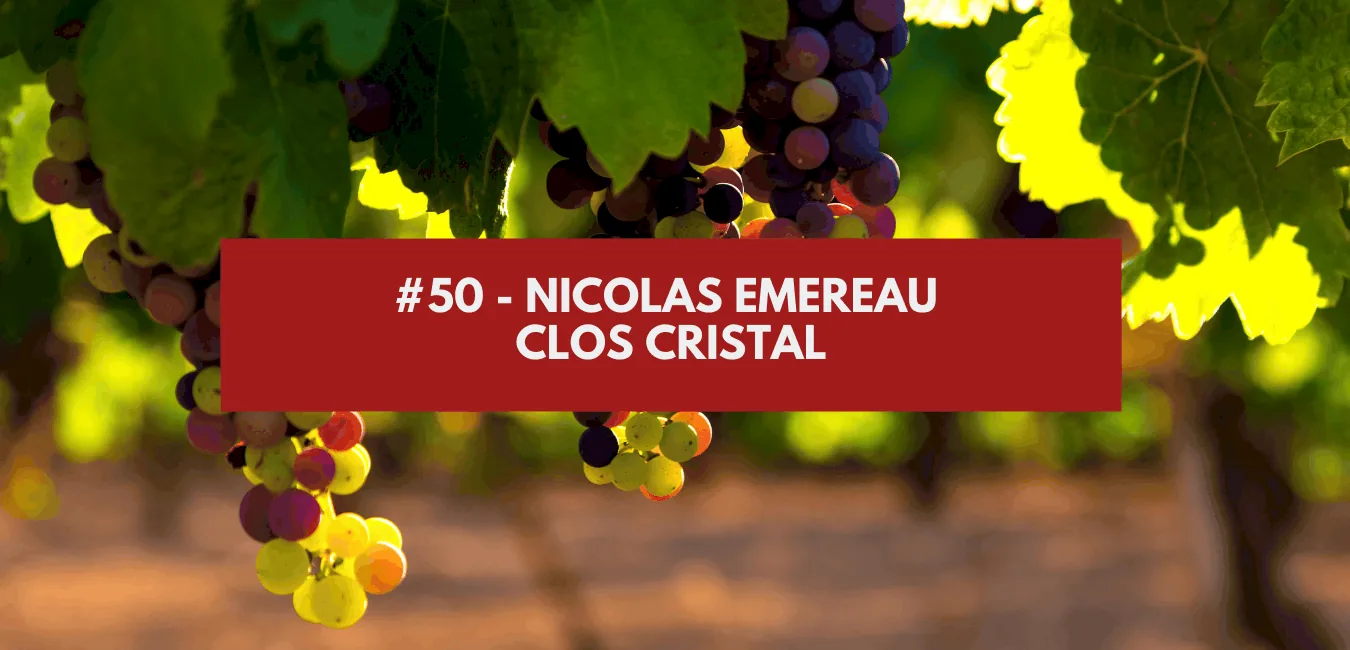
New episode of the Wine Makers Show, your wine podcast. In this episode, we had the chance to meet Nicolas who manages, among other things, the Clos Cristal. This passionate meeting was ultra interesting and we learned a lot. We hope you’ll enjoy this exchange.
Nicolas, I’ll let you introduce yourself.
Nicolas: So to start, I’m not from the wine world. I’m the grandson of farmers, more in the agricultural domain, polyculture and livestock in the Vendée. The link with viticulture at the time is that my grandfather made his cider. He also made in the same press noir, baco and Oberlin. I have trouble remembering, but I remember the face of my father and uncles when they tasted the wine. It was something absolutely fabulous to see their expression. That’s the memory I have in relation to the wine world. After the bac, I went to agricultural school in Angers, where I discovered the wine world. We had several types of cultures to discover and I fell into it right away. I did an internship in Germany. That’s already quite an exotic side. Then, I continued in Romania in a wine research center on the shores of the Black Sea. There are always meetings that make you really want to continue. At that time, we had a viticulture professor, Frédérique Jourjon. She’s someone passionate and passionating. The classes that were supposed to last 2 hours always lasted 3 or 4 hours. We learned to prune the vine and she made us discover the whole wine universe. Whether négoce or cooperation, we went to the Coulée de Serrant at Nicolas Joly, in Champagne at Mumm, at Moët, but also in the Bordeaux châteaux. We met people from INRAE, all the institutional ones. She told us: “Viticulture is this. I tried to show you the whole panorama of what you can encounter. Now it’s up to you to make your own path.” And then one of the incredible moments too with her was when we learned to prune the vine. We no longer saw her. We turned around, and she was there with Roquefort and Coteaux de l’Aubance. And she told us: “Wine is this.” When you start like that, you only have one desire, which is to dive in and continue.
It’s true there are worse starts. Was it a bit of chance for you to choose this option at that moment?
Nicolas: It was chance but not so much, because in fact when you do an agricultural school, you’re meeting different cultures, whether polyculture or livestock. Anything animal wasn’t really my thing. I was rather oriented to the plant and culture part. Wine really hooked me, knowing that we went to meet producers. And what made me dream is that contrary to my uncle who was a cattle breeder, when you meet a peasant, you see the pride in the terroir and territory. A winegrower has three trades. He’s a grape producer, he’s a transformer-vinifier and a merchant. He has this capacity to share the fruit of his production with you and have you taste it. I didn’t find that with my uncles, because taking a knife and cutting a piece of meat from the live cow, that’s not really it. It was chance without being chance, it matched right away.
What happens just after?
Nicolas: For my first job, I left for a super beautiful region, Cahors in the southwest, with an incredible grape variety the malbec or côt as they say there. I worked with all the producers of the Cahors appellation, I’m a technical advisor for vine and wine at the union level. And then, it was a pleasure every day to accompany winemakers. It was a first job, so I was a beginner. It’s not the story of a winemaker’s son who roamed the vines since he was a kid. There were moments not simple. The first time, when you have to give advice but you haven’t been steeped in it, it’s never easy. And I met a second person, a second mentor, named Francis Laffargue, who’s a technician at the Chamber of Agriculture. He accompanied me and made me discover this wonderful world. His first advice was: “Never tell a farmer you don’t know, but on the other hand you have to find out very fast and come back to him to give him the elements.” I was 24, I was impatient, I wanted to discover and learn and be able to transmit. Often under the impulse of irritation I’d say: “I don’t know.” He told me: “How old are you?” I answered: “I’m 24.” Then he told me: “Me, you reverse the two digits, I’m 42. I’d love to be your age and know everything I know today.” It’s people like him who made me want to continue in the sector.
What was your role at that time? You’d tour all the Domaines?
Nicolas: Yes, I was technical advisor vine and wine at the service of all the producers of the appellation. I did that for a year and I had the opportunity to come back to my native region. I came back to the Loire to a négociant called Ackerman. He was in a setup phase of everything that was aging and vinification. So vinification centers with a will to build strong partnerships with producers. I came back to the region and invested in this mission, both technically following producers and ensuring all supply at the Domaine level.
Did you keep in touch with your mentor of the time?
Nicolas: Yes, we rarely see each other but when we call it’s like it was yesterday. Antoine: Is there a moment that particularly marked you with him or advice that was particularly useful during your career? Nicolas: Yes it’s really all the sense of observation, empiricism. Because we talk a lot today for example about frost. Why does one parcel freeze more than another? At the time, there was the will of certain producers to set up and replant a vineyard in Rocamadour, with a chenin blanc grape variety. I’m from the Loire, the magic chenin blanc grape variety… We were wondering where we could replant parcels, it was really his sense of observation and the fact of questioning the elders to know where a certain parcel had been planted, and why it had been kept or not. It was this side both observation and empiricism that was super important. And that I kept and I think it really is part of daily life.
How do you try to apply it today?
Nicolas: So today, it’s good peasant sense in fact. When I make a decision for the company I work for, it’s as a good father of the family, always at the service of the collective. You also have to know how to take risks, that’s important if you want to advance. It’s the principle of effectuation, with measured risk, by testing, it’s on small quantities or small approaches, to transform afterwards.
Let’s come back a bit to the rest of your experiences. So you arrive at Ackerman to help them launch vinification centers. They opened a négoce company, it consists of buying wine from winemakers in the region and then vinifying them, bottling them and selling them themselves under their own wine brand.
Nicolas: Yes absolutely. It was the very beginning of vinification centers in the Loire. We had cooperative structures that had already been set up, very high-performing structures, but at the négoce level, it was really the first négociant aging-vinifier that was implanted in the Loire during the years 1996-1999 with a will to master raw material as best as possible.
Your role at that moment was to manage all aspects of vinification?
Nicolas: It was to manage all the supply part, all the part of adequacy of raw material in relation to the style of the desired product and also ensure all the vinification part.
How did these few years go, how long did you stay?
Nicolas: I stayed three years there, well four vinification campaigns. It really allowed me to know what I wanted to do later. Where I had the most pleasure wasn’t necessarily the pure technical approach, so it’s important to know yourself well, but it was really on accompanying people; the fact of carrying collective dynamics and making a set of producers advance. That’s mostly what I noted and it strongly oriented me for the rest of my career. In 2002, Ackerman was bought by a set of cooperative cellars from the Val-de-Loire, so Alliance Loire for which I still work today. I came in as technical coordinator.
At that time then?
Nicolas: Yes, it’s this cooperative cellar that had the excellent idea of founding a commercial, marketing and logistics structure to be able to offer consumers, at national and international levels, a transversal Loire offering. But there were different origins of cooperative cellars, different sizes and social origins. Some cellars were only cellars of fine bubble production like in Vouvray; service cellars where originally, producers brought their grape and sold their own wine themselves. There were very different cultures and stories. It was necessary to harmonize functioning and be able to provide the same service to all our clients. That was my first job. I started as technical coordinator with oenologists and vine technicians. I was the first quality manager of the structure, and I created after the research and development service to make a strong link between market needs and the way we transformed at the production level.
You joined them at the end of these three years so it must have been around 2000?
Nicolas: Yes, it was in 2002.
What happened between 2002 and today?
Nicolas: First I worked a lot on the technical part but rather in animation and coordination and the fact of creating this famous collective dynamic with my peers. And then, little by little, the directors of the structures asked me to take more responsibilities, to animate all the strategic committees at the management level. And then, in 2016, the presidents of the cooperative cellars asked me to take the direction of a strategic commission to deeply reorient the organization. Really much more centered on the consumer approach. At the end of this production, our president asked me to take the direction of the organization, both the commercial structure but also the biggest cooperative cellar, the Robert-Marcel cellar to set up all this new organization.
Can you come back to this consumer approach and this strategy change you made at that time? What were the main lessons you took from the market, how did you orient your strategy for the years to come?
Nicolas: It was really to change from a producer approach. In the wine world we’re nourished by the product, and in France in particular, we have the culture of taste, we’re really centered on the product. It was important to go conquer our consumers, we work a lot in B2B at Alliance Loire. We work a lot with mass distribution chains, we work with the traditional circuit, wine shops etc. For the most part we lost the sense of the consumer, we mostly did logistics, and we became disinterested in the consumer. It was important to go conquer, search, so we put a working group but not only composed of commerce or marketing people, also winemakers, production people, quality service people… What was important for us, was understanding who the consumer was, bringing out typologies and so knowing what each does in their daily life, their way of consuming, at home or outside, their habits etc. It was important for us to bring out typologies and the way they wanted to consume, both wine but not only. That is to say, in what we brought out, what was important for us, was to make discover all the sensory richness one can discover in the Loire and not only on the product as such. That was important. It’s very fashionable, the experiential dimension. It’s a bit changing trades. Today, we’re producers of quality wines but it’s how we transform wine and we go from know-how to use and how we offer this consumer or these different types of consumers something that corresponds to their personality. Globally the consumer has evolved, has changed in an incredible way these last years. Most people have personal aspirations. We’re less in consumption like in the 80s-90s. It was very normed. Today, we really have a development of personalities who want something personalized.
Can you tell me who these consumer profiles you established are?
Nicolas: They’re multiple. We worked on our target countries: France, the United Kingdom and the United States. We brought out roughly twenty different consumer typologies, with things that come close. For example young consumers, what we call “millennials”, have the same aspirations, even if there’s a schizophrenic side because they want both responsible consumption and a universe very deployed by social networks. We have this consumer typology that’s quite interesting because they’re young people who want to discover and consume in an uncomplexed way. There are also consumers we call experts. It’s a universe in which we’re not present yet today, but we’re starting to come there via a gem vineyard we recently took over called Clos Cristal. We also have a set of discoverers, connoisseurs… We framed a set of consumer typologies for which we’ll make value propositions linked to who they are and what they want to perceive.
Starting from there, you said: “How are we going to segment our offer into different cuvées and different ranges?”
Nicolas: That’s exactly it. It’s the whole process that’s underway with us and it’s really a will to think of the consumer but at all levels of the company. It’s not just downstream of the chain, it’s really all collaborators but also all producers because at Alliance Loire, we have a certain number of producers who work in different cooperatives. We want everyone to be aware of this and apply it in their daily work.
Can you explain how a cooperative works?
Nicolas: A cooperative is a big Domaine, they’re producers who pool their production tool. They own their vine and they become shareholders of a common structure in which they’ll pool their vinification tool, their packaging tool, their commercial tool… That’s why we often say a cooperative is the extension of different operations and we operate at a large scale compared to an independent winegrower.
That allows to potentially address a market that’s wider for people who most of the time don’t only do vine. I don’t know if that’s your case, but there’s quite a bit of polyculture set up.
Nicolas: At our place, if we take the example of the Robert-Marcel cellar, we have different typologies, we have producers who are 100% grape providers, who are specialized on this part. We also have polyculturists in some zones who do cereals who do field crops. And then we also have providers who both bring part of their production to the cooperative cellar but who are also independent winegrowers who vinify at home and commercialize to private clients.
How many people does that represent at the moment with you?
Nicolas: At the Robert-Marcel cellar it’s 200 producers, and it’s 15 to 20% who vinify partly at home.
Can we come back to the range you offer? You did these consumer studies, operational structuring in production etc. What comes out of all that? What’s the wine range you offer?
Nicolas: The wine range today is very wide. We go from the Atlantic, so the Nantais, muscadet, to Touraine, Loir-et-Cher so it’s all the touraine-sauvignon. There are some gems too in the north of the Loir-et-Cher department, in Vendôme. So the coteaux-du-vendômois with the very spicy variety pineau d’aunis, so we have a diversity of grape variety, terroir. The Loire is magic because it’s a large territory with more than 70 appellations, and we have this capacity to offer both small gems and forgotten grape varieties like chasselas, real pinot blanc, fié gris or malvoisie… But also the great Loire wines, the chenin blanc grape variety, which is a magical variety because it has this capacity both to produce still wines, dry, semi-dry, sweet but also fine bubbles of Loire. We have all this panorama in fact in our portfolio that allows us to offer a diversity of proposition to our consumers.
You mentioned the Clos Cristal which is part of the parcels, the flagship Domaines you took over recently. Can you tell us a bit about it? It’s a quite particular Domaine.
Nicolas: Yes, it’s very particular. For us, it’s a discovery universe because I was talking earlier about expert consumers. It’s rather premium or super premium categories. Until now we weren’t there, or barely present. That’s because there’s also an inferiority complex of cooperation. We make excellent wines but we don’t have the image conveyed of a small Domaine. In fact it’s also all the embodiment that’s very important. The Clos Cristal is a magical clos. There’s almost no other in the Val de Loire. It’s a 10-hectare clos. A clos of walls a bit like you can see in Burgundy. The magic of the Clos is first a man, Antoine Cristal. He was born in 1838 and he was someone who had made a fortune in fabric. He had traveled a lot in France and internationally. He was someone erudite who was interested in many things. He had seen that at the Thomery Abbey, near Fontainebleau. Climatic conditions weren’t those of today, now we talk a lot about climate warming. The gardeners to ripen the grape planted the stocks north of a wall and made the branch pass through the wall using a small hole and all the foliage came out south of the wall. It was the expression “Feet in the cool, head in the sun.”, and so that allowed to have an incredible ripeness. Antoine Cristal at 48, came back to his native region. He came back to the Château de Parnay and devoted all the rest of his life to his great passion which was wine. For him, wine had to be something natural. Organic agriculture didn’t exist at the time. We must do as natural as possible. Antoine Cristal was the first in the region not to use chaptalization. One of his mantras was to say halt to sugaring. Tolerating sugaring was a great fault. There are little anecdotes you find in the writings. He’d interpellate the agriculture minister saying: “Sugaring is a fault.”, and the risk is that wine only comes from the brain of chemists and we make products that are competed by large production vineyards like Algerian or Bordeaux wines. At the time, the Bordeaux region was considered the garden of France. He was someone “extreme”. He tested a lot, he was innovative and visionary. Antoine Cristal set up this clos and he was the first in the region to set up a grafting school, because there was the phylloxera era. He was the first to use glass-lined vats with Bohemian glass, fairly innovative presses… He was someone who was innovative, precursor and who wanted to show that in his native region, you can make wines equal to the greatest. His model was Burgundy wines. He bequeathed at the end of his life, in the 1930s, the clos to the Hospices of Saumur because his model was a bit the Hospices de Beaune and there you go. He wanted to reproduce a bit this scheme.
What became of the clos? It still belongs to the Hospices of Saumur and they make a long-term lease if I’m not mistaken. It’s a lease that’s very long.
Nicolas: That’s exactly it. The Hospices of Saumur had some financial difficulties with the clos and then we know that public or semi-public establishments, it’s not really their vocation. So they were looking for someone to take over to ensure the work of the vine and value the terroir and territory of Saumur. We’re all heirs of Antoine Cristal. And then it was also to have a takeover person who would be able to give back its aura to this gem, to this icon. It’s a wine that’s known and recognized by enthusiasts that was consumed at the court of England and the court of Russia. Clémenceau was also a friend of Cristal. Coming back to his native Vendée, he often passed through Saumur. We found very nice posters where it’s even indicated: “The tiger drank it.” So I haven’t finished on the organoleptic quality of the Clos Cristal. How the walls bring something really very particular. I come back a bit to the start of the interview, we were talking about empiricism. Cristal also tested grape varieties pinot noir, chenin blanc, furmint, the Tokay grape variety on this clos. And then he realized that the grape variety that expressed itself best was cabernet-franc, the variety of the great Loire reds. What this clos or these walls bring to the wine is incredible ripeness. We have between two and three weeks ahead of the Champigny appellation. For a cabernet-franc grape variety, that’s quite important because we can often encounter bitterness, astringency or acidity. So everything that’s component of wine aggressiveness. Having a very lovely maturation allows us to have an incredible tannin grain, silkiness on the palate and especially a nose with incredible ripeness. Cabernet-franc is often marked by vegetal components like grilled pepper. We don’t find it at all in the Clos Cristal aromatics. We really have a strong link between what the walls bring and the organoleptic quality of the wine.
It’s quite incredible and the landscape is spectacular. I haven’t yet come to visit but I’ve seen photos and I find that incredible.
Nicolas: So I invite you with pleasure to come.
It’s open for visiting?
Nicolas: Yes. You can come in and visit. It’s really one of the stakes too. That’s what we discussed with the hospices. For us, it’s giving back life to the Clos Cristal. We want to make it accessible for all Saumur residents but also for all consumers or visitors who would want to live a magical moment with this incredible history. It’s part of what we’re setting up. We were talking earlier about value proposition with consumers, it’s bringing an experiential dimension too. It’s everything oenotourism we deploy both at the level of our cooperative cellars, but also at the Clos Cristal level to spend a good time and have a savvy consumer, who loves wine, enjoy themselves but not only. We also want families with children to come and visit.
Listen, with the renewed interest for French regions in general, in tourism, then there must be fewer foreigners who come see you but it also makes French families coming to discover vineyards.
Nicolas: Yes and we hope foreign visitors will come back soon!
Yes, that’s clear. Super interesting, it sounds really spectacular this Clos Cristal. How do we discover it? I suppose that must be small quantities?
Nicolas: Yes. The first vintage was in 2017, a frost year, so we produced 4500 bottles. We started commercialization in December 2020. It’s all recent. We operate with an allocation system. There’s a circle of friends of the Clos Cristal. You can ask to become an allocation holder. You have to go to the Clos Cristal site, it’s very accessible with an allocation request. It’s a possibility for each to buy from 1 to 6 bottles every year according to their requests and needs.
How does it work precisely? Do you have to commit for several years?
Nicolas: No, you make a request for the first year, and after you have priority for purchase the following years but it’s without obligation. Antoine: It commits to nothing so don’t hesitate to come discover the Clos Cristal, in any case it makes you want to. We talked a bit about oenotourism and you told me it was important for you to open the doors of Loire wines, and in general, I suppose everyone must play the game.
How long have you been doing this? Have you seen an evolution in the type of people who come see you? Do you see the sector taking off in oenotourism?
Nicolas: We’ve been doing visits for a very long time. We have the chance to have troglodyte cellars. In the Loire, under our vinification cellars, we have kilometers of galleries. More than five years ago, we imagined an experiential journey with discovery of the region, wines, our producers. We have a will of exchange between the people who make discover and consumers or visitors and with, I was talking earlier of experiential, the fact of making people participate. They’re participations through quizzes, games, children can participate. There are also participations with physical tests. For example, learning to disgorge a wine on the fly is something you can come do at our place. It has crazy success. We see an interest because people learn to do what was done at the time. It can also be learning about the dosage of an effervescent wine, the addition of liqueur de tirage. These are things really very appreciated by consumers. They bathe in this universe under our troglodyte cellars. This journey is more than 5 years old already but we’re in full revolution to bring lots of incredible moments so each lives these moments under our feet.
You’ve been in the Loire for about twenty years. How have you seen the region evolve and the appellation in general?
Nicolas: With certainly more affirmation. In fact the Loire can seem diffuse when you compare with Burgundy, the Bordeaux region, Champagne. We don’t have a transversal Loire appellation, apart from Crémant de Loire or rosé de Loire which carry that name. For a consumer, it’s not necessarily obvious. There are more than 70 appellations. You really have to be a connoisseur or savvy, the Loire can seem complicated. Foreigners know muscadet and sancerre, but they don’t know it’s in the Loire. They know the Châteaux of the Loire but they don’t know there’s wine in the Loire. The story is evolving because there are more and more mature consumers in relation to this wine approach in all countries and also in France. And then a slightly stronger affirmation of the region’s operators. Even if, in relation to other wine appellations, we often compare ourselves to Burgundy, we have négociants vinifiers who really value the wines and in the Loire that’s a bit lacking. We have operators and that’s also our ambition and our role to deploy at national and international levels. Little by little, there’s really an affirmation of different operators and independent winegrowers to show we have very beautiful things. What I was evoking earlier is really to make all this sensory richness we have come alive. The Loire is magical, it’s like a garden with all the different agricultural cultures one can encounter. We have the châteaux. We don’t have a wine city in the Loire but the châteaux are our wine city. It’s the link with history, terroir, territory, men. And then, we have faces as Puisais said. We have the face of the place. We have all these very strong personalities that mean today more and more the Loire is known and recognized.
I suppose that must have also evolved in international trade and distribution of your wines. How does it go today? What are the most represented regions?
Nicolas: It evolves a lot, I was talking about market maturity, a market like the United States, for example. It’s about fifty states but we’re progressing enormously. We meet people who now know our appellations and our wines. Europe is the historical cradle of Loire wines. But North America is exploding in terms of demand for our wines. It’s great.
Northern Europe in general is also a strong segment for Loire wines. All the Scandinavian countries?
Nicolas: Yes. Where we see strong evolution at the regional level is in culture and the environmental dimension. We have quite strong development in everything organic agriculture. But also in everything reasoned viticulture with the development of HVE, High Environmental Value. That means our vineyards are visible and relatively requested.
How do you explain this development of interest for Loire wines in the United States?
Nicolas: I think it’s really a maturity of consumers who had a very segmented grape variety approach about twenty years ago, and who are really requesting wines with personality, gems. Hence the strong link with these small appellations, so it’s an additional segment to grape variety. Some consumer typologies are really in the search for exceptional wines. They want to shine in public or make people discover with relations, friends or buddies. Antoine: Yes, it’s a market that’s reaching a maturity level that’s really different from what we knew a few years ago. It’s always been a huge market the United States. It’s a market that developed very early. We quickly sold either great wines with an incredible market position present for centuries, or wines that aren’t incredible. It’s a segment that consumes grape variety wines, some very industrial. Nicolas: Yes, with local wine consumption that represents a big majority. About 60 to 70% of Crémants de Loire commercialized in the United States, it’s us. It was a long-haul work that started in the 2000s. Today, we really see the benefit. We have distribution in many states in the United States. And we’re very happy with this success. There we address a category of consumers from popular suburbs who have good purchasing power. It’s really something very interesting. Antoine: It’s a market whose maturity only progresses. More and more people discover and become interested in the depth of the product. You told us about climate warming.
Is that something you already know today? You told us many Domaines were experiencing a transition to organic and applying reasoned viticulture precepts etc. How do you apprehend this subject? Do you feel it in the vines and in the wine? What actions do you set up?
Nicolas: We feel it really at several levels. First of all, harvest dates are more and more early. But also bud break which is more early. We’re really for some years subject to spring frosts and quite strongly. It’s something national this year.
Bud break is the moment when the bud appears on the vine. The big danger is that it appears earlier and earlier. Since it can still freeze at that time, the bud can be weakened, either by frost or by sun rays. The bud can be destroyed, and so if we have no bud, we have no grape and so no wine.
Nicolas: We see these phenomena more and more frequently. They’ve for some years modified the balance of wines. I was talking earlier about wine aggressiveness which is for me a mix of acidity, astringency and bitterness. Northern wines, as a general rule, are much more lively and fresh than those from the south of France. That could be a reproach, we often spoke of austerity of our Loire wines. We keep our freshness. It’s important freshness, acidity and vivacity. A wine too heavy or too warm, we don’t necessarily want a second glass. Climate warming brought us more ripeness at the tannin level. There’s a bit more alcoholic potential, which is a good support at the level of wine balance. Today, we really have wines that are really well balanced. The danger is that warming brings us impacts in production, that we have jolts in production. That means all the producers in the region can have trouble making a living from their trade. We don’t ensure recurrence of production. There’s whole work underway at the inter-profession level. At our level, we need to be able to choose plant material that has later bud break to adapt to climatology. It’s also pruning as late as possible. There are a number of techniques at the vineyard level to allow bud break to arrive as late as possible and be less subject to deadly frosts. Antoine: I believe it’s José Sanfins who’s at Cantenac-Brown who told me about these different elements that can be set up to fight against the effects of climate warming and there are clearly plant dimensions on the composition and on the Domaine’s grape variety mix. You have to choose grape varieties that have slightly later ripeness to push back harvest dates. There’s also a technical part like planting some vine plants with another orientation to facilitate shade on leaf-stripping too, so leaf-strip a bit less to protect the grape. And finally a part on harvest dates so earlier and earlier. But it’s an interesting subject and it’ll disturb a bit or adjust balances on wines and we’ll see a change in wine taste. Nicolas: Yes clearly. We really have evolutions. I was talking earlier about the vegetal aromatic dimension we can find in a grape variety like cabernet-franc or sauvignon blanc. More and more, we lose this dimension that can bring a lot of freshness. For example notes of tomato leaf, blackcurrant bud, gooseberry. The English are very fond of them. And we lose this identity. The challenge is how to make all this evolve, but seeking to preserve this freshness. Antoine: Thank you very much for this tour of Loire wines and what you do. Thank you very much also for these clarifications on the Clos Cristal.
Where can we find all the wines you offer? Is there a website?
Nicolas: Yes on the Clos Cristal site or mainly at wine shops but we’re also in the period of digital revolution and we’re finalizing our merchant site where you can find all the wines from different producers.
I have three remaining questions that are traditional. Do you have a book on wine to recommend to me?
Nicolas: We’re partner of the book and wine fair in Saumur, and it’s the children of Antoine Cristal who are partners at the wine level, that is to say the clos between the walls and the Clos Cristal. “On va déguster la France”, by François-Régis Gaudry. For me it’s a gem. Me who’s very gourmand, it’s gourmandise with the meeting of chefs. I was talking about pineau d’Aunis earlier which has a very spicy component. We worked with Olivier Roellinger’s spices, it’s part of what François-Régis put forward. But also it’s all the recipes for example of my grandmother, the churn butter etc. It’s a super memory.
Do you have a recent favorite tasting?
Nicolas: I was talking earlier about Cahors and one of my favorite Domaines, it’s the Clos de Triguedina at Jean-Luc Baldès and we tasted for my daughter’s 23 years a magnum of Probus 98, it’s not an exceptional vintage but there we had a great time. We have this tannin grain that’s really very particular to malbec in Cahors and with a lovely ripeness. It was divine. Antoine: I think there are very beautiful things happening in Cahors and I think it’s part of the appellations that are a bit undervalued by some or in any case that sometimes pass under consumers’ radar and it’s a shame because there are very beautiful things to discover. Nicolas: We have very beautiful appellations in France and in the world, but it’s true we have appellations with incredible character, it’s Cahors, it’s Madiran but I’m also thinking of Jura with Savagnin, we have pleasure in spades everywhere.
Who should be the next guest of my podcast?
Nicolas: So I was thinking of Francis Laffargue who for me is, I don’t know if we can say the Pope of Cahors, but he’s a lover of his appellation, his malbec grape variety and I think it would be very nice if he made us discover this lovely appellation. Antoine: Bingo, I’ll go meet Francis with very great pleasure in the weeks or months coming. Thank you very much Nicolas. Nicolas: Thank you. Antoine: I had an excellent time in your company, and I’m thrilled to have discovered everything you do today. Nicolas see you very soon, and hopefully a next time in the vines! Nicolas: Very soon and I invite you all to come discover the incredible atmosphere of the Clos Cristal. Antoine: Great, see you very soon!