With smoked salmon, pour a dry white with no oak, or something sparkling. The three safe bets are blanc de blancs Champagne, Chablis, and dry Alsace Riesling. Salt, fat and smoke all demand acidity. Avoid oaked whites and big reds: the iron in wine turns metallic on oily fish. Serve the whites and the bubbles at 8 to 10 degrees.
Why is smoked salmon harder to pair than it looks?
On paper it is fish, so white wine. In practice smoked salmon has almost nothing in common with a poached fillet. Three things make it awkward.
First, salt. The fish is cured before it is smoked, and salt actually softens a wine rather than hardening it: it mutes bitterness and makes you salivate. The problem is intensity. A properly salted slice overwhelms a soft, low acid white, and 14 degrees of alcohol only adds warmth to a plate that already has fat and smoke.
Second, fat. Salmon is an oily fish and smoked flesh leaves a film across the palate. That is lovely on the first bite and heavy by the fifth. The job of the wine is to clean, not to add.
Third, the smoke. It is aromatic, persistent, and it occupies exactly the same territory as new oak. Two kinds of smoke stacked on top of each other do not make a pairing, they make an ashtray. That is the number one reason an expensive oaked white fails here while a 20 euro bottle succeeds.
The conclusion is simple, and it is the same principle that runs through all our food and wine pairings: high acidity, low alcohol, zero oak.
What white wine goes with smoked salmon?
White is still the safest route, as long as you stay in the dry and taut family. The absence of tannins in white wine already removes the main risk of a clash with oily fish.
Chablis is our first reflex. It is Chardonnay raised in tank, no vanilla, with lemony acidity and a saline edge that does exactly the same work as the wedge of lemon on the plate. A village Chablis is plenty; save the premier cru for a creamy version.
Dry Alsace Riesling is the other serious candidate, and probably the best value on the list. It is straight, citrus driven, usually around 12.5 degrees, and it does not flinch at salt. Alsace Pinot Gris is rounder and faintly smoky itself, which creates an echo rather than a fight. If you want to go deeper into the region, we have a full guide to Alsace wine.
Sancerre and Pouilly-Fumé work too, though not for the reason people assume. The “fumé” in Pouilly-Fumé refers to the grey bloom on the Sauvignon skins, not to smoked fish. What actually works is the citrus and the green edge of Sauvignon, which is perfect when dill, capers or red onion are on the plate.
Two outsiders earn their place: Muscadet Sèvre-et-Maine sur lie, saline and under 12 euros, unbeatable for canapés, and Jurançon sec, whose exotic citrus answers a slightly sweet cure very well.
Is Champagne really the best match?
Often, yes. Bubbles have a mechanical advantage that still wine does not: the carbon dioxide scrubs the fat and resets the mouth between bites. Add the naturally high acidity of the region and you have the ideal tool against oily, salty fish.
One detail changes everything here. Choose a blanc de blancs, meaning 100% Chardonnay, and a low dosage, extra brut or brut nature. A standard brut built on Pinot Noir and dosed at 9 grams brings red fruit and sugar exactly where you do not want them. Residual sugar plus cured salt gives a sticky, cloying finish.
If budget matters, a brut Crémant d’Alsace or Crémant de Bourgogne does 80% of the job for a third of the price. And if you are opening the bottle in front of guests, we even wrote about the art of sabering Champagne, best kept for the terrace.
Which bottles should you actually buy?
| Appellation | Why it works | Indicative price |
|---|---|---|
| Champagne blanc de blancs extra brut | Bubbles plus chalky Chardonnay acidity, cuts the fat without covering the smoke | 35 to 55 € |
| Chablis village | Unoaked Chardonnay, taut and saline, built for oily fish | 18 to 28 € |
| Dry Alsace Riesling | Straight lemon acidity, stands up to salt, moderate alcohol | 12 to 20 € |
| Dry Alsace Pinot Gris | Rounder and faintly smoky itself, excellent on creamy versions | 14 to 22 € |
| Sancerre or Pouilly-Fumé | Sauvignon citrus and herbs stand in for the lemon and dill | 18 to 30 € |
| Muscadet Sèvre-et-Maine sur lie | Best value on the list, saline, perfect for canapés | 9 to 15 € |
| Crémant d’Alsace brut | The bubbles for a third of the Champagne price | 10 to 18 € |
| Jurançon sec | Gros Manseng, exotic citrus, ideal on a sweeter gravlax | 14 to 22 € |
| Alsace Pinot Noir served cool | The only genuinely credible red, low tannin, tart red fruit | 15 to 25 € |
Can you drink red wine with smoked salmon?
You can, and it can be very good, but the margin for error is thin. Our guide to what red wine goes with fish actually files smoked fish among the ones to keep away from red, because smoke and tannin stack up into bitterness. That objection is about tannin and not about colour, which is the loophole this section runs through. The two real problems are iron and tannin: the iron in the wine oxidises the unsaturated oils of a fatty fish into aldehydes, and that is where the distinctly metallic, coin-like taste comes from, while the tannin piles a drying astringency on top and doubles the bitterness of the smoke.
So you want a red with next to no tannin, served cool. The grapes to aim for are Pinot Noir and Gamay: Alsace Pinot Noir, red Sancerre, a generic Bourgogne, a Beaujolais village. Serve them around 14 degrees, not at room temperature.
Forget the Saint-Joseph and Crozes-Hermitage this article used to recommend. On cold smoked salmon, peppery Syrah and its tannin flatten the fish. It becomes just about playable on hot smoked salmon.
Does cold smoked or hot smoked change the wine?
Yes, and most people miss it. Cold smoked salmon, the translucent slices sold for Christmas and for brunch, is essentially raw: silky texture, discreet smoke, salt in charge. That is Champagne, Chablis and Riesling territory.
Hot smoked salmon, the kind that flakes into chunks and comes as a fillet or as rillettes, is cooked. The smoke is franker, the flesh drier, the flavour more rustic. Here you can go up a notch: Alsace Pinot Gris, a Jura Chardonnay, or that light Pinot Noir. It is the one version that takes a real red without wincing.
Which wine for blinis, bagels and a plated starter?
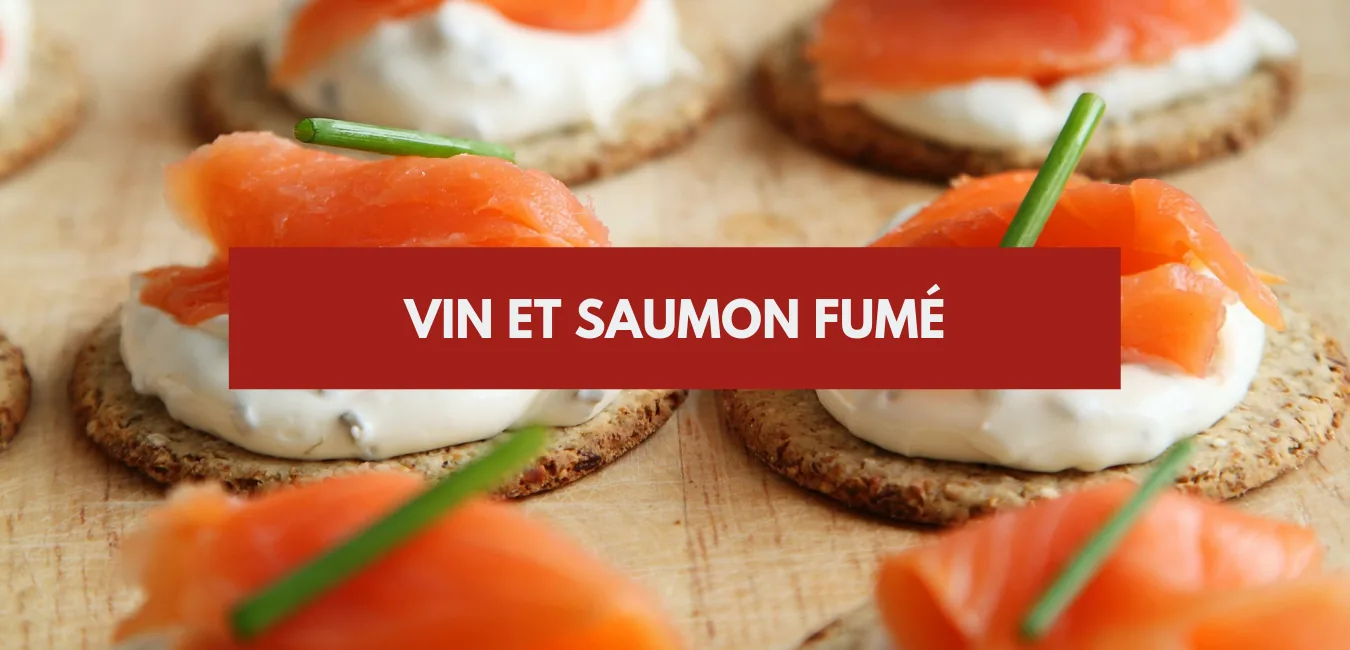
Blinis, crème fraîche, dill. The cream rounds everything out and asks for more substance: Chablis premier cru, dry Pinot Gris, or a fuller blanc de blancs.
Bagel with cream cheese. The cheese is both acidic and fatty. A very dry sparkling wine or a Muscadet cuts straight through; a round white turns pasty.
A plated starter with lemon and capers. Nothing creamy to absorb the salt, so the wine carries it alone. Sauvignon or Riesling, and keep the pour small.
Gravlax. Technically not smoked at all, but cured in salt, sugar and dill. The sugar calls for exotic fruit: Jurançon sec, or a Riesling with a touch of residual sugar.
Smoked salmon pasta or risotto. Hot, creamy, less salty per mouthful. A lightly oaked white Burgundy such as Mâcon or Saint-Véran becomes possible. It is the only preparation where oak passes.
Should you serve vodka or aquavit instead?
Honestly, the Scandinavian tradition is not a gimmick. An ice cold neutral spirit strips the fat as efficiently as bubbles do, and aquavit flavoured with caraway and dill converses with the cure rather than merely cutting it. The catch is alcohol: 40% numbs the palate in three sips. Our compromise is two centilitres from the freezer with the first bites, then wine for the rest of the meal.
Which wines should you avoid?
Three families, and we see all three poured every 24 December. Heavily oaked whites: young Meursault, vanilla driven New World Chardonnay, barrel aged white Bordeaux. Smoke plus vanilla plus fat is too much. Big reds: Bordeaux, Cahors, Madiran, young northern Syrah. They swamp the salmon, and the iron in the wine leaves a metallic taste on the oily fish. Sweet whites: Sauternes, Coteaux du Layon. The sugar smothers the delicacy of the salmon and the whole thing turns heavy within two bites. Sweet wine belongs with foie gras, not with salmon.
So what do we pour?
Three lines to remember. To be safe: extra brut blanc de blancs, Chablis, or dry Alsace Riesling. On a budget: Muscadet sur lie or Crémant d’Alsace. For a red: Pinot Noir served cool, and nothing tannic.
Serve dry whites and sparkling between 8 and 10 degrees, light reds around 14. Too cold and the fruit vanishes, too warm and the alcohol collides with the smoke and the fat. If you are cooking a fresh fillet rather than opening a pack of slices, the maths changes completely, and we covered that in what wine goes with salmon. The same logic transfers to oysters, and the rest of the dishes live on our food and wine pairing hub.
Frequently asked questions
What is the best wine with smoked salmon?
An extra brut blanc de blancs Champagne, or a Chablis. Both bring the same thing: straight acidity, no oak, and enough tension to clean the smoky fat between bites. If you want something simpler and cheaper, a dry Alsace Riesling does almost as well for twelve euros. The classic mistake is trading up to an expensive oaked white.
Can you drink red wine with smoked salmon?
Yes, but only one kind: a light, low tannin red served cool, around 14 degrees. Alsace Pinot Noir, red Sancerre or an entry level Burgundy all work. Anything tannic, Bordeaux, Cahors, Madiran, turns metallic against oily salted fish, because the iron those wines carry oxidises the salmon oils while the tannin dries the flesh. The colour is not the culprit.
Should you serve vodka or aquavit with smoked salmon instead?
It is the Scandinavian tradition and it has a real logic: an ice cold neutral spirit cuts the fat as effectively as bubbles do. Aquavit, with its dill and caraway, even echoes a gravlax cure. The drawback is the alcohol, which numbs the palate fast. So pour two centilitres very cold rather than a full glass, and keep the wine for the rest of the meal.
Does smoked salmon need a different wine from fresh salmon?
Very much so. Fresh salmon is mild, barely salted and carries no smoke, so a lightly oaked Chardonnay or a Pinot Noir suits it well. Smoking adds salt, smoke and often a little sugar from the cure. Those three elements flatten oak, and it is the sugar in the cure that sharpens tannin while the salt softens it, so you need more acidity, less wood and lower alcohol.
What wine goes with blinis, smoked salmon and cream?
Cream thickens the dish and asks for a slightly broader wine. A dry Alsace Pinot Gris, a Chablis premier cru or a fuller blanc de blancs Champagne hold up better than a very sharp Sauvignon, which can read thin alongside. If you add dill or capers, go back to Sauvignon: the herb and the salt call for Sancerre.