Yes, red wine goes with fish, on one condition: low tannin and low iron. A village red Burgundy, a Beaujolais, a Sancerre rouge or a Jura Poulsard served at around 14 degrees are excellent with tuna, salmon, red mullet and monkfish. Delicate white fish should still stay with white wine.
The real rule was never “no red with fish”. It is more precise and far more useful than that: no tannin and no iron with fish. Those are two very different things, and confusing them costs you some of the best pairings on the table.
Why are we told never to drink red wine with fish?
Because the rule protects beginners from a genuine accident. “White with fish, red with meat” is service shorthand, born in the dining rooms of the last century when a waiter had to advise quickly and be right. Across a hundred tables it prevents about ninety disasters. For a six-word sentence, that is a remarkable hit rate.
The problem is what it costs. The shortcut also bans the remaining ten pairings, which are often the most interesting food and wine moments of a meal. A rare tuna steak with a cool red Burgundy is a better, sharper and more surprising match than the same tuna with a nondescript Chardonnay. Eel matelote and lamprey Bordeaux-style are fish literally cooked in red wine, and nobody has ever thought to serve them with white.
In other words, the colour is not the problem. What is inside the bottle is.
What actually causes the metallic taste?
There are two culprits, and the important one is not the one most people name.
The first is tannin. With red meat, tannin binds to protein and fat, and the drying sensation softens. With fish there is almost nothing for it to grip: the flesh is lean and short on collagen, so the tannin stays naked in the mouth. It reads twice as hard as it did on its own.
The second is iron, and this is the one that explains the metallic taste. Japanese researchers published work in the late 2000s comparing a range of wines tasted alongside scallops. The fishy aftertaste did not track the colour of the wine, or its age, or its grape variety. It tracked the iron content. Iron catalyses the oxidation of the highly unsaturated fats in fish, the omega 3s, and that oxidation produces aldehydes, compounds that smell of low tide and warm metal.
Two practical consequences follow. First, a white wine high in iron can fail just as badly as a red, something most people have experienced without ever having a name for it. Second, the lemon wedge is not decoration: citric acid binds iron and limits the reaction. The oldest reflex in fish cookery turns out to be chemistry.
Iron content appears on no label, so we read it through the clues that travel with it: a light red, lightly extracted, little or no oak, moderate alcohol, served cool.
Which red wines work with fish?
One instruction covers it: freshness and fruit, never structure. Pinot Noir is the king of this exercise, in Burgundy and beyond it. Gamay from Beaujolais is close behind. The Jura varieties, Poulsard and Trousseau, are so pale they were practically designed for the job. Loire Cabernet Franc works when it is young and light, not when it has spent a year in barrel. In Italy, Nerello Mascalese from Etna and Schiava from Alto Adige are fish reds by nature.
The blacklist is short and absolute: young Bordeaux, Cahors, Madiran, Argentine Malbec, Cabernet Sauvignon from anywhere, Barolo, and young oaky Syrah. Too much tannin, too much wood, too much weight.
| Appellation | Why it works | Price band |
|---|---|---|
| Village red Burgundy | Silky Pinot with resolved tannin, the benchmark match for tuna and salmon | 20 to 32 EUR |
| Sancerre or Menetou-Salon rouge | Lighter, tarter Pinot Noir, superb when served properly cold | 16 to 26 EUR |
| Beaujolais-Villages or Fleurie | Pure-fruited Gamay with no rough edges, unbeatable with grilled fish | 12 to 22 EUR |
| Alsace Pinot Noir | Light, clean, usually unoaked, the best value on the list | 14 to 24 EUR |
| Jura Poulsard or Trousseau | Pale, saline reds that behave almost like a white at the table | 18 to 28 EUR |
| Young Chinon or Saumur | Fresh peppery Cabernet Franc, ideal with red mullet or bacon-wrapped monkfish | 12 to 22 EUR |
| Etna Rosso | Fine volcanic Nerello Mascalese, the Mediterranean answer to Pinot | 18 to 30 EUR |
| Bardolino or Valpolicella Classico | Light Italian reds built for tomato sauces and charred fish | 12 to 20 EUR |
| Crozes-Hermitage from an older vintage | Syrah softened by time, the only one really at ease with seared tuna | 18 to 30 EUR |
Which fish take red wine best?
Four names come up every time, and for good reasons.
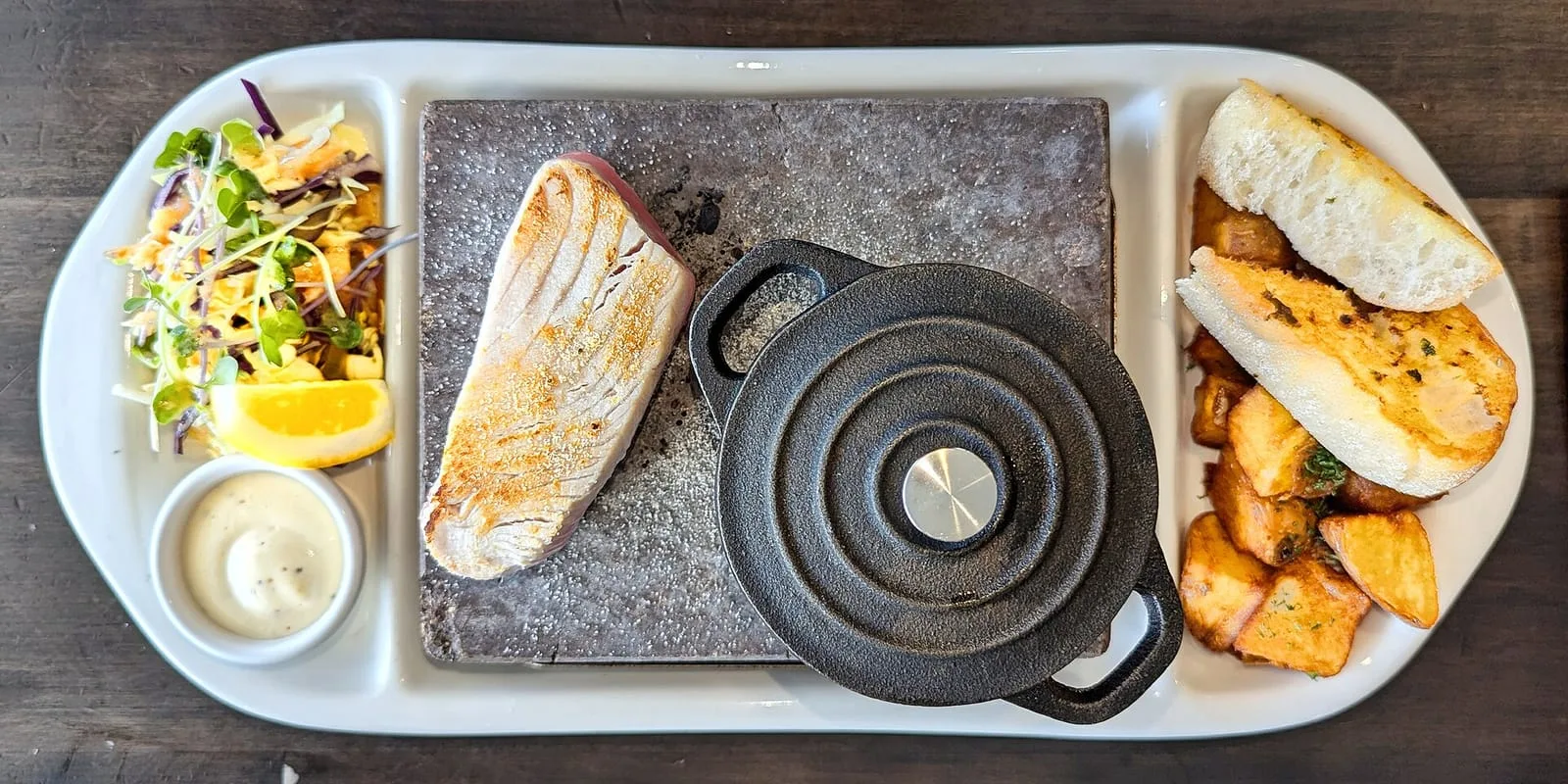
Tuna. The obvious case. The flesh is dark, rich in myoglobin, firm, and it carves like a piece of beef. Grilled rare, it asks for red the way meat does. This is the fish that tolerates the most weight in the glass.
Salmon. Oily, meaty, with a clear flavour that does not vanish behind a sauce. Pinot Noir beats most whites here, particularly when the fish is roasted or barbecued. We go through the whole question in our guide to wine and salmon.
Red mullet. A small fish with a big flavour, an elegant bitterness and skin that loves a hot pan. A light red from Provence, the Languedoc or the Loire suits it far better than a neutral white.
Monkfish. The French call it the leg of lamb of the sea, and the nickname is earned: firm, boneless flesh that roasts. Wrapped in smoked bacon, or cooked American-style with tomato and brandy, it takes red without hesitation.
Add grilled oily fish to the list, sardines and mackerel, where the fat and the char of the grill neutralise most of the problem before it starts.
Which fish should you keep away from red?
Anything lean, white and gently cooked. Sole meuniere, steamed cod, poached turbot, sea bass in a salt crust, bream baked in a parcel: these dishes have no fat, no caramelisation and no dominant flavour. The lightest red flattens them, with nothing on the plate to build a bridge to it.
The most brutal case is raw shellfish. On an oyster, red wine delivers an instant metallic shock, with no exceptions and no way to rescue it. Smoked fish is the other trap, because smoke and tannin add up to pure bitterness.
Do the cooking method and the sauce change the pairing?
They decide it, far more than the species of fish does.
Steamed, poached, baked in a parcel. Stay with white. There is no argument here.
Grilled, on the plancha, on the barbecue. Caramelisation and the bitterness of char build a bridge to red. This is where the pairing becomes easy.
Tomato, olives, peppers, chorizo. Red becomes close to compulsory. The sauce has taken over from the fish.
Beurre blanc, cream, citrus. White, without discussion.
Red wine sauce. A matelote, a lamprey, any fish braised in wine: serve the same family of wine you cooked with.
What temperature should the red be?
Between 13 and 15 degrees, which is cooler than almost everyone pours. Twenty to thirty minutes in the fridge is enough for a light red taken from a cupboard. The chill tightens the fruit and calms the alcohol. It does firm up the tannin, which is one more reason to keep this to reds that have almost none. We cover the whole subject in our guide to red wine serving temperature.
Two details worth knowing. Skip the long decant: light reds do not need it and lose their nerve. And count one bottle for three people over a fish dinner, since a fish meal is naturally drunk more slowly than a meat one.
The best test is also the simplest: pour a glass of white and a glass of red side by side with the same plate and let the table decide. For every other match, everything is gathered in our food and wine pairing guide.
Frequently asked questions
Can you really drink red wine with fish?
Yes, and easily. The rule that forbids it is a piece of restaurant shorthand, not a law of nature. What ruins the pairing is not the colour of the wine but its tannin and its iron. Pinot Noir, Gamay, Poulsard and Nerello Mascalese served cool are excellent with oily or grilled fish. A young Bordeaux, a Cahors or a Madiran are not.
Why does red wine taste metallic with fish?
Because the iron in the wine speeds up the oxidation of the highly unsaturated fats in fish, the omega 3s. That oxidation releases aldehydes, compounds that smell of low tide and hot metal, and they linger long after the mouthful. Tannin then piles a drying, astringent sensation on top of it. The two together produce the taste everyone remembers.
What is the best red wine with tuna?
Tuna is the easiest fish of all to match with red, because its dark flesh behaves like meat. With a rare grilled steak, a village red Burgundy or an Alsace Pinot Noir is close to perfect. If the tuna is seared with sesame, soy or slow-roasted tomatoes, a northern Rhone Syrah from an older vintage handles the intensity better.
Which red wine goes with fish in tomato sauce?
The sauce decides, not the fish. Tomato, black olives, peppers, chorizo or saffron all push the pairing towards a light Mediterranean red. A young Cotes du Rhone Villages, a Bardolino, a Valpolicella Classico or an unoaked Languedoc red all work well. Serve them at around 14 degrees, never at room temperature.
How cold should red wine be with fish?
Between 13 and 15 degrees, which is cooler than most people pour. Twenty to thirty minutes in the fridge is enough for a light red that has been sitting in a cupboard at 20 degrees. The chill tightens the fruit and calms the alcohol. It does sharpen the tannin, so this only works with a red that has very little, which is exactly what fish needs.