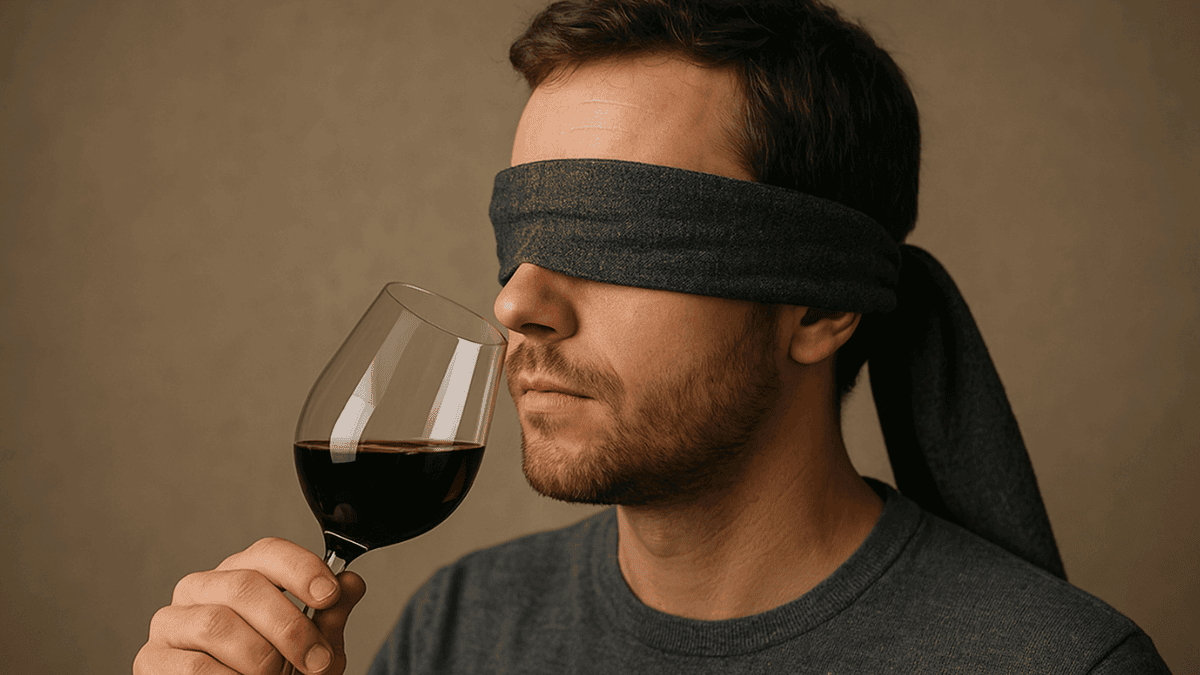
You have probably already cross path with someone tasting a wine and being super sure of its aromas. “It’s smell like wet rock in a morning of September in the South of France when it’s 13°C”. And you’ve probably been impressed by this level of knowledge. When tasting wines, we can sometimes be overwhelmed by such behaviors. These behaviors can be problematic for a very simple reason: your nose can fool you. Let’s dive in to how it fools you.
The power (and limits) of the nose
When we taste wine, sure we use our mouth. But what matters is the nose. Obviously, the first thing we do is actually smelling the wine. But there is more to it.
The full experience of flavor is only possible because of the nose; around 80% of what we perceive as taste is actually due to aroma molecules detected by olfactory receptors in the nasal cavity.
And the nose… is magical. It can stir emotions, unlock memories. The smell of fresh orange juice and coffee? Boom. I’m instantly back at breakfast at my grandparents’ house.
But here’s the thing: compared to our other senses, especially vision, our sense of smell kinda sucks.
It has two major flaws:
- It’s slow: Olfactory detection takes about 400 milliseconds ; roughly 10 times slower than vision.
- It’s low-res: We only have around 50,000 mitral cells in our nose which are the cells that generate the information. Compare that to millions of retinal cells that give us high-res visual images.
Our eyes see in 4K with fiber-optic speed, while our nose is stuck in 280p on dial-up from 2005.
But there is worse. We don’t even have a shared language for smells. We name smells after things that smell like them. Orange smells like… orange. Fresh-cut grass smells like… fresh-cut grass. But if I say “it smells like blackcurrant”, do you smell the same thing as I do? Probably not.
So here’s the real question: Is it really our nose that analyzes wine… or is it being fooled by our other senses?
The Experiment That Blew Everyone’s Mind
This is exactly the question a study from 2001 tried to answer.
A professor takes one red wine and one white wine. Then he takes the same white wine… and adds a scentless red dye.
He now has three wines:
- R (Red)
- W (White)
- RW (White + Red Color)
And now it is time to have fun.
He organizes two tasting sessions with students.
Session 1:
The students taste in black glasses, under red light; so they can’t see the color.
The professor has two goals:
- Make sure W and RW are perceived as the same. They are.
- Gather the words students use to describe each wine.
These words are then categorized. For example:
- Acacia, lemon → typical white descriptors
- Cherry, blackberry, pepper → typical red descriptors
So at the end of the first tasting session, we know that white wine and white wine tainted in red taste the same. And we have a list of descriptors for the red wine and the white wine.
The first tasting session ends here.
Session 2:
Now students can see the wines. They taste W and RW and must describe them using the same vocabulary as before.
The result is brutal. Students describe W as a white wine. But RW, the same wine with just red color added? They describe it as a red wine.
That’s how easily vision overpowers olfaction.
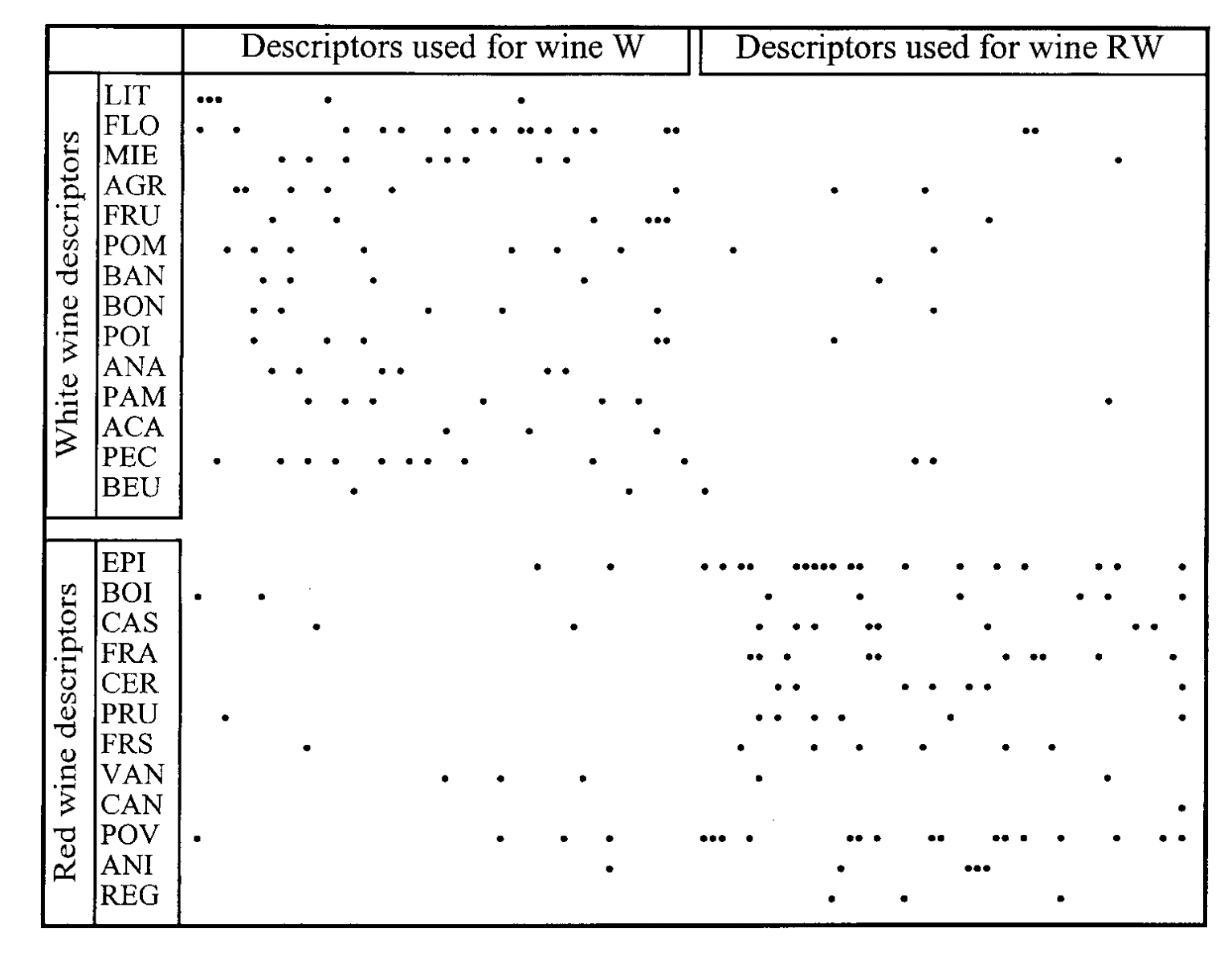
The professor does this graph. It comes straight from the study. It shows how the red-colored white wine is now described using red wine descriptors. The conclusion? From a cognitive point of view, smell is heavily influenced by our other senses. It doesn’t analyze, it confirms what we already suspect.
So if it’s that easy is to trick your nose, how do you get better at tasting wine? Let’s find out.
So… What do we learn from all this?
First lesson: our sense of smell is underdeveloped. But that’s fixable. If we trained it more often, we’d bring much more consciousness to our experiences.
Start small. Ask yourself:
- What does this dish taste like?
- Is my morning coffee actually good?
- What am I smelling in this meal?
Want to take it further? Go to a farmers’ market and actually smell things.
Finally Try Le Nez du Vin. It’s one of the best wine games ever made. You smell tiny vials and try to guess the aroma.
And yes, it’s frustrating when you go: “Ughh I know this smell… but what the hell is it?!” That said, it’s one of the best things you can do.
The real lesson: humility
For anyone tasting wine, this is a core lesson in humility.
Tasting is fun. But when facing a wine, we must stay humble. We all smell differently. Our memories are different. Our noses are different.
So, people who list aromas with absolute certainty and arrogance? They’re jerks.
What matters is: What do YOU smell?
And I can tell you, the most inspiring people I’ve met in the wine world share this humility. They invite you to feel, to experience. They don’t judge. They want to share (not impose) a truth.
The greatest tasters are humble. They know they can be wrong. They’re grateful for what they taste. And they want to bring you along.
Ask any great winemaker, they’ll tell you the same. They are grounded. They know they’re just passing through. Their terroir came before them, and will live on after them. They know that weather can ruin everything. They know wine is a miracle.
So maybe, wine teaches us this… In its silent eloquence: True greatness is always born from humility.
Or, to put it more simply: Wine is a humbling experience. And that’s why it’s beautiful.
Thanks for reading us!
- If you want to go further on this topic, you can download the original research paper on which this article is based right here.
- You can also discover my list of 10 wine books.
- And finally, join the Academy and learn wine like never before.