


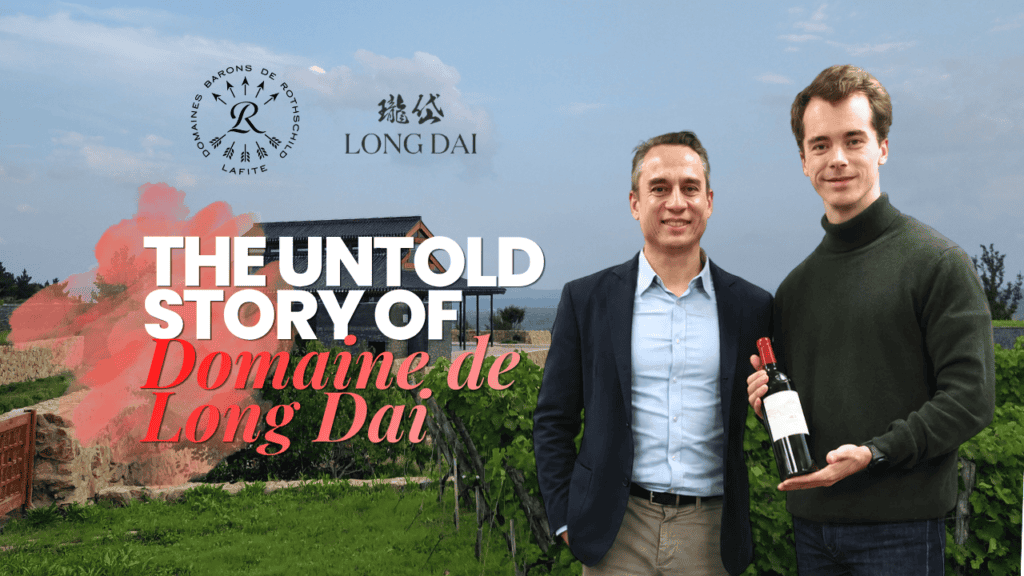
Curious about how a world-renowned Bordeaux house is shaping the future of Chinese wine? In this episode, we dive into the journey of Charles Treutenaere, the driving force behind Domaine de Long Dai, DBR Lafite’s ambitious estate in Shandong, China.
Together, we explore how he navigates cultural bridges, builds a winery from the ground up, and adapts French expertise to a unique Chinese terroir. We unpack the challenges of earning recognition for Chinese fine wines, the evolution of the local market, and the delicate balance between tradition and innovation.
From vineyard practices to consumer education, this conversation reveals what it truly takes to craft world-class wines in an emerging region. And why the story of Long Dai is only just beginning.
Watch the full interview with Charles Treutenaere

Listen to the Podcast with Charles Treutenaere
A summary of the interview with Charles Treutenaere
A career rooted in China
Charles Treutenaere recounts a long and unconventional journey that began in China in 1998, when he first arrived in Beijing to study language and culture. With no initial plan to enter the wine industry, his early immersion gave him a deep understanding of Chinese society at a time when the country was still developing and relatively unknown to many Europeans.
After returning briefly to France, he chose to go back to China in 2005, joining the wine importer Summergate. There, he gained first-hand experience of a booming market, driven by rapid economic growth and demand from international hotels and restaurants. Over time, he moved from distribution into brand development, before eventually joining DBR Lafite to lead the Long Dai project.
The birth of Domaine de Long Dai
The Long Dai estate in Shandong province is the result of a bold vision launched in 2008 by the Rothschild family. At a time when China had little reputation for fine wines, the ambition was to create a world-class wine rooted in a local terroir rather than replicate Bordeaux.
Charles joined the project in 2018, facing the challenge of finalizing a complex, decade-long development. His priority was to prepare the estate for its official opening in 2019, coordinating construction, regulatory approvals, and team building.
More than just launching a winery, the mission was to create a bridge between French winemaking expertise and Chinese culture. Something Charles sees as essential to the project’s identity.
Respecting Culture and Terroir
A key theme in Charles’s vision is humility. Rather than imposing Bordeaux methods, Long Dai was designed to integrate local traditions and knowledge. The architecture itself reflects this philosophy, using traditional Chinese construction techniques instead of mimicking a French château.
In the vineyards, the approach is equally meticulous. The estate is located in the Qiu Shan Valley near the coast. It then benefits from a temperate climate similar to parts of Europe. The land, historically used for orchards, features hundreds of terraces. Each treated individually to maximize quality and express complexity.
For Charles, the goal is not power, but balance and elegance: core principles inherited from the Lafite philosophy.
Building a local ecosystem
Another important aspect of the project has been working closely with local communities. Since land ownership laws differ in China, Long Dai collaborates with local farmers, offering stable employment and training in viticulture.
This approach ensures both consistency in vineyard work and a meaningful exchange: farmers contribute their deep agricultural knowledge, while the estate provides expertise and long-term opportunities. Charles sees this as a “win-win” model that strengthens both quality and local integration.
The evolution of the Chinese wine market
Drawing on his experience since the early 2000s, Charles highlights how dramatically China’s wine market has evolved. Initially dominated by imported wines and large distributors, the market has become more fragmented and competitive, with shorter distribution channels and direct access to consumers through digital platforms.
Consumer preferences have also matured. While red wine once dominated almost exclusively, Chinese drinkers are increasingly exploring a wider diversity of styles. However, wine is still not deeply rooted in Chinese culture, unlike tea or baijiu, which means education remains essential.
The challenge of Chinese wine recognition
One of the biggest challenges today is convincing Chinese consumers of the value of their own wines. According to Charles, this requires patience, storytelling, and continuous education.
Interestingly, he notes that foreign consumers in China are often the first to embrace Chinese wines like Long Dai, driven by curiosity and a desire to explore local products. This suggests that international recognition may help accelerate domestic acceptance.
Looking ahead
Charles is confident that Chinese wines will gain global visibility over time, much like Chinese industries in other sectors have done. However, success will depend on sustained efforts to build credibility, educate consumers, and highlight the uniqueness of Chinese terroirs.
For him, Long Dai represents more than a winery. It is the meeting point between centuries of French winemaking tradition and the untapped potential of China.
Charles Treutenaere recommendations
A book: Château Lafite: the Almanac 1868, by Saskia de Rothschild
Discover more about: Domaine de Long Dai