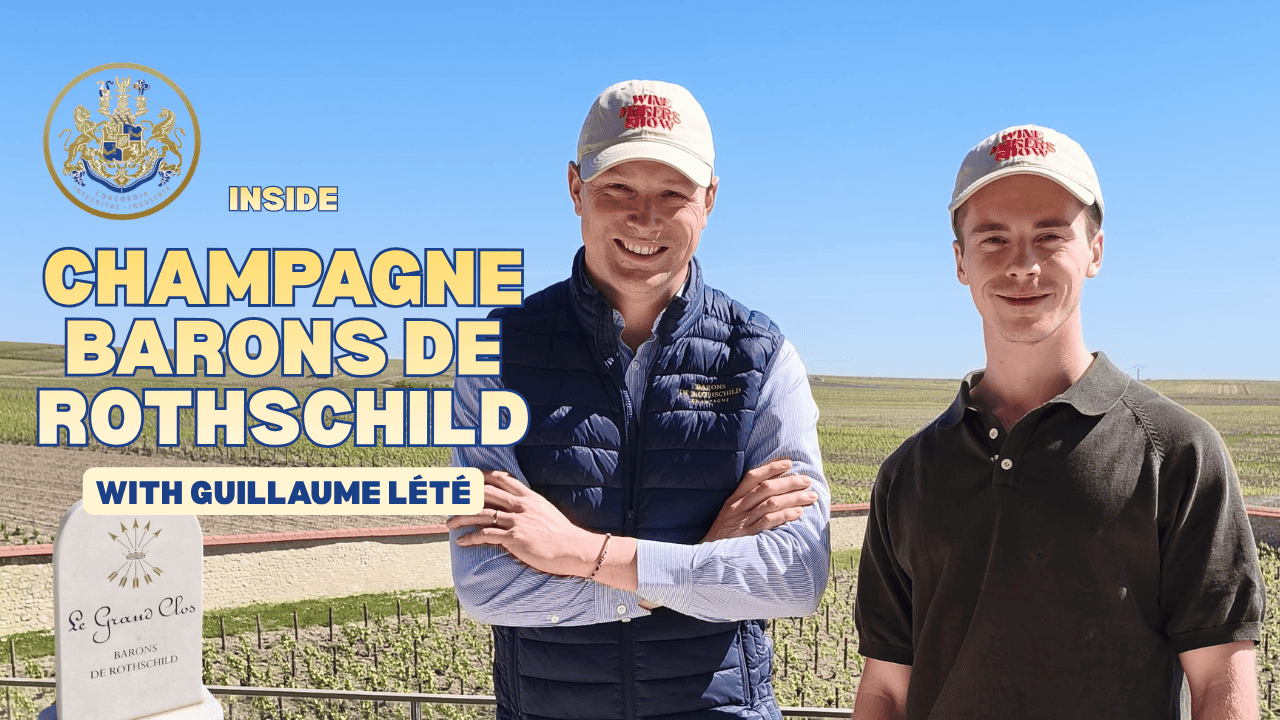
I bring you with me into the world of fine Champagne as I sit down with Guillaume Lété, cellar master and head winemaker at Champagne Barons de Rothschild. In this episode, we explore how a young house built its identity from the ground up, and how Guillaume helped shape its signature style.
From vineyard philosophy to the art of blending, Guillaume breaks down what it really takes to craft exceptional Champagne. We dive into terroir, Chardonnay dominance, and his innovative approach to perpetual reserve wines. Guillaume also shares insights on climate challenges, precision winemaking, and the vision driving the house forward.
If you want to understand what’s behind every great bottle, this conversation will spark your curiosity and deepen your appreciation.
Watch the full interview
Listen to the Podcast
A summary of the interview with Guillaume Lété
From Champagne roots to Head Winemaker
Guillaume Lété, now head winemaker at Champagne Barons de Rothschild, has a story deeply rooted in his native region. Born and raised in Champagne, he pursued winemaking studies and gained experience abroad in Bordeaux and California before returning home. In 2011, he joined Barons de Rothschild at a very early stage, when the house was still in its infancy, and quickly grew with the project. By 2016, he became head winemaker, overseeing everything from vineyard management to final production.
What drew him in was not just the prestige of the Rothschild name, but the rare opportunity to build something from scratch. At the time, the house was small, with limited vineyard holdings. Everything, from grape sourcing to winemaking philosophy, had to be developed step by step.
Building a Champagne House from the ground up
When Guillaume arrived, the house was still defining its identity. Over the years, he helped shape a clear direction: a strong focus on Grand Cru and Premier Cru vineyards, with an emphasis on Chardonnay (around 70%) complemented by Pinot Noir.
The estate combines two approaches:
- Owning a small portion of vineyards (less than 8 hectares)
- Partnering with carefully selected growers who share the same philosophy
This dual model allows for both control and diversity, ensuring consistent quality while capturing the nuances of different terroirs.
A philosophy rooted in detail
For Guillaume, great wine is built through attention to detail at every stage. His philosophy is simple: the wine is made in the vineyard, and the role of the winemaker is to guide it, not overpower it.
His responsibilities span the entire process:
- Monitoring vineyard conditions
- Making precise decisions during vinification
- Blending wines to achieve balance and consistency
- Managing aging and disgorgement
He emphasizes minimal intervention, allowing the wine to express itself while ensuring each step is carefully executed. Champagne, he explains, is always a dialogue between past, present, and future, especially through the use of reserve wines.
Innovation in Reserve Wines: the perpetual approach
One of the house’s distinctive features is its use of a “perpetual reserve” system. Unlike traditional methods where reserve wines are kept year by year, Guillaume and his team maintain reserves tied to specific blends.
This approach offers flexibility:
- It helps maintain stylistic consistency despite climate variations
- It allows adjustments depending on the character of each vintage
- It ensures continuity from the earliest years of the house
Alongside this, they also preserve terroir-specific wines (single plots, single varieties, single years) to fine-tune final blends, much like seasoning in cooking.
Crafting Champagne: a balance of technique and time
Guillaume highlights the complexity of Champagne production, from hand-harvesting to the second fermentation in bottle. While regulations require a minimum aging period of 15 months, the house chooses to age its wines for around four years to enhance depth and elegance.
The goal is always balance: freshness and structure ; precision and expression ; consistency and personality.
A new winery anchored in history
The house recently moved into a new winemaking facility in Vertus, built on historic cellars dating back to 1874. This space reflects their philosophy: combining tradition with modern precision.
Different materials are used in vinification (stainless steel, concrete, and oak) to highlight the character of each terroir. The facility allows for greater precision and experimentation, reinforcing the house’s commitment to continuous improvement.
Terroir at its finest: the case of Le Grand Clos
A standout example of their approach is “Le Grand Clos,” a small, walled vineyard with remarkable diversity despite its size. Variations in soil, exposure, and microclimate create distinct expressions within the same plot, sometimes requiring multiple harvest passes.
This prestigious cuvée illustrates the essence of terroir: a combination of soil, climate, and human influence.
A young house with long-term ambitions
Despite rapid growth over the past decade, Guillaume insists the journey is far from complete. The focus now is on refining processes, strengthening vineyard practices, and establishing the house among Champagne’s great names.
Challenges include:
- Adapting to climate change and more variable vintages
- Increasing precision in winemaking
- Expanding global recognition while maintaining exclusivity
A signature style: Chardonnay-led elegance
Across its range, Champagne Barons de Rothschild maintains a clear identity:
- Chardonnay-driven wines
- High proportion of reserve wines (around 40%)
- Long aging periods
- A style focused on purity, finesse, and elegance
From the classic Brut “Concordia” to Blanc de Blancs, Rosé, and more exclusive cuvées like Le Grand Clos, each wine reflects this philosophy while offering different expressions for various occasions.
Looking ahead
For Guillaume Lété, the project is a long-term commitment. Even after 15 years, he sees endless opportunities for improvement. The house may be young by Champagne standards, but its ambition is clear: to craft wines of precision and character that stand alongside the region’s most established names.
Guillaume Lété recommendations
A book: 30-Second Wine: The 50 Essential Elements, each explained in Half a Minute, by Hugh Johnson
Discover more about: Champagne Barons de Rothschild