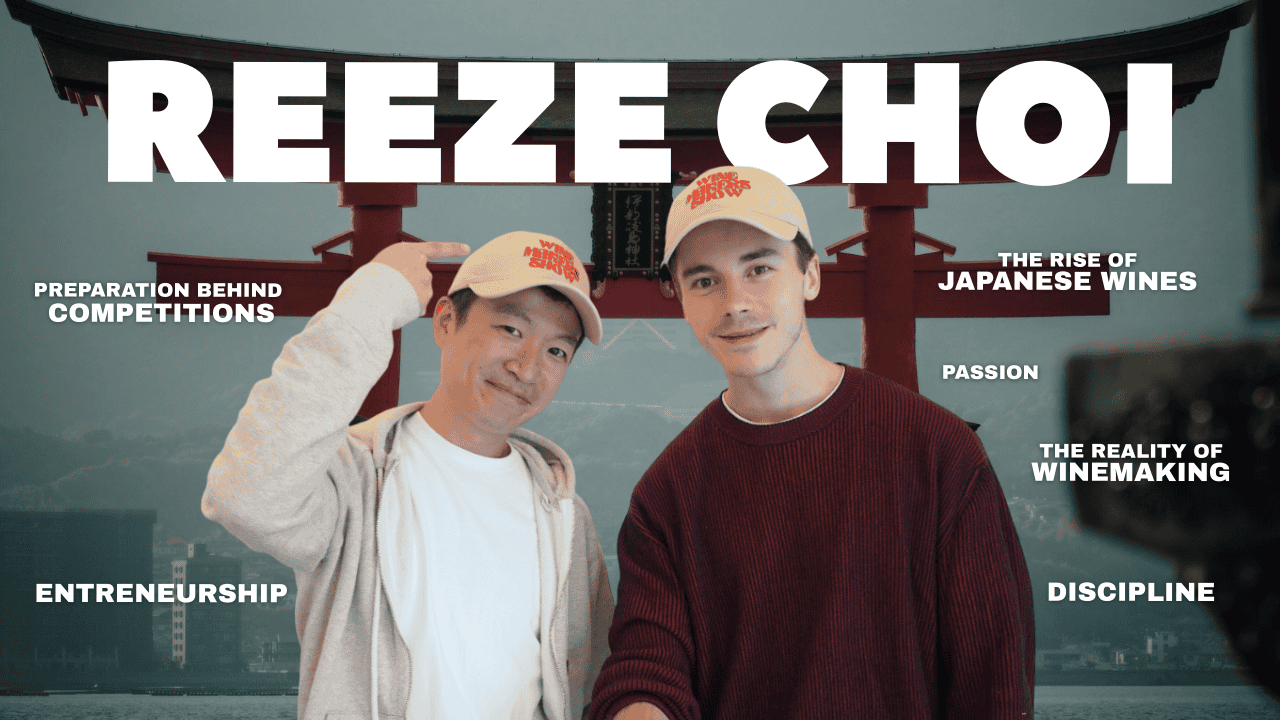
What happens when one of Asia’s top sommeliers decides to become a winemaker? That’s the journey Reeze Choi is on, and it’s far more intense than you might imagine. In this episode, we discover how he moved from restaurant floors to building his own consulting company, and now crafting wines in Hiroshima.
We explore the intense preparation behind sommelier competitions, the reality of winemaking, the vibrant rise of Japanese wine regions, and even his surprising experiences in Kazakhstan. If you want to dive into passion, discipline, entrepreneurship and the future of Asian wine, you’ll love this episode as much as I did.
Watch the full interview
Listen to the Podcast
A summary of the interview
Reeze, recently crowned Best Sommelier of Asia & Pacific, has spent more than a decade shaping his career between restaurant floors, competition stages and, more recently, Japanese vineyards. In this interview, he reflects on his journey from learning wine for a higher salary to becoming a respected sommelier, consultant and emerging winemaker.
How Reeze discovered wine
Reeze did not enter the world of wine for romantic reasons. He openly explains that his first motivation was money. Working in a high-end Italian restaurant in Hong Kong, his manager encouraged him to learn wine because sommeliers earned more. What began as a pragmatic choice quickly evolved into passion as he discovered wine’s connection to history, culture and life.
With a strong personal motto, “either don’t do it, or become the best”, he studied intensely, surrounded himself with peers, and entered his first sommelier competition around 2012–2013. Though he didn’t win, the experience and early praise fueled his ambition. He later met his mentor, who guided him through the demanding path of professional competitions.
The long road to excellence
Reeze refuses the idea that he is “talented.” For him, success came from 13 years of hard work, not innate gifts. He stresses two principles for aspiring sommeliers:
- Learn from every mistake.
- Be consistent and disciplined.
Before major competitions, he studied an average of eight hours per day, exercised regularly, and followed a strict lifestyle to remain sharp. Training covers a vast range: wine theory, blind tasting, service simulations, and even categories like sake, beer, spirits, tea, coffee and cheese. Handling stress is also crucial, especially when performing on stage in front of thousands of spectators.
Consulting and training in Asia
Since 2020, Reeze has been running Somm’s Philosophy, his consultancy company. He creates wine lists, designs pairings, trains restaurant teams and helps venues develop better wine programs.
His work varies depending on the client: some already have a list needing refinement, while others start from zero and require full program creation. Training focuses not only on service standards but also on storytelling, because sommeliers must communicate wine clearly, confidently and in a way that builds trust with guests.
Transition toward Winemaking
Reeze is now gradually moving into winemaking in Miyoshi, Hiroshima, after discovering a surprising blind-tasted wine from that region. Impressed, he approached the producer and was welcomed to collaborate.
His experience as a winemaker completely changed his perception of wine. The romantic image he had as a sommelier faded when he saw the difficult, physical and constant work required. Winemaking involves long days, intense labor and practical decisions, sometimes less poetic than sommeliers imagine. This experience also reshaped how he teaches sommeliers, urging them to appreciate the work behind every bottle.
Understanding Japanese wine
Japan’s wine history spans only about 150 years, yet the country now has over 500 wineries across nearly every prefecture.
Key points about Japanese wine:
- The climate is challenging, with heavy summer rain and cold winters.
- Human intervention plays a major role. Reeze estimates 70% human, 30% nature.
- Five regions hold official GI status: Hokkaido, Yamanashi, Nagano, Osaka and Yamagata.
- Hokkaido is rising quickly, especially for Pinot Noir.
- Yamanashi is home to local grapes like Koshu.
- Nagano produces some of the country’s best Merlot.
- Exports remain very limited, which explains why Japanese wine is still under-the-radar globally.
Discovering Kazakhstan
Reeze recently visited Kazakhstan as an international judge for their national sommelier competition. The trip surprised him: vibrant cities, active nightlife, warm hospitality and growing wine culture. It marked a memorable discovery, although he is not involved in winemaking there, yet.
What winemaking taught him
Two major revelations transformed his mindset:
- Romance vs. reality: winemakers must make business-driven decisions, not idealistic ones.
- Respect for labor: after working days from 8 am to 11 pm during harvest, he believes every sommelier should work at least one harvest to truly understand wine.
Maintaining Balance
Although passionate about winemaking, Reeze emphasizes that producing wine alone is not enough to sustain a living. He plans to maintain a balance between consulting, sommelier work and winemaking. He even dreams of perhaps opening a wine bar in Japan in the future.
Reeze’s recommendations
Reeze suggests two impactful books:
- The expressiveness of a sommelier, by Shinya Tasaki: focuses on how to express wine and food using precise, evocative language.
- Concepts in Wine Technology, Small winery operations, by Yair Margalit: a deep dive into the chemistry and fundamental operations behind winemaking.
- Discover Reeze consultancy company: Somm’s Philosophy
- Discover Reeze’s work in Vinoble Vineyard (Miyoshi, Hiroshima)