


A few years ago, I had the opportunity to meet Pauline Bich and Philippe Chandon Moët for an interview at Château de Ferrand. I was struck by their warm welcome, their hospitality, and the attention to detail they bring to everything they do at Château de Ferrand. When I asked them, “Who should I interview next?” I could only be pleasantly surprised by their answer — and eager to meet this next person.
A few years later, here we are. I had the chance to spend a few moments at Château Haut-Bailly and to meet Véronique Sanders. That afternoon at Château Haut-Bailly allowed me to discover its treasures, talk with Véronique Sanders, and taste the 2022 wines.
Discovering the treasures of Château Haut-Bailly
Every time I mention Château Haut-Bailly, I see people light up with joy at the name. And now I finally understand why.
First of all, the heritage of Château Haut-Bailly is both vast and impressive. Upon arrival, Véronique Sanders suggested we start with a visit of the estate before doing the interview. She mentioned it would give me useful context — and she wasn’t wrong.
A warm and vibrant estate
We began with a tour of the magnificent house. Of course, many wine estates have beautiful buildings — but this one has a soul. There’s a distinct, welcoming atmosphere. You immediately feel like settling in and staying a while. The house is stunning and offers a variety of spaces that invite moments of sharing — for tastings, dinners, and more.
The old vines of Château Haut-Bailly
Next, we head into the vineyard. I look down and see gigantic old vines. Standing at the top of a hill overlooking a beautiful vineyard, I find myself face-to-face with century-old vines. Even in winter, it’s easy to tell how old they are. My level of ampelography doesn’t yet allow me to identify much else — but I notice different grape varieties are planted within the same plot. This is called complantation: the art of mixing grape varieties in a single parcel. I had already seen this in some historic vineyards, notably at Plaimont.
Let’s return to the 4 hectares of old vines at Château Haut-Bailly. Planted in 1905 by Alcide Bellot des Minières (a 19th-century winemaker known as “The King of Winemakers”), these vines include 1/12 Cabernet Franc, 1/12 Carménère, 1/12 Merlot, 1/12 Malbec, 1/12 Petit Verdot, and 7/12 Cabernet Sauvignon. All of these grapes are blended into the estate’s grand vin, contributing to its unique character and complexity.
The winery at Château Haut-Bailly
When I visit wine estates, people often talk to me about their winery. And it makes sense — it’s a crucial part of the winemaking process, and I love spending time there, not just out of curiosity, but for the sensory pleasure: I adore the smell.
But sometimes, people make a big deal out of a winery that’s nothing special. That was definitely not the case here.
I entered a building unlike any other. This winery is perfectly integrated into the Château Haut-Bailly landscape. Once inside, it’s clear that every detail was carefully considered in its design. The space radiates calm and precision. From the ground floor, there’s a tasting room bathed in soft natural light, open to the outside world.
From this room, I first notice concrete vats arranged in a circle, and then stainless steel vats lining the wall. Everything has been designed for precision winemaking. The vats are seamlessly built into the structure, and work can be done from a beautiful wooden walkway above. As I walk downstairs, I discover a control screen that monitors and manages the data for each vat. At that moment, I’m torn between feeling like I’m in a spaceship or a James Bond film. Either way, it’s a good thing I don’t work at Château Haut-Bailly — I could spend entire days in front of that screen.
The barrel room
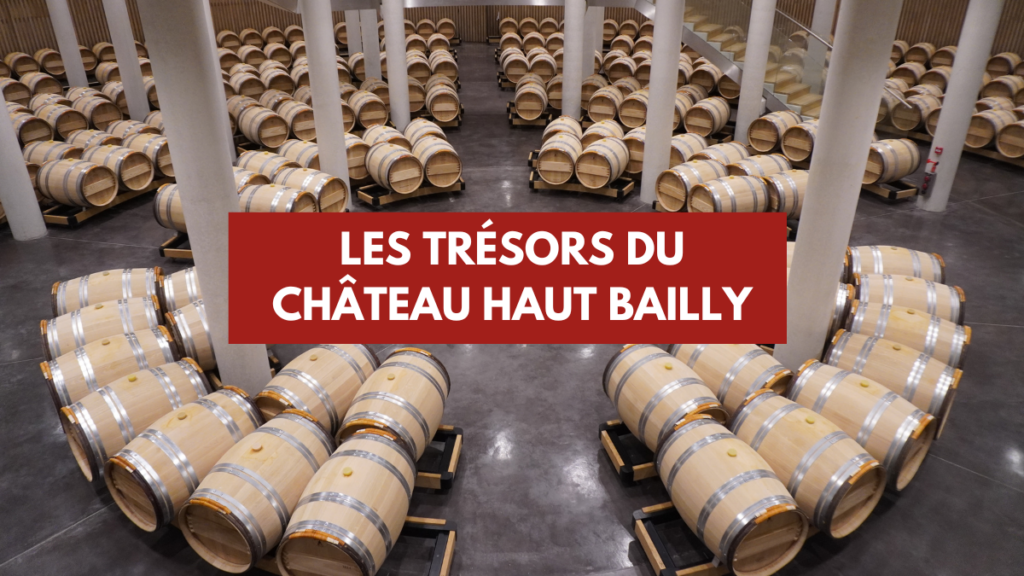
Going one floor further down, I reach the barrel room. It’s the first time I’ve seen barrels in Bordeaux without the usual red-painted hoops. I ask about it — they explain that at Château Haut-Bailly, everything is done with such precision that no wine drips, so there’s no need to paint the barrels.
I spend a bit more time there, mesmerized by the light, the attention to detail, and the layout of the space. Then we take the elevator to the rooftop — transformed into a garden, seamlessly blending into the vineyard like a natural hill. From here, I have a stunning view over the vines. A moment of stillness, one that others will surely experience again for centuries to come.
Meeting Véronique Sanders
After the tour, I had the chance to sit down with Véronique Sanders, the president of Château Haut-Bailly. You can listen to the podcast episode on your favorite platform or watch the interview on YouTube (link below). I met someone who truly reflects her vineyard — a blend of calm presence and intense determination. A creative force. A vibrant energy.
👉 Watch the interview on YouTube
I also discovered a powerful personal story — that of a family parting with its vineyard, and a woman fighting to stay connected to it, determined to keep bringing this magical place to life. When we talk about Château Haut-Bailly, Véronique Sanders’ face lights up. You can see memories, deep admiration for the terroir, and a love for the beauty of the place.
The wines of Château Haut-Bailly
I can’t finish this article without mentioning the wines — the final treasure I haven’t yet discussed. I had the chance to taste Château Haut-Bailly 2022 and HBII 2022, and I truly hope to write about them again soon in proper tasting notes. If I’m already excited to taste them again, that’s a good sign!
Of course, they’re still young, but all the qualities of a great wine are already there. They’re already highly drinkable — but beneath that accessibility lies a powerful energy, a desire to express itself, one that will only deepen with time. I was particularly struck by the liveliness and drive in these wines.
Tasting Château Haut-Bailly 2022
These wines will undoubtedly earn a well-deserved place in your cellar, and you’ll enjoy revisiting them over the years. I hope to taste the 2022 vintage again in a few years — and I’ll be sure to update you on how it evolves. And who knows? I hope to discover even more vintages along the way!